THE ANGEL’S IN THE DETAILS
By MICHAEL PERKINS
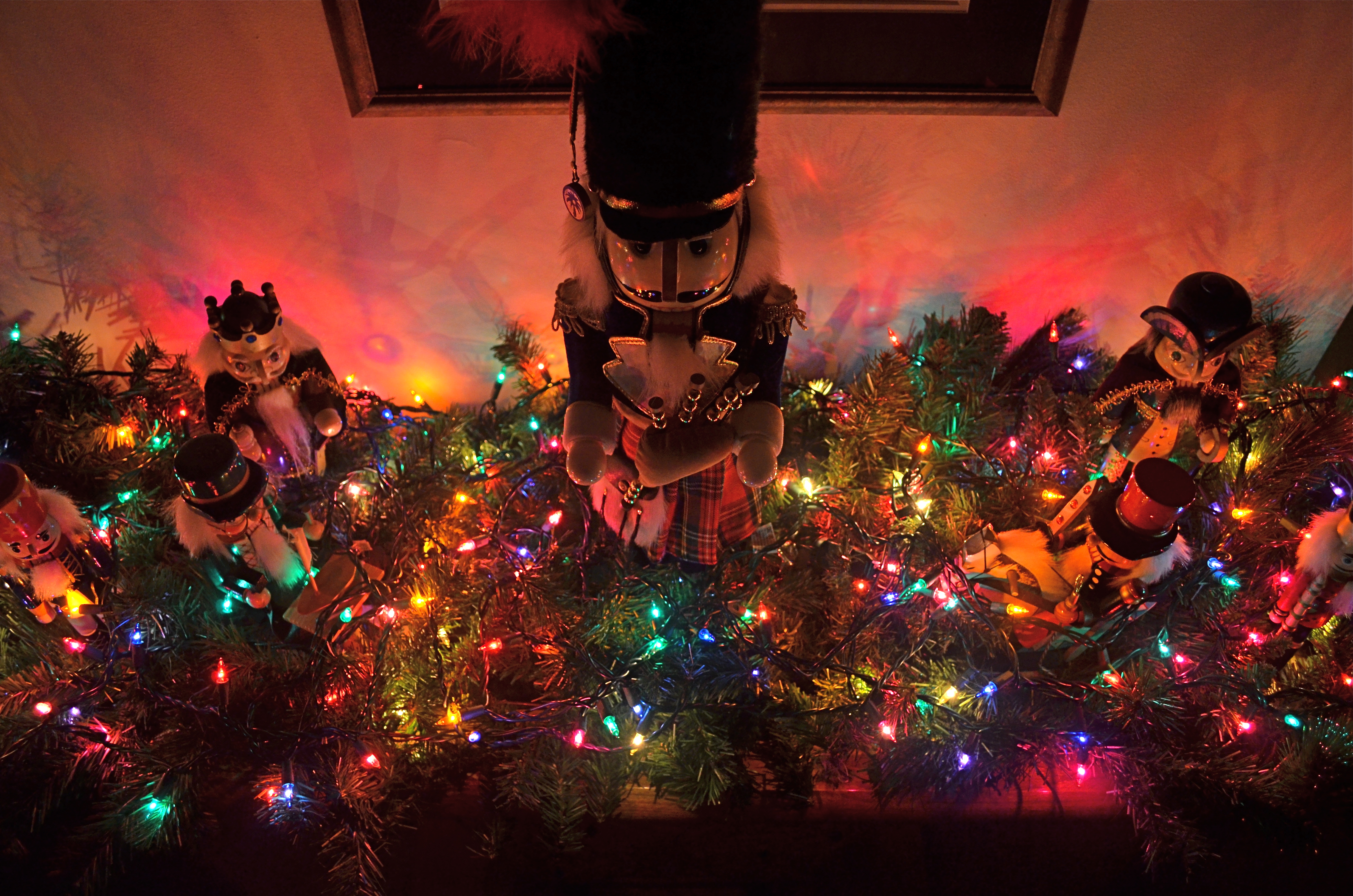 I IMAGINE THAT, IF SOMEONE UN-INVENTED CHRISTMAS, the entire history of personal photography might be compressed into about twenty minutes. I mean, be honest, was there ever a single event or phase of human experience for which more images were clicked than the holiday season? Just given the sheer number of cameras that were found under the tree and given their first test drive right then and there, you’d have one of the greatest troves of personal, and therefore irreplaceable, images in modern history.
Holidays are driven by very specific cues, emotional and historical.
We always get this kind of tree and we always put it in this corner of the room. I always look for the ornament that is special to me, and I always hang it right here. Oh, this is my favorite song. What do you mean, we’re not having hot chocolate? We can’t open presents until tomorrow morning. We just don’t, that’s all.
It’s tradition.
If, during the rest of our year, “the devil’s in the details”, that is, that any little thing can make 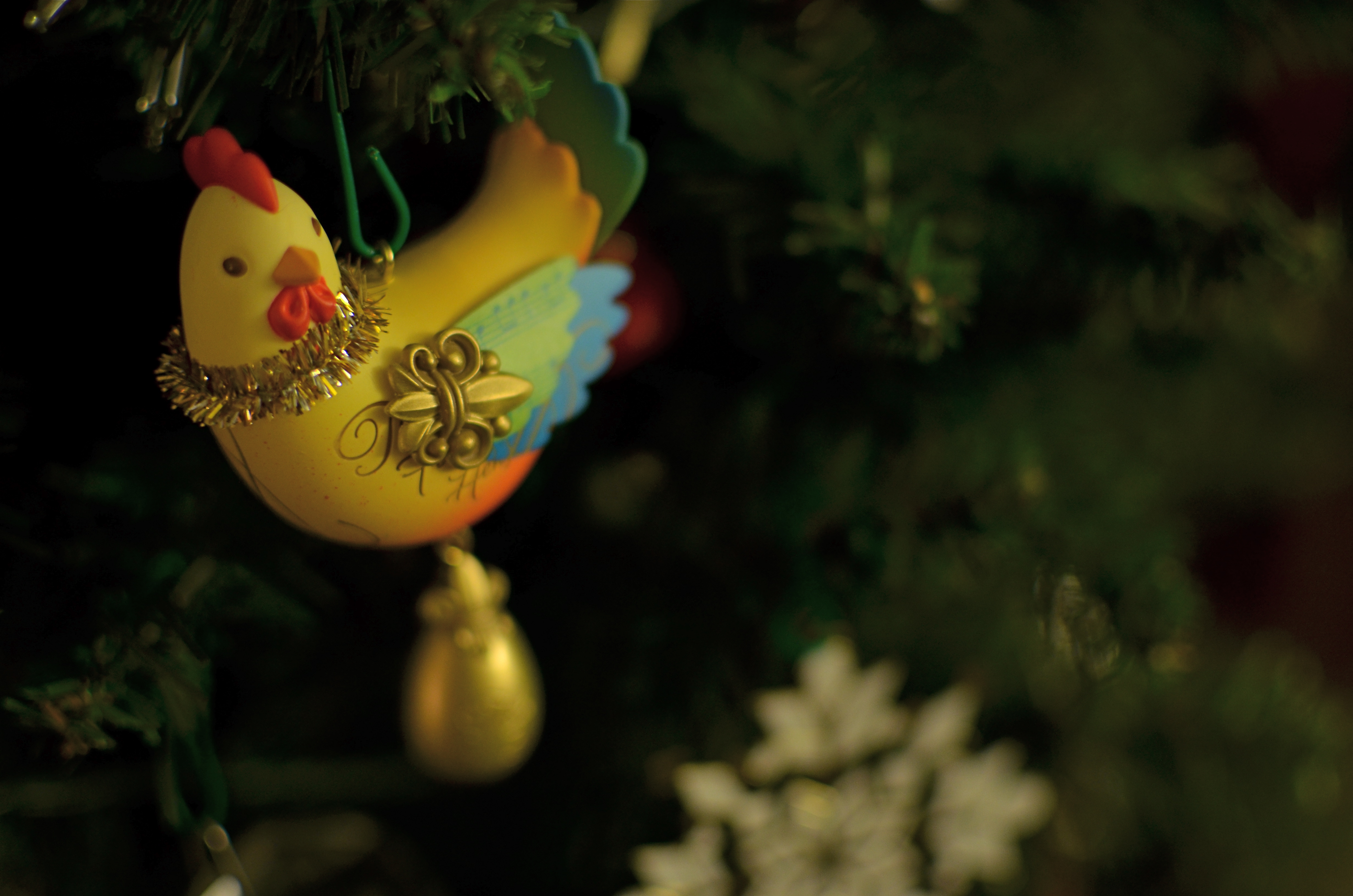 life go wrong, then, during the holidays, the angel’s in the details, since nearly everything conspires to make existence not only bearable, but something to be longed for, mulled over, treasured in age. Photographs seem like the most natural of angelic details, since they lend a gauzy permanence to memory, freezing the surprised gasp, the tearful reunion, the shared giggle.
As the years roll on, little is recalled about who got what sweater or who stood longest in line at GreedMart trying to get the last Teddy Ruxpin in North America. Instead, there are those images…in boxes, in albums, on hard drives, on phones. Oh, look. He was so young. She looks so happy. That was the year Billy came home as a surprise. That was the last year we had Grandma with us. Look, look, look.
So remember, always….the greatest gifts you’ll ever receive aren’t under the tree.
Merry Click-mas.
HERE COMES THE NIGHT
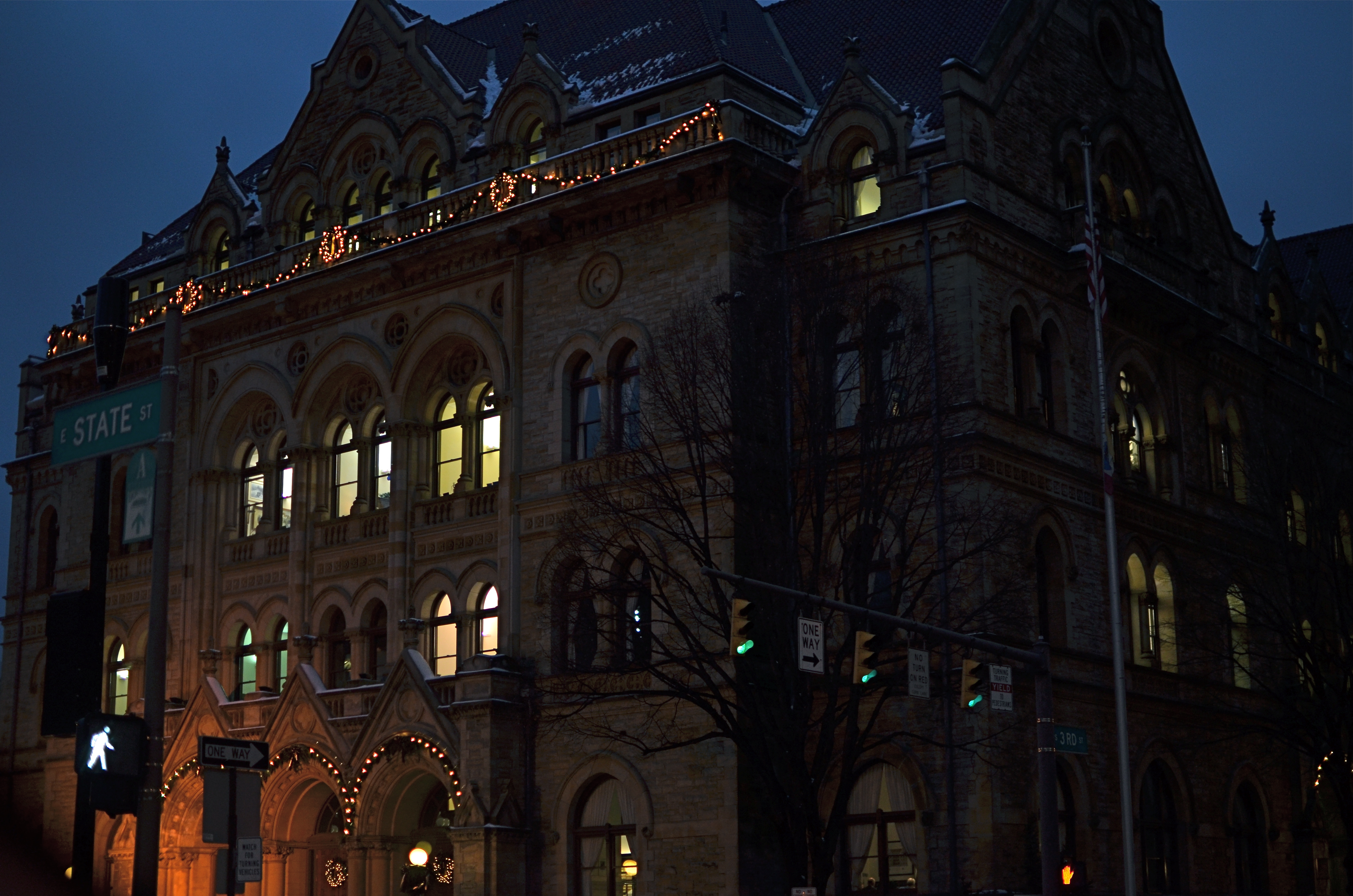
Letting the shadows be the shadows.1/100 sec., f/1.8, ISO 250, 35mm.
By MICHAEL PERKINS
FOR SOME PHOTOGRAPHERS, THE END OF A CALENDAR YEAR MEANS BUSTING OUT THE “BEST OF” LISTS, and, certainly,for people with a certain level of skill, that’s a normal instinct. I am always far too horrified by how many losing horses I put in a given year’s race to try to find the few who didn’t go lame, wander off the track, or finish last, so I confine my year’s-end computations to lists of what I tried, and whether I got close to learning anything. For 2013, one bulletin emerges:
I like the dark. A lot.
That is, a simple head count of shots taken this year reveal that I was outside, after supper, at nearly every opportunity. And yes, with mixed results. Always and forever will them results be mixed, amen. If my results were in a Waring blender, going at full “puree” speed, they could not be more mixed, okay?
But for some reason, the quest took me back into a renewed appreciation of shadows, shades, a lack of light. I probably embraced the missing information and detail that the dark represents more joyfully than I have in many years. And that’s something of a journey, since, if I had any kind of post-processing crack habit recently, it was the mania to rescue more and more of that detail, whether in High Dynamic Range photos, Exposure Fusion photos or Tone Compression photos. For a while, I was acting like your Grandpa the first week he owned his new Magnavox (“…hmm, needs a little more green….no, now the horses look purple….let’s add some red…”).
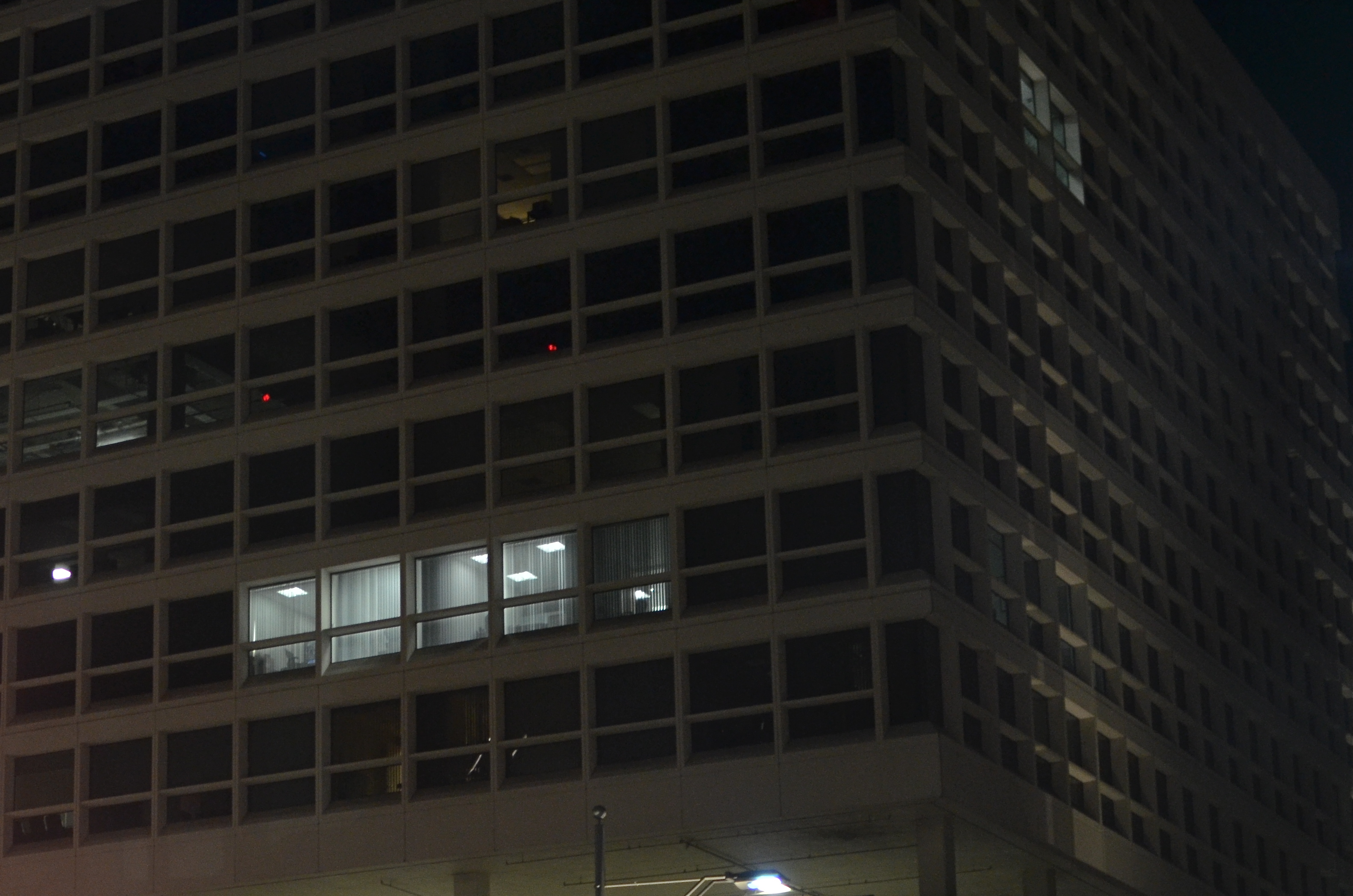
What’s left out is as vital as what’s shown. 1/50 sec., f/1.8, ISO 640, 35mm.
Maybe 2013 was the year I pulled back a bit and just let darkness be, let it express the unknown and the unknowable. Photography is always at least partly about what you don’t show, not depicting the world as a giant Where’s Waldo overdose of texture and detail. In ’13, I spent a lot more time shooting night shots at the technical limit of my camera, but did not fiddle about much further afterwards. I was interested in “getting as much picture into the click” as possible, but what couldn’t be achieved with faster lenses or mildly enhanced ISO just got left out of the pictures. I feel like it was a year of correction, with me playing the part of a new teen driver has to learn to correct for over-steer.
The whole thing is about remembering that technique is not style. What you have to say is style. The mechanical means you use to get it said is technique. Learning to execute a technique is like mastering the workings of a camera. It does not guarantee that your results will be revelatory or eloquent. That means that falling in love with the consistent polishing of processing is a danger, since you can begin to love it for its own sake. Technique says “Look what I can do!”. Style says, “but, is this what I should be doing?”
Anyway, whatever I presently think is essential for my growth will, eventually, become just one more thing that I do, and will be supplanted by something else. That said, a good year in photography should not end with the collection of a pile of hits, but an unafraid assessment of the misses.
That’s where the next batch of good pictures will come from, anyway.
DEPTH OF FEELING
By MICHAEL PERKINS
OFTEN, THERE ARE ONLY SCANT MOMENTS TO DETERMINE HOW TO “USE” PEOPLE IN YOUR PHOTOGRAPHS. The decision as to how prominently a person figures in the overall scheme of a given image is frequently made on the fly, and your result will reflect whether that person is an element of the picture or a select feature.
Of course, you can wind up with wonderful photos either way, which is one of the most attractive aspects of picture making. This is all multiple choice, and there is no wrong answer. Also, if the answer was right for you, chances are that it will be so judged by others. Your conviction carries the picture to its desired audience, if you will.
This October, I fell into a virtual pot of gold on a trip to visit friends in rural New Mexico, since the entire countryside was awash in a gilded flood of yellow with the turn of the leaves. You could literally point the camera at a trash can, and, if it was next to a cottonwood tree, the thing became a palace. As a midwestern kid who has spent nearly fifteen years in the Arizona desert, I was long overdue for the richness of the autumnal palette, and I got a little drunk on it all. I wanted to immortalize every tree, shooting generally at small apertures to get as much sharp detail as possible.
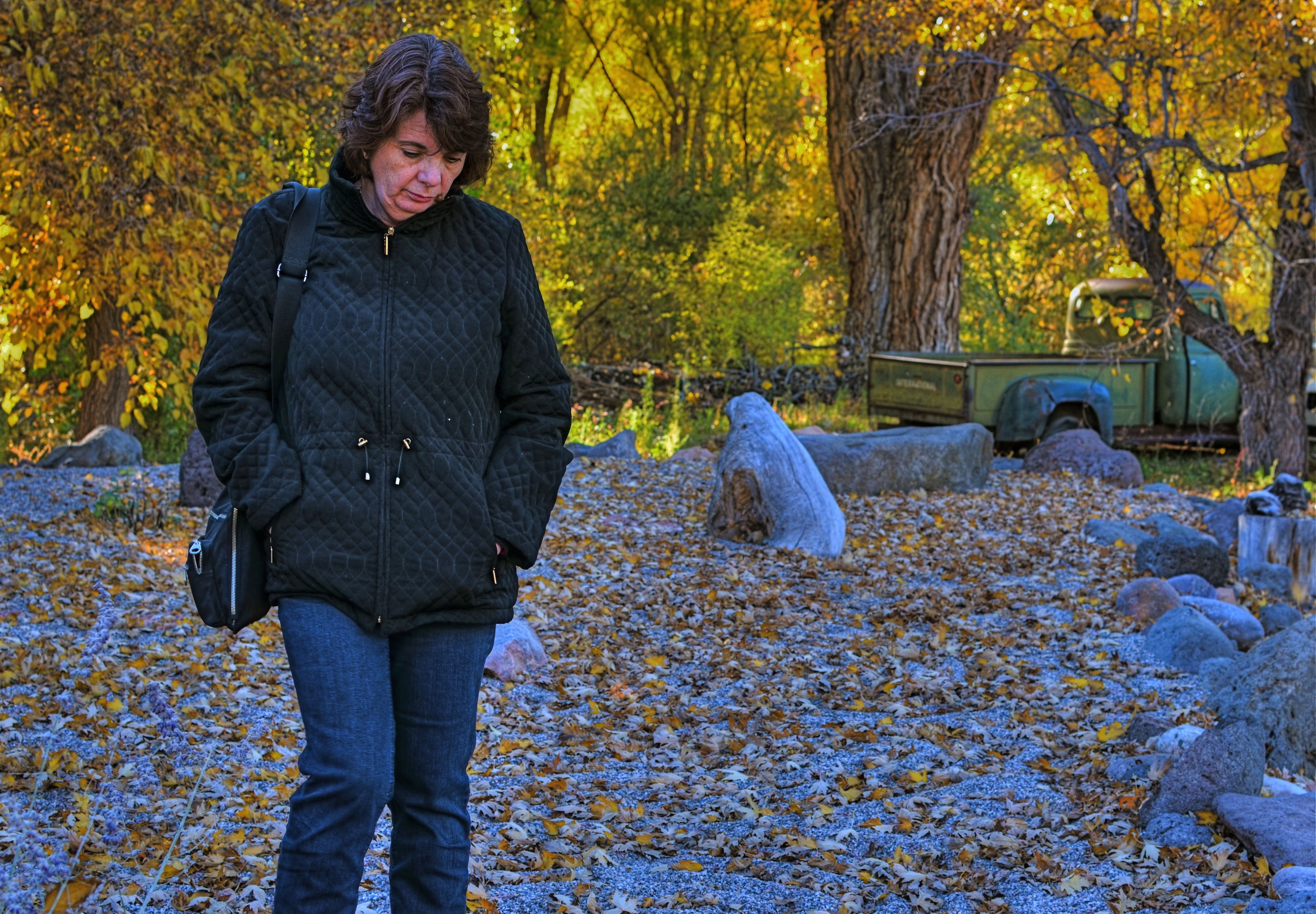
1/80 sec., f/5.6, ISO 100, 35mm.
That’s what I was doing in the side yard of a roadside gallery when my wife Marian wandered outside for a brief walk, so the first few frames I shot showed her and the background in about the same focus. Just for variety, I re-focused on mostly her at f/5.6, slightly softening the foliage beyond so it wouldn’t fight with her for the viewer’s attention. In that one frame, she morphed from element to feature, and all that color was put at her service, so to speak. As an afterthought, I made a dupe of the image, lightened it by about a third, then blended the two in Photomatix, since HDR processing also accentuates detail, giving me an even sharper contrast between her sharpness and the softer background. It wasn’t a big bump, processing-wise, just the bow on the box.
Experimental “light field” cameras, once perfected, may make such planning moot, since images taken with this very different technology allows the photographer to redo the depth of field on an image after it has been taken. For now, however, it’s a decision of the moment.
Again, part of the fun.
Related articles
- Depth of Field (mariatobon.wordpress.com)
ANOTHER YEAR OUT THE WINDOW
By MICHAEL PERKINS
IF YOU WANT TO PUT A SMILE ON MY FACE WHEN I VISIT YOUR CITY, there is no sweeter sentence you can say to me than:
“I’ll drive”.
There is, for photographers, one way to maximize your time touring through other people’s towns, and that’s the time-honored tradition of “riding shotgun”. Drive me anywhere, but give me a window seat. I wasn’t trying to go for some kind of personal best in the area of urban side shots in 2013, but by good fortune I did snag a few surprises as I was ferried through various towns, along with a “reject” pile about a mile high. Like any other kind of shooting, the yield in window shooting is very low in terms of “killers per click”, but when you hit the target, you crack through a kind of “I’m new in town” barrier and take home a bit of the street for your own.
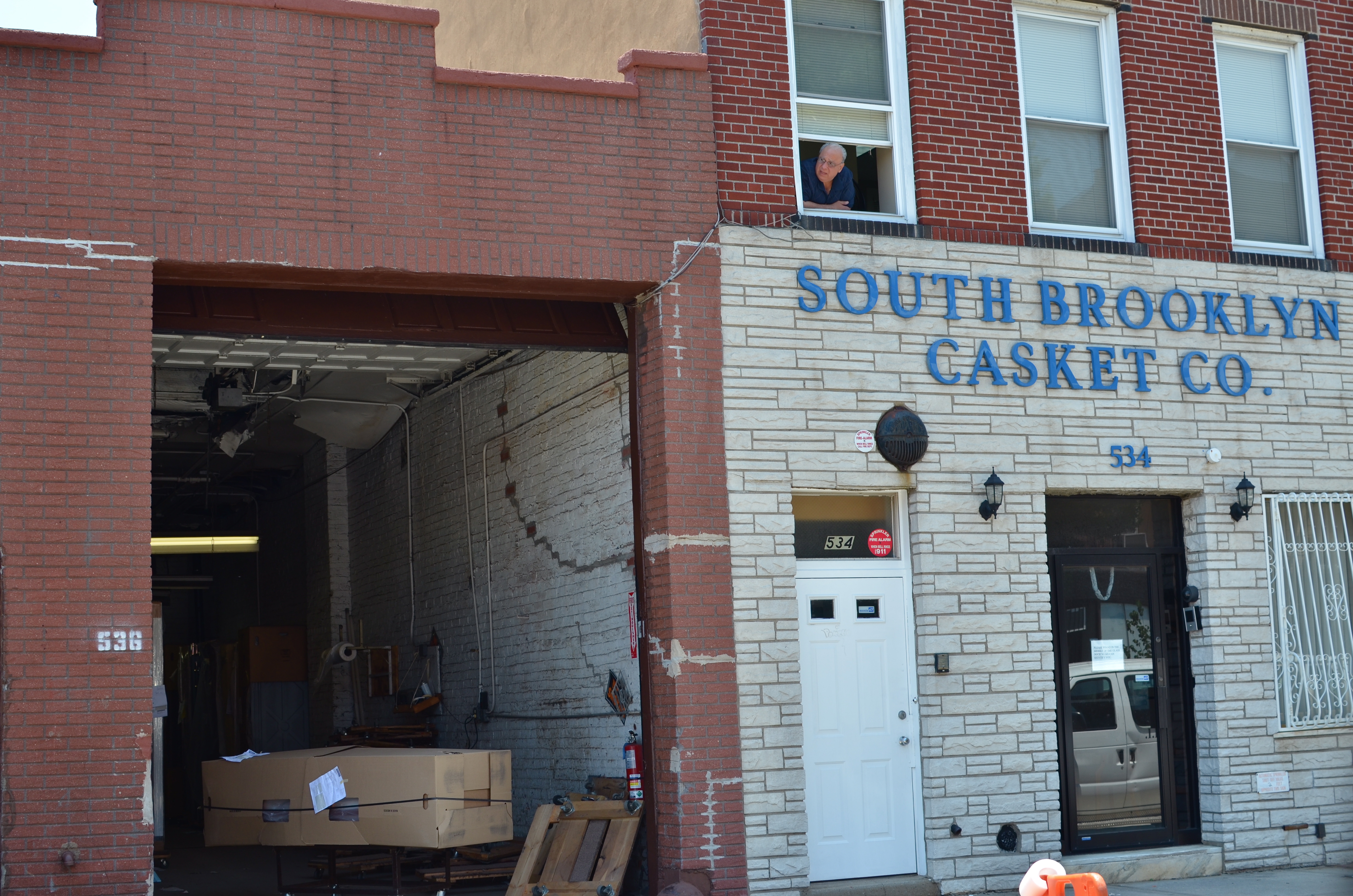
Business has been really dead lately. 1/250 sec., f/5.6, ISO 100, 35mm.
This guy just killed me (excuse the expression). He seemed like he was literally waiting for business to drop in (or drop dead), and meanwhile was taking in the view. Probably he didn’t even work for the casket company, in which case, what a bummer of neighbor to pick. Maybe he’s rent controlled.
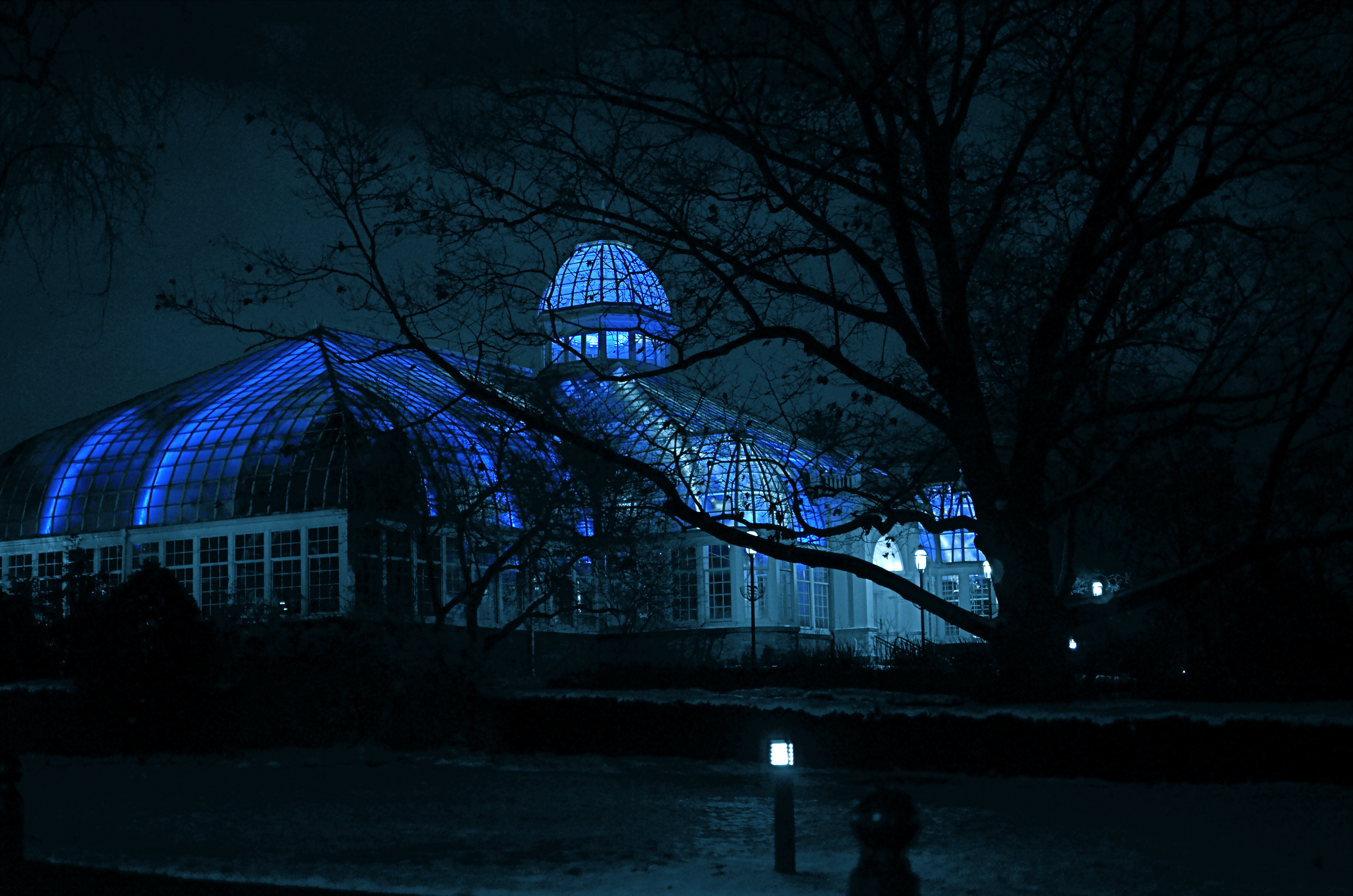
Franklin Park Conservatory, Columbus, Ohio. 1/40 sec., f/1.8, ISO 500, 35mm.
This one took a little tweaking. The building was actually blue, as you see here, lit with subdued mood for the holidays. However, in lightening this very dark shot, the sky registered as a muddy brown, so I made a dupe, desaturated everything except the conservatory, then added tint back in to make the surrounding park area match the building. All rescued from an “all or nothing” shot.
I’m also ashamed to admit that I bagged a few through-the-window shots while actually driving the car, all done at red lights and so not recommended. Don’t do as I do, do as I……oh, you know.
Here’s to long shots, at horse tracks or in viewfinders, and the few that finish in the money.
KICK-STARTING THE ENGINE
By MICHAEL PERKINS
THE POPULAR IMAGE OF A BLOCK-STRICKEN WRITER HELPLESSLY STARING AT A BLANK PAGE is enough to send an empathetic chill up the spine of anyone who has ever been haunted by a deadline or stymied by a narrative suddenly gone dry. And I am convinced, as both a writer and a photographer, that there is an equivalent “block” lurking in the shadows for any shooter, a visual desert that produces stretches of formless, pointless images, dry spells that are terrifying because they are open-ended. No one knows why, for everyone from time to time, the pictures stop coming, and no one can predict when they will come back.
It’s terrifying, because it’s as if vision or imagination were accounts that one can overdraw, bouncing artistic checks all over town and leaving you feeling, like Alice, that there is no bottom, only more hole. At least it’s terrifying to me.
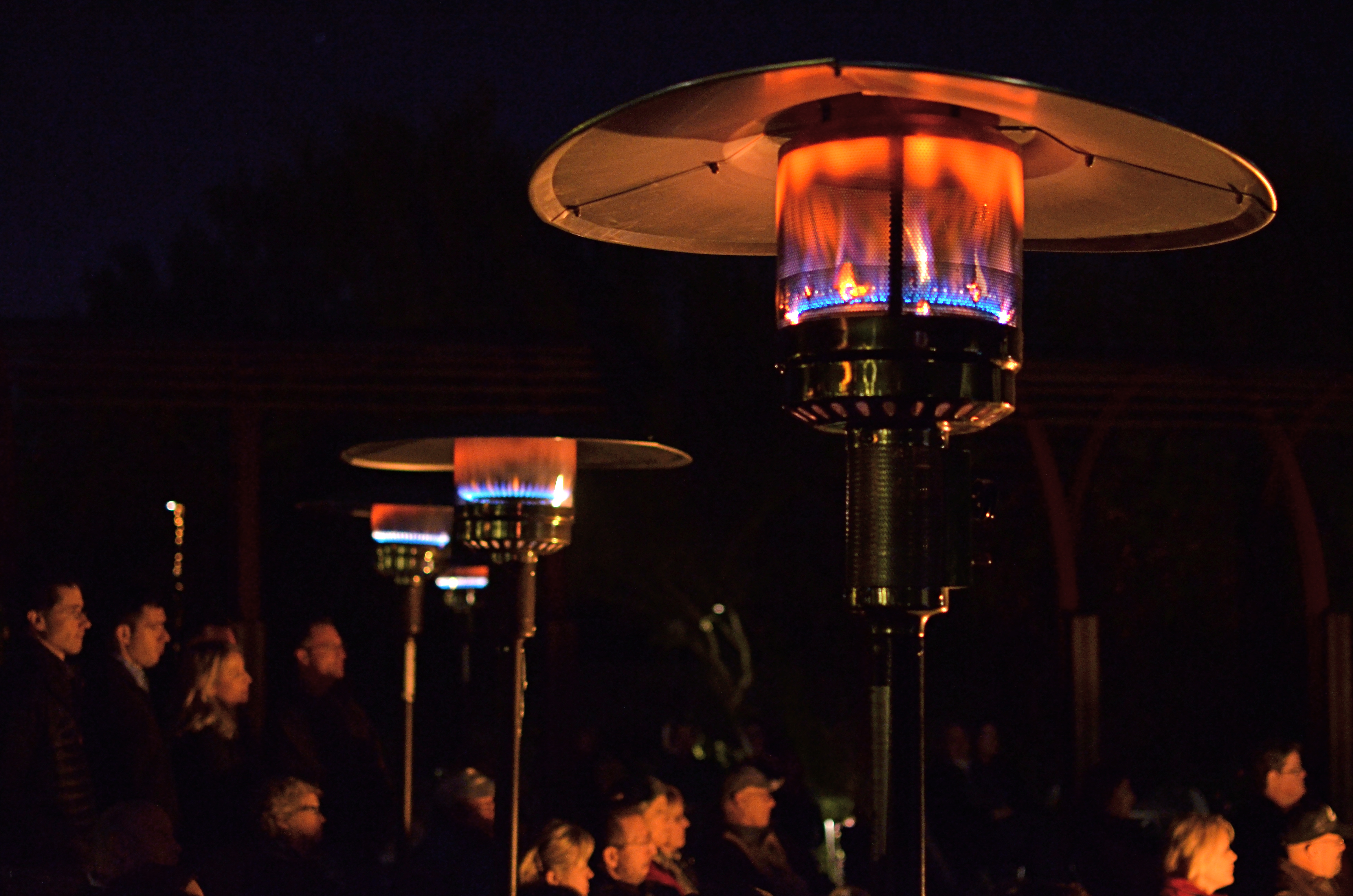
Torchlight Parade, 12/14/13. 1/40, f/2.5, ISO 1000, 35mm. You work your way through dry spells with what’s at hand.
As I write this, I have just come off several weeks of scrapings and scraps that should have been photographs but instead are equivalent to something smeared by an ape on his cage wall. I have seldom experienced such an extended period of mega-nothing, and it is only my unswerving oath to myself to shoot something, anything, every single day, that has allowed me to keep faith with the inevitable return of whatever eye I sometime possess. But, I have to admit, I am also suppressing strong urges to, like Norman Bates, lock my camera inside a car trunk and seek out the nearest swamp.
Okay, that’s a tad dramatic, but my current case of the “drys” is unnerving for a particular reason. I am typically able to conjure pictures out of nearly nothing, which is more liberating than having to wait for obvious or “big” projects. You can shoot daily if you can get off on still lifes of plastic spoons. You can’t shoot daily if you need a vacation, a birthday, or a mountain for inspiration. So it’s doubly troubling if you can’t even summon up the humble crumbs needed for some kind of image.
I know, that, at one point or another, something will demand my attention/obsession, and we’ll be off to the races again. But there is always the nagging question. What happens if I can’t kick-start the engine? Everything has a beginning and an end. So…?
Oh, wait, the light is doing something really cool just now…..
THE BLUE AND THE GREY
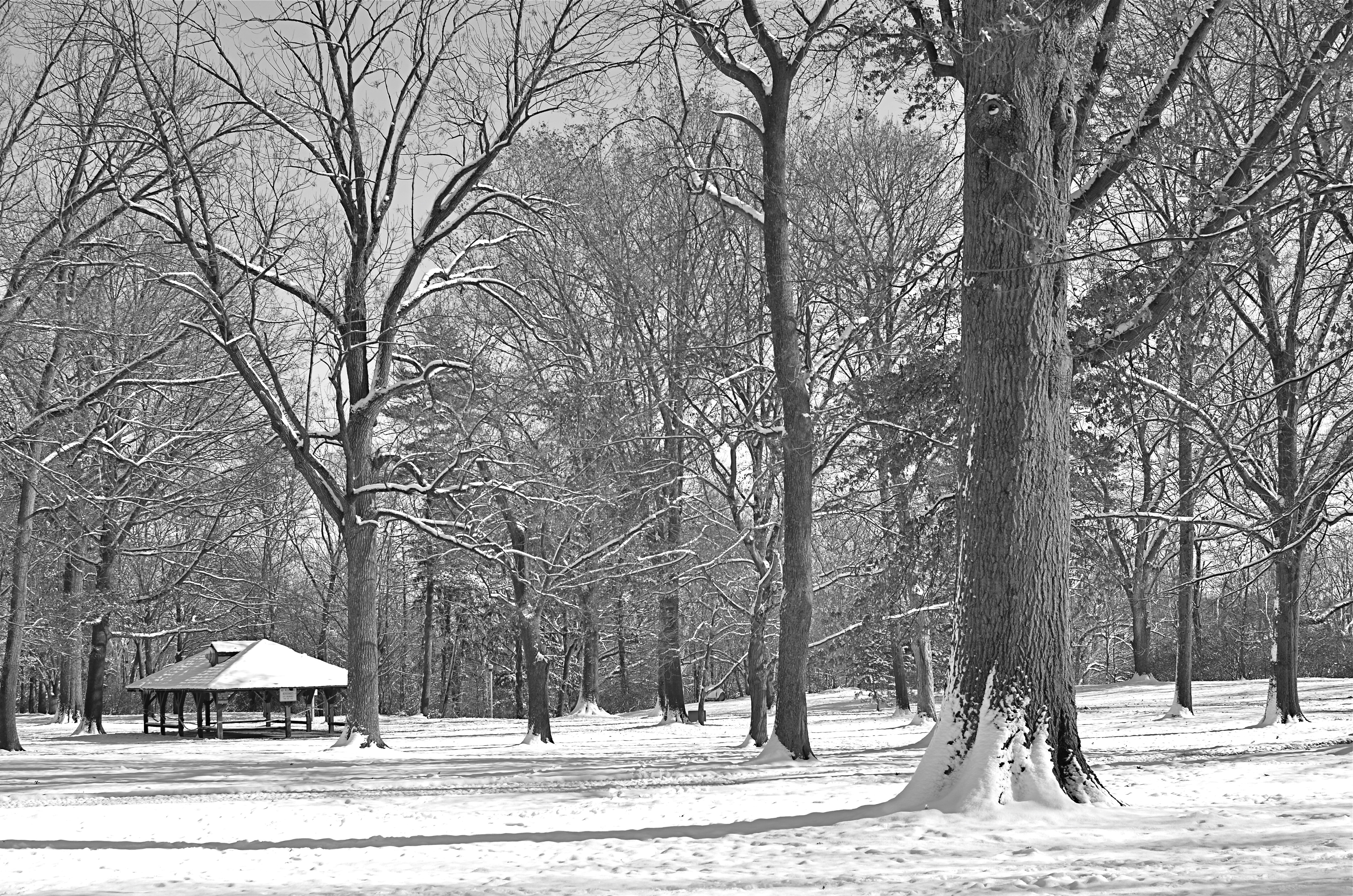
A decent winter scene, a bit too charming in its full color original, converted in-camera to straight monochrome. Now, however, it’s too bland.
By MICHAEL PERKINS
ONE OF THE GREAT BENEFITS OF DIGITAL PHOTOGRAPHY, other than its ease and affordability, is the speed at which it allows you to make comparative value judgements on images in the field. Even as digital darkrooms make it ever easier to change or modify your vision after the fact, today’s cameras also allow you to choose between several versions of a photograph while its subject is right at hand. This is an amazing mental and artistic economy, and it’s another reason why this is the absolute best time in history to be making pictures.
Many of us who made the transition from film have a lifelong habit of “bracketing”, taking multiples of the same image over a range of exposure rates to ensure that we are “covered” with at least one keeper in the batch. Others have already adopted the equivalent habit of taking several different frames with a sampling of varying white balances. I also find it helpful to use today’s in-camera filters to instantly convert color shots to three other monochrome “takes”….straight black and white, sepia and cyanotype. It’s a way to see if certain low-color subject matter will actually benefit from being reworked as duotone, and knowing that fact extra fast.
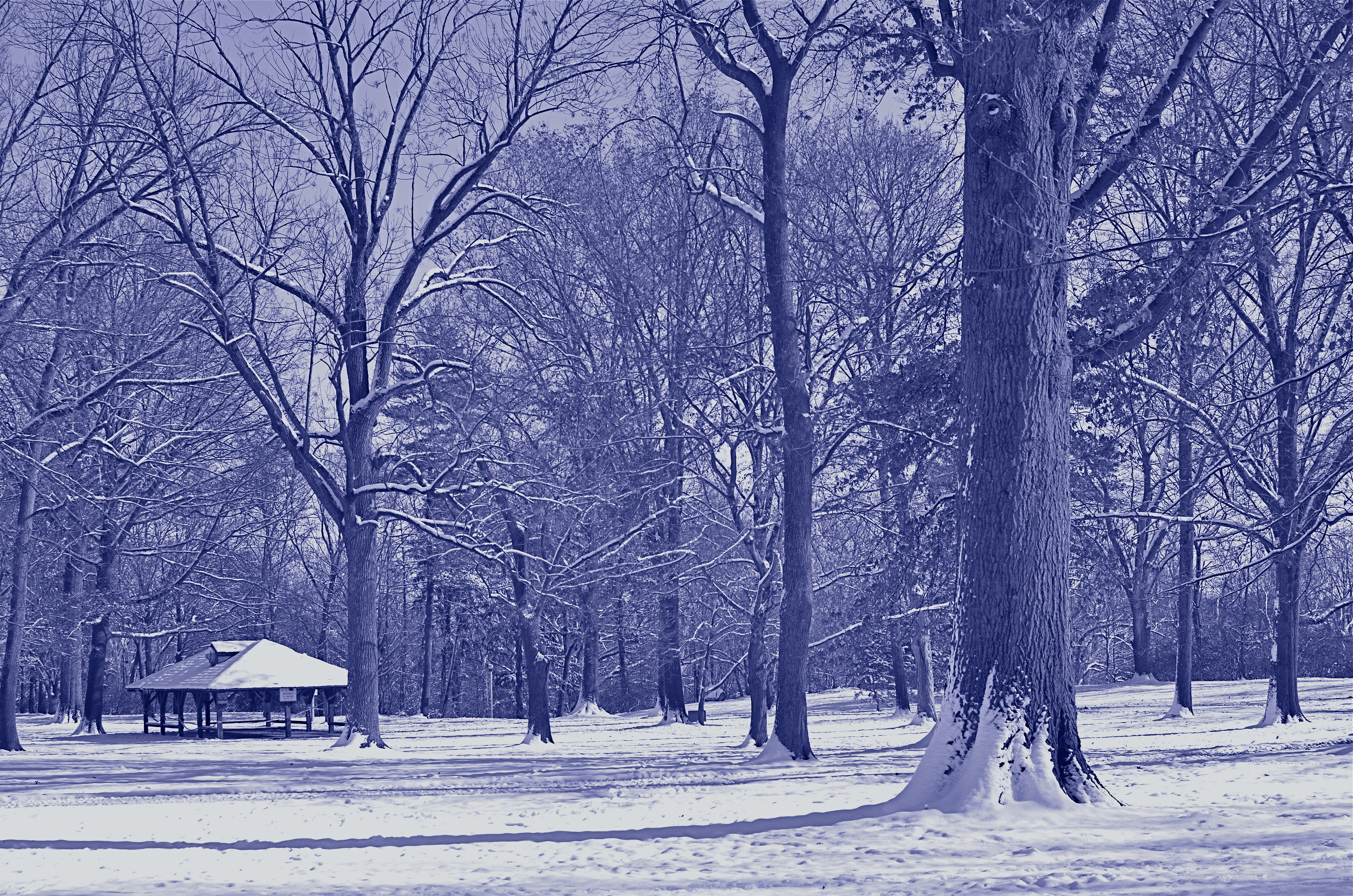
Another in-camera conversion, this time to cyanotype. This one says “winter” to me. 1/320 sec, f/5.6, ISO 100, 35mm.
Color or its selective elimination is one of the easiest tools to wield in photography. In the case of the series shown in this post, I decided that the winter scene was a little too warm and cheery in full color, a little flat in straight B&W, but properly evocative of winter’s severity in cyan. The choice was quick, and I still had the color master shot that I could choose to massage later on.
Shooting fast, that is, at the speed of your mood or whim, is a remarkable luxury, and exploiting it to the max is easy with even the most elementary camera. And anything that converts more “maybe” shots to “yes” is my idea of a good time.
I’ll have a Blue Christmas, thank you.
Related articles
- 5 Good Photography Habits to Start Today (digital-photography-school.com)
EAVESDROPPING ON REALITY
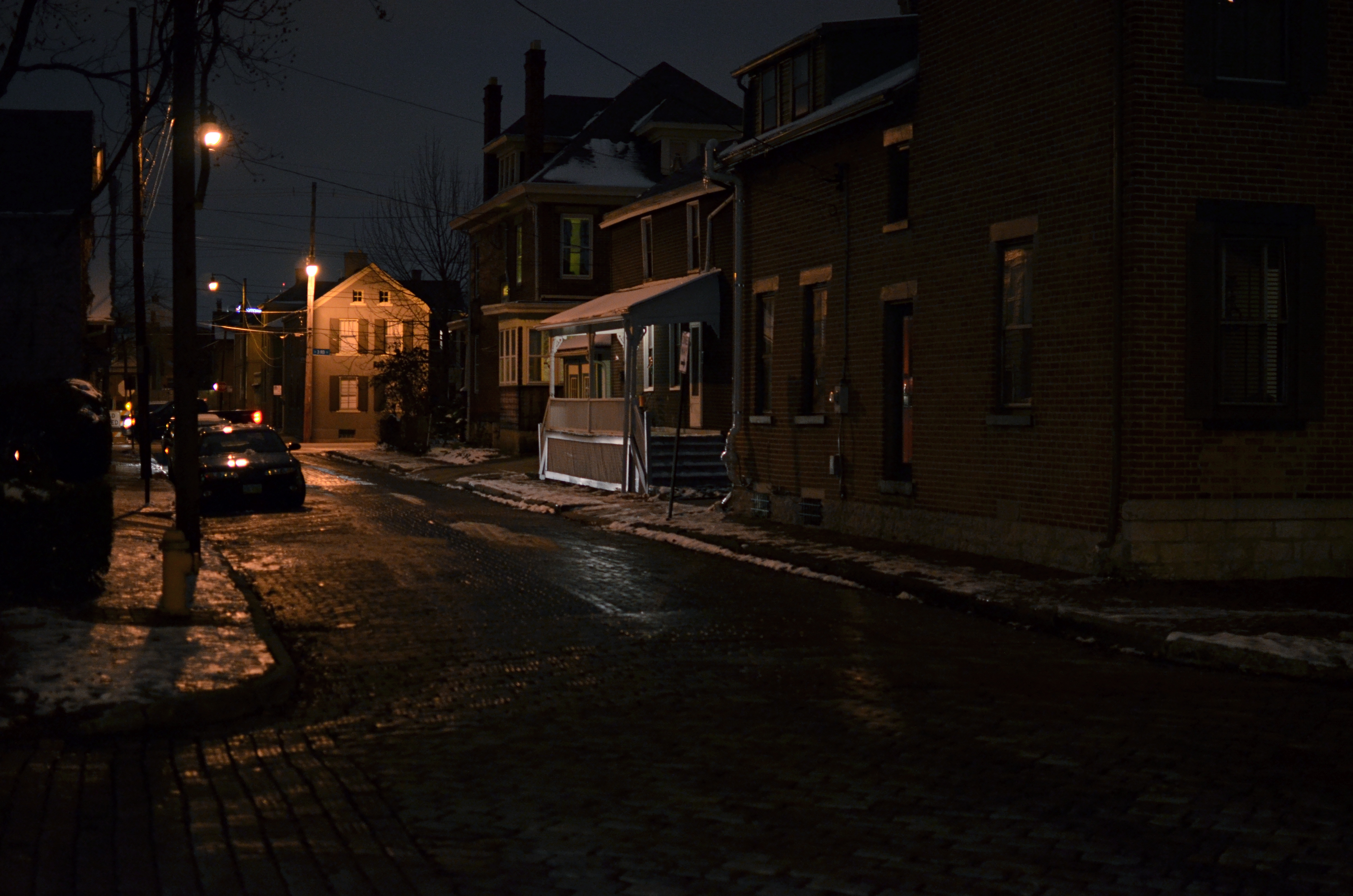
Stepping onto Blenkner Street and into history. Columbus, Ohio’s wonderful German Village district, December 2013. 1/60 sec., f/1.8, ISO 800, 35mm.
By MICHAEL PERKINS
THE FAMILIAR ADMONITION FROM THE HIPPOCRATIC OATH, the exhortation for doctors to, “First, Do No Harm” has applications to many kinds of enterprises beyond the scope of medicine, photography among them. We are so used to editing, arranging, scouting, rehearsing and re-imagining reality that sometimes, we need merely to eavesdrop on it.
Some pictures are so complete in themselves that, indeed, even minimal interference from a photographer is a bridge too far. Sometimes such images come as welcome relief after a long, unproductive spell of trying to force subjects into our cameras, only to have them wriggle away like so much conceptual smoke. I recently underwent several successive days of such frustration in, of all things, my own home town, fighting quirky weather, blocked access, and a blank wall of my own mental making. I finally found something I can use in (say it all together) the last place I was looking.
In fact, it was a place I hadn’t wanted to be at all.
Columbus, Ohio at night in winter is lots of things, but it’s seldom conducive to any urge more adventurous than reheating the Irish coffee and throwing another log on the fire. At my age, there’s something about winter and going out after sunset that screams “bad idea” to me, and I was reluctant to accept a dinner invite that actually involved my schlepping across the tundra from the outskirts to the heart of downtown. Finally, it was the lure of lox and bagel at Katzinger’s deli, not my artistic wanderlust, that wrenched me loose from hearth and home, and into range of some lovely picture-making territory.
The German Village neighborhood, along the city’s southern edge, has, for over a century, remained one of the most completely intact caches of ethnic architecture in central Ohio, its twisty brick streets evoking a mini-Deutschland from a simpler time. Its antique street lamps, shuttered windows and bricked-in gartens have been an arts and party destination for generations of visitors, casting its spell on me clear back in high school. Arriving early for my trek to Katzie’s, I took advantage of the extra ten minutes to wander down a few familiar old streets, hoping they could provide something….unfamiliar.
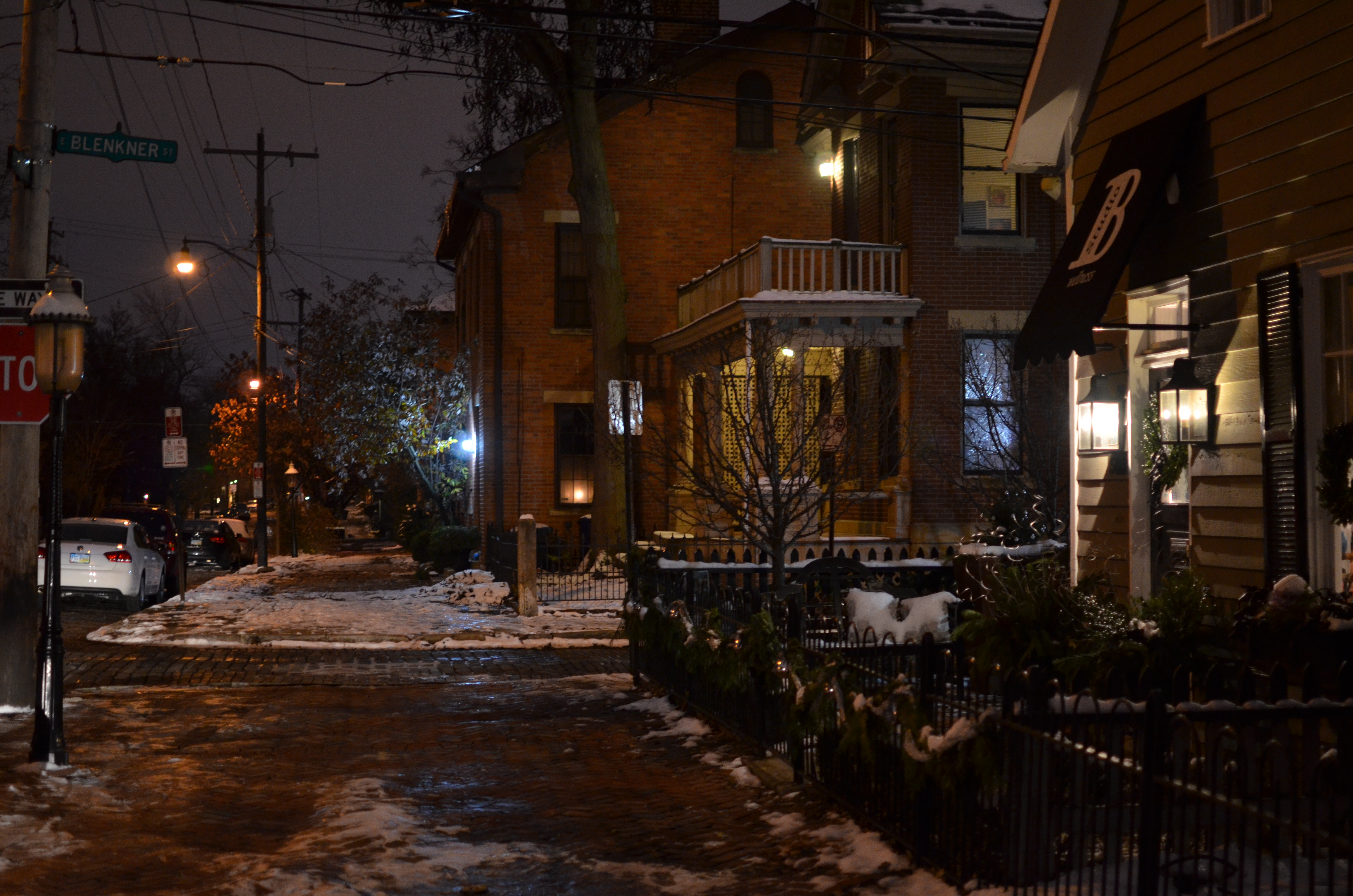
1/60 sec., f/1.8, ISO 800, 35mm.
The recently melted snowfall of several days prior still lent a warm glaze to the cobbled alleyways, and I soon found myself with city scenes that evoked a wonderful mood with absolutely minimal effort. The light was minimal as well, often coming from just one orange sodium-vapor street lamp, and it made sense to make them the central focus of any shots I was to take, allowing the eye to be led naturally from the illuminated streets at the front of the frame clear on back to the light’s source.
Using my default lens, a 35mm prime at maximum f/1.8 aperture, and an acceptable amount of noise at ISO 800, I clicked away like mad, shooting up and down Blenkner Street, first toward Third Street, then back around toward High. I didn’t try to rescue the details in the shadows, but let the city more or less do its own lighting with the old streets. I capped my lens, stole away like the lucky thief I had become, and headed for dinner.
The lox was great, too. Historic, in fact.
CROP YOUR WAY TO SUCCESS
By MICHAEL PERKINS
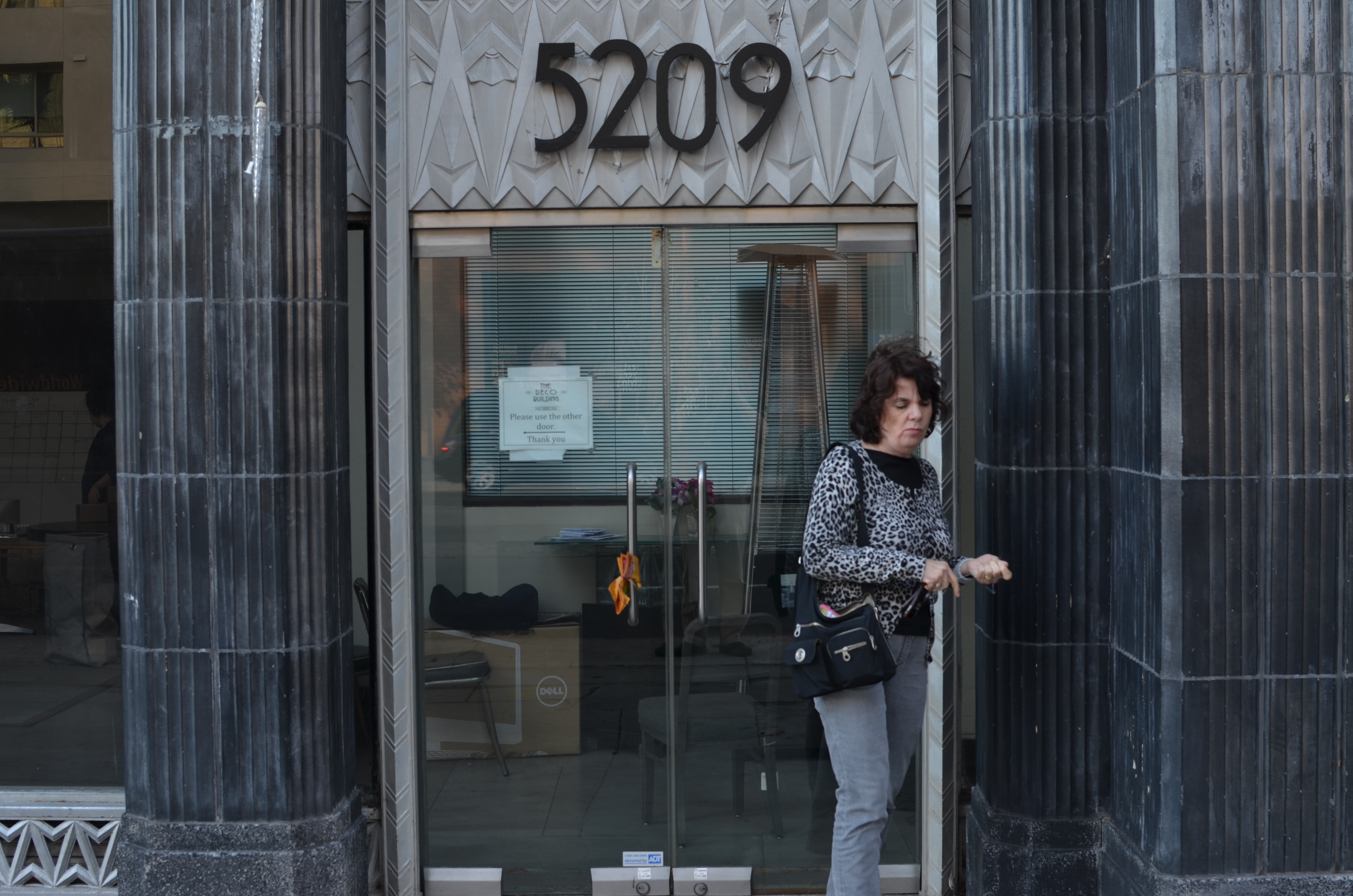
Whoops, I wasn’t ready. 1/100 sec., f/5.6, ISO 100, 35mm.
THOSE OF US WHO HAVE LOGGED SOME TIME IN THE WAITING ROOMS OF PEDIATRICIANS can recall struggling through the “Hidden Pictures” page of Highlights For Children magazine. I would love to tell you that I always found 100% of cartoonist John Gee’s camoflaged squiggles by the time the receptionist invited me into the examining room. But I would be lying.
That said, there are many times when, as photographers, we play the same game with our images, especially the ones in the “doesn’t work” pile. Loving at least the idea behind what we were originally after, we pore over every pixel in the frame, repeating the vain mantra there must be a picture in here somewhere. Often, the photo simply returns to the Hall of Shame despite our best efforts to redeem it. Sometimes, the crop tool is your unexpected best friend.
I recently looked at a failed candid of my wife outside one of my favorite buildings in Los Angeles, the “Deco” Building (real name) at the corner of La Brea and Wilshire near the museum district. A combination of wind and facial expression had spoiled the quickie portrait, but the address panel over Marian’s head contained something I could use if I re-purposed the picture.
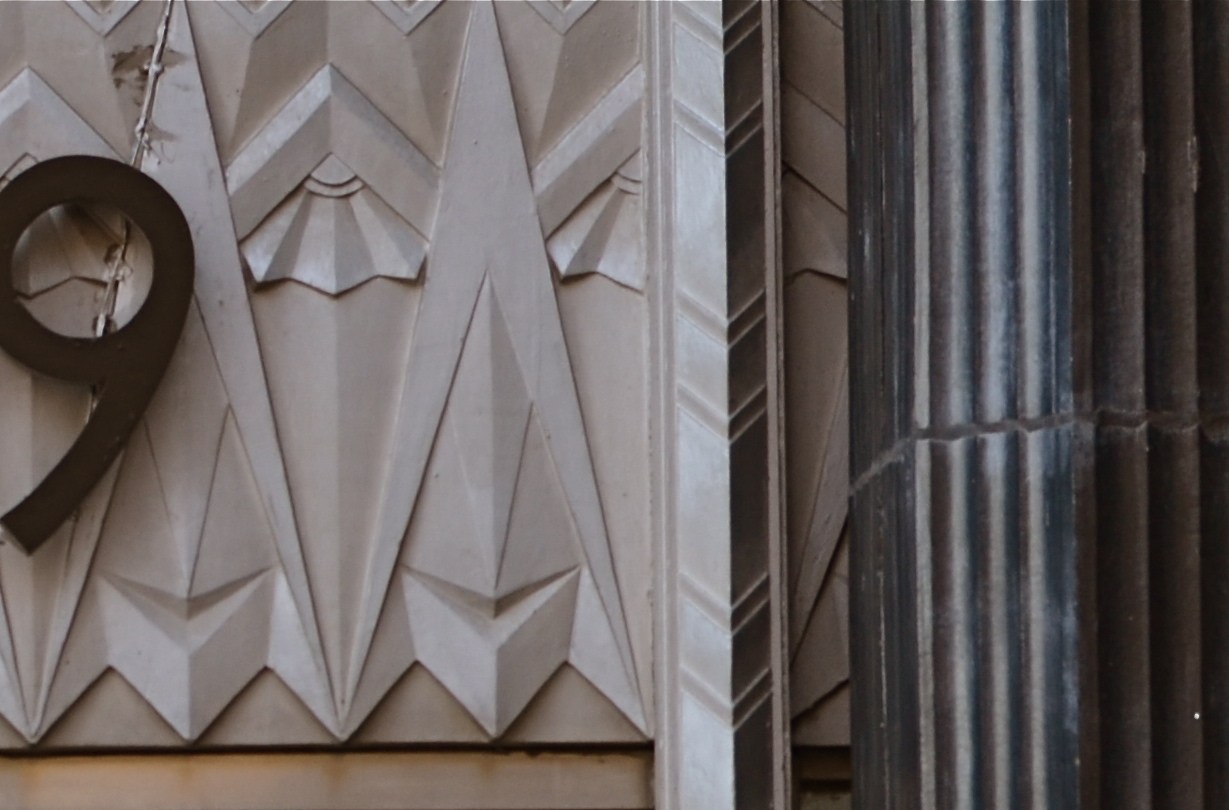
I gave the above shot a severe haircut and wound up with this. Hmm, maybe this was all the picture I needed in the first place.
In the space of a few inches of the building’s entrance was a miniature representation of the best features of the entire building; its wild pattern of chevrons and zigzags. I had already done a master shot of about 90% of the front of the place, but a study of its details started to sound appealing. Cropping away more than 2/3rds of the original shot reduced the sharpness a little, but since I always shoot at the highest file size possible, I just squeaked by.
For a moment, I found that I had redeemed all those failed sessions with Highlights.
Watch out, New York Times crossword. You’re next.
THE WORLD IN A FACE
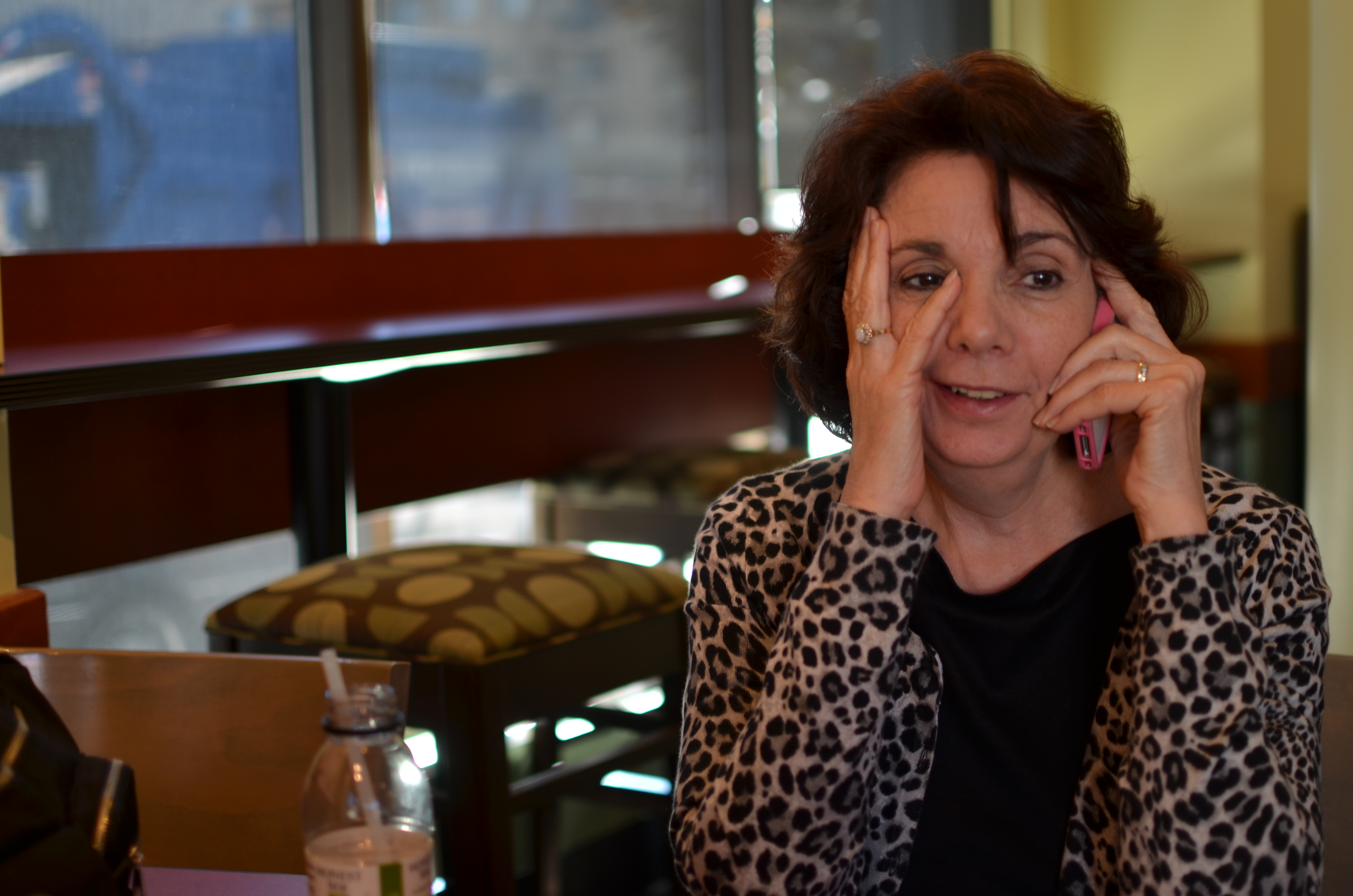
Marian, Los Angeles, November 2013. 1/100 sec., f/1.8, ISO 100, 35mm.
By MICHAEL PERKINS
The mystery isn’t in the technique. It’s in each of us.
THE AMERICAN PHOTOGRAPHER HARRY CALLAHAN , author of the above quotation, knew about the subject of mystery, especially as it regarded women. Make that one woman, namely his wife Eleanor, who posed for Callahan’s camera for sixty-three years in every kind of setting from abstracts to nudes and back again, providing him with his most enduring muse.
Lucky man.
I know exactly how he felt. Because I feel the same way about my own wife, Marian.
Interpreting and re-interpreting a single face over time is one of the best ways I can imagine to train your eye to detect small changes, crucial evolutions in both your subject and your own sense of seeing. And Marian has given me that gift during our time together, as her features seem, to me, to be an inexhaustible source of exploration. It’s a face that is equal parts tenderness and iron resolve, a perfect balance between joy and tragedy, a wellspring of sensations. It is a great face, a great woman’s face, and a fascinating workspace.
Working as I always am to make her relax and forget herself when I am framing her up, I have long since abandoned the practice of announcing that I was going to take her photograph. There is never any posing or sitting. I approach her the way I would a stranger on the street. I wait for the moment when her face is in the act of becoming, than sneak off with whatever I can steal. Sometimes it takes a little more stealth than I am comfortable with, but my motives are simple; I don’t want the mechanics of photography to block what is coming from that face.
Phone conversations are my best friends, as they seem to magically suspend her self-consciousness and her awareness of the schmuck with the camera. And every once in a while, in viewing the results, she bestows my favorite compliment:
“That one’s not too bad…”
For praise like that, I’ll follow a face anywhere. Because the mystery isn’t in the technique.
It’s in all of her.
CHANGE OF PLAN
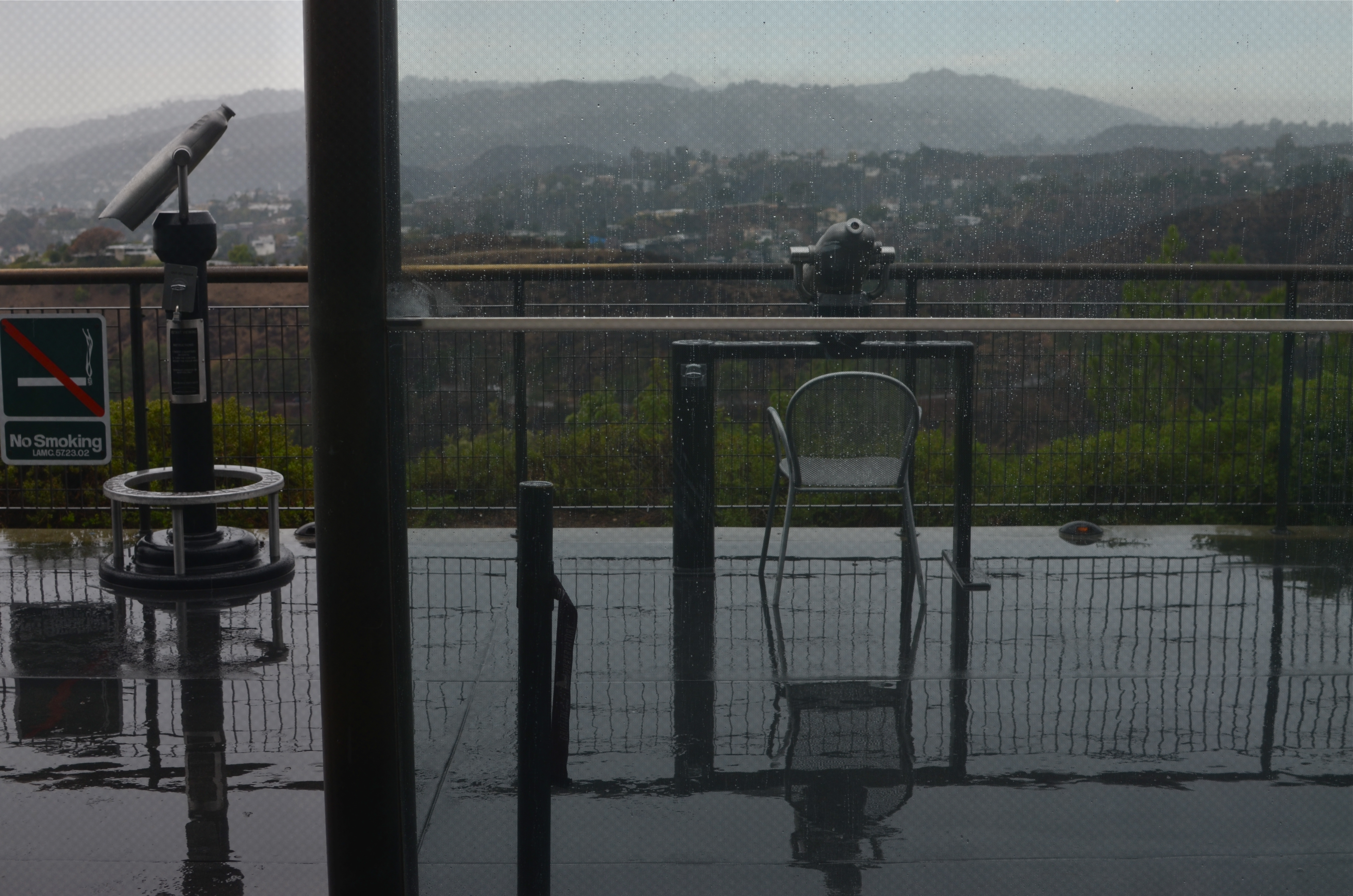
Rainy day, dream away. Griffith Observatory under early overcast, 11/29/13. 1/160, f/5.6, ISO 100, 35mm.
by MICHAEL PERKINS
VISUAL WONDERS, IN EVERY HOUR AND SEASON, ARE THE COMMON CURRENCY OF CALIFORNIA’S GRIFFITH OBSERVATORY. The setting for this marvelous facility, a breathtaking overlook of downtown Los Angeles, the Hollywood Hills, and the Pacific Ocean, will evoke a gasp from the most jaded traveler, and can frequently upstage the scientific wonders contained within its gleaming white Deco skin.
And when the light above the site’s vast expanse of sky fully asserts itself, that, photographically, trumps everything. For, at that moment, it doesn’t matter what you originally came to capture.
You’re going to want to be all about that light.
Upon my most recent visit to Griffith, the sky was dulled by a thick overcast and drenched by a slate-grey rain that had steadily dripped over the site since dawn. The walkways and common decks were nearly deserted throughout the day, chasing the park’s visitors inside since the opening of doors at noon. By around 3pm, a slow shift began, with stray shafts of sun beginning to seek fissures in the weakening cloud cover. Minute by minute, the dull puddles outside the telescope housing began to gleam; shadows tried to assert themselves beneath the umbrellas ringing the exterior of the cafeteria; the letters on the Hollywood sign started to warm like white embers; and people of all ages ventured slowly to the outside walkways.
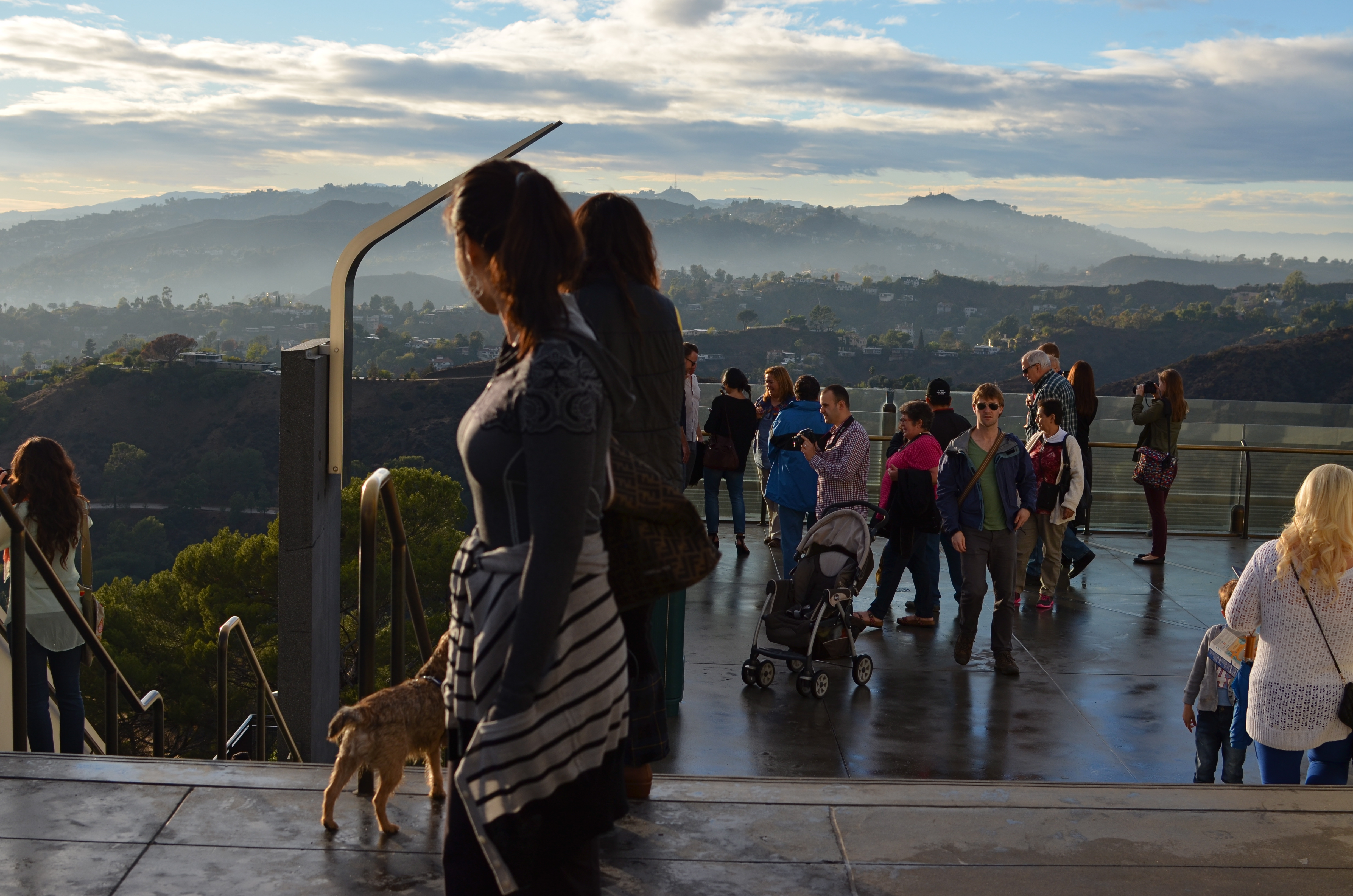
The moment the light broke, Griffith’s common areas after the rain,11/29/13. 1/640 sec., f/5.6 (this image), f/6.3 (lower image), ISO 100, 35mm.
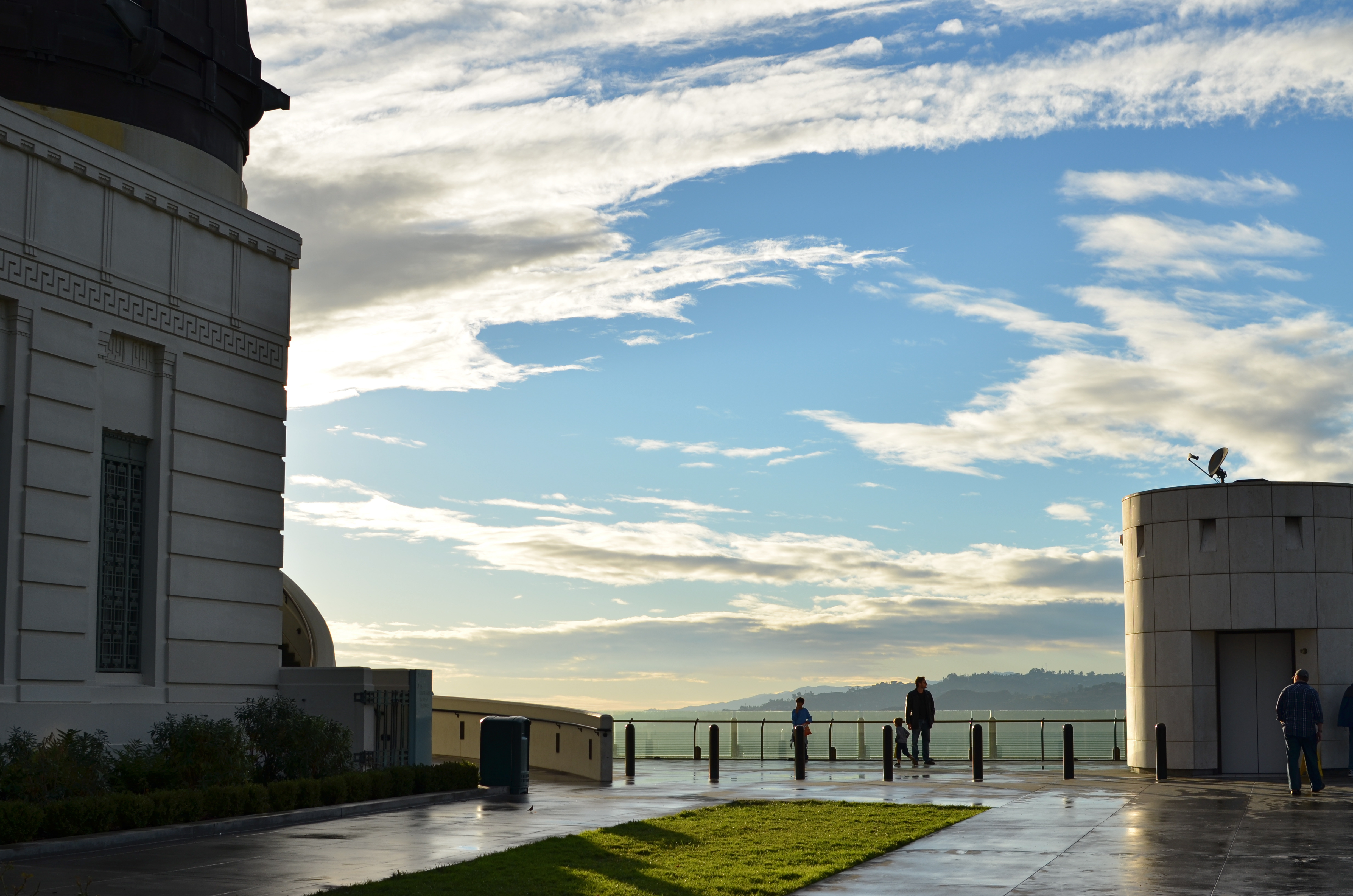
By just after 5 in the afternoon, the pattern had moved into a new category altogether. As the overcast began to break and scatter, creating one diffuser of the remaining sunlight, the fading day applied its own atmospheric softening. The combination of these two filtrations created an electric glow of light that flickered between white hot and warm, bathing the surrounding hillsides with explosive pastels and sharp contrasts. For photographers along the park site, the light had undoubtably become THE STORY. Yes the buildings are pretty, yes the view is marvelous. But look what the light is doing.
Like everyone else, I knew I was living moment-to-moment in a temporary, irresistible miracle. The rhythm became click-and-hope, click-and-pray.
And smiles for souvenirs, emblazoned on the faces of a hundred newly-minted Gene Kellys.
“Siiingin’ in the rainnnn…”
Related articles
RISING TO THE OCCASION
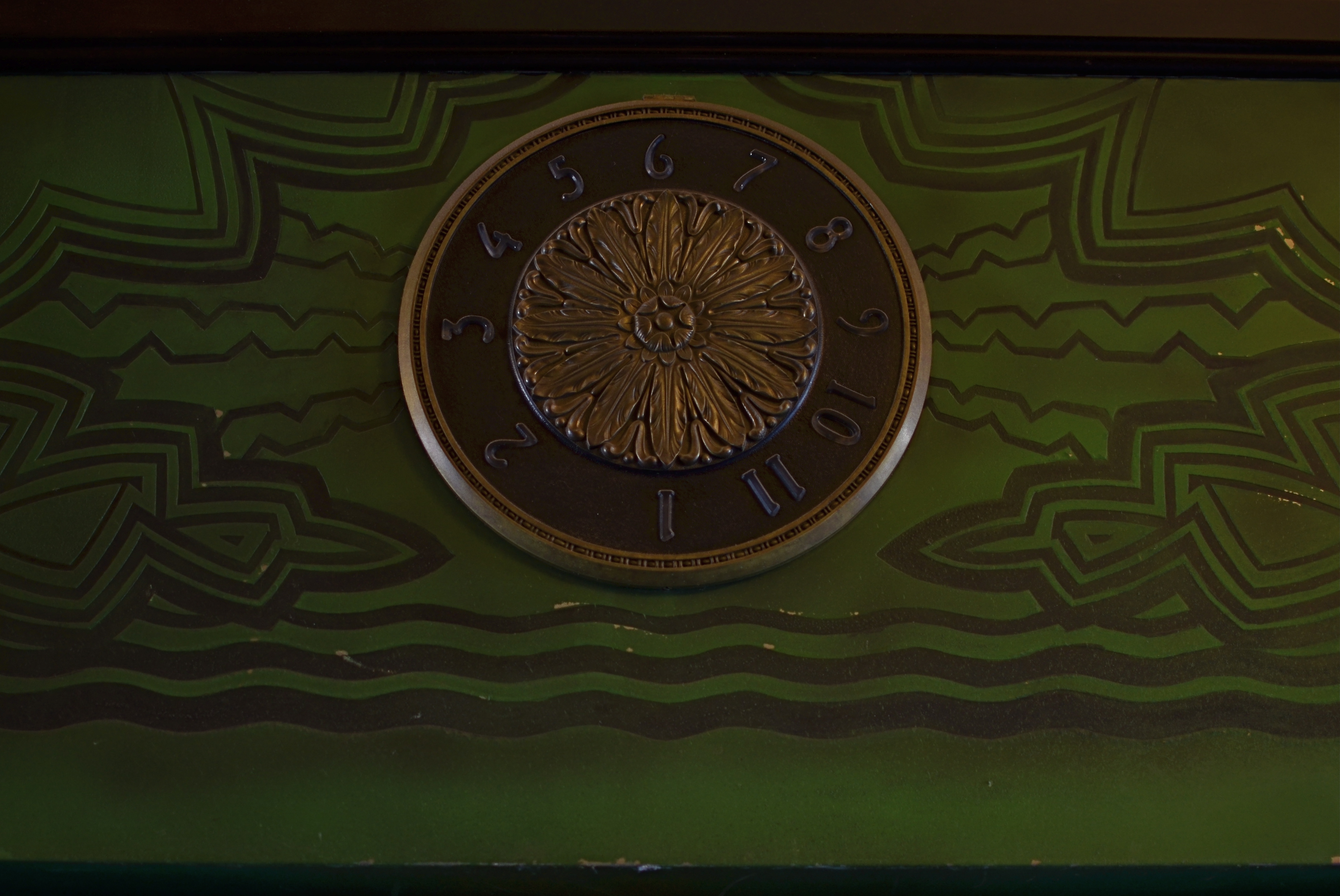
The Desmond building’s elevator floor indicator, circa 1928. 1/40 sec., f/1.8, ISO 100, 35mm.
By MICHAEL PERKINS
LOS ANGELES USED TO BE COMPOSED OF MANY PEOPLE LIKE RUBEN PARDO, the balding, beaming driver of the elevator at the Desmond building at 5500 Wilshire Boulevard. Once upon an urban time long, long, ago there were people who specialized in guiding, in fact, feeling the rise and fall of elevators in cabs they manually controlled. They were the unofficial greeters of their buildings, as familiar with the fortunes of the tenants and clients of their respective towers as the counterman at a diner.
Once, these ascension specialists were turned out in resplendent uniforms befitting their twin duties as both concierge and mechanic. Epaulets. Braided cords. Hats that earned the word “snappy”. Gloves. And always, the inextinguishable smile that Ruben still radiates to all, from the edgy curators of the Desmond’s second floor Gallery “A” to its street level Fed Ex workers to the Deco lovers who float into his lobby to admire his peacock-bedecked elevator doors and the warm mahogany wood of his stately 6×8 foot cab, all original from 1928.
And always, there is the science of measuring the distance between the floors himself, knowing when the car is level, waiting for the right moment to sweep back the flexible cage door that protects his passengers. Watch your step, sir. Turn right and go to the end of the hall, ma’am. Press the button to call me if you finish early, and I’ll come up and get you.
Mr. Pardo has seen Desmond’s descend into the ashes of yesterglory, and now, is still around to see new leases beginning to give the old girl a facelift in one of L.A.’s biggest comeback neighborhoods. Everything old is new again, and, as the crowds start coming back, he is ready.
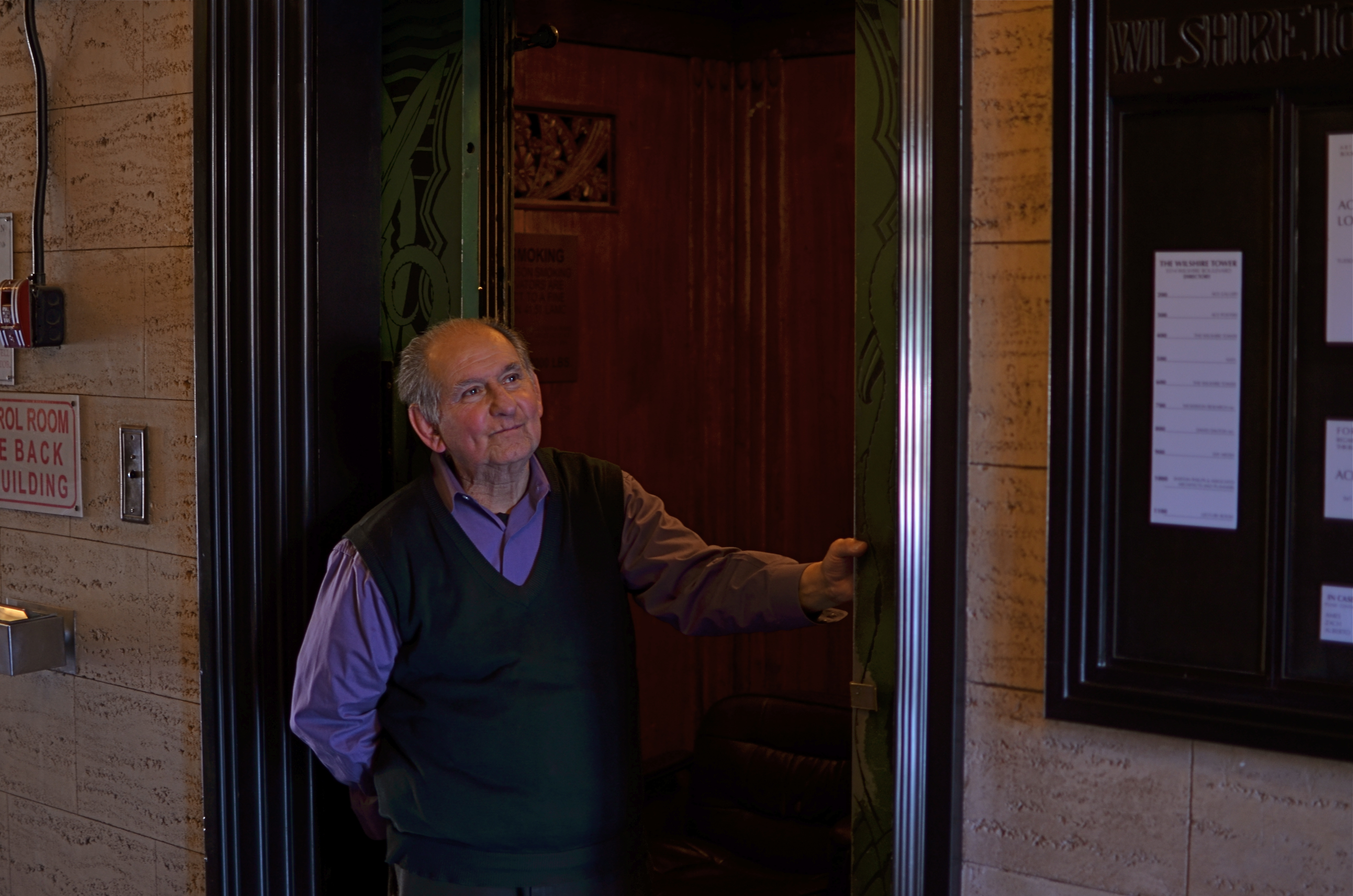
Don’t do the joke about his job having “its ups and downs”: he’s heard it. Ruben Pardo at his post at the Desmond’s elevator. 1/40 sec., f/1.8, ISO 100, 35mm.
I asked Ruben, after thirty-seven years on the job, if he would mind posing for me before his cab. “I’ll just look out toward the street”, he said, and he was right. Mid-morning sun from Wilshire lit his smiling face to perfection as he stood next to his beloved car. It was the look of someone who is doing exactly what he wants to do, a rare thing in a world where we hurry to throw things away, to surge on to we don’t know what. Ruben has earned his little vertical sliver of sky, and he’ll take you up there anytime, himself.
Whenever you’re ready.
Related articles
JUST ENOUGH
By MICHAEL PERKINS
PHOTOGRAPHERS SPEND HALF THEIR LIVES TRYING TO PUT AS MUCH INFORMATION INTO THEIR IMAGES AS POSSIBLE, and the other half trying to remove as much as practicable. Both efforts are in service of the telling of stories, and both approaches are dictated by what a particular photograph is trying to convey.
Sometimes you need the cast of The Ten Commandments to say “humanity”. Other times, just a whisper, an essence of two people talking carries the entire message. That’s where I wound up the other day…with one woman and one very young boy.
Their shared mission was a simple one: hooking up an iPhone Facetime visit with an aunt half a country away. Nothing dramatic, and yet plenty of story to fill a frame with. Story enough, it turned out, for me to get away with weeding out nearly all visual information in the picture, and yet have enough to work with. Time, of course, was also a factor in my choice, since I would be losing a special moment if I stepped into a dark hall and spent precious moments trying to mine it for extra light.
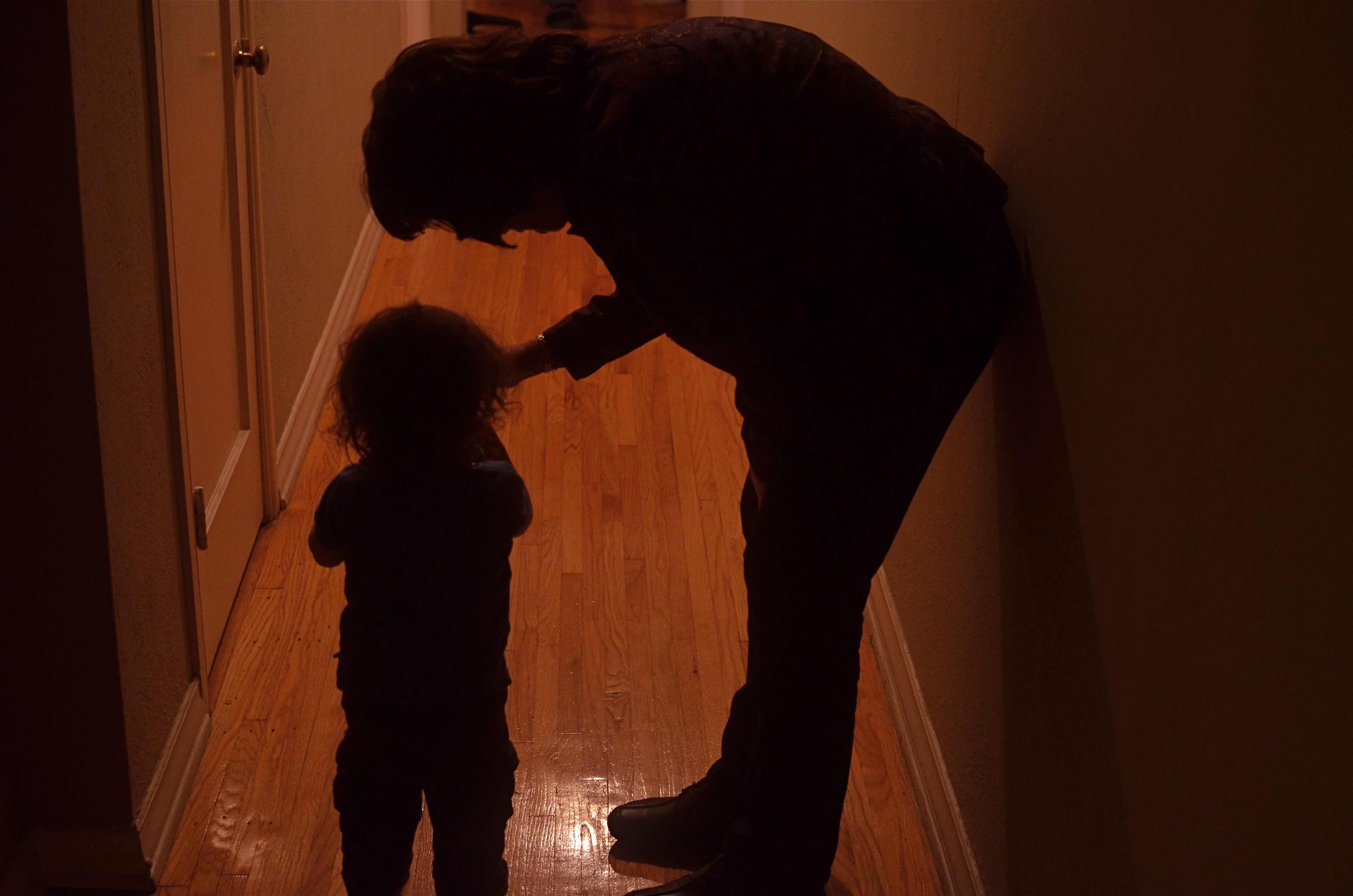
Conference call: 1/50 sec., f/3.5, ISO 800, 35mm.
In a second, I realized that silhouettes would carry the magic of the moment without any help from me. What would it matter if I could see the color of my subjects’ clothing, the detail in their hair, even the look on their faces? In short, what would I gain trying to massage an image that was already perfectly eloquent in shadow?
I exposed for the floor in the hall and let everything else go. There was plenty of story there already.
I just had to get out of its way.
KEEPING SPIRITS BRIGHT
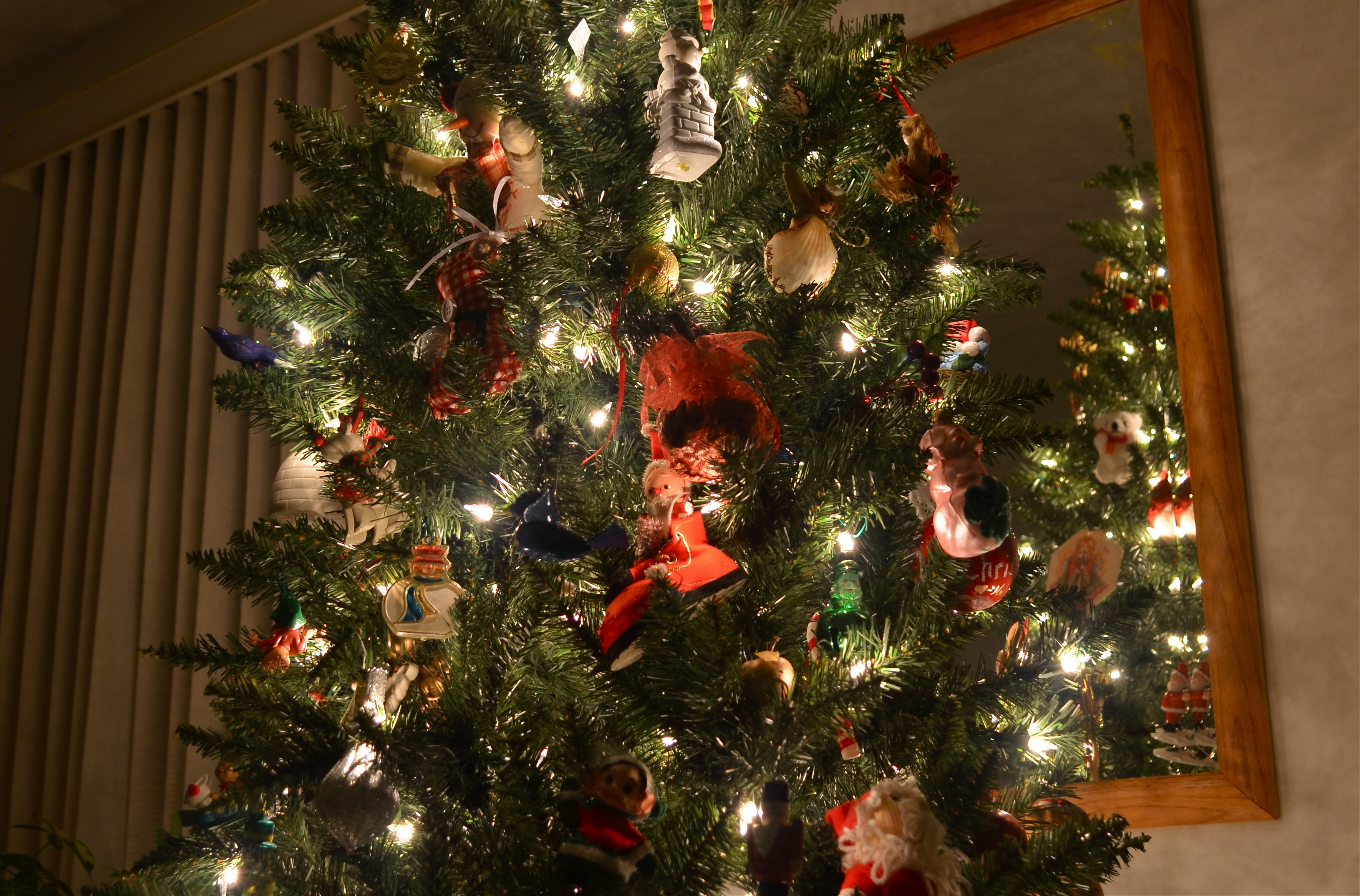
1/16 sec., f/4, ISO 100, 20mm.
By MICHAEL PERKINS
IT IS A SEASON OF LIGHT AND COLOR, perhaps one of the key times of the year for all things illuminated, burning, blazing and glowing. It is a time when opportunities for vivid and brilliant images explode from every corner.
And one way to unleash all that light is to manage darkness.
One example: your family Christmas tree involves more delicate detail, tradition and miniature charm than any other part of your home’s holiday decor, but it often loses impact in many snapshots, either blown out in on-camera flash or underlit with a few colored twinkles surrounded by a blob of piny silhouette.
How about a third approach: go ahead and turn off all the lights in the room except those on the tree, but set up a tripod and take a short time exposure.
It’s amazing how easy this simple trick will enhance the overall atmosphere. With the slightly slow exposure, the powerful tree LEDs have more than enough oomph to add a soft glow to the entire room, while acting as a multitude of tiny fill lights for the shaded crannies within the texture of the tree. Ornaments will be softly and partially lit, highlighting their design details and giving them a slightly dimensional pop.
In fact, the LED’s emit such strong light that you only want to make the exposure slow enough to register them. The above image was taken at 1/16 of a second, no longer, so the lights don’t have time to “burn in” and smear. And yes, some of you highly developed humanoids can hand-hold a shot steadily at that exposure, so see what works for you. You could also, of course, shoot wide open to f/1.8 if you have a prime lens, making things even easier, but you might run into focus problems at close range. You could also just jack up your ISO and shoot at a more manageable shutter speed, but in a darkened room you’re trading off for a lot of noise in the areas beyond the tree. Dealer’s choice.
Lights are a big part of the holidays, and mastery of light is the magic that delivers the mystery. Have fun.
I’M DREAMING OF A ‘CHROME CHRISTMAS
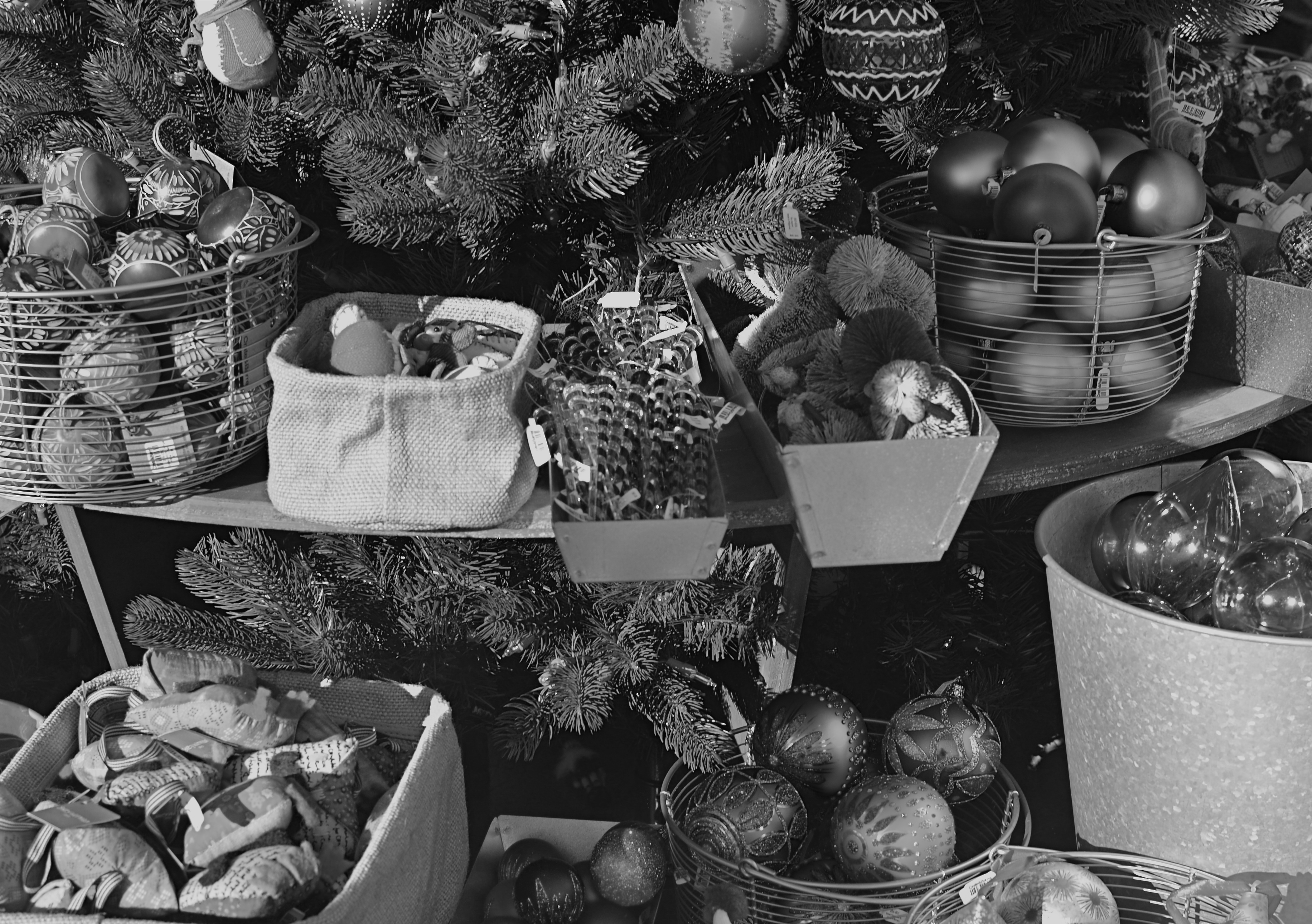
All The Trimmings, 2013. 1/160 sec., f/5.6, ISO 100, 35mm.
By MICHAEL PERKINS
IF YOU HAVE BEEN ON THE PLANET FOR MORE THAN FIFTY CHRISTMASES, your holiday memories (at least those frozen in family snapshots) will include more than a few black and white images. Some families made the switch to color photography earlier than others, but, at least until the mid-1960’s, for millions of us, more than a few “our best tree ever” photos were shot in monochrome. A little web research or family album-browsing can illustrate just how well beloved memories were captured by millions of us, long before Kodachrome became the visual currency of family folklore.
It’s interesting to note that, with the universal availability of not only simple cameras but post-processing apps, there’s been a sort of retro-fed love of b&w that’s refreshing, given that we are, once again, admitting that some subjects can be wonderfully rendered in a series of greyscale tones. Certainly the general marketing and depiction of the season is a color-drenched one, but many new photographers are re-discovering the art of doing more with less, or, more properly, seeing black and white as an interpretation of reality rather, as in the case of color, as a recording of it.
Observing the season out in the American West, thousands of miles from loved ones, I find that my holiday shots are increasingly journalistic or “street” in nature, since I am viewing and interpreting other people’s Christmases. The contours and designs of retail become a vibrant source of stories for me, and black and white allows me to shoot at an emotionally safe distance while calling special attention to texture and detail.
Depending on whether you’re showing the splendor of food and presents or evoking some Dickens-era urban grit, some subjects will come up flat or drab in black and white, given our very specific memory cues as to what Christmas should “look like”, so getting the desired result may be elusive. But, of course, if photography was easy, everyone would do it.
Oh, wait, everybody does do it.
Thing is, you always add another voice to the creative conversation. That’s the best part of both photography and the holidays.
No way is best but your way.
Related articles
- Photography 101: Shooting in Black and White (dailypost.wordpress.com)
DO SOMETHING MEANINGLESS
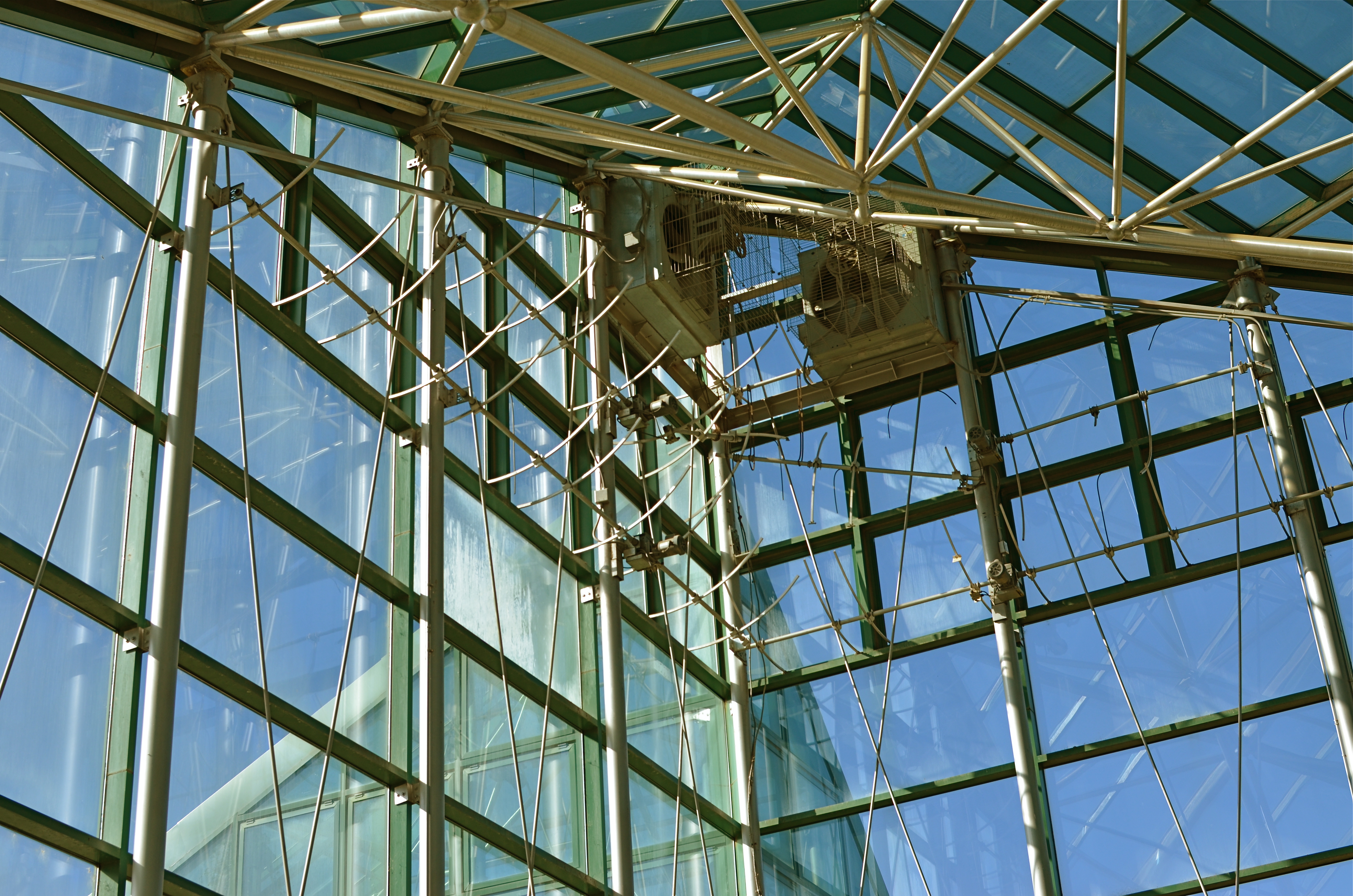
The subject matter doesn’t make the photograph. You do. A pure visual arrangement of nothing in particular can at least teach you composition. 1/400 sec., f/5.6, ISO 100, 35mm.
By MICHAEL PERKINS
SHOOT WHAT YOU KNOW. SHOOT WHAT YOU LOVE. Those sentences seem like the inevitable “Column A” and “Column B” of photography. And it makes a certain kind of sense. I mean, you’ll make a stronger artistic connection to subject matter that’s near and dear, be it loved ones or beloved hobbies, right? What you know and what you love will always make great pictures, right?
Well….okay, sorta. And sorta not.
I hate to use the phrase “familiarity breeds contempt”, but your photography could actually take a step backwards if it is always based in your comfort zone. Your intimate knowledge of the people or things you are shooting could actually retard or paralyze your forward development, your ability to step back and see these very familiar things in unfamiliar ways.
Might it not be a good thing, from time to time, to photograph something that is meaningless to you, to seek out images that don’t have any emotional or historical context for you? To see a thing, a condition, a trick of the light just for itself, devoid of any previous context is to force yourself to regard it cleanly, without preconception or bias.
Looking for things to shoot that are “meaningless” actually might force you to solve technique problems just for the sake of solving, since the results don’t matter to you personally, other than as creative problems to be solved. I call this process “pureformance” and I believe it is the key to breathing new life into one’s tired old eyes. Shooting pure forms guarantees that your vision is unhampered by habit, unchained from the familiarity that will eventually stifle your imagination.
This way of approaching subjects on their own terms is close to what photojournalists do all the time. They have little say in what they will be assigned to show next. Their subjects will often be something outside their prior experience, and could be something they personally find uninteresting, even repellent. But the idea is to find a story in whatever they approach, and they hone that habit to perfection, as all of us can.
Just by doing something meaningless in a meaningful way.
JUST SAY THANK YOU
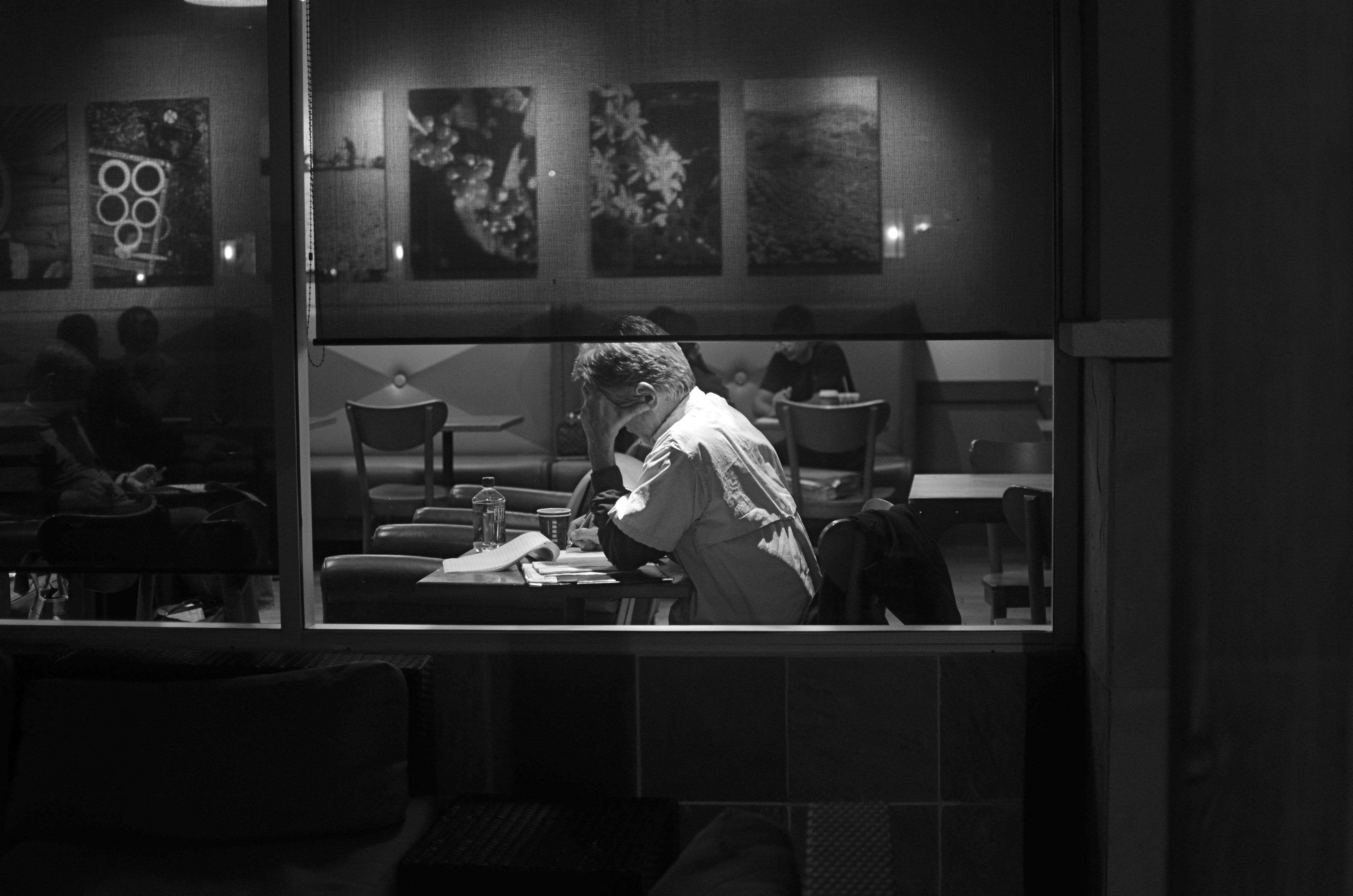
The All-Nighter: 1/60 sec., f/1.8, ISO 800, 35mm.
By MICHAEL PERKINS
PICTURES HAPPEN WHEN YOU’RE OUT TRYING TO TAKE “OTHER” PICTURES. Pictures happen when you didn’t feel like taking any pictures at all. And, occasionally, the planets align perfectly and you hold something in your hand, that, if you are honest, you know you had nothing to with.
Those are the pictures that delight and haunt. They happen on off-days, against the grain of whatever you’d planned. They crop up when it’s not convenient to take them, demanding your attention like a small insistent child tugging at your pants leg with an urgent or annoying issue. And when they call, however obtrusively, however bothersome, you’d better listen.
Don’t over-think the gift. Just say thank you….and stay open.
This is an overly mystical way of saying that pictures are sometimes taken because it’s their time to be taken. You are not the person who made them ready. You were the person who wandered by, with a camera if you’re lucky.
I got lucky this week, but not with any shot I had set out on a walkabout to capture. By the time I spotted the scene you see at the top of this post, I was beyond empty, having harvested exactly zip out of a series of locations I thought would give up some gold. I couldn’t get the exposures right: the framing was off: the subjects, which I hoped would reveal great human drama, were as exciting as a bus schedule.
I had just switched from color to monochrome when I saw him: a young nighthawk nursing some eleventh-hour coffee while poring over an intense project. Homework? A heartfelt journal? A grocery list? Who could tell? All I could see, in a moment, was that the selective opening and closing of shades all around him had given me a perfect frame, with every other element in the room diffused to soft focus. It was as if the picture was hanging in the air with a big neon rectangle around it, flashing shoot here, dummy.
My subject’s face was hidden. His true emotion or state of mind would never be known. The picture would always hide as much as it revealed.
Works for me. Click.
Just like the flicker of a firefly, the picture immediately went away. My target shifted in his chair, people began to walk across the room, the universe changed. I had a lucky souvenir of something that truly was no longer.
I said thank you to someone, packed up my gear, and drove home.
I hadn’t gotten what I originally came for.
Lucky me.
related articles:
- Crop and turn a bad picture into a good one (weliveinaflat.wordpress.com)
11/22/63: THE DAY THE WORLD UNSPOOLED
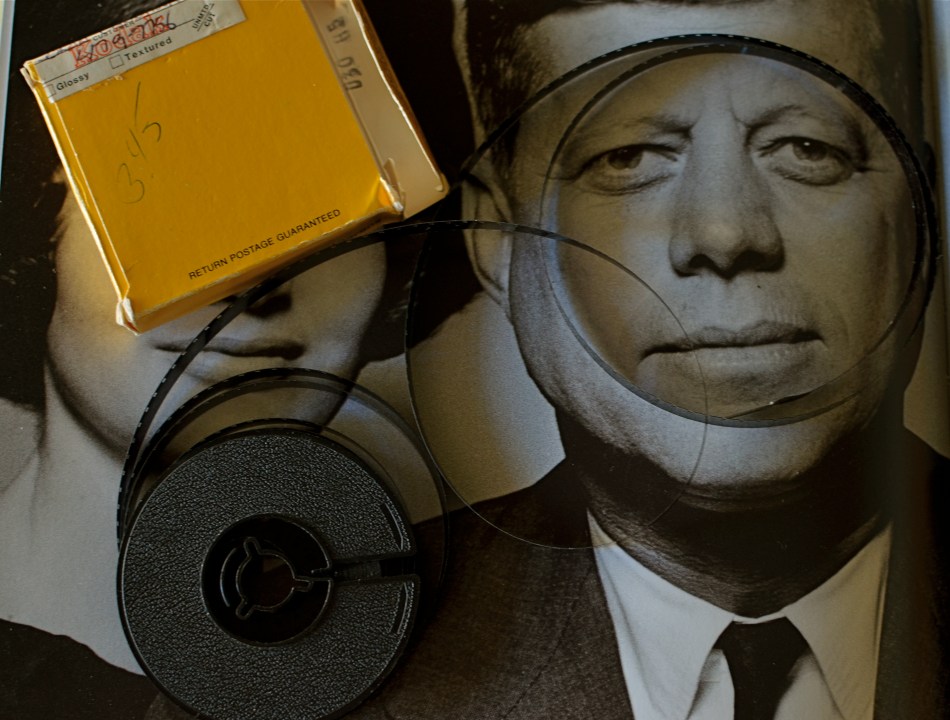
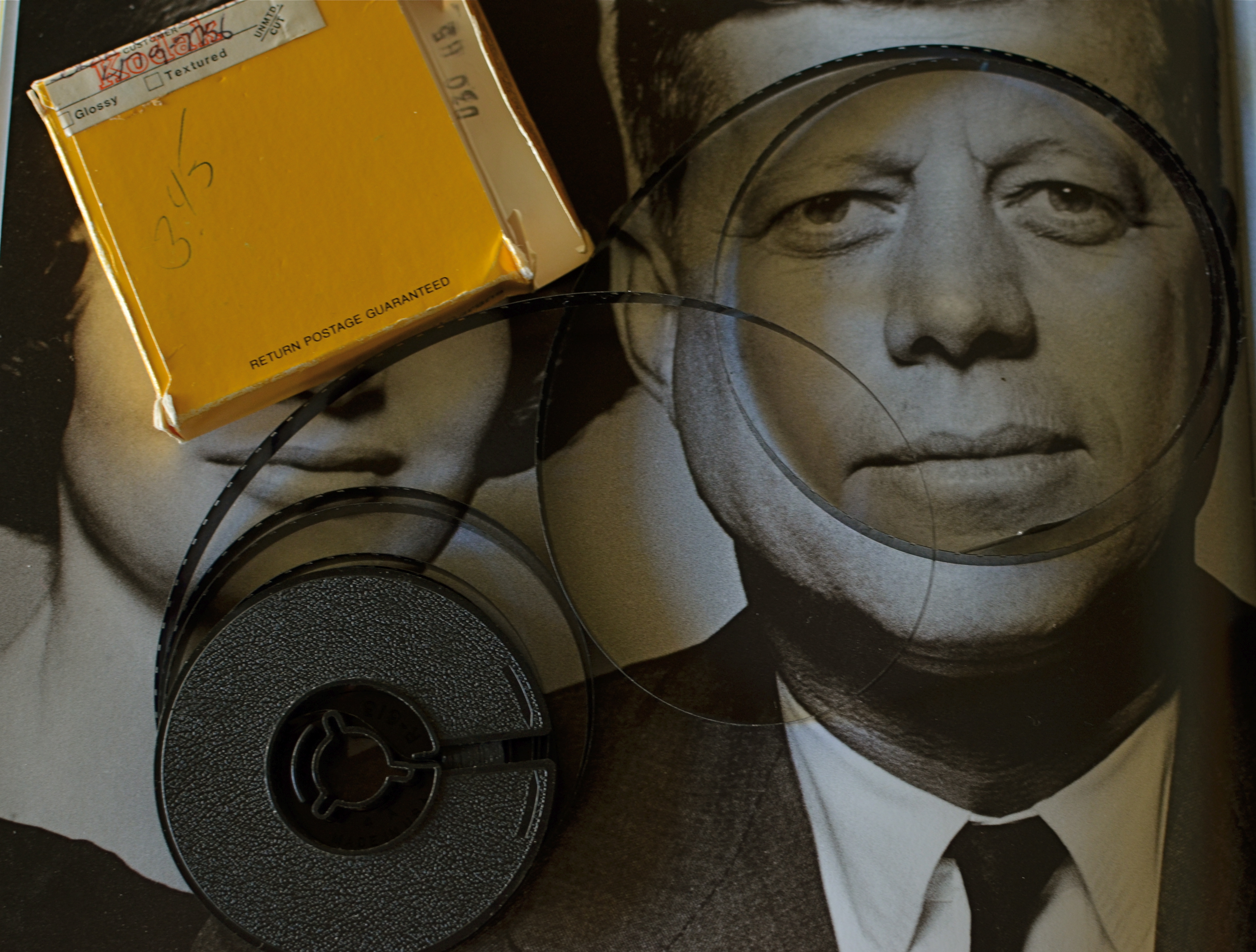
- Photomontage by Michael Perkins. Original Kennedy family image by Richard Avedon, now copyright The Smithsonian Institution. All rights reserved.
By MICHAEL PERKINS
ABRAHAM ZAPRUDER almost didn’t change history.
The Dallas women’s wear designer, a refugee from Soviet Russia and a Democrat, was eager to take a break from his office on November 22, 1963 to head down to the city’s Dealey Plaza, accompanied by his receptionist, to get a look at the man for whom he had voted three years earlier. An assistant suggested he first swing by his house and pick up his movie camera, a Bell & Howell Zoomatic “Director” Model 414 PD. Standing on a concrete pedestal, framing the presidential motorcade as it made its turn onto Elm Street, Zapruder, too stunned by what he was seeing through his viewfinder to even stop, captured 26.6 seconds that would document the world’s shift from innocence to agony.
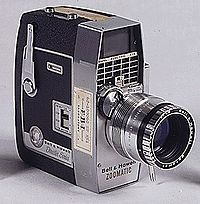
- Abraham Zapruder’s Bell & Howell Movie Camera.
He had no sophisticated experience documenting news stories. He had never taken a course on photography. Understandably, for the rest of his life, he could never again even bring himself to shoot either still or movie images. But that day, he had a camera. And if anything of Abraham Zapruder’s unique role in the Kennedy tragedy is emblematic of the fatefulness of photography, of being present when things are ready to happen, it is those 486 frames of Kodachrome, footage that no one….no news service, no network, no freelancer…nobody but a dressmaker with an amateur camera was poised to capture.
Because of Abraham Zapruder, the chaos and fear of those seconds now represent a time line, a sequence. The event has parameters, colors. Tone. Zapruder’s camera transformed him from “a” witness to “the” witness, the image maker of record, just as it had for others when the Hindenburg erupted into flame, the Arizona billowed black smoke, and, a generation later, Challenger painted the sky with a billion fiery atoms.
Half a century later, the multiplier effect of personal media devices guarantees that each key event in our history is documented by hundreds, even thousands of witnesses at once, but, on that horrible day in Dallas, Abraham Zapruder’s preservation of murder on celluloid was an outlier, an accident. And by the end of Friday, November, 22, 1963, the day the world unspooled, he was no longer merely a tourist taking a home movie. He was the sole possessor of Exhibit A.
Related articles
- Zapruder Film: Images As History, Pre-Smartphone (dfw.cbslocal.com)
FRAGMENTING THE FRAME
1/160 sec., f/5.6, ISO 100, 35mm.
By MICHAEL PERKINS
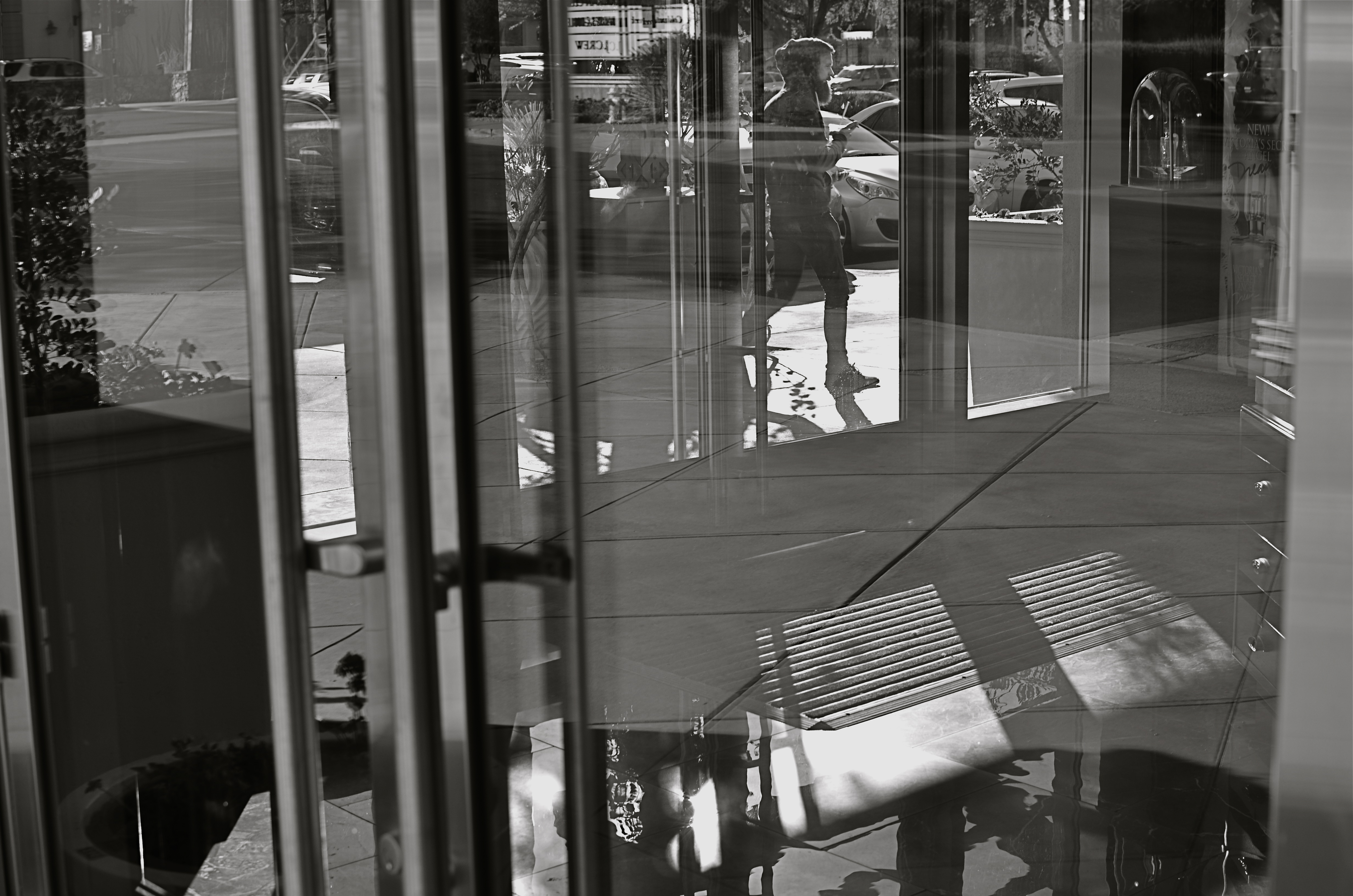
I HAVE MADE A CONSCIOUS EFFORT, IN RECENT YEARS, TO AVOID TAKING A “STRAIGHT SHOT” OUT OF, OR THROUGH A WINDOW, of using that rectangle or square as a conventional means of bordering a shot. Making a picture where a standard view of the world is merely surrounded by a typical frame shows my eye nothing at all, whereas the things that fragment that frame, that break it into smaller pieces, bisecting or even blocking information…..that’s fascinating to me.
This is not an arbitrary attempt to be “arty” or abstract. I simply prefer to build a little mystery into my shots, and a straight out-the-window framing defeats that. My showing everything means the viewer supplies nothing of his own. Conversely, pictures that both reveal and conceal, simultaneously, invite speculation and encourage inquiry. It’s more of a conversation.
Think about it like a love scene in a movie. If every part of “the act” is depicted, it’s not romantic, not sexy. It’s what the director leaves out of the scene that fires the imagination, that makes it a personal creation of your mind. Well-done love scenes let the audience create part of the picture. Showing everything is clinical….boring.
With that in mind, The Normal Eye’s topside menu now has an additional image gallery called Split Decisions, featuring shots that attempt to show what can result when you deliberately break up the normal framing in and out of windows. Some of the shots wound up doing what I wanted: others came up short, but may convey something to someone else.
As always, let us know what you think, and thanks for looking.
Related articles
- Framing Framing Framing!!! (destynimcbeth.wordpress.com)
COMFY VS. CONFRONTATIONAL
By MICHAEL PERKINS
THERE SEEMS TO BE TWO SETS OF RULES WHEN IT COMES TO CANDID PHOTOGRAPHY.
It seems size does matter.
Let me explain.
The physical dimensions of cameras are an unspoken code for the comfort level we extend to the photographers behind them. This may go back to the very first days of the medium, when all cameras were obtrusively large and obvious. Getting your picture “took” was a formal, intentional thing, and that bulky machine was there to record something permanent, important. Contrast that with the appearance , at the end of the 19th century, of the Kodak Brownie, the first genuine “everyman” camera. Small. Personal. Informal. Most of all, non-threatening.
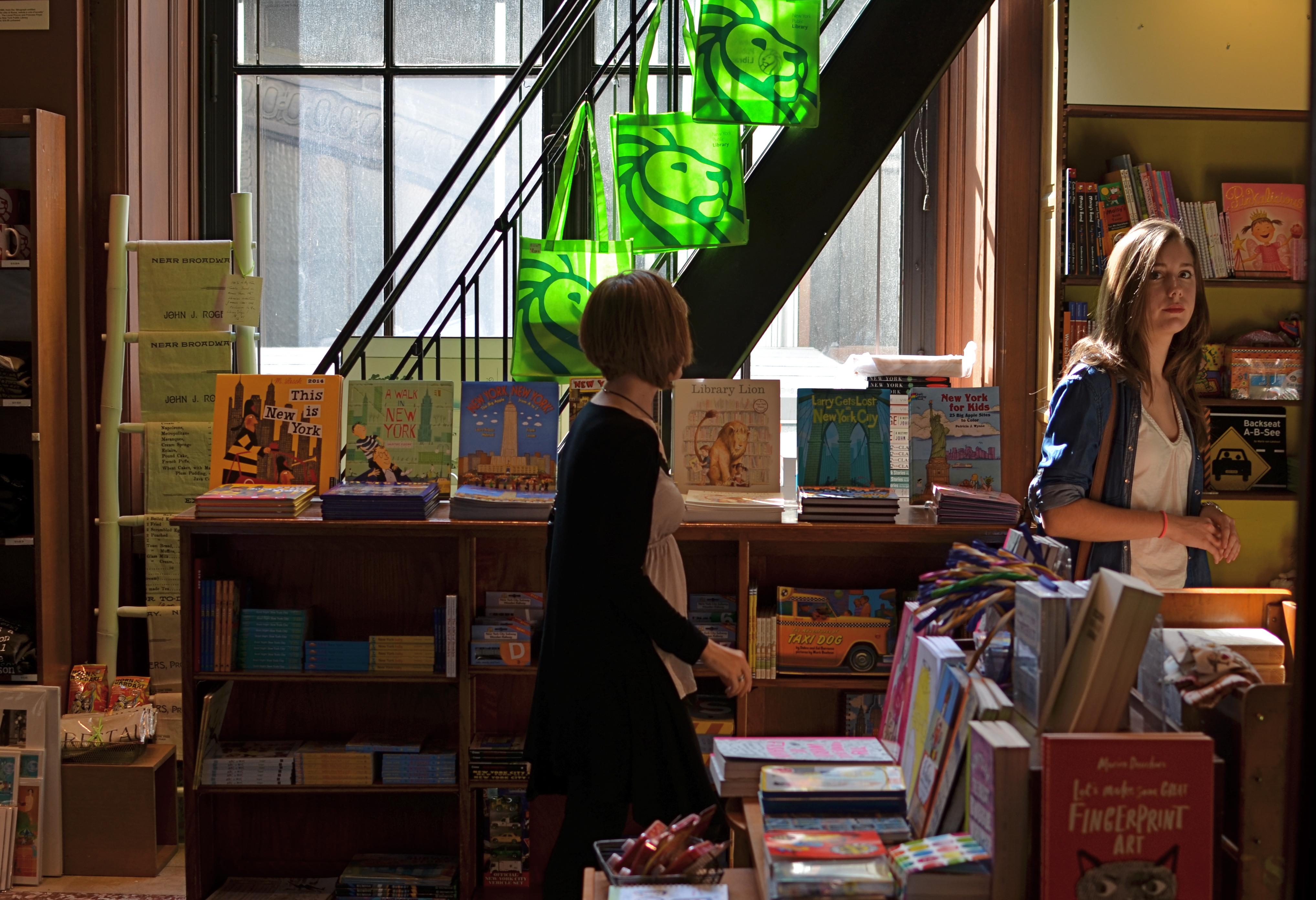
NYPL Giftshop, 2012. Street photography or invasion? 1/125 sec., f/3.2, ISO 100, 35mm.
Jump to the present day and the pronounced size difference between compact cameras and DSLRs, a distinction which still signals whether a photomaker is perceived as friend or foe. “Friend” is the guy who quickly snaps a picture of you and your friends blowing out birthday candles with his cute little Fuji or iPhone. “Foe” is more likely the guy taking time to frame a shot while hiding his predatory face behind a big scary Nikon….since he’s the “serious” photographer, thus less trustworthy. Is he after something? Is he trying to catch me doing something stupid, or worse, actually revelatory? Is he trying to imprison my soul in his box?
This binary reaction….good camera, bad camera…is deeply rooted in our collective DNA. It’s understandable. But it’s illogical.
Seriously, consider the twin assaults that digital media and miniaturization have launched on the concept of privacy in recent decades. Ponder the sheer ubiquity of all those millions of new “friendly” little phones. Contemplate the invasion represented by the indiscriminate, relentless posting of giga-hunks of previously personal moments on social networks, then tell me how the presence of more formal, “foe” cameras represents anything close to the same level of risk or exposure. And yet it is the purse-sized camera that is regarded in public places as benign, while the DSLR is far more likely to be rousted by mall cops acting as self-appointed foto sheriffs.
I’m not saying for a moment that there shouldn’t be civility, decency, respect and restraint practiced by photographers who are, however briefly, entering the personal space of strangers. That’s just common sense. I always feel horrible when I think my presence has caused my subjects to cringe or twitch. However, I think it’s time that, for candid photography, there be a single set of rules on the concept of comfy versus confrontational.
Related articles
- Kodak Brownie Reimagined as Vintage iPhone Dock (iphonesavior.com)
THE LION IN WINTER
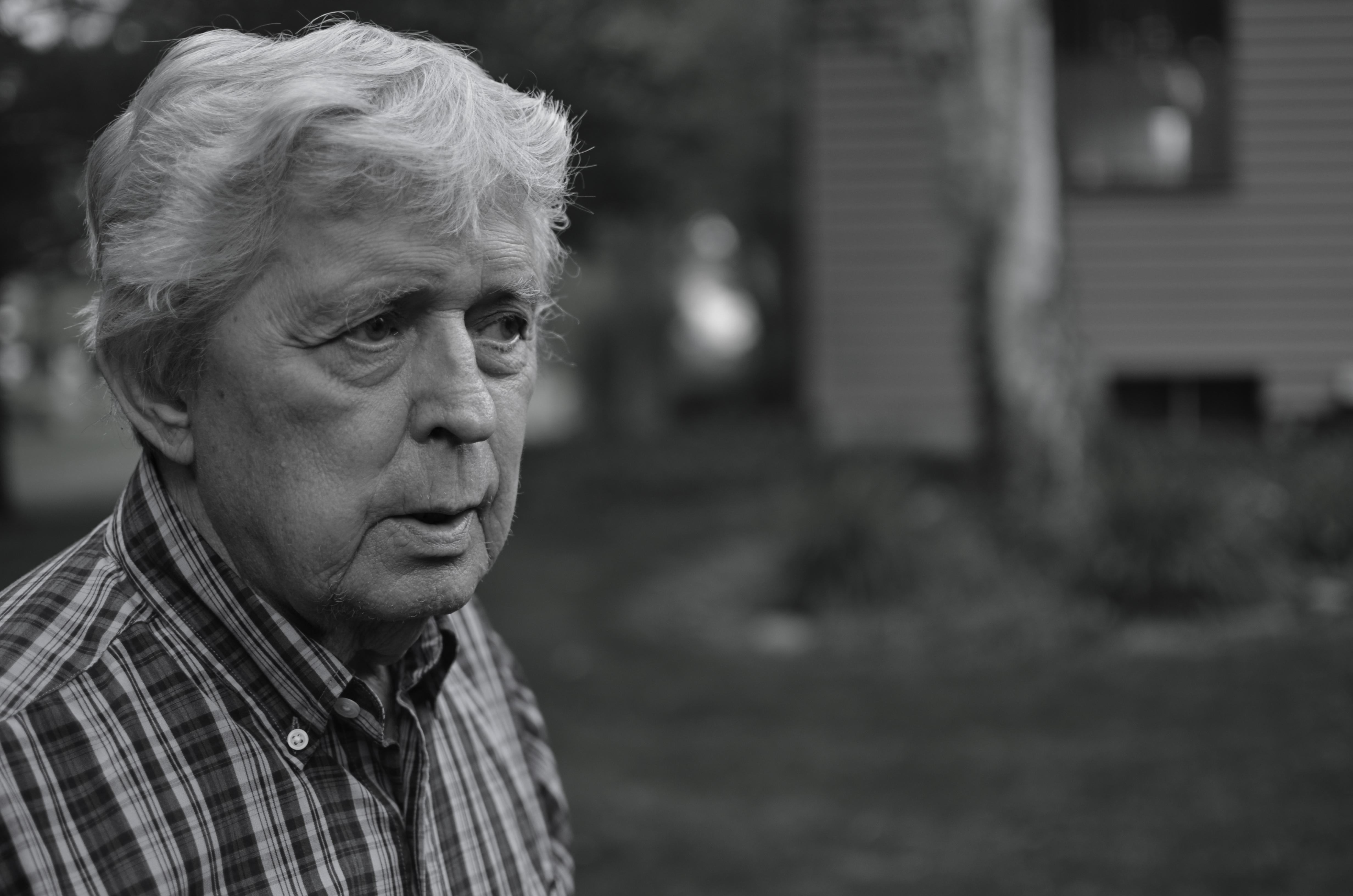
Ralph Adrian Perkins, June 12, 2013. 1/100 sec., f/1.8, ISO 100, 35mm.
By MICHAEL PERKINS
I AM AMAZINGLY BLESSED TO BE ENTERING OLD AGE, STILL TRAILING MY FATHER BY ABOUT TWENTY-THREE YEARS. Defying the odds, statistical probabilities, and luck, my personal North Star is still, at 84, providing me with a point of light to steer by. I cannot imagine a world in which he is not just a few miles ahead of me, gently insisting, “this way.” And, years after the worst the world has to offer has long since stopped generating any panic in me, the thought of life without him remains unimaginable, like trying to envision the world without gravity, or sunlight.
I can’t begin to catalogue the thousands of ways his wisdom and patience have tempered and shaped me, but it’s worth singling out his influence on my visual sense and curiosity as a photographer. I remember his intrepid search for beauty, armed with the simple tool of a Kodak Pony 828 camera, a device which both intrigued and frustrated him. During my childhood, the Pony was the official recorder of dreams, events, and possibility for the Perkins clan. We all cheered when it delivered what Dad saw in his mind’s eye. We all offered sympathy and encouragement when he asked it to see beyond its powers, when a set of Kodachrome slides entered the “better luck next time” category.
As a designer and illustrator for North American Aviation, then, later, as a fine arts teacher, he had a developed eye for beauty, a genuine instinct for how a visual story was framed and shown. Armed with my first cheap plastic camera, I only knew I wanted my images to be as good as his own. His eagerness became my ambition, and, half a lifetime later, I still regard a picture as “good” if the old man sees something in it.
Like many photographers major and minor, I am happy to make my father a subject in my own work. I am recording, interpreting and saluting his life all at once, and trying, in my halting way, to capture, in his face, all of the wisdom I have drawn from him over a lifetime. It’s a tall order, but he always taught me to go a little bit beyond what you think you can deliver. I remember him pushing the Kodak Pony to its limits, and beyond, in impossible situations. Some projects landed with a clunk, but it was always about the next frame, the coming opportunity.
There was…is….no bad photograph. Just mileage markers on the way, toward “gee, who knows?”
Thank you, Dad, for showing me that the journey is everything.
 thenormaleye