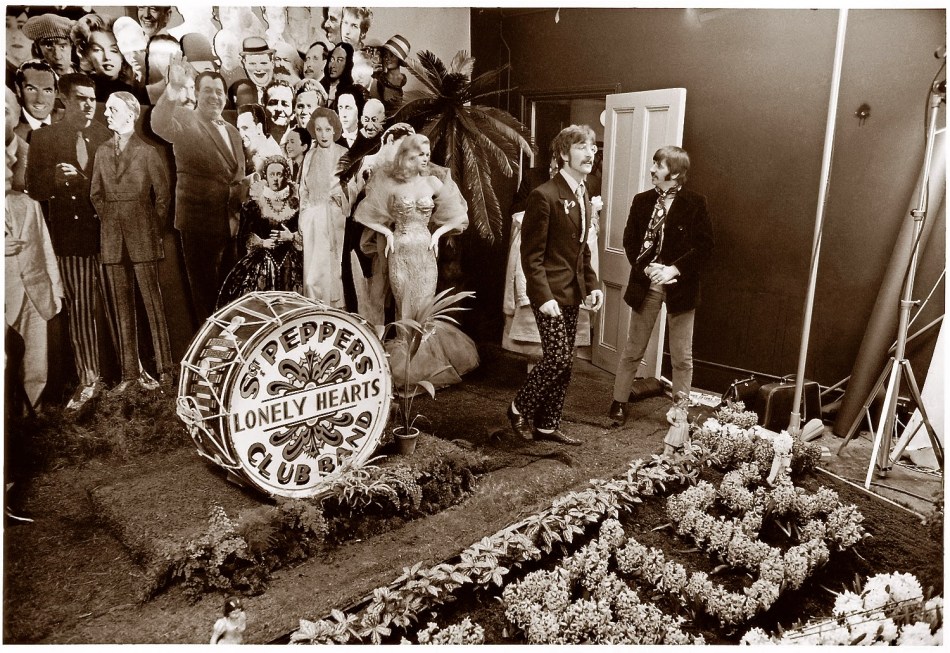
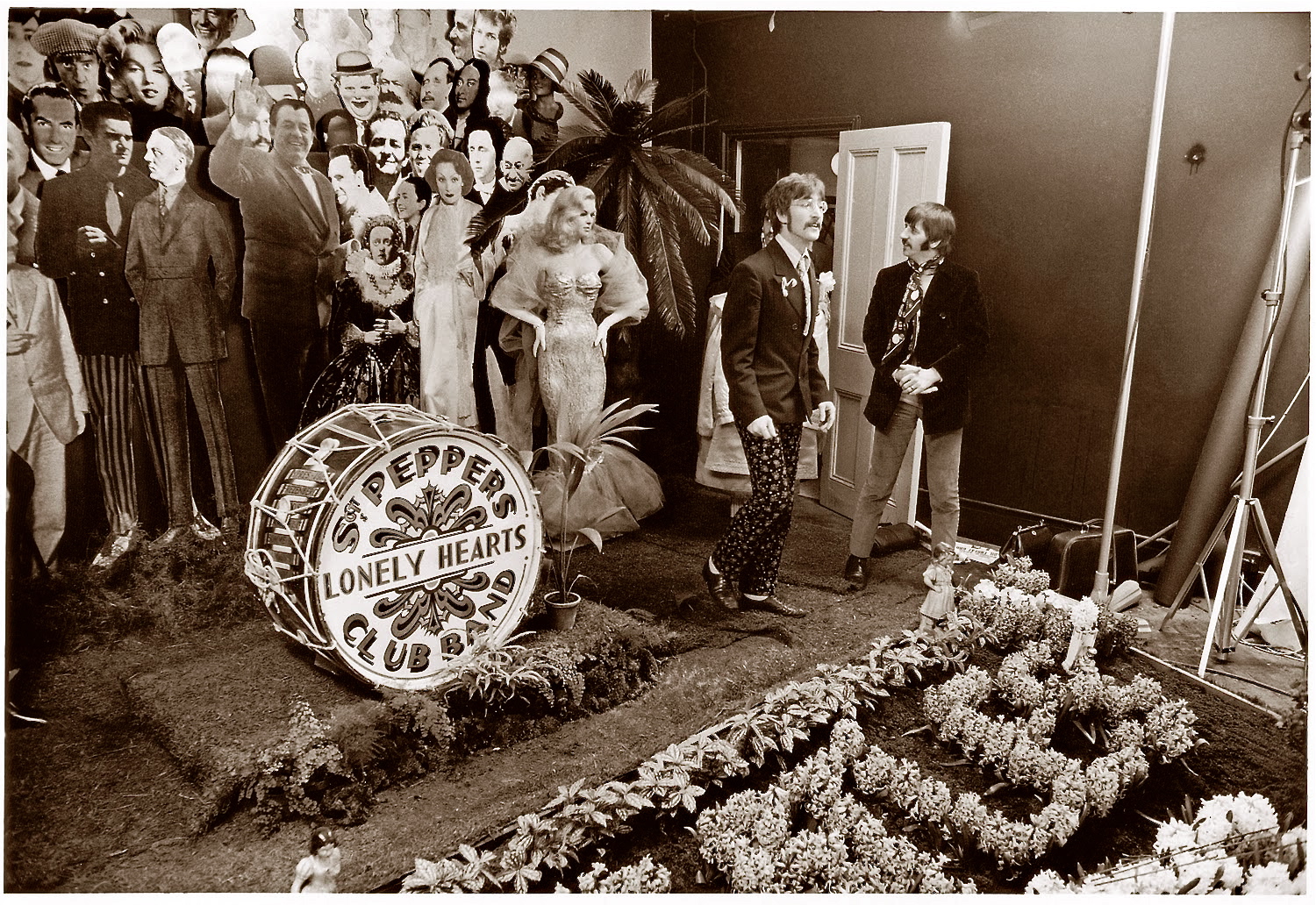
John Lennon and Ringo Starr inspect the assembly of the celebrity diorama that would be the main set piece for the Sgt. Pepper album cover, 1967.
By MICHAEL PERKINS
ANY COMPLETE DISCUSSION OF THE LEGACY OF THE BEATLES‘ Sgt. Pepper’s Lonely Hearts Club Band, marking its fiftieth anniversary in 2017, will include voluminous analyses of its ground-breaking production technique and breakthrough approach to musical composition, and rightfully so. But this most fundamental of pop culture events of the 1960’s must also be thought of in purely visual terms, since many of us first encountered it as an amazing, challenging image.
In truth, the collaboration between Pop Art designer Peter Blake and studio photographer Michael Cooper, with its ad-hoc gathering of cardboard celebrities grouped around a gravesite with the word BEATLES spelled out in blossoms, is the first act of a two-act play. The cover set the same audacious terms of engagement that the record inside the sleeve would abide by: Art and Music are what we say they are: We, the Beatles, are in complete charge of our music, our image, and our connection with the audience: we will not have “a” style, but will hybridize whatever schools of thought come to hand, from modes of composition to instruments to shifting patterns of Past, Present, and Future to coloring outside the lines of even our own culture. I read the news, today, oh, boy, and it said there are no more rules: there are no more walls. The stage can no longer hold us. Only the studio itself is vast enough to contain what we have to say.
The cover of Sgt. Pepper made a stunning break with the accepted practices used by record labels to market their goods. Quite simply, the suits in the front office were no longer in charge of the pictures. And what of that picture, or, more accurately, that picture of pictures? Is it a tribute? A put-on? A serving of notice that the Beatles are dead, long live the Beatles? Yes, yes, and hell, yes. Pepper made it plain, once and for all, that album covers, which had begun in the 1930’s as basic advertising sleeves for the goods within, could be venerated, influential, and, yeah, framed on some freak’s wall. Like, you know, man, art.
And, if Cooper and Blake were drawing a line between eras for the record world, they were doing so to an even greater degree for photography, which, in 1967, was still considered by some as more craft than art. Within a few years after A Day In The Life‘s long, ringing super-chord, museums were mounting shows by Diane Arbus, Lee Friedlander, and Robert Frank, right alongside the painters, and directly adjacent to people like Warhol who constituted categories all their own.
Just as Alice In Wonderland is somehow legless without John Tenniel’s illustrations, Sgt. Pepper’s’ outside will always be wedded to its inside, and vice versa. As the most popular multimedia product in commercial history, it owes much of its titanic impact to the image of four oddly costumed men with four strangely new mustaches and one big message: there is more to us than meets the eye. Like the best of photography, the picture issues a challenge. Nothing is real.
And nothing to get hung about…….







THAT WHICH IS EARNED
By MICHAEL PERKINS
THE MORE INDEPENDENCE DAYS that I mark as an American, the more the holiday is fine-tuned, for me, from one of pure celebration to one of sober reflection. As a child, I waved my little flag, oohed and ahhed at fireworks, and ran up the scores of all our national wins and points of pride. As a middle-aged man, I think of the USA as a wonderful, but incomplete “to-do” list. I cherish what we’ve been but also try to be mindful of what we need to be. And that, in turn, widens my concept of what an Independence Day photograph can look like.
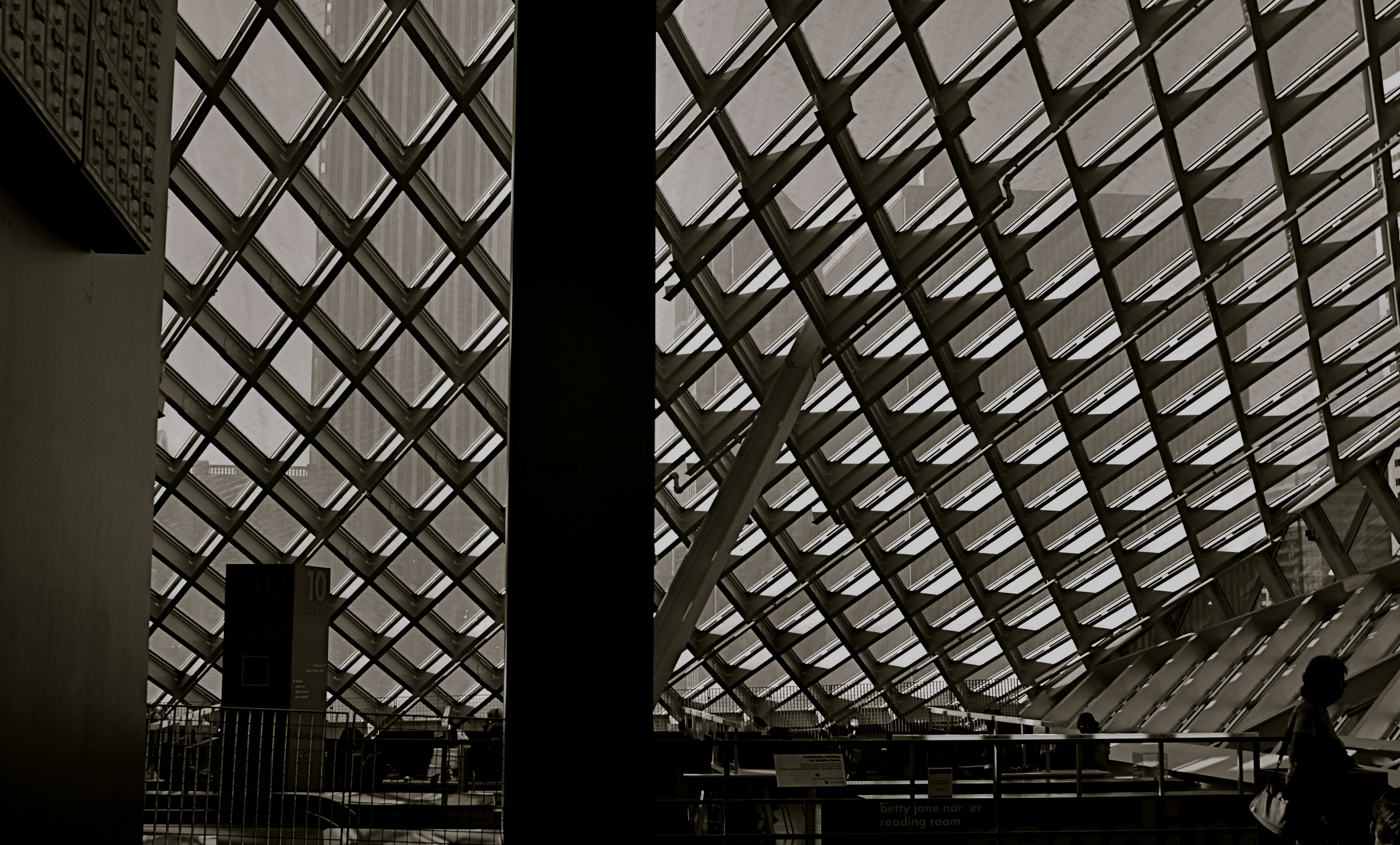
The above image, taken within the solemn sanctum of the 9/11 memorial, may not be many people’s choice for a “Happy 4th” -type picture, for a whole bunch of reasons. And I get that. There’s nothing celebratory about it. No wins, no rousing anthems. No amber waves of grain. That doesn’t mean, however, that it’s inappropriate. It may not rhapsodize about victory, but it does affirm survival. It doesn’t brag about what we have, but it does remind us of how much we stand to lose, if we take it easy, or take our eye off the ball.
The 9/11 site is unique in all the world in that it is battlefield, burial ground, transportation hub, commercial center, and museum all in one, a nexus of conflicting agendas, motives and memories. And while it’s a lot more enjoyable smiling at a snapshot of a kid with a sparkler than making pictures of the most severe tests of our national resilience, photography taken at the locations of our greatest trials are a celebration of sorts. Such pictures demonstrate that it’s the freedom we earn, as well as the freedom we inherit, that’s worth raising a cheer about.
And worth capturing inside a camera.
Share this:
Posted by Michael Perkins | July 3, 2017 | Categories: America, Americana, Commentary, Editorial | Tags: 4th of July, Street photography. composition | 3 Comments