A NEW TAKE ON OPAQUE
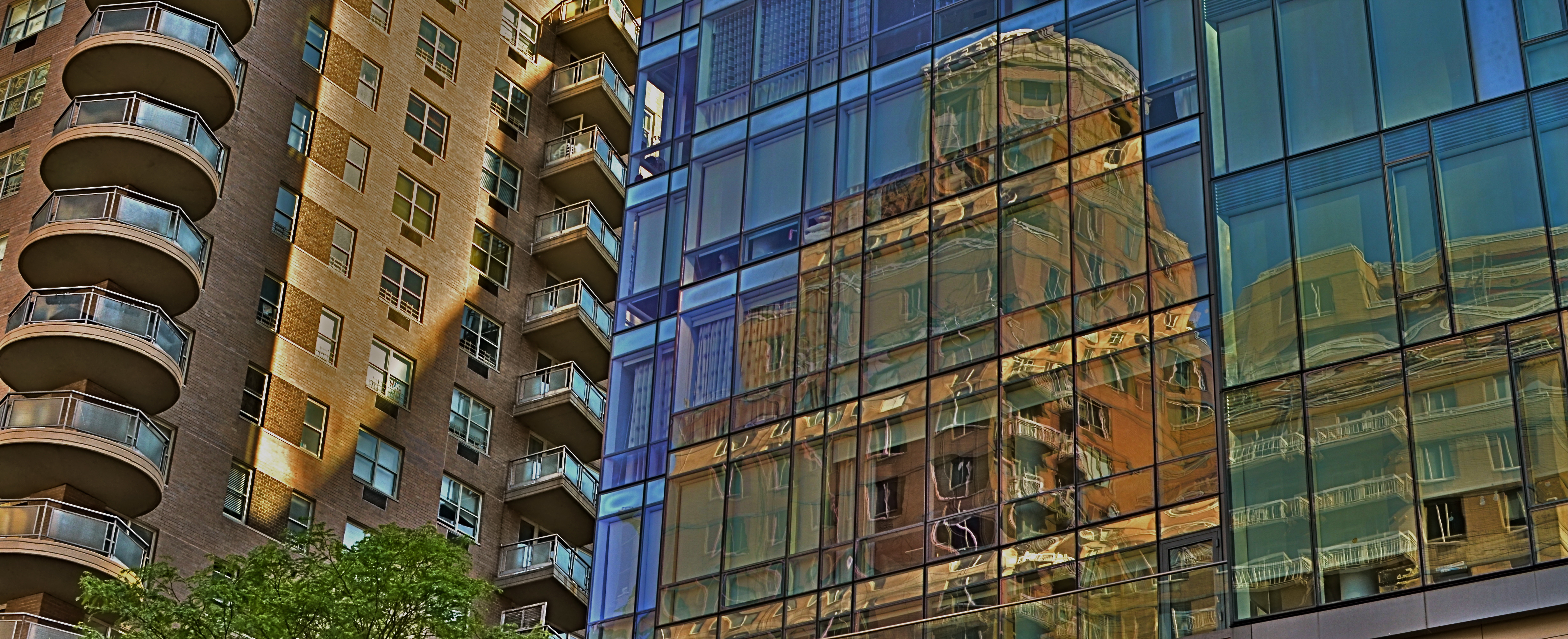
Canyon Echoes (2015). A circular polarizing filter helps the building across the street to be more vividly captured in the glass grids.
By MICHAEL PERKINS
THE TWENTIETH CENTURY’S REVOLUTION IN URBAN ARCHITECTURE produced a radical re-imagining of the physical science of erecting buildings, along with a remarkable shift in what those buildings should look like. An extreme shift in outward design can be tracked from the ornate Greco-Roman and Gothic textures of the Woolworth Building at century’s start to the stark, spare rectilinear boxes of the ’40’s and 50’s, as we jetted from doric columns, oak clusters and gargoyles to the completely un-ornamented glass boxes that we associate with, say, the Pan Am or United Nations buildings at the other end. That changed the way we live, and likewise transformed the way we photo-document our cities.
And, whatever your opinion of what came to be called the “International Style”, the boxes today co-exist with their more decorous ancestors, a contrasting mix which creates amazing opportunities for abstraction. The collision of the two periods creates an endless shuffling of visual cues, with all that glass and terra cotta dueling for dominance in our compositions. And therein lies a tip: one tool which you may find of enduring value in shooting in these situations is a circular polarizing filter, which can help you create a wide variety of effects…quickly, and on the cheap.
People in sun-soaked sectors of the world mostly use the CPL to deepen the blue in overly-bright skies, but the filter’s ability to cut glare on reflective surfaces like water and glass can also be dramatic, and that’s how I use it in urban settings. I’ve come to love the idea of a sheer wall of glass in one building being stamped with all the details of the building directly across the street (over my shoulder). Twisting the upper ring of the CPL dials in the degree of glare you want in your image, allowing you to see none, some, or all of your neighboring structure in the glass in front of you. One caution: the filter also deepens color and can rob you of up to a stop of light, so you want to plan your exposures more carefully, something that’s done easier shooting on full manual.
The dominant idea of design in the International Style was to eschew detail and ornament to as great a degree as possible. That resulted in a lot of very boring exteriors as a vast crop of largely faceless boxes shot off the assembly line. However, using their sheer screens of glass as a vibrant kind of video display for the neighborhoods around them actually breathes a little life into them, and the circular polarizing filter gives you a remarkable amount of control over that process.
RE-OPENING THE LAB
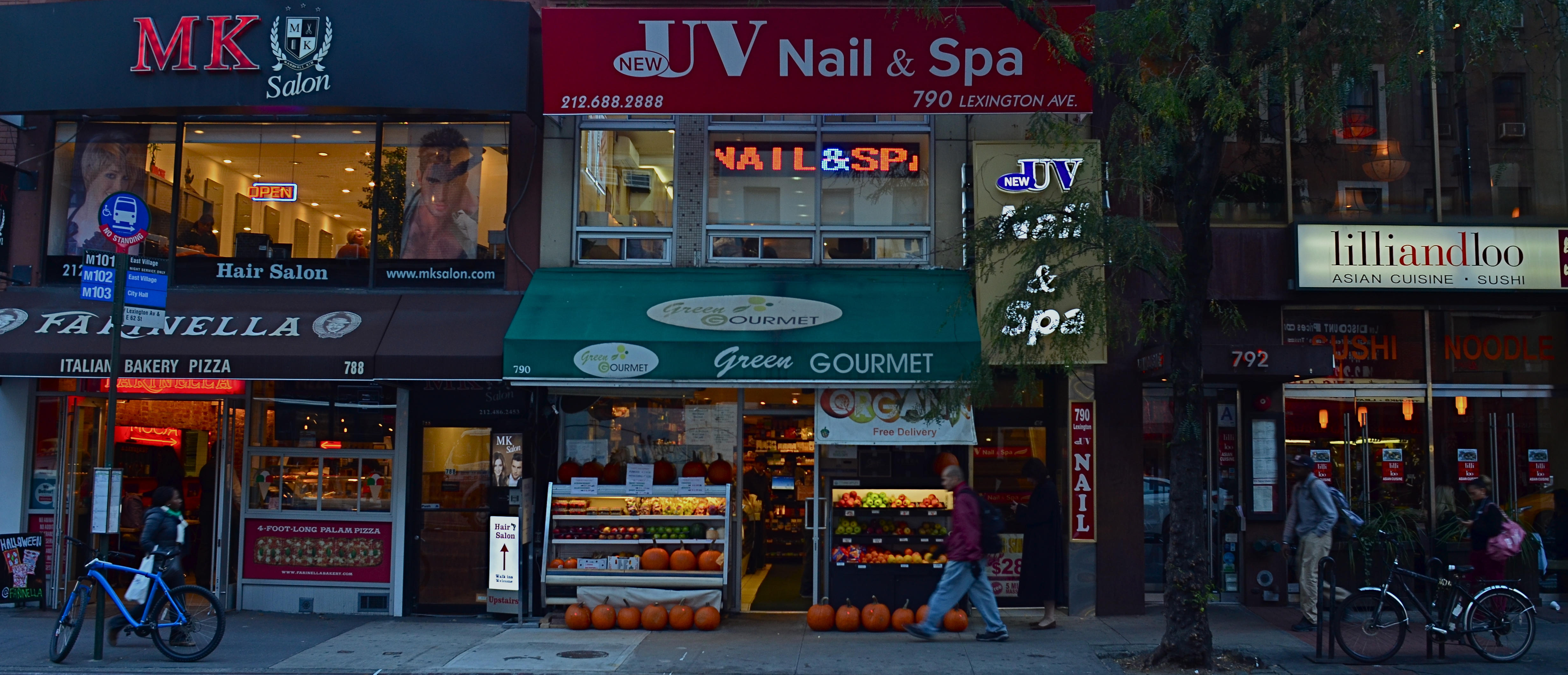
Lovin’ Life On Lex (New York City, 2016)
By MICHAEL PERKINS
PHOTOGRAPHERS WILL ALWAYS BENEFIT FROM SOCIOLOGICAL “PIVOT POINTS“, those unique junctures in time when tectonic plates between eras shift, grind and re-configure. Images, for better or worse, are the way we testify to big changes in our world. They are documents of where one age ends and a new one begins. They illustrate contrasts between then and now.
A change in society is an opportunity for pictures, photos which become obvious, even inevitable, in telling the story of how we evolve. And one of the biggest such changes over the last decade or so has been the re-birthing of the walking neighborhood. Urban cores long given up for dead are being re-vitalized by young people who want close, hands-on engagement with city life.
Whether this shift is a boomerang effect at the end of half a century of suburban flight, an economic remedy to rising housing prices (refurbishing is cheaper than new building), an ingenious way to re-purpose old resources for a greener planet (and get rid of cars), or just a generational restlessness, the old laboratory known as the urban neighborhood is back open for business, with darkened and deserted blocks sprouting new colors, shops, rhythms. Prime picking for photographers, who, first and foremost, go where the stories are.
For me, lateral, wide-angle portraits of businesses is great fun, as I try to channel the “neighborhood in miniature” panels made popular by painter Norman Rockwell during his magazine years. Watching foot traffic flow between laundries and liquor stores, with maybe a pizza joint in between, affords an instant variety of color, signage, reflections, and texture…in other words, lots to work with.
The street is dead. Long live the street.
OF DISTANCES AND DOMAINS
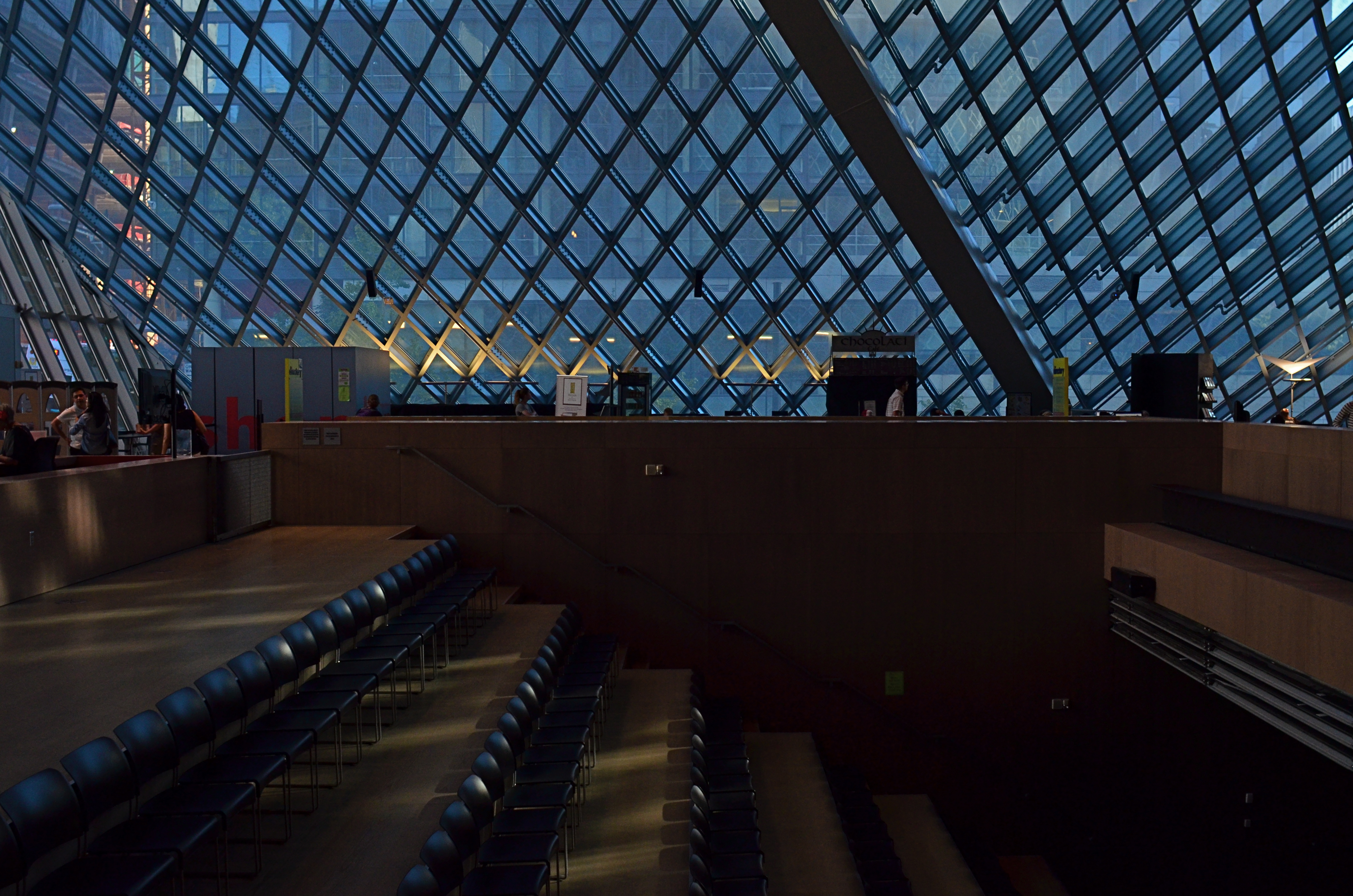
Designed by humans? Certainly. Designed for humans? Well….?
By MICHAEL PERKINS
PHOTOGRAPHY IS AN EFFECTIVE WAY TO MEASURE MAN’S RELATIONSHIP to his physical environment, giving us the distance we need to see these arrangements from a more objective distance. People design places in which other people are to live and work, but once these plans get off the drawing board, it can become unclear what people’s place in the whole puzzle was intended to be.
More to the point, there is real picture-making potential in the occasional mis-match between what we design and how we fit into it. Some things that seem terrific to the people on the planning board seem cold or intimidating to regular users once they’re actually built. Seeing us try to find our place in things that are really inhospitable can be visually interesting because it makes us look and feel somewhat alien. We can become oddly placed props in our own projects, as the places made to house our dreams look more like warehouses for our nightmares.
Of course, one man’s horror is another man’s heaven, a rule that has certainly been constant over the history of innovation. That means, artistically, that we can wind up, inevitably, making images that start arguments, which is, I believe, the perfect function for art anyway. It’s one thing to smear a daub of paint on a canvas and lacerate someone’s vision with it. After all, you can abandon the painting, leave the gallery, etc. But if the building that was meant to be the gallery seems like a bad fit for you as a human being, that’s something else entirely.
The right compositions with the right lenses deliver stark visual messages about how we slot ourselves into the world we’ve created. Sometimes we make a statement for the ages. Sometimes we erect mouse mazes. Either way, there’s a picture in the process.
IT’S ALL YOURS
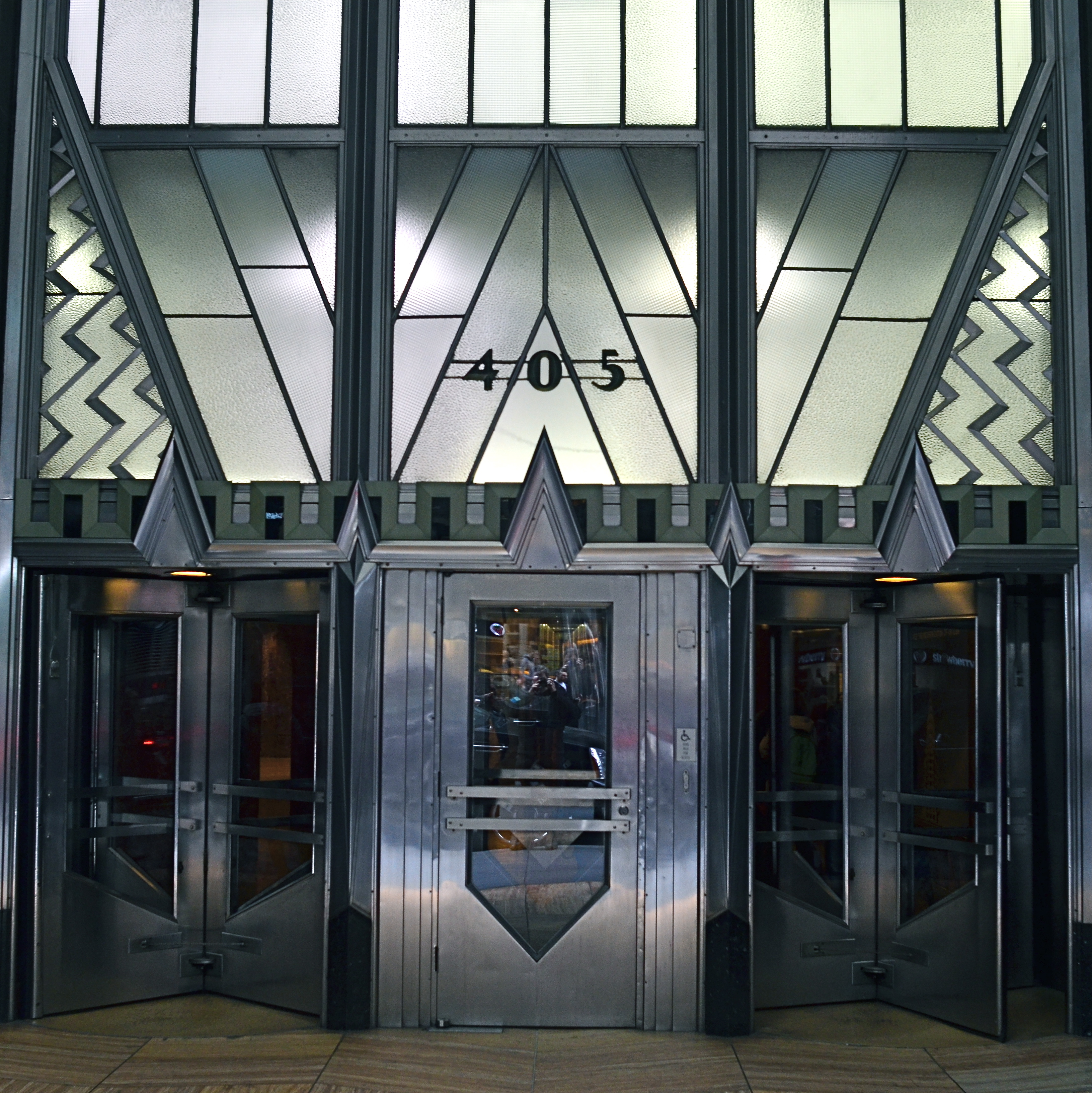
This is not “the” Chrysler Building, but it is “a” Chrysler Building.
By MICHAEL PERKINS
MANY OF THE MOST VALUED ARTIFACTS OF ANCIENT TIMES might not be considered so magnificent if they were not also so rare. The shards of pots found within the burial chambers of the Pharoahs seem remarkable because they are some of the only things that survive the age of their owners. However, were there hundreds, thousands of such sites around the world, these broken bits of pottery might be of less value than the discarded cigarette butts that litter the world’s highways.
Hey, isn’t this blog supposed to be about photography? Well, yeah, give me a little room here.
Photographs are thought to be documents, that is, a literal recording of reality. In fact, almost all of them are interpretations of reality, one person’s individual take on what’s “real”. In the beginning of the medium, pictures were more purely documentary, in that very few people took very few pictures of things unlikely to be photographed by anyone else before they vanished. It would be great to see dozens of different shooters’ interpretation of the battlefield of the Civil War, but, since the medium was not generally in use in the 1860’s, the work of Matthew Brady and his team of field photographers serves as our only record….in fact, as a document.
In the modern day, it is virtually impossible for your photograph of, say, the Empire State Building to be a “document”, since it will never, ever serve as the official or historical record of that structure. Once everyone’s picture is a document, then nobody’s is. You can interpret the building to endless variation, but you have to avoid thinking of the resulting images as “real”, since your own sense of that state defines how you make the picture. The edifice may be public property, but the vision is all yours.
Which brings us back to the Egyptians. Show a chamber filled with burial booty to a 21st-century archaeologist and he’ll exclaim, “let us carefully preserve this living record!”. Show the same room to the average Tut-era housewife and she might say, “get me a broom so I can clear all this junk out of here.” Photographs are your view of “reality”. Only when yours is the only eye on something vanished can it be documentary. Saying that a picture is great because it “looks realistic” is our way of admiring the photographer’s interpretation. That is, we agree with it. But images are more “istic” than they are “real”.
INVISIBLE CITIES
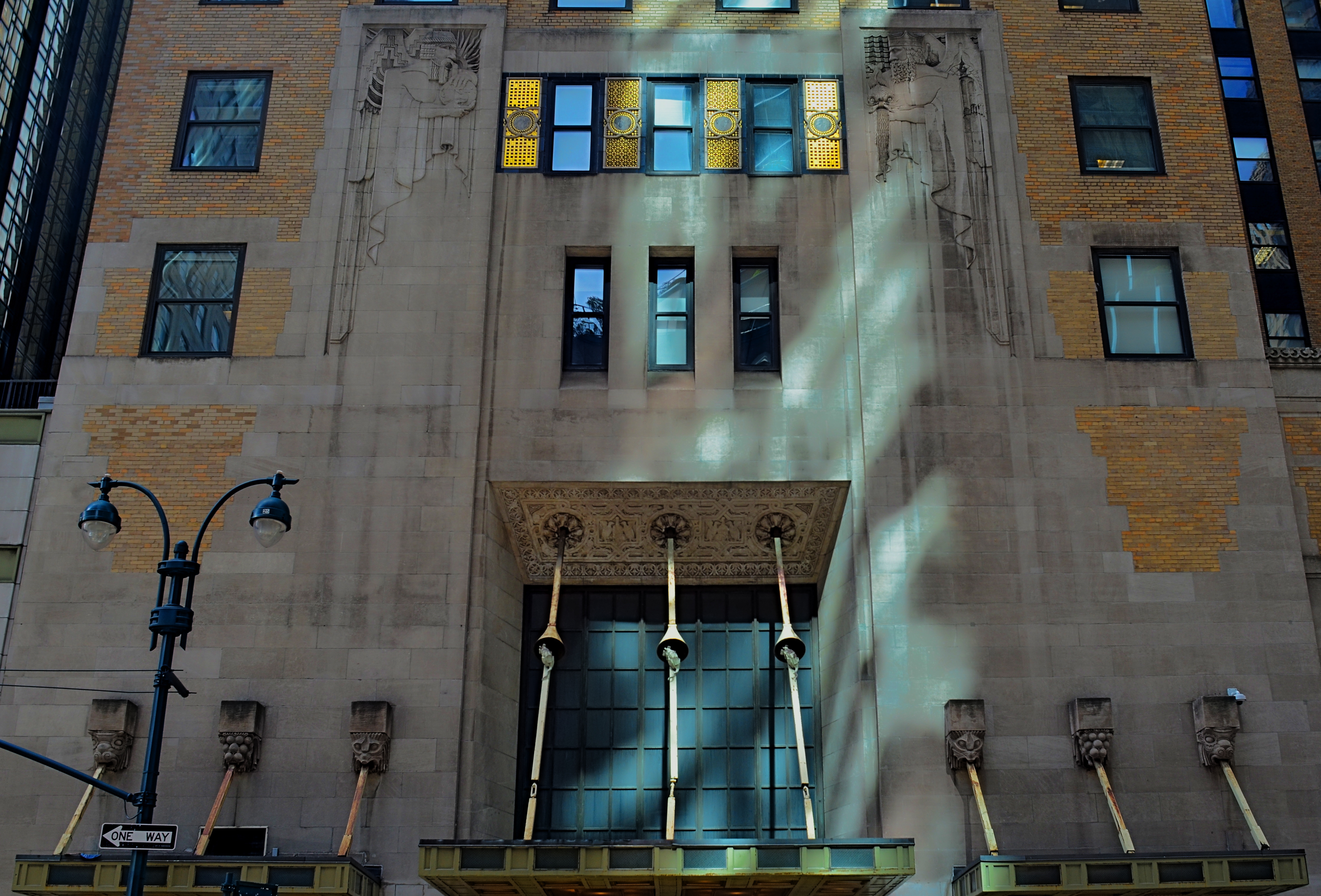
New York is one of the great treasure troves for lovers of Art Deco. This complex, along Lexington Avenue, is literally in the shadow of the Chrysler building.
By MICHAEL PERKINS
THERE IS, IN THE WORLD OF SPORTS, A PSYCHOLOGICAL EDGE known as the “home field advantage”, wherein a team can turn a superior knowledge of its native turf against its visiting opponent. The accuracy of this belief has never been conclusively proven, but it’s interesting to think on whether it applies to photography as well. Do we, for the purposes of making pictures, know our own local bailiwicks better than visitors ever can? Or is it, as I suspect, the dead opposite?
Familiarity may not breed contempt, but, when it comes to our seeing everything in our native surroundings with an artistic eye, it can breed a kind of invisibility, a failing to see something that has long since receded into the back part of our attention, and thus stops registering as something to see anew, or with fresh interpretation. How many buildings on the street we take into the office are still standouts in our mind’s eye? How many objects would we be amazed to learn are actually part of our walk home, and yet “unseen” by us as we mentally drift along that drab journey?
It may be that there is actually a decided “out-of-towner” advantage in visiting a place where you have no pre-conceptions or habitual routes, in approaching things and places in cities as totally new, free of prior associations. I’ve often been asked of an image, “where did you take that?” only to inform the questioner that the building in the picture is a half block from their place of business. The above image was taken on Lexington Avenue in Manhattan, not more than a half block and across the street from the Chrysler building. It is a gorgeous treasure of design cues every bit as symbolic of the golden age of Art Deco as its aluminum clad neighbor, and yet I could hold a contest amongst many New Yorkers as to where or what it is and never have to award the prize money. The Chrysler’s very fame eclipses its neighbors, rendering them less visible.
Perception is at the heart of every visual art, and the most difficult things to re-imagine are the ones which have ceased to strike us as special. And since everyone lives in a city that is at least partly invisible to them, it stands to reason that an outside eye can make its own “something new” out of everyone else’s “something old”. Realize and celebrate your special power as a photographic outlier.
THIS MUST BE / MIGHT BE THE PLACE
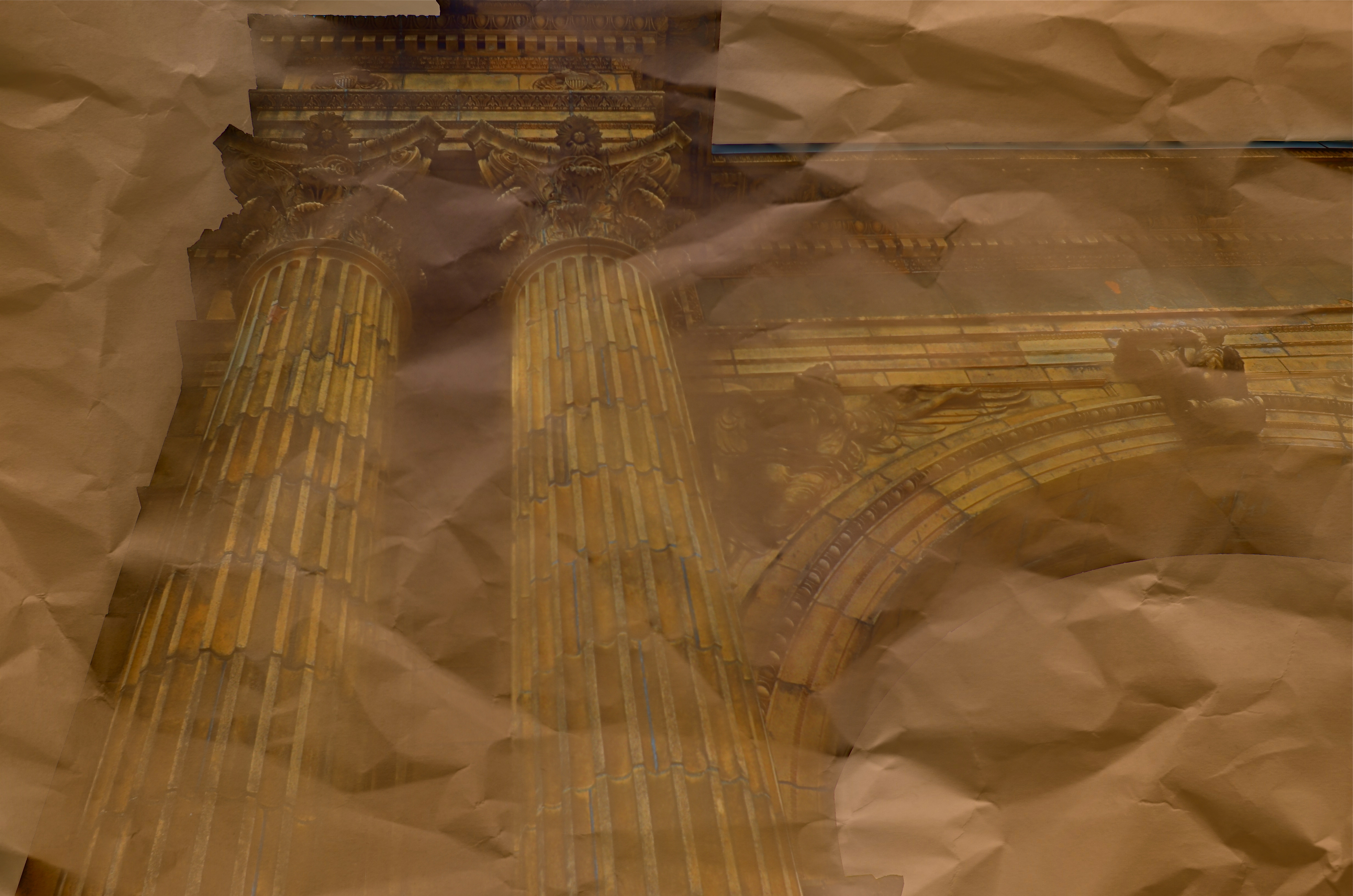
Dream Parchment, 2016.
By MICHAEL PERKINS
URBAN PHOTOGRAPHERS ACT IN MUCH THE SAME WAY AS ARCHAEOLOGISTS in that they must try to supply context for objects, backstories that have been either altered or erased. Cities are collections of things created by humans for specific motives, be it profit, shelter, play, or worship. Often, the visual headstones of these dreams, that is, the buildings, survive beyond the people that called them into being. Photographers have to imply the part of the story that’s crumbled to dust. Like the archaeologist, we try to look at shards and imagine vases, or see an entire temple in a chunk of wall.
During the dreaded “urban renewal” period in the mid-twentieth century, my home town of Columbus, Ohio duplicated the destruction seen in cities across the country in the wanton devastation of neighborhoods, landmarks and linkages in the name of Progress. Today’s urban planners thumb sadly through vast volumes of ill-considered “improvements” wrought upon history from that period, with New York’s Penn Station, Pittsburgh’s Forbes Field, and Columbus’ Union Station surviving today only as misty symbols of fashion gone amok.
In the case of Columbus’ grand old railroad station, there is at least a fragment of the original structure, its beaux-arts entry arch, left standing, serving as either stately souvenir or cautionary tale, depending on your viewpoint. The arch has been moved several times since the demolition of its matching complex, and presently graces the city’s humming new hockey and entertainment district, itself a wondrous blend of new and repurposed architecture. Better late than never.
Thus, the Union arch has, by default, become one of the most photographed objects in town, giving new generations of artists permission to widely interpret it, freed, as it is, of its original context. Amateur archaeologists all, they show it as not only what it is, but also what it was and might have been. It has become abstracted to the point where anyone can project anything onto it, adding their own spin to something whose original purpose has been obliterated by time.
I have taken a few runs at the subject myself over the years, and find that partial views work better than views of the entire arch, which is crowded in with plenty of apartment buildings, parklands and foot traffic, making a straight-on photo of the structure busy and mundane. For the above image, I imagined that I had recovered just an old image of the arch….on a piece of ancient parchment, a map, perhaps an original artist’s rendering. I shot straight up on a cloudy day, rendering the sky empty and white. Then I provided a faux texture to it by taking separate a sepia-toned photo of a crumpled piece of copier paper and fusing the two exposures (the HDR software Photomatix’ “exposure fusion” feature does this easily). Letting the detail of the arch image bleed randomly through the crumpled paper picture created a reasonable illusion of a lost document, and I could easily tweak the blend back and forth until I liked the overall effect.
Cities are treasure hunts for photographers, but not everything we find has to be photographed at, let’s say, face value. Reality, like fantasy, sometimes benefits from a little push.
DESIGN FOR LIVING
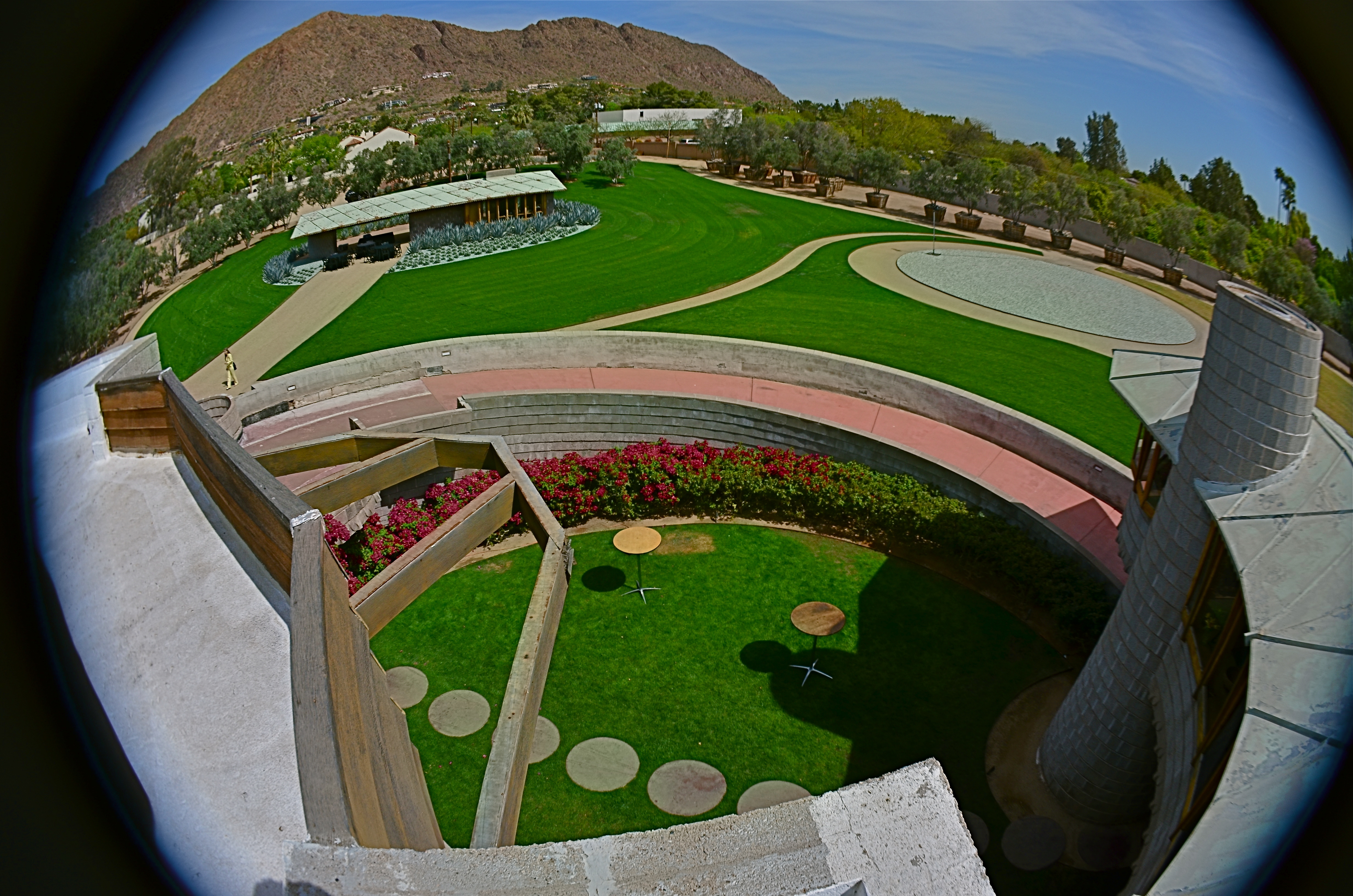
A view into the courtyard of the David Wright House, Frank Lloyd Wright’s gift to his son, built in Phoenix, Arizona in 1950 and now being prepped for complete restoration. The detached guest house and Camelback Mountain are in the distance.
By MICHAEL PERKINS
HIDDEN IN PLAIN SIGHT IT WAS, the final residential design completed by the late Frank Lloyd Wright, mysteriously unsung in every major study of his late work and absent from nearly every retrospective on the cantankerous colossus of twentieth-century architecture. The house, designed for his son David in the Arcadia neighborhood of central Phoenix, Arizona, rose from the desert in 1950 and almost immediately faded from popular view, staying under the radar less than a mile from Camelback Mountain, the sight of which dictated the site of the home, in one of Wright’s most dramatic examples of organic architecture.
And now, just a few years after since daughter-in-law Gladys Wright’s death at the age of 104 and a blink of time since an interim owner first threatened the place with demolition, it is, in 2016, about to sink back from view once more, as the benevolent millionaire who saved it confers with various local factions on the best route to its complete restoration. Tours, which, for the past year have allowed visitors from around the world to walk through what Wright called a solar hemicycle design, his recipe for “how to live in the southwest”, will be suspended. 3-D laser scans will be studied to see where the house’s sixty-five year old foundations need to be fortified and repaired. And, for a time, this remarkably unique dwelling will again be beyond the reach of the camera.
Since The Normal Eye began, we have occasionally mounted photo essay pages featuring singular places, sites too special to be addressed in one or two images. The most recent of these was a tour of author Edith Wharton’s home, The Mount, in Massachusetts. And today, we’ve added a new tab at the top of the blog titled Wright Thinking, with select photos of the David Wright home and its detached guest house, in an attempt to remind people that this hidden treasure does, indeed, survive in the American West.
The essay format seem appropriate because the Wright home is difficult house to convey in just a single photograph, rising from the desert floor in a continuous circular ramp that climbs to the house proper, a 2000 square-foot crescent of rooms mounted on concrete piers and looking north to Camelback Mountain with a window array that presents a view arc of over 200 degrees. Within and without are Wright’s signature components: dramatic furniture design; innovative use of humble materials, from linoleum to concrete; a visionary use of solar energy; and the most Wright of Wright ideas, the organic credo that the site comes first, the house second, and never the other way around.
So thumb through our impromptu Wright family album and visit the house’s wonderful website at www.davidwrighthouse.org to keep apprised of the next sighting of one of the master’s final bows.
A TRICK OF THE LIGHT
By MICHAEL PERKINS
PHOTOGRAPHERS WHO TRACK THE SUN AS IT TRAVELS EAST TO WEST over the vast expanse of the Grand Canyon have made amazing images of the way light changes contours, shadows, even the sensation of depth and scale over the course of a single day. Such hour-by-hour portfolios present pictures which are less about the subject matter and more about how light shapes that subject. And the same tracking exercise is possible in canyons of another sort, the vertical jungles we call cities.
Buildings in urban settings reveal more in pictures than their own particular physical shapes and designs: they also have visual artifacts tattooed onto them from their neighbors, which block, warp and reflect light patterns in their direction. Thus the most architecturally drab tower can become hypnotic when bathed in patterns of shadows shaped by the tower next door. And that means that those seeking abstract images may find that ordinary parts of the city can be rendered extraordinary by light’s odd bounces. Additionally, the fact that many of these light effects are fleeting, visible, in some cases, only for minutes each day, presents both a challenge and an adventure for the photographer.
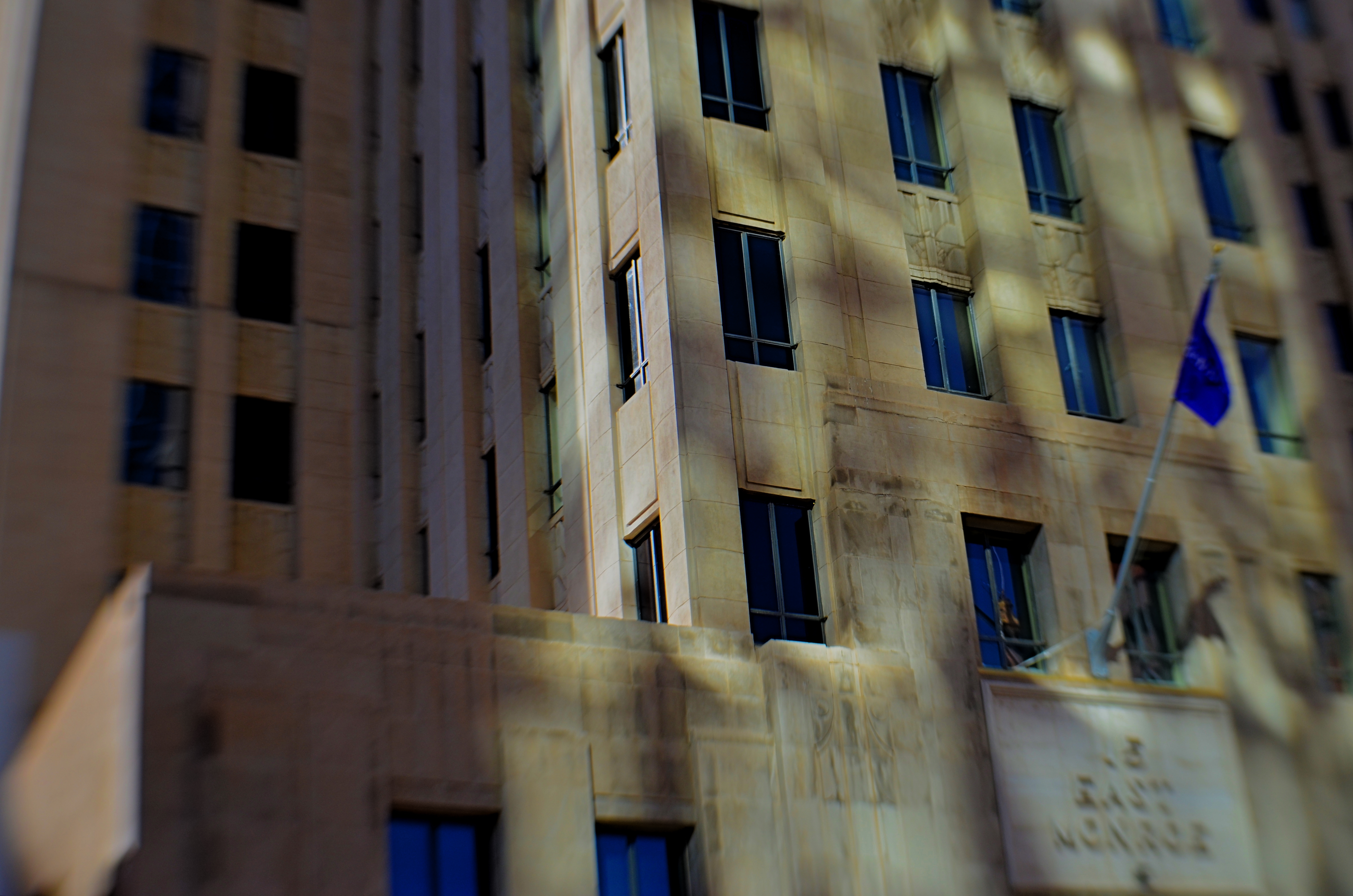
Fifteen East Monroe, 2016.
In the shot above, a gorgeous Art Deco building in downtown Phoenix, Arizona benefits from a light effect that has only been possible for the last forty years of its existence. Erected in the late 1930’s, the northern face of 15 East Monroe Street would not, at its opening, have been dappled with the shadow patterns seen here. No, it took a soul-less glass box from the ’70’s, located across the street, to bounce patterns of reflected light onto the building as you see it here, and only for about two hours a day between late morning and noon.
During that window, 15 East Monroe displays a wonderfully checkered mix of reflected illumination on its golden terra-cotta exterior. I first observed the patterns ten years ago, and have been going back for occasional looks ever since. The trick, in this image, was to keep the texture of the building from looking too sharp, since the effect itself is somewhat dreamy, and works better if the overall photo of the building is also a little soft. I used a selective focus lens (sharp at the middle, softer toward the edges) to give the overall building a gauzy look, and let the picture really be about the light effect, rather than any specific part of the building. Even at this point, I am imagining about a half-dozen other ways to accomplish this, but this image can at least serve as an initial study, a guideline for what may, eventually, be my final word on the subject.
Photography, clinically defined, is the art of writing with light. Sometimes, regardless of the object in our viewfinder, what light does to things is, by itself, enough for an interesting picture. It takes some restraint to let the light be the subject, and to let the picture, in its most basic form, breathe.
A NEW PATH
A dream of life comes to me. Come on up for the rising tonight—-Bruce Springsteen
By MICHAEL PERKINS
THE POST 9/11 RESURRECTION OF LOWER MANHATTAN might have begun as a kind of act of defiance, a refusal to knuckle under to fear in the aftermath of the largest attack in history on American soil. Somewhere amidst the tears and rage, however, the project to re-establish this crucial corner of New York City moved onto a higher plane, transitioning from anger to elegance, mourning to…morning. And now, for both casual travelers and astounded visitors, the master plan for the area is an ever-blooming monument to faith. To excellence.
Photographers from around the world have known, from the days of the first cleanups, that an amazing opportunity for historic documentation was unfolding on this hallowed ground, and their images have provided an invaluable service in tracking the city’s transition between two distinct eras. The first two mile-markers in this transformation, the openings of World Trade Center One and the 9/11 Memorial Museum, have been interpreted in a global cascade of visual impressions, occurring, as they have, in the first explosion of social media and digital imaging. And now, the third piece of the puzzle, the stunning new Oculus PATH terminal, is nearly ready to serve as the proof that the city, along with all its millions of comings and goings, is still very much open for business.
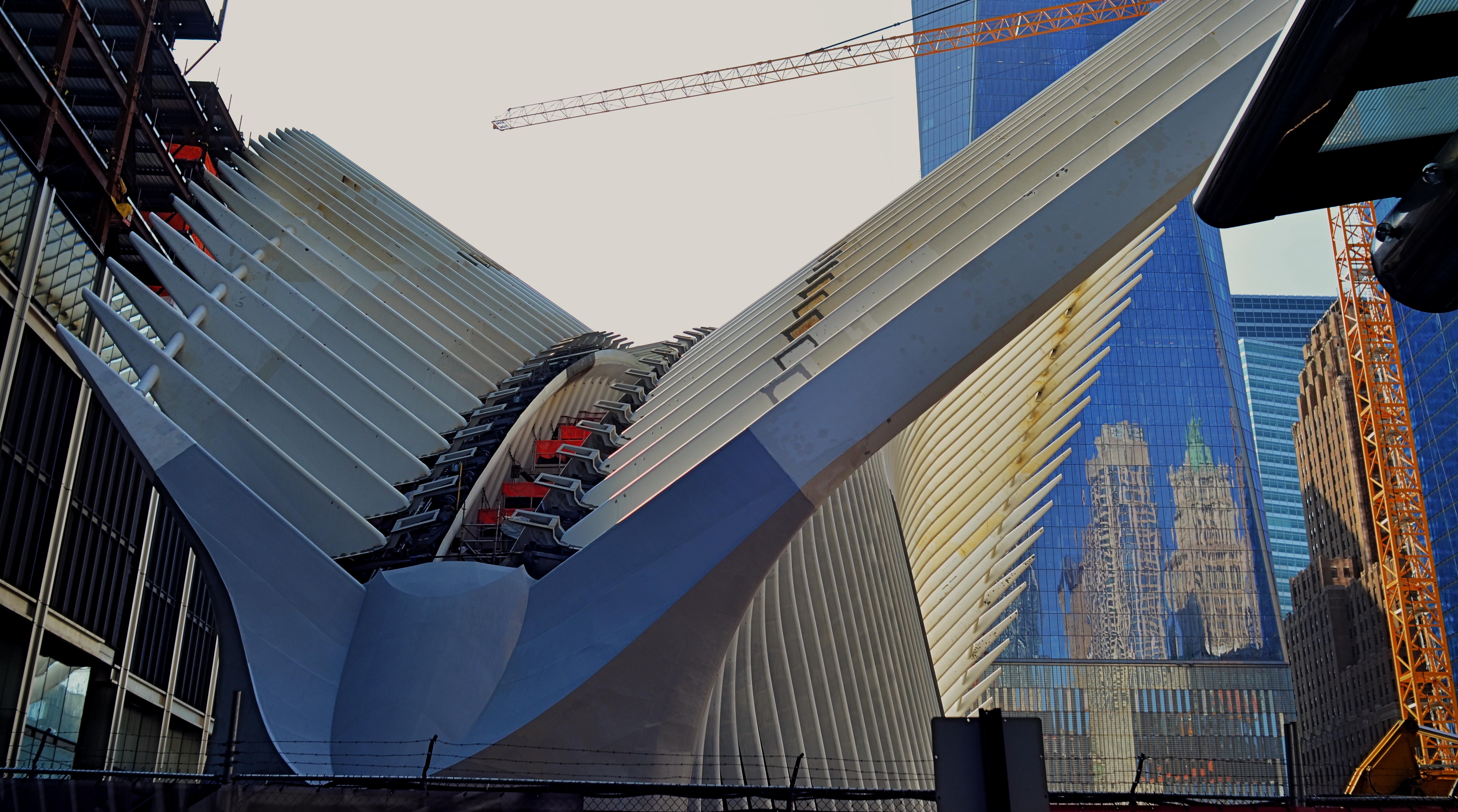
Oculus Aloft: the steel wings of the new PATH terminal for New York’s World Trade Center, nearing completion in 2015.
Photographers have already made a visit to Oculus something of a pilgrimage, and, looking over the first few photos to emerge from their visits, it might be closer, architecturally, to a religious experience. Designed by Santiago Calatrava, the structure, presenting its ribbed wings to the skies like an abstract bird of prey, resembles, within, a kind of sci-fi cathedral of kaleidoscopic light effects, serving as both monument and utility. An inventory of its features and a gallery of interior images can be seen here.
And, of course, this is New York, so opinion on the Oculus’ value, from poetic prayers to crass carping, will go through the usual grappling match. But, whatever one’s eventual take on the project, its power as a statement….of survival, of power, of hope, and, yes, of defiance, cannot be denied. To date, I’ve only been able to photograph limited parts of the construction phase (see above), but I will be back after the baby’s born. And my dreams will collide with Oculus’ own, and something magical will happen inside a box.
Make your way to Manhattan, and let your own camera weigh in on the new arrival.
Come On Up For The Rising.
FACE TIME
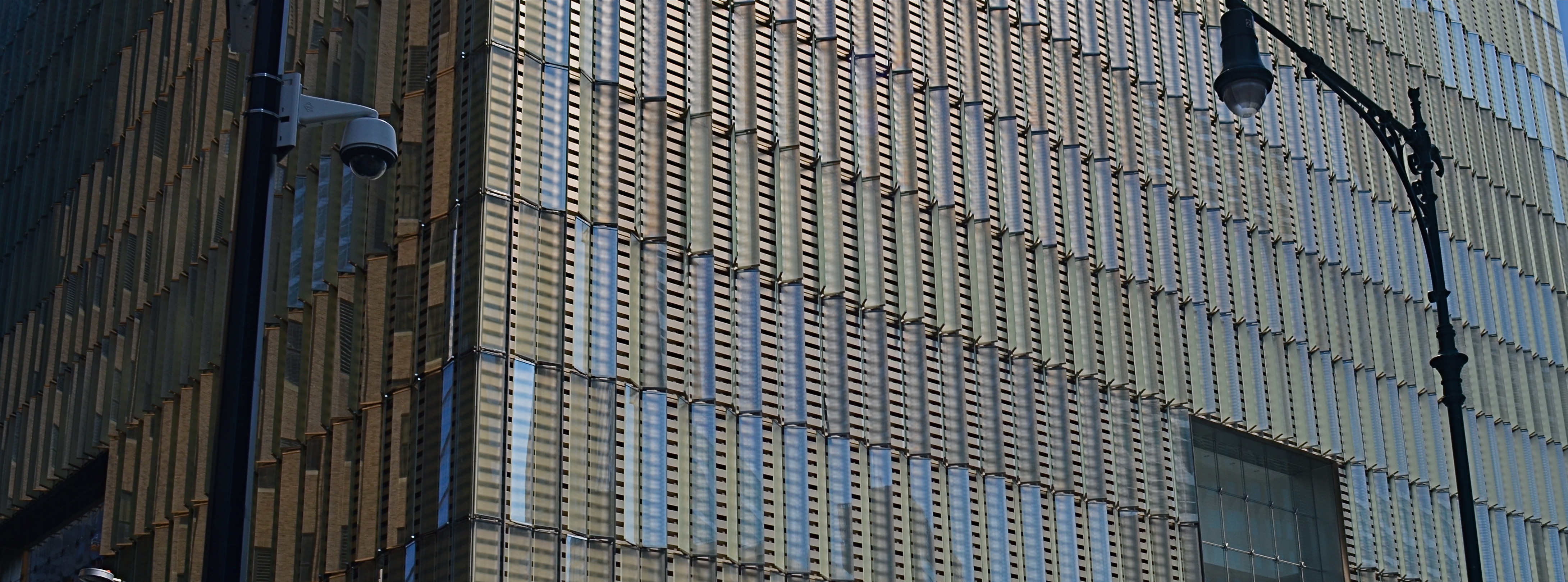
The resurrected World Trade Center, as seen at eye (rather than “craning neck”) level. 1/125 sec., f/5.6, ISO 100, 24mm.
By MICHAEL PERKINS
I AM OFTEN ASKED WHY ARCHITECTURE FIGURES SO STRONGLY in my photography, and I can only really put part of my answer into words. That’s what the pictures are for. I imagine that the question itself is an expression of a kind of disappointment that my work doesn’t focus as much on faces, as if the best kind of pictures are “people pictures”, with every other imaging category trailing far behind. But I reject that notion, and contend that, in studying buildings, I am also studying the people who make them.
Buildings can be read just as easily as a smile or a frown. Some of them are grimaces. Some of them are grins. Some of them show weary resignation, despair, joy. Architecture is, after all, the work of the human hand and heart, a creative interpretation of space. To make a statement? To answer a need? The furrowed brows of older towers gives way to the sunny snicker of newborn skyscrapers. And all of it is readable.
In photography, we are revealing a story, a viewpoint, or an origin in everything we point at. Some buildings, as in the case of the first newly rebuilt World Trade Center (seen above), are so famous that it’s a struggle to see any new stories in them, as the most familiar narratives blot the others out of view. Others spend their entire lives in obscurity, so any image of them is a surprise. And always, there are the background issues. Who made it? What was meant for it, or by it? What world gave birth to this idea, these designs, those aims?
Photography is about both revelation and concealment. Buildings, as one of the only things we leave behind to mark our having passed this way, are testaments. Read their faces. No less than a birthday snapshot, theirs is a human interest story.
THE LAST OF MANY GOODBYES
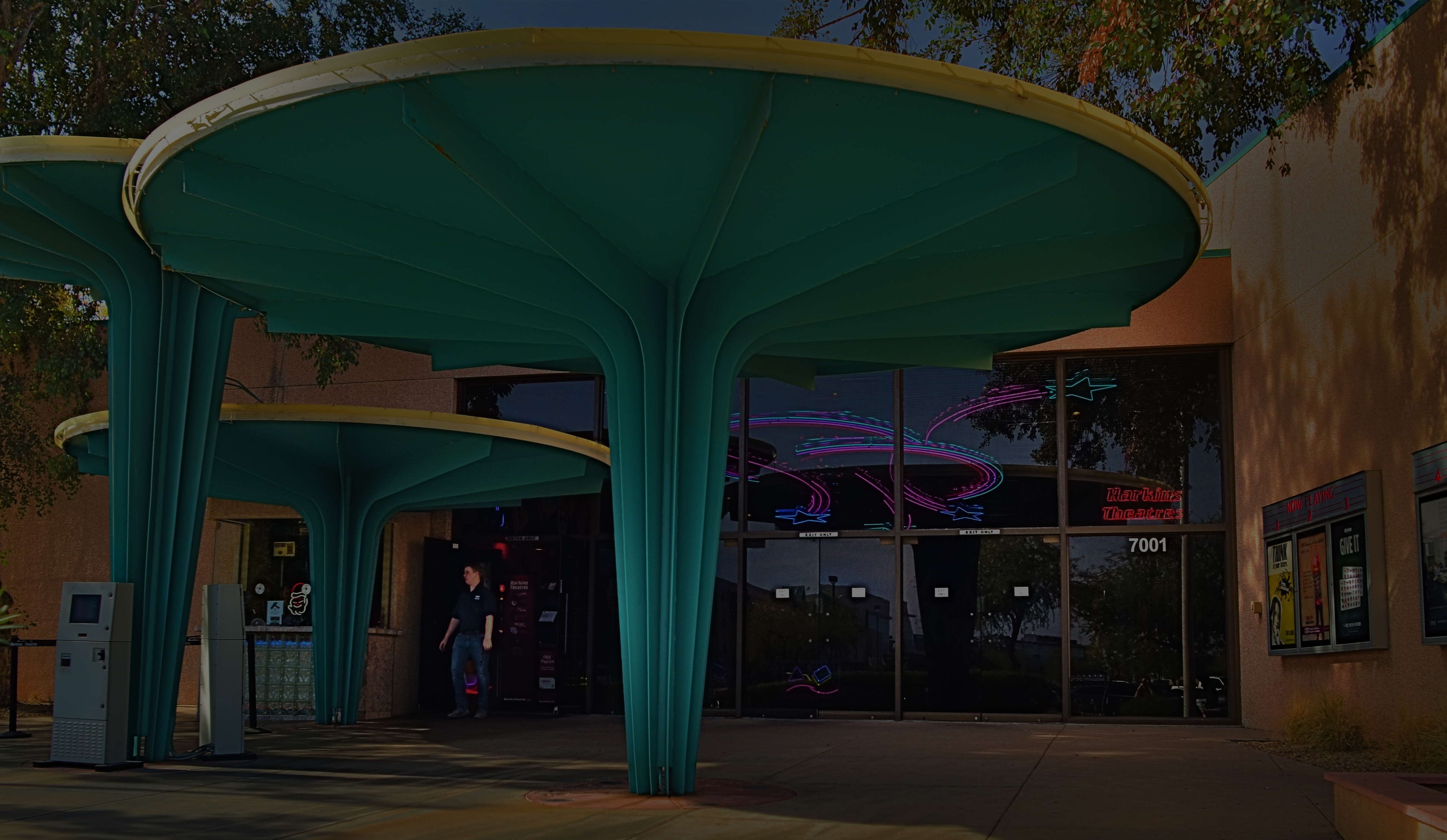
Scottsdale, Arizona’s gorgeous little art-house complex, the Camelview Theatre, on the afternoon of its final day, December 10, 2015.
By MICHAEL PERKINS
ON THE SPOCK SIDE OF OUR BRAINS, OF COURSE WE KNOW that there is nothing particularly magical about buildings per se. Stone and steel cannot, after all, generate memory or experience; they merely house the people who do. Still and all, the loss of certain edifices engenders a purely emotional response in us, perhaps because special things can no longer happen there, and the physical proof that any of it happened at all is being rendered, at least physically, into dust. That puts us in the realm of dreams, and that’s where great photographs are born.
When a place that is special to us is about to wink out of existence, everyone who used that place stamps it with their own stories. We went to school here. This is where I proposed to your mother. The bandstand was here, along this wall. So personal a process is this that our farewell photographs of these places can take on as many different flavors as the number of people who walked their halls. And, as a result, it’s often interesting to compare the final snaps of important places as filtered through the disparate experiences of all who come to reflect, and click, in the shadow of the wrecking ball.
I have attended many an opening at theatres, but I always make a point to attend their closings. Not the end of a certain film or engagement, but the final curtain on the theatres themselves. How best to see their final acts? As a quiet, gentle sunsetting, as with the above image of Scottsdale, Arizona’s Camelview theatre, shuttering in deference to a bigger, newer version of itself at the end of 2015? Or, in the colorful confusion of the venue’s final night, with crowds of well-wishers, local dignitaries and well-wishers crowding into the final screening?
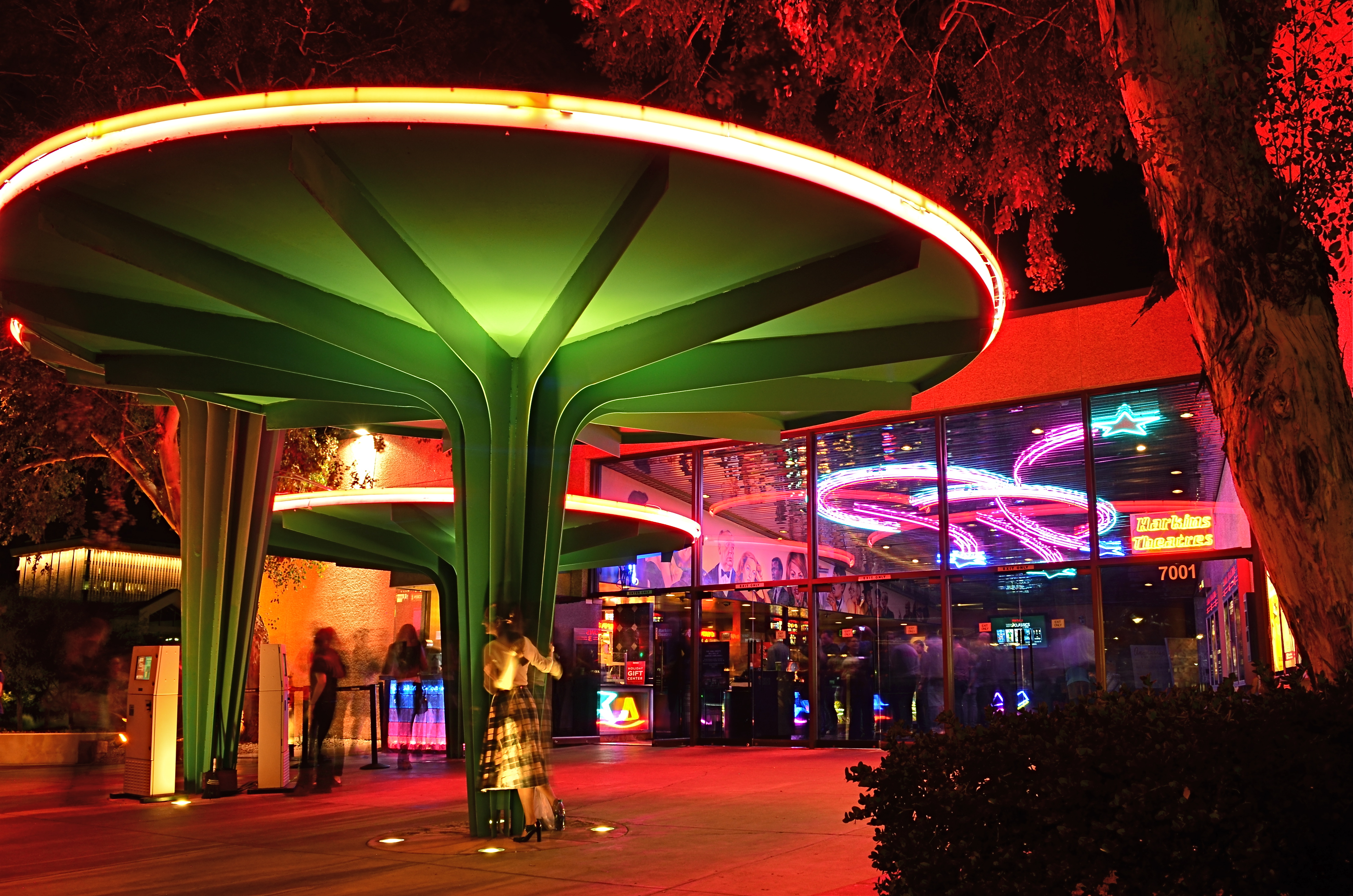
Later that same day: the Camelview’s last neon-lit night of glamour.
Each view projects my own feelings onto the resulting images, whether it be a golden dusk or a frenetic, neon-drenched, tomorrow-we-die send-off, complete with champagne and cheers. The introspective daytime shot has no teeming crowds or fanfare. The night, with its ghostly guest blurs (a result of the longer exposure) features people who are as fleeting as the theatre’s own finite run. Both are real, and neither is real. But they are both mine.
Buildings vanish. Styles change. Neighborhoods evolve. And photographic goodbyes to all these processes are never as simple as a one-size-fits-all souvenir snap. People, and memories, are too customized for that. As with movies themselves, there is always more than one way to get to the final fadeout.
LOOKING FOR AN OPENING
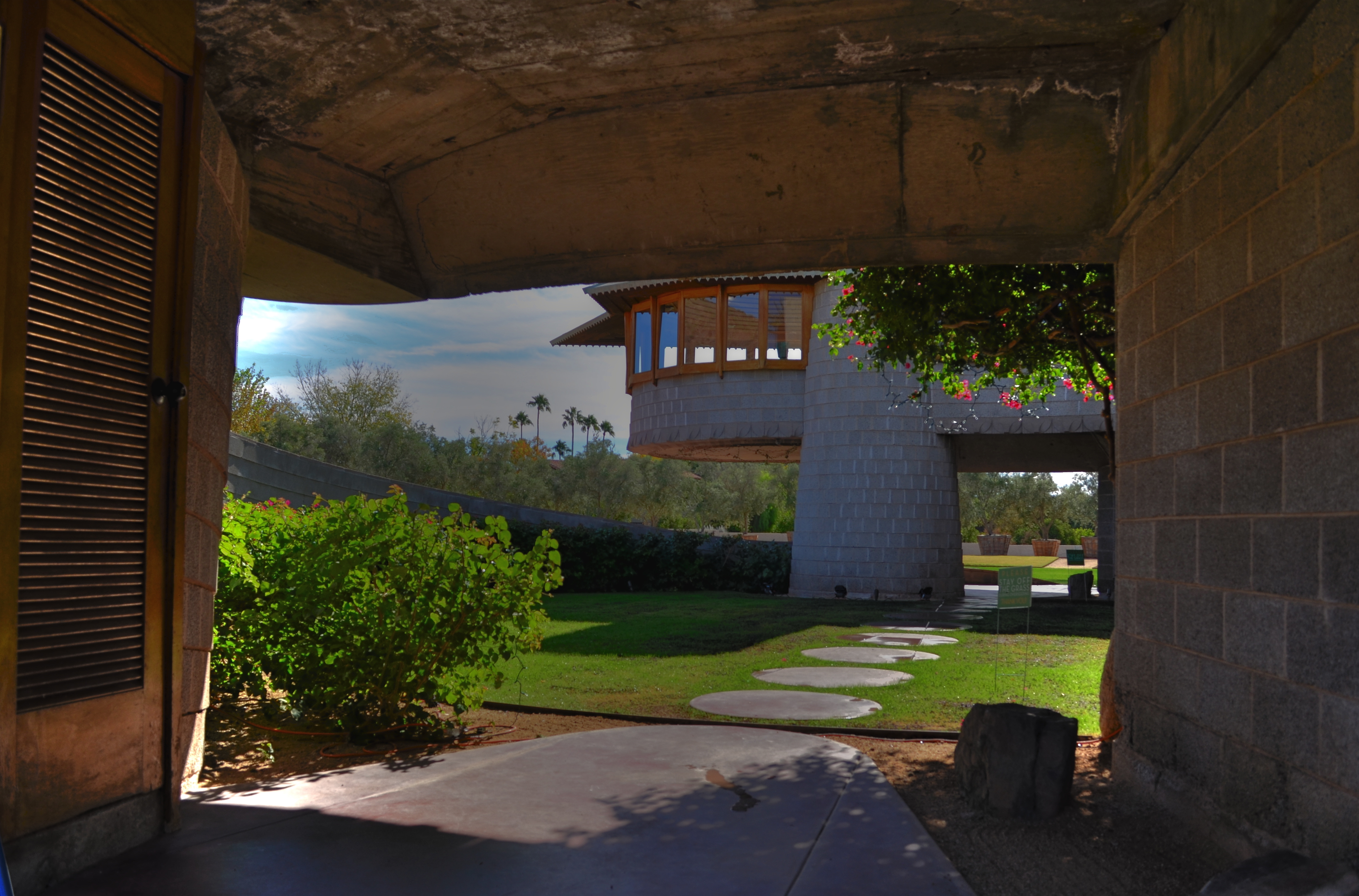
Entering a Frank Lloyd Wright home is like unwrapping a birthday present. The concrete walk ends in a circular ramp that rises to the left and around the David Wright house to create this wonderful open space.
By MICHAEL PERKINS
IF A HOME CAN BE SAID TO BE AN EVENT, then a door is the engraved invitation that bids you to witness that event. When you think about it, a door is the most crucial part of a house’s design, certainly its most deliberately provocative. It advertises and defines what lies within. It’s a grand tease to a mystery, the last barrier before you invade someone’s most personal space. It’s no wonder that entrances to places are among the most photographed objects on the planet. The subject is as inexhaustibly varied as the people who construct these lovely masks.
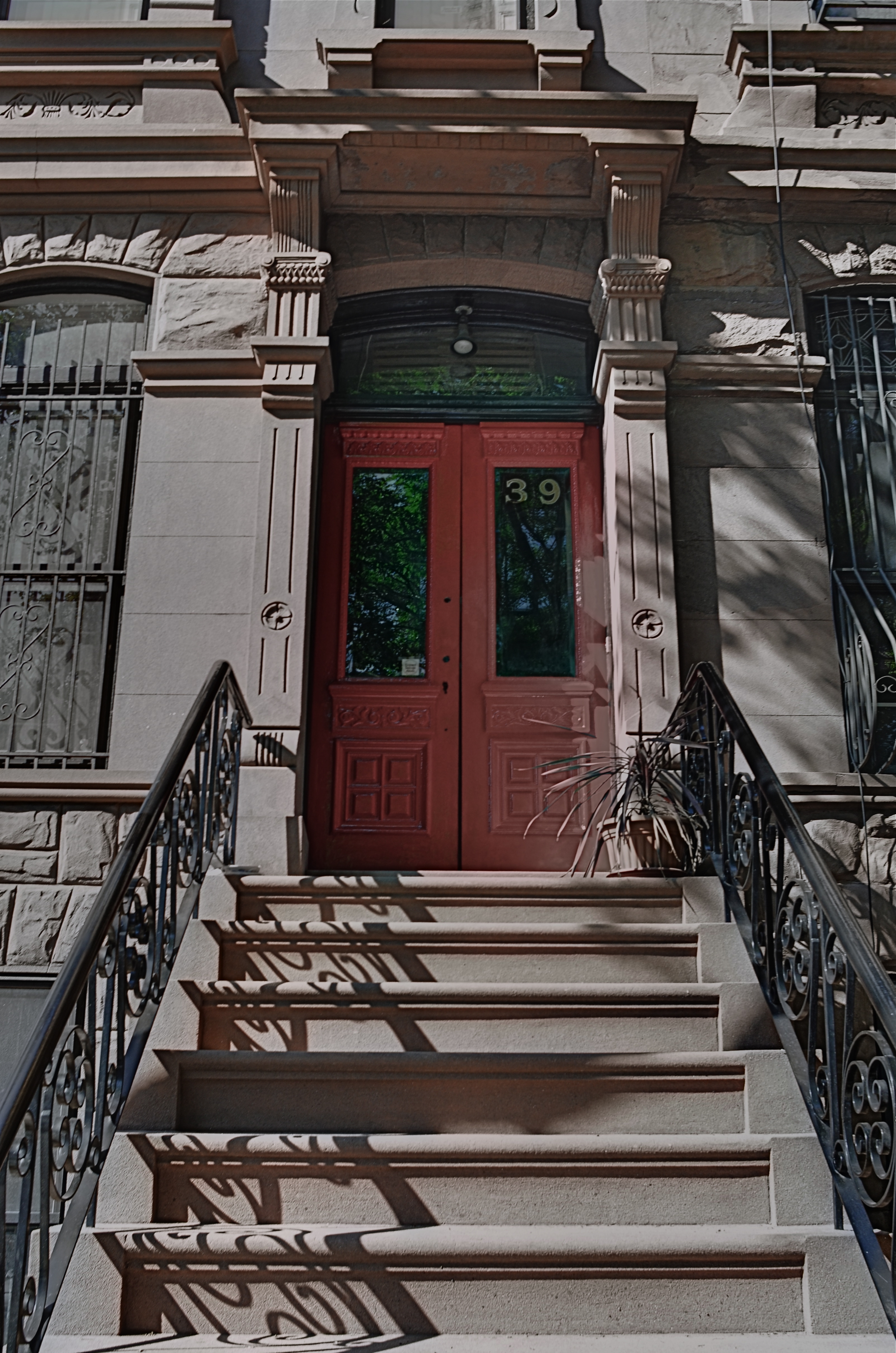
Doors are the first story tellers in a house.
Frank Lloyd Wright did more than create drama as you entered one of his houses; he actually enlisted you in generating your own wonder. Often the great man made you a little squirmy as you prepared to come inside, compressing door heights and widths to slightly uncomfortable dimensions. Pausing for a moment, you could almost feel like Alice after she ate the wrong cake, as if you might never be able to wriggle through the door frame.
Shortly after this ordeal, however, Wright would let the full dimensions of the inner house open suddenly and dramatically, as he does in the image above, taken at the home that he designed for his son David in Phoenix, Arizona. After ducking your head, you step into a court that has…no ceiling…since it ends in a ramp that both climbs around and supports a house that encircles you, creating an intimate courtyard that is both confined and limitless.
Doors make statements, almost boasts, about the wonder that lies just inches beyond them, and, like all generators of mystery, they are often most interesting when the question is never answered. Doors we never see beyond are often the most intriguing, like a woman behind a veil. When I invade a new neighborhood, my camera’s eye goes to doors before anything else. Sometimes the spaces they conceal don’t live up to the hype, but doors, these stage productions at the front of grand and humble abodes alike, offer something tantalizing to the eye.
JUST OUT OF SIGHT
By MICHAEL PERKINS
PART OF THE EVOLUTION OF A PHOTOGRAPHER’S EYE is the imparting of new importance to things we have forgotten to see, those everyday objects that line or border our rituals and our daily to-and-froms, but which gradually are rendered invisible because our gaze is focused elsewhere. We fix upon the subway train that we have to catch, but miss the miniature tales buried in brick, steel, rust, entrances and exits. We’ve been down this street a million times, and always pause to peer in the window of, in order, the bakery, the newsstand, the Chinese take-out joint. Across the same street are a dry cleaner, a watch repair shop, and a storefront cathedral. We have never seen them.
Photography involves extracting stories where others see a blank slate, but that means first training ourselves to constantly re-see the things we believe we “know”, only to find that there are stunning revelations mere inches away from those known things. It’s the hardest habit to cultivate, this revealing of new layers in what we assume is the familiar. And yet it’s really the fresh blood that rejuvenates our art when it’s gone anemic.
One trick I try more often than I used to is to pause, after entering a building, to look back at the other side of that entrance…in other words, the view I would see facing me if I were using that entrance as an exit. It’s a very simply thing, but frequently there’s something fresh that presents itself, in something I believed I knew all about.
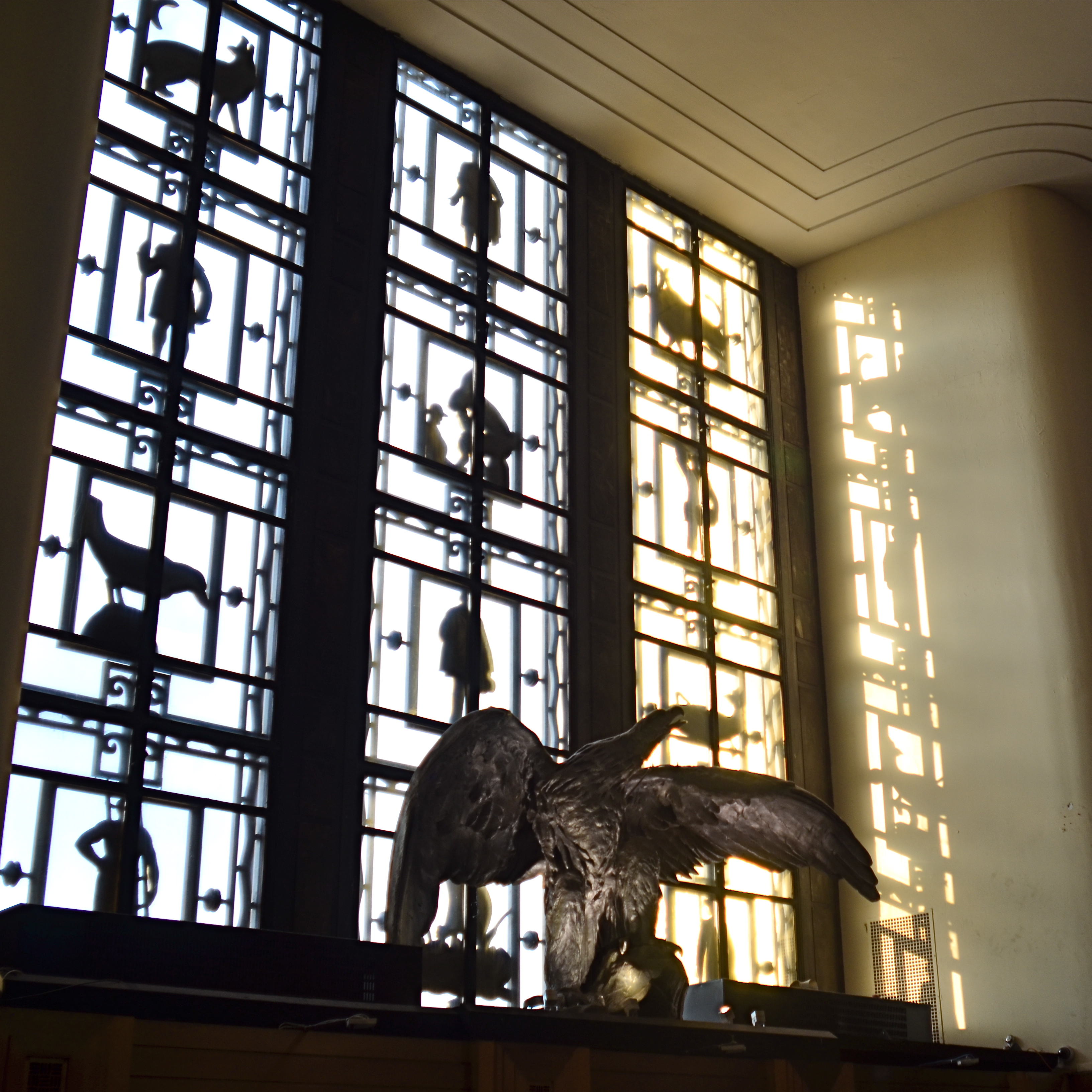
Flights of fancy, right under our wing….ah, nose.
The above image comes from such an exercise. It’s taken just inside the main entrance to the Brooklyn Public Library, which, as you can see, has a great Art Deco grille of storybook characters over the door. But that’s just as you walk in. Pay equal attention when you’re walking out, and you see a strange bird looming over the entrance (now your exit). But not just any bird. It is, in fact, a rescued statue which once graced the main lobby of the long-departed Brooklyn Eagle newspaper, out of its old context as a symbol of high-flying journalism, but now a reminder of one of the city’s best voices. Best of all, the late afternoon sun projects the silhouettes of the storybook grille onto the eagle and the adjacent wall in an unearthly display of shadow. It’s worth looking back at. Or I could say I am always looking forward to looking back at it.
When looking for something new to photograph, seek out the places in which you’ve seen it all. You’ll never be happier to be proven wrong.
CHOCK-A-BLOCK
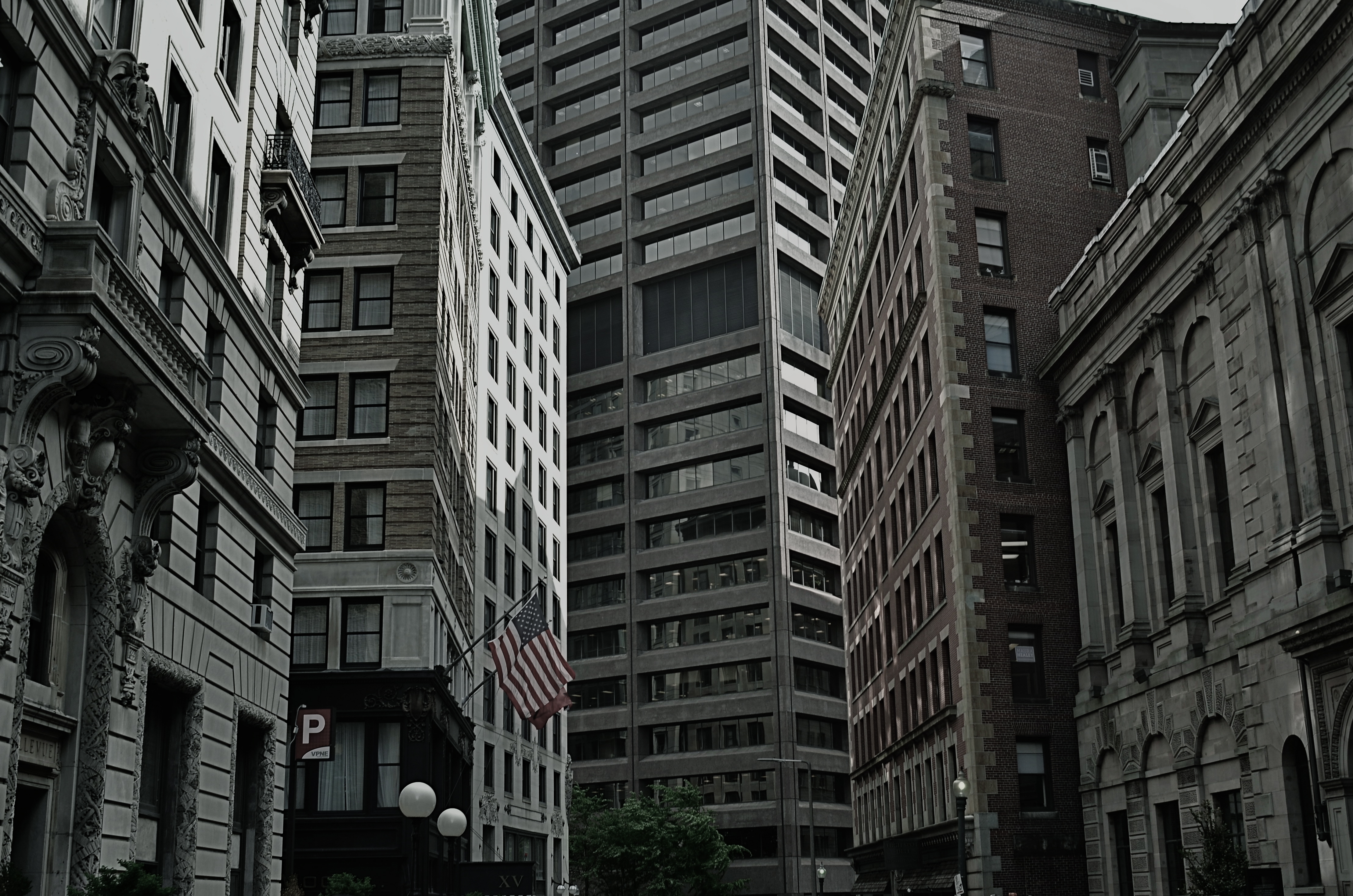
Yes, you could find a more frustrating job than making city maps for Boston streets. But you’d have to look hard….
By MICHAEL PERKINS
WHEN WE THINK OF URBAN BLOCKS, IT’S NATURAL TO THINK of those blocks as regular rectangles, well-regulated, even streets that run at direct parallels or hard right angles to each other. And while there certainly are cities with such mathematically uniform grids, some of the most interesting cities in the world don’t conform to this dreamy ideal in any way. And that means opportunities for photographers.
We’ve all seen street scenes in which the left and right sides of the road vanish directly toward the horizons, like staring down the middle of a railroad bed. But for the sake of dramatic urban images, it’s more fun to seek out the twisty mutants of city design; the s-and-z curves, the sudden zigzags, the trapezoids and triangles which signify confusion to cabbies and pedestrians but which mean good times for photogs. Let’s face it; snapping pictures of orderly things gets old fast. The very nature that makes us idealize “rightness” also makes us want to photograph “wrongness.”
That’s why I love to shoot in towns where the city was laid out with all the logic of the Mad Hatter on speed, those streets that seem barely coherent enough to admit the successful conduct of trade. Cities where locals and visitors alike curse the names of the urban planners, if there ever had been planners, if there ever had been a plan. A grand collision of avenues and alleys that looks like a kid whose teeth are crowding together in a greedy orthodontist’s dream fantasy. In such cities, including Manhattan, Pittsburgh, San Francisco, Boston and many others, “order” is a relative term. There are precious few neat streets vanishing back to infinity, politely lined by cooperative structures queueing up parallel to the curb. And that’s my kind of living, breathing… chaos.
As a mild example, consider the Boston street shown above, on which nearly every building seems slightly askew from every other building, sitting on foundations that jut out at every conceivable angle and plane. It’s a grand, glorious mess, and a much more interesting way to show the contrasting styles that have sprouted in the neighborhood over the centuries. It’s reality that looks like an optical illusion, and I can’t get enough of it.
A straight line may be the shortest distance between two points, but it’s also the least interesting. Go find cities that make no sense, God bless ’em.
THE WRITE SIDE OF HISTORY
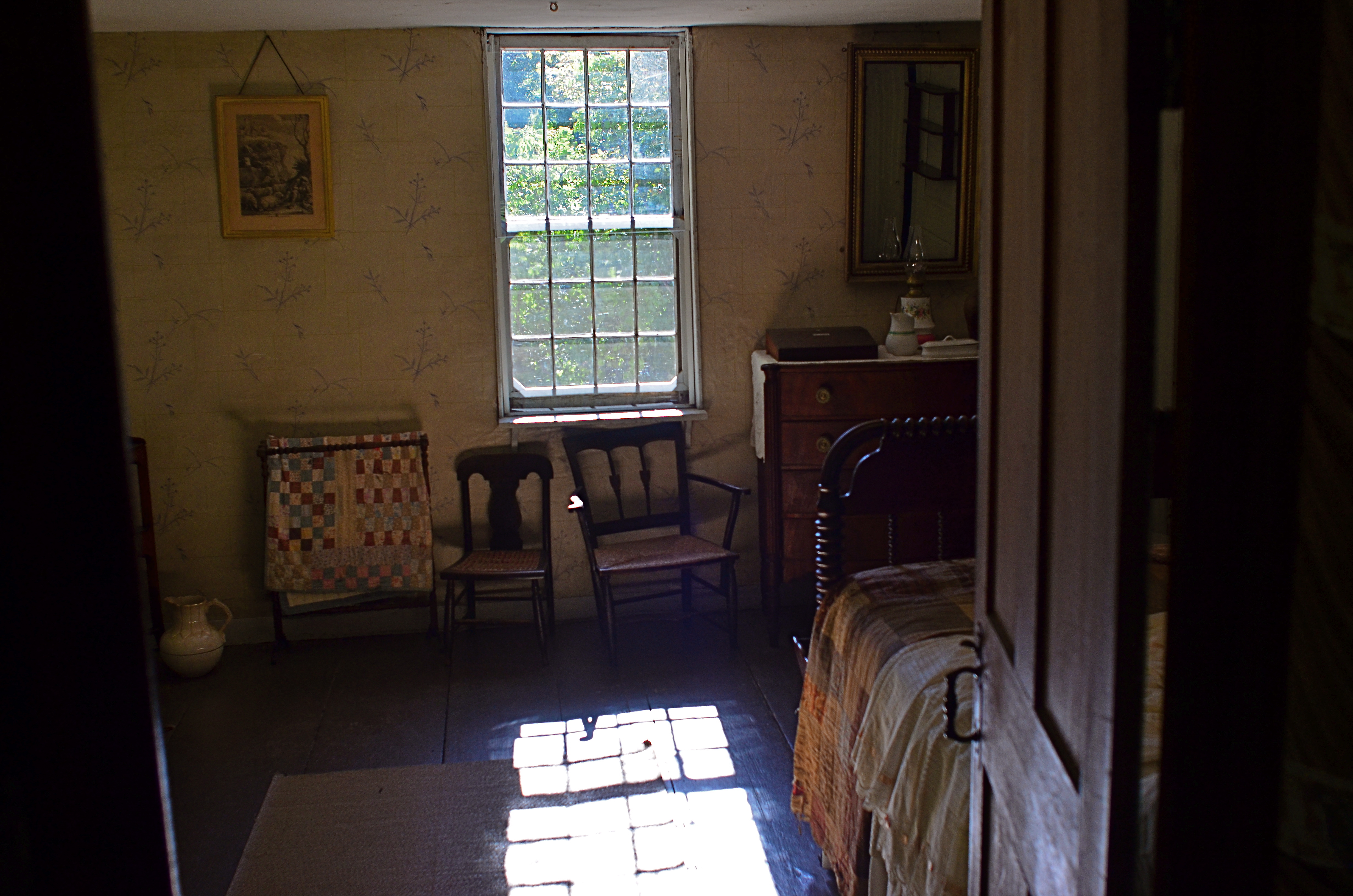
A sunlit bedroom at the Old Manse, the farm home built for the grandfather of Ralph Waldo Emerson.
By MICHAEL PERKINS
THERE CAN BE NO BETTER DEMONSTRATION OF THE HUMAN RACE’S TWO CONFLICTING APPROACHES TO EXISTENCE than are on display in the peaceful town of Concord, Massachusetts, where one of the most renowned jumping-off sites for war and destruction sits cheek-by-jowl with one of the quietest monuments to the serenity of the mind. It’s a contrast which no photographer should fail to experience.
Just a few hundred yards from the tiny footbridge which is rumored to have launched the American Revolution is a carefully preserved haven known as the Old Manse, a modest two-story country home built in 1770 for patriot minister William Emerson. The home came, eventually, to temporarily host a trio of the young nation’s most eloquent voices: Nathaniel Hawthorne, Henry David Thoreau, and Ralph Waldo Emerson (the good minister’s grand-son).
The house remained in the hands of the extended Emerson family until as late as 1939, when it was conveyed to the state’s Trustee of Reservations. Over the years, the Manse helped incubate the energies that produced Emerson’s Nature, Hawthorne’s Mosses From An Old Manse, and various love poems written between Thoreau and his wife. The house also retains writing desks used by Hawthorne and Emerson.
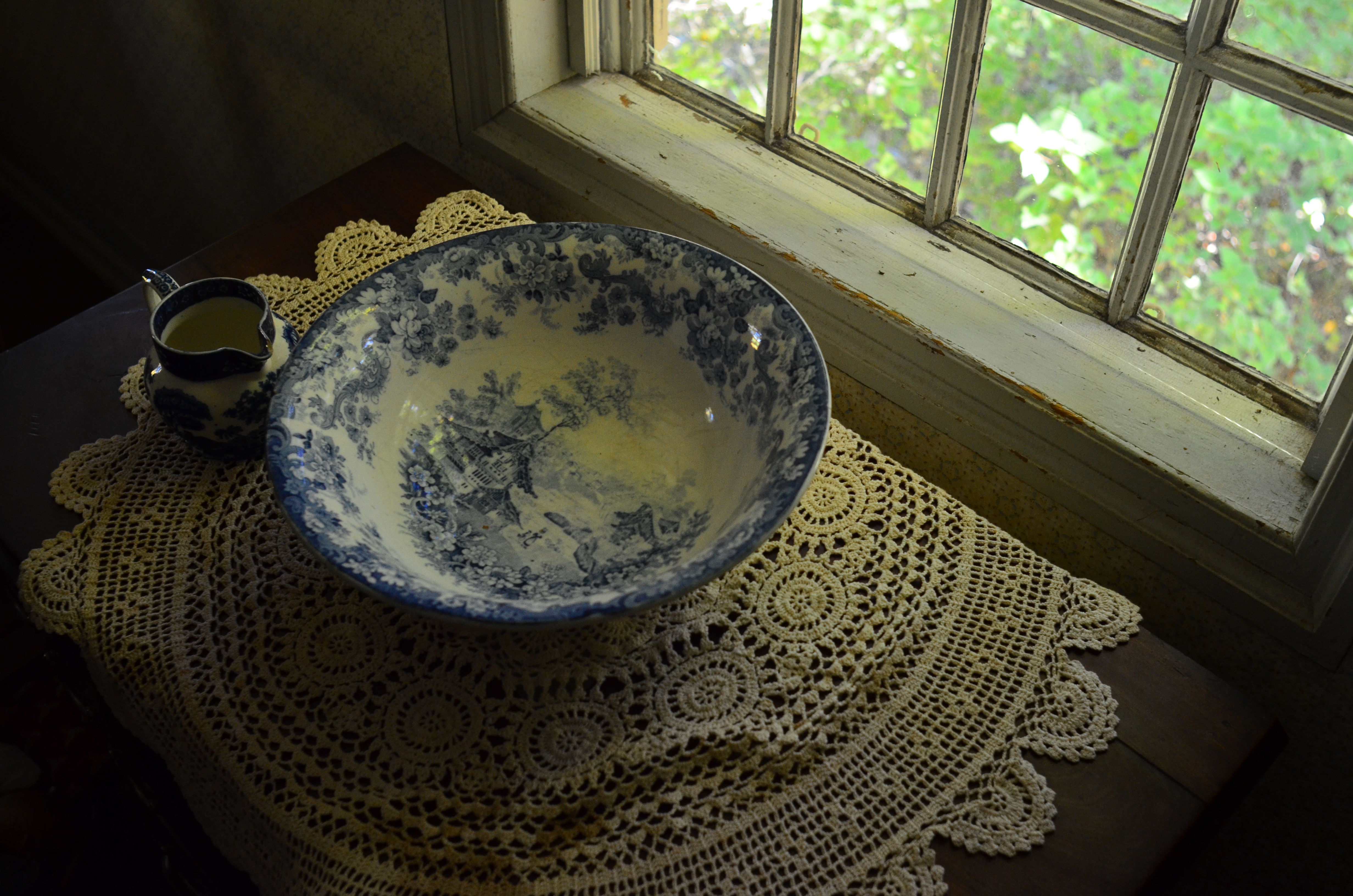
Over 90% of the Manse’s original furnishings from the 18th century have been preserved.
The manse supports itself, its side garden and its replica corn field with a modest bookstore and daily walking tours of the house’s rooms, which are said to feature nearly 90% of the structure’s original furnishings. However, as is the case with Annie Liebowitz’ profound essay on the living spaces of quintessential Americans, Pilgrimage, the effect of the house on the photographer’s eye can never only be in the arrangement of physical artifacts. There is something more ethereal going on than merely snapping The Place Where He Sat And Wrote, an unfilled space that exists between these mere things and the essence of those transcendent writers.
And while I’m not sentimental enough to believe that you can render a person just by photographing an object from his desk, there is something that lingers, however impossible it is to quantify. Revolutions are very amorphous things. Some come delivered by musket ball. Others arrive in wisps of quietude, seeping into the soul with the stealth of smoke. The Old Manse launched its own crop of “shots heard ’round the world”, the echoes of which can sometimes resound in the echo of an image.
It’s a lucky thing to be ready when the message comes.
THE PLACES THEY LIVED
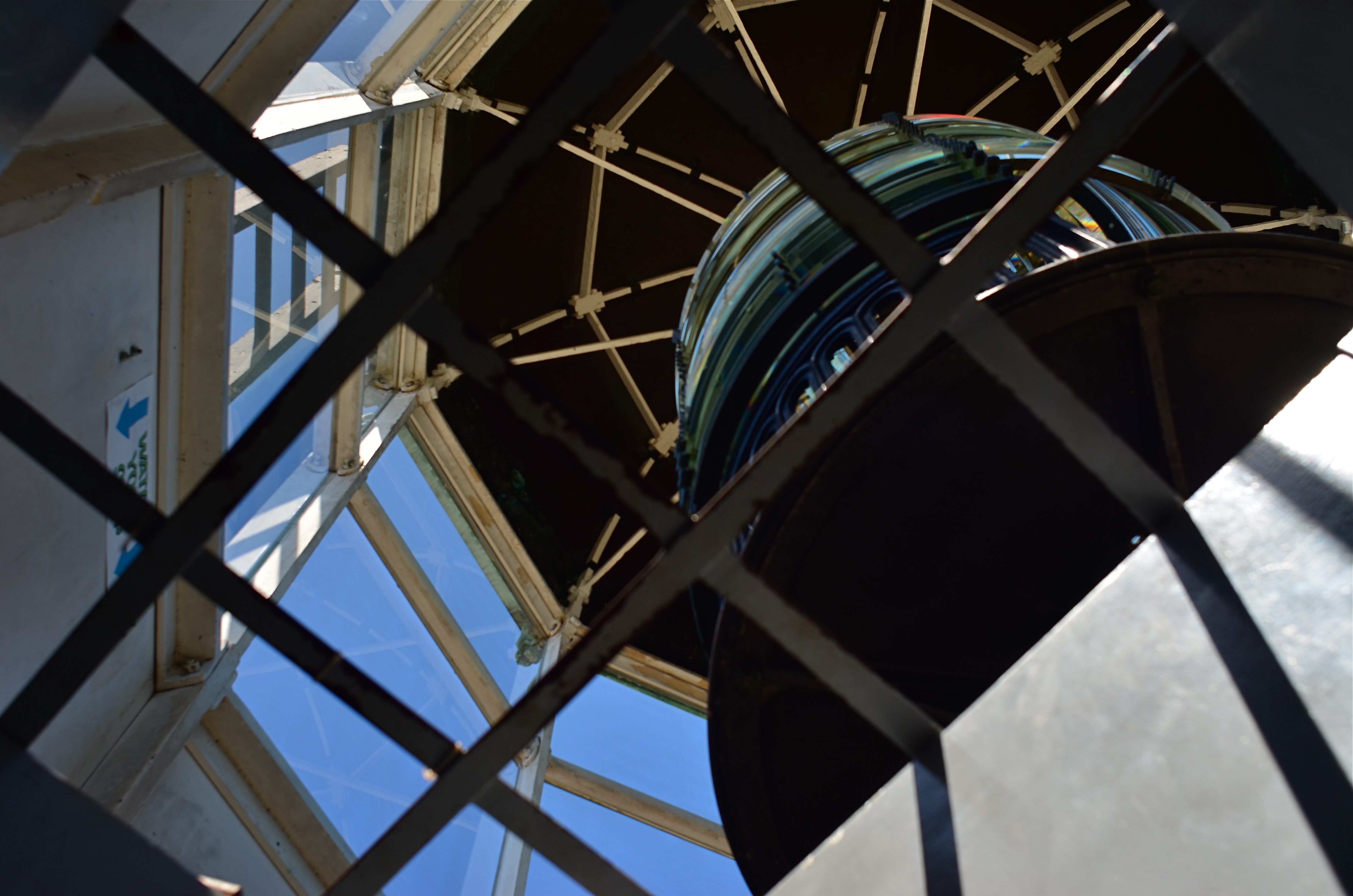
“I want to marry a lighthouse keeper…” 1/125 sec., f/3.5, ISO 100, 24mm.
By MICHAEL PERKINS
PHOTOGRAPHERS INSTINCTIVELY SEEK OUT VARIATION. We spend so much time looking at so much of the world that a lot of it starts to sort itself into file folders of things, patterns, or places, pre-sorting our pictures into this or that category. Sunsets: see Nature. Famous Buildings: a sub-set of Travel. And so on, until we are fairly starved for some visual novelty to shock us out of our slumber and spur us on to new ways of seeing.
One of the things that settles most readily into sameness is the human dwelling. Most of us live in some kind of basic four-walls, bedroom-kitchen-bath sequence, making our living spaces fairly predictable as subject matter. By way of awe and admiration, the real geniuses of, magazine illustration, to me, have always been the “house beautiful” photographers, since they must spend year after year making Mr.& Mrs. J.D. Gotmore’s McMansions seem unique and bold. That said, there is something about nearly everyone’s castle that might be distinctive, even revelatory, about the people who live within. It’s all in your approach.
I love to explore the places where people are forced to improvise living spaces either near or as part of their work, places that usually exist in stark isolation as compared to the crush of crowded urban centers. In the above image, I was allowed to climb to a small viewing angle of the beacon room atop a coastal lighthouse in San Diego, and, perhaps because I was limited to a shooting stance below the surface of the room’s floor, the resulting photo further exaggerated the confined, angular working space, which sits above living areas further down the house’s twisty central staircase.
These areas pose more questions than they answer. What is it like to have this building be your entire world for long stretches of time? What kind of person can do this work? What is the center of this unusual story? The blurring of boundaries between working and living areas is among the most novel material a photographer can tackle, since it contains one of the things he craves most….mystery.
WITHOUT A LEG TO STAND ON
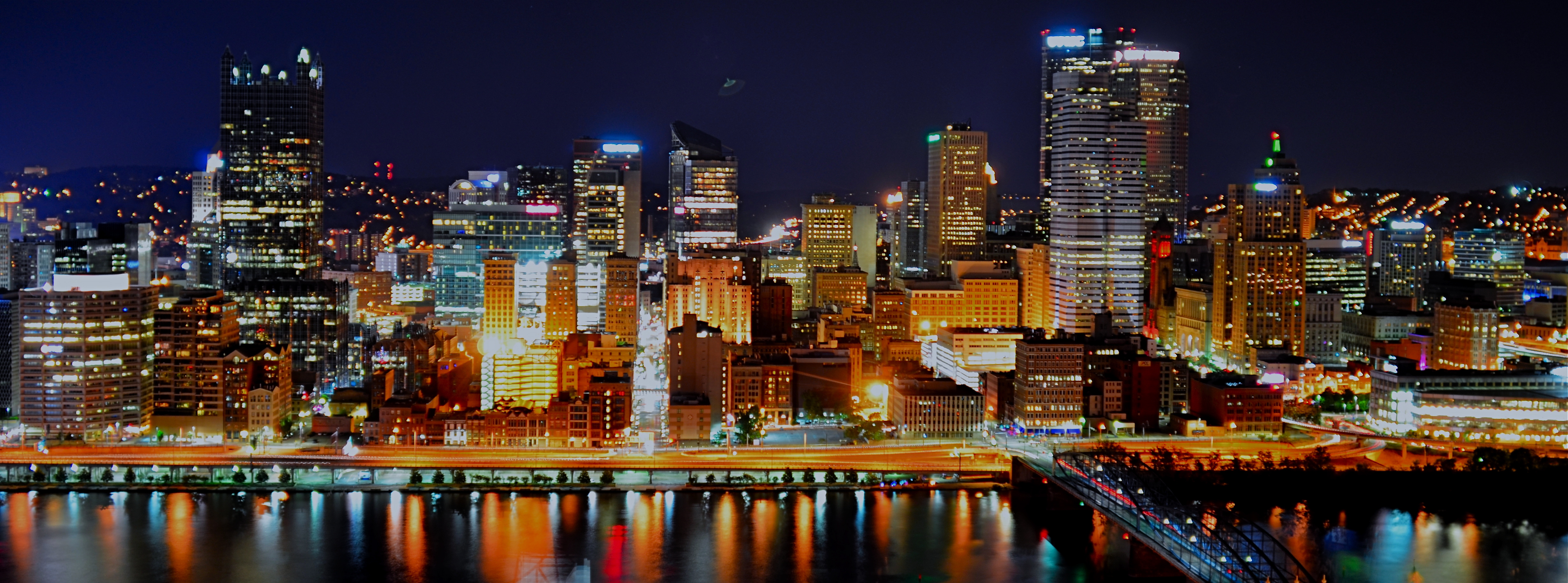
A tripod night exposure that could have been a contender, had I truly been prepared.
By MICHAEL PERKINS
SHOOTING ON A TRIPOD IS OFTEN RECOMMENDED as the way to afford yourself the most stability in a long exposure. After all, few of us are robotic enough to hold a camera stock-still for anything below a third of a second, so it’s a no-brainer to park your camera on something that’s too inhuman to flinch. You can also take amazing stuff hand-held on shorter night exposures, so long as you (a) have a lens that will shoot around f/1.8 or wider and (b) you can live with the noise a higher ISO will engender.
So, yeah, tripods have their place, but they are not the only determinants in the success of a night-time shoot. And those other x-factors can severely compromise your results. There is the stability of the tripod itself, which isn’t a big sweat if you shelled out $900 for a carbon-fiber Gitzo Pan/Tilt GK, but might generate heartburn if you got something closer to a set of metallic popsicle sticks for $29 at Office Max. The shot above was taken using my own modest (cheap) rig atop Mount Washington across from downtown Pittsburgh, and a few of the healthier gusts threatened to take it and me on a quick lap around the riverfront. Some people buy sandbags. Some believe in the power of prayer. Your choice.
Another x-factor for ‘pod shots is the actual weather you’re shooting in, which will, let’s say, shape your enthusiasm for staying out long enough to get the perfect shot. The smaller your aperture, the longer the exposure. The more long exposures you take, the longer you, yourself, are “exposed”…to snow, sleet, and all that other stuff that mailmen laugh at. Again, referencing the above image, I was contending with freezing drizzle and a windbreaker that was way too thin for heroics. Did I cut my session short? i confess that I did.
I could also mention the nagging catcalls of the other people in my party, who wanted me to, in their profound words, “just take the damned picture” so they could partake of (a)a warm bar, (b) a cold beer, (c) a hot waitress. Result: a less than perfect capture of a fairly good skyline. A little over-exposed, washing out the color. A little mushy, since the selfsame over-exposure allowed the building lights to burn in, rendering them glow-y instead of pin sharp. I was able to fix some of the color deficiencies later, but this is not a “greatest hits” image by any stretch.
Tripods can be lifesavers, but you must learn to maximize their effectiveness just like any other piece of camera equipment. If you’re going to go to a buncha trouble to get a shot, the final result should reflect all that effort, quality-wise.
CHANGE YOUR ATTITUDE
By MICHAEL PERKINS
PHOTOGRAPHY IS OFTEN A GAME OF INCHES, a struggle in which outcomes vary wildly based on small, rather than large issues. Early photographers learned this the hard way, since their limited gear forced them to innovate composition and exposure with tiny tweaks that slowly but gradually added more refined skill to their work and better performance from their equipment. Ernest Haas’ great quote that a wide-angle lens is just as close as taking three steps backward still holds true. What has changed is that we have a greater tendency to think that we need more tech to make better pictures. That concept, simply, is poppycock.
For years, the option of a zoom lens was out of the question for the average photographer. The consumer-level zooms that existed were often optically inferior to standard or wide-angle glass (as testified to by Annie Leibowitz and other heavyweights), and so composition was acquired by physically closing or widening the actual distance between yourself and your subject. This is not to say that zooms didn’t eventually prove amazing tools, because they have. However, they demonstrate and instance in which tech has automated, and thus eliminated, an extra step of mindful concentration that used to reside solely in the photographer’s brain. This can lead, over time to an over-reliance on the gear to bring everything home, something it cannot ever do.
Learning to simply maximize the effect of whatever you have up front of the shutter is the easiest, and yet most overlooked aspect of many people’s work. We’d spend a lot less time lugging and swapping lenses if we knew how far we could push whatever we’ve got attached at the moment, and, indeed, masters like Scott Kelby, author of the best-selling Digital Photography Book series, has several “why change lenses? hunks of glass like the 18-200mm that can get him through an entire day without a swap. This works because he works a little harder at exploiting everything his gear can do.
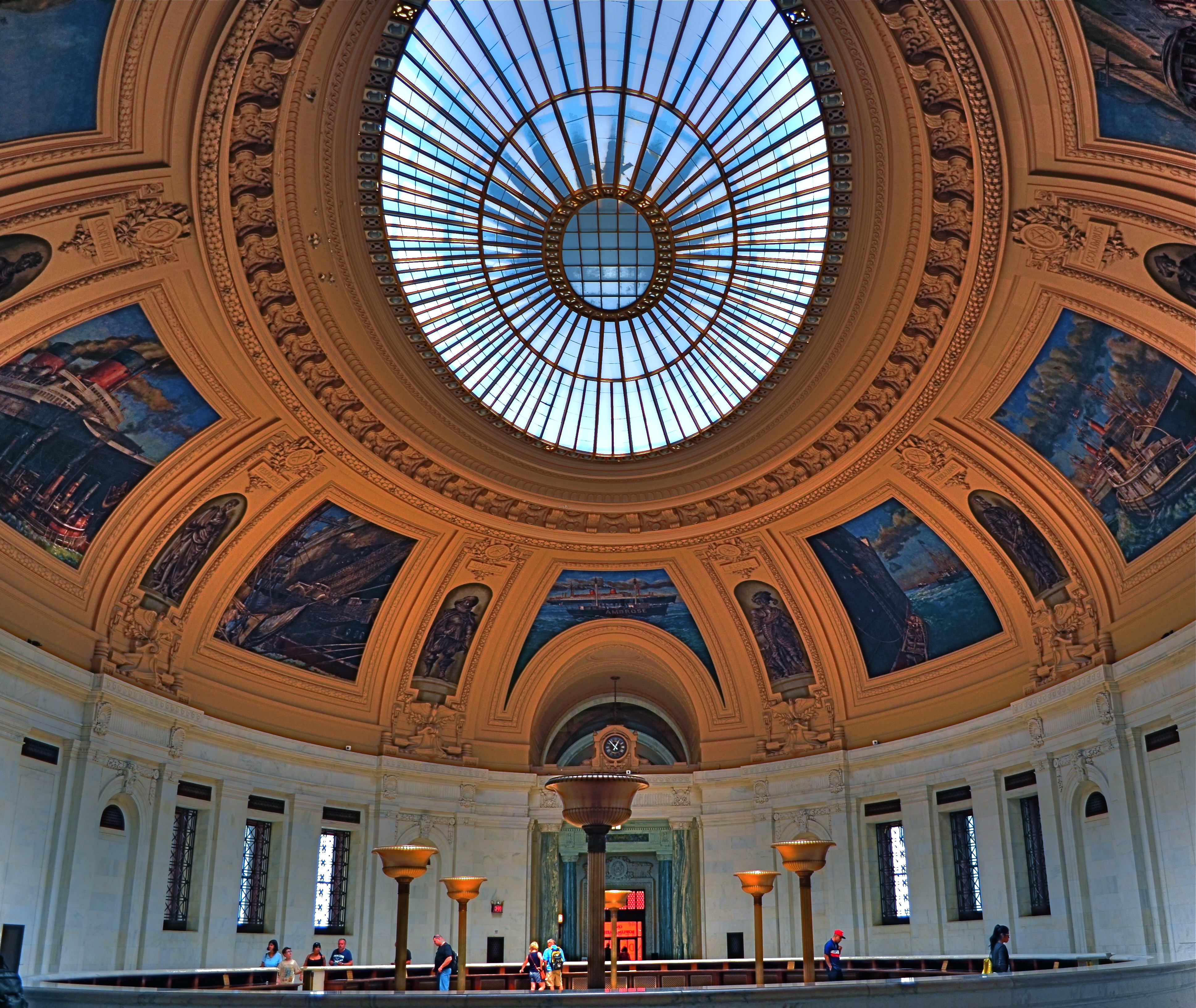
Wide-angle lenses deliver a variety of effects beyond just width.
Consider the above image. It’s taken at 18mm, but, because I arched the shot upwards, instead of maintaining a level horizon line, I forced the lens to do a little more of what it was originally designed to do….exaggerate dimensions and distances. The development of wide-angle lenses was, after all, pursued by shooters who wanted an enhancement, an interpretation, and not a recording, of reality. As such, the wide-angle in this shot over-accentuates the most prominent feature of this room within the old U.S. Customs building in Manhattan…its amazing murals. It also creates an illusion of vastness, front-to-back, in a room that is already pretty huge. And this is all done by pivoting my head upward about 30 degrees.
The game of inches is the great equalizer in photography between pro and amateur, because it gives the advantage to those who plan the best, see the most, and think the widest. And you don’t need a closet full of geegaws to do that.
REVERSAL OF FORTUNE
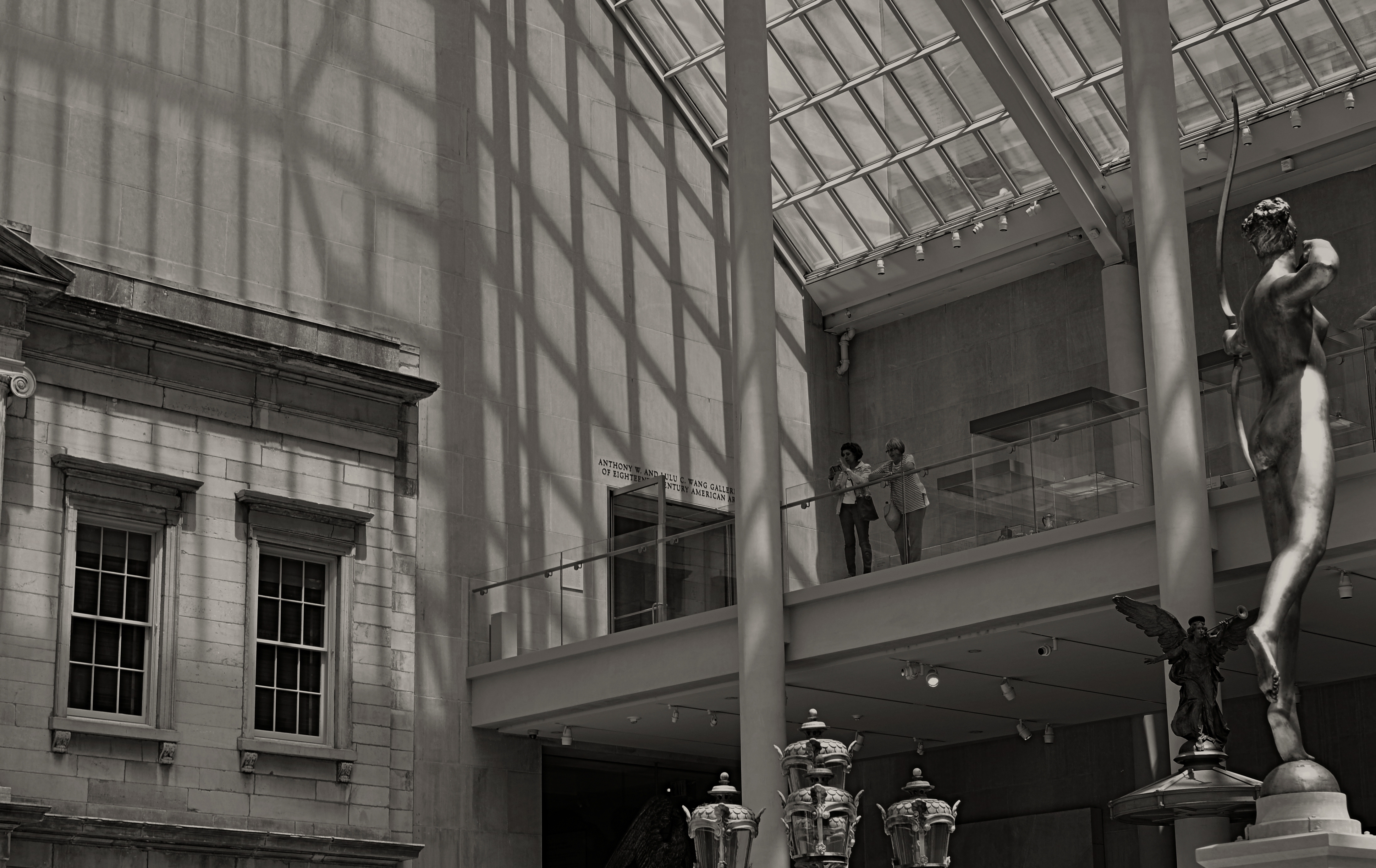
Spaces like this vast sculpture gallery beg to be visualized from as many angles of view as possible, Diana hunts from the right edge of the frame.
By MICHAEL PERKINS
ANYONE WHO HAS EITHER STUDIED OR DABBLED IN CANDID PHOTOGRAPHY has heard Henri-Cartier-Bresson’s term “the decisive moment”, which refers to that heat-lightning instant when the best possible photograph of a situation or sensation can be made. Of course, you don’t have to really believe that there is a single such moment, and many do not. There may be any one of thirty possible frames to be extracted from even the simplest human subjects, but we seem to always be looking for that salient, isolated image that defines it for all time.
Cartier-Bresson’s pursuit of the decisive moment is usually thought of with regard to photographing human activity, but there is also a mindset about photographing places that there can be a “superior” or “best” angle to view them from. That is why landmarks and monuments yield so many pictures that are so much the same. We all shoot the Eiffel Tower the way that everyone else before us has shot it…..because? Well, there’s a great question.
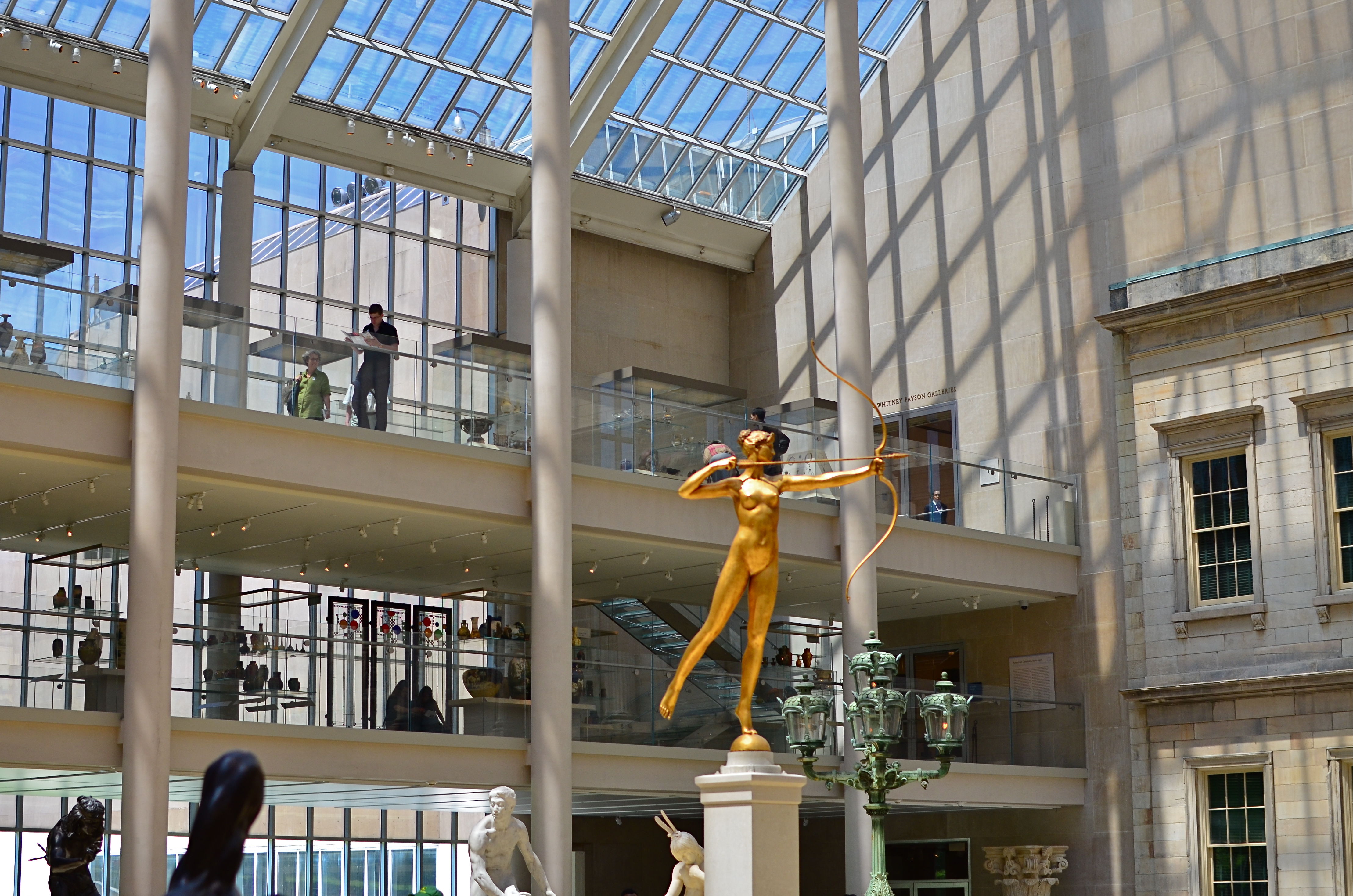
My original, “official” angle on the exact atrium. Diana holds center stage.
Do we think of earlier images of the tower as a standard of some kind that we only certify by imitation? Is our mind eager to catalogue things in their “proper” orientation? Are we only interesting in what things are “supposed” to look like? Ideally, we should be making pictures to authenticate our own visions, not to rubber-stamp those generated before us. And yet, with famous places, it’s often a case of human see, human ape.
We have to teach ourselves to photograph places as if we were the first to ever point a camera at them. It’s not that hard a habit to cultivate, really. Crank yourself around 180 degrees and take the reverse angle. Move six inches to the left and frame the most obvious part of the cathedral, ruins, or palace out of your composition. It might yield nothing, and then again, it might add enough freshness to the image to overcome what I refer to as “tourist fatigue”.
The above image from the sculpture plaza at the Museum of Modern Art in New York is a near reverse of the more conventional view in the smaller color shot at left, which I first featured in the post Put Yourself Out There a while back. In one shot, the Diana statue is center stage. In the other, she is relegated to the edge of the frame, acting as a pointer toward the rest of the photograph’s information. Extra cost in terms of time to get this very different composition? Ten seconds.
It’s not that re-imagining a subject is that hard. It’s that we so seldom question our first imagining of things, often settling for the first, technically successful image we get. And that first image, as we often learn, might only be a dress rehearsal for the real show.
THE LOOK OF SILENCE
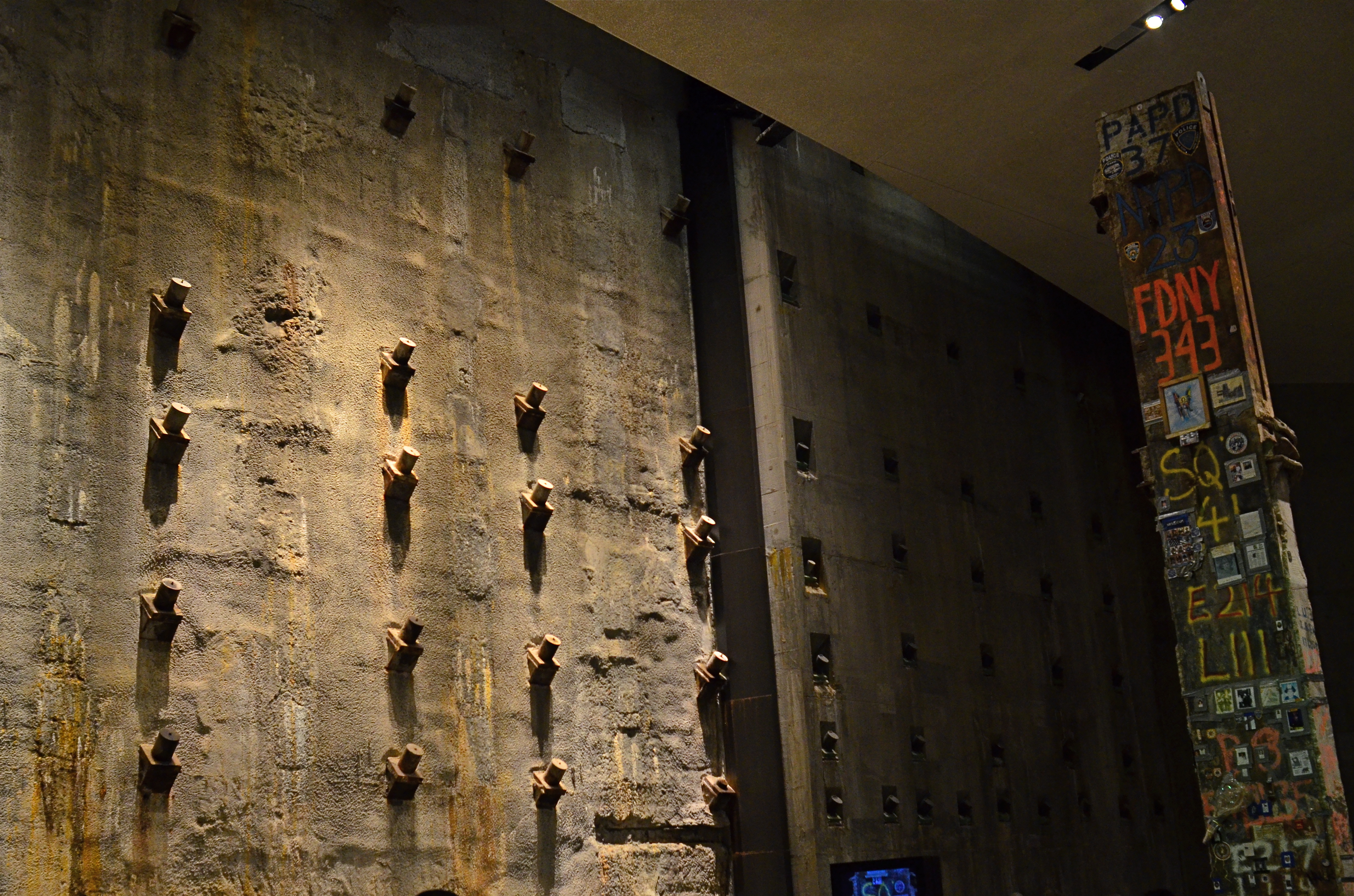
Slurry Wall And Hero’s Girder, 2015. The 9/11 Memorial Museum in New York is a cathedral of grim silence.
By MICHAEL PERKINS
AS THE MOST PHOTO-DOCUMENTED EVENT IN HUMAN HISTORY, the attacks of September 11, 2001 have spawned images that can never be unseen. Images that tear at you, slam you in the back of the head, wring tears and rage from you, stun you mute.
As the keeper and curator of many of the most powerful of these images, the 9/11 Memorial Museum in lower Manhattan has achieved a tough but fair balance of emotion and academia. Given the staggering number of people whose personal stake in this space covers every human motive and perspective, the making of this part-exhibit-part-shrine may have been one of the most thankless jobs imaginable.
And yet the job has been done, with eloquence and a spare, stark restraint that is poetic. Visiting the museum is no easy task. As Shakespeare said, if you have tears to shed, prepare to shed them now. But visit you should, and, yes, there is something that a camera can capture there without being crass or irreverent. The designers have seen to it.
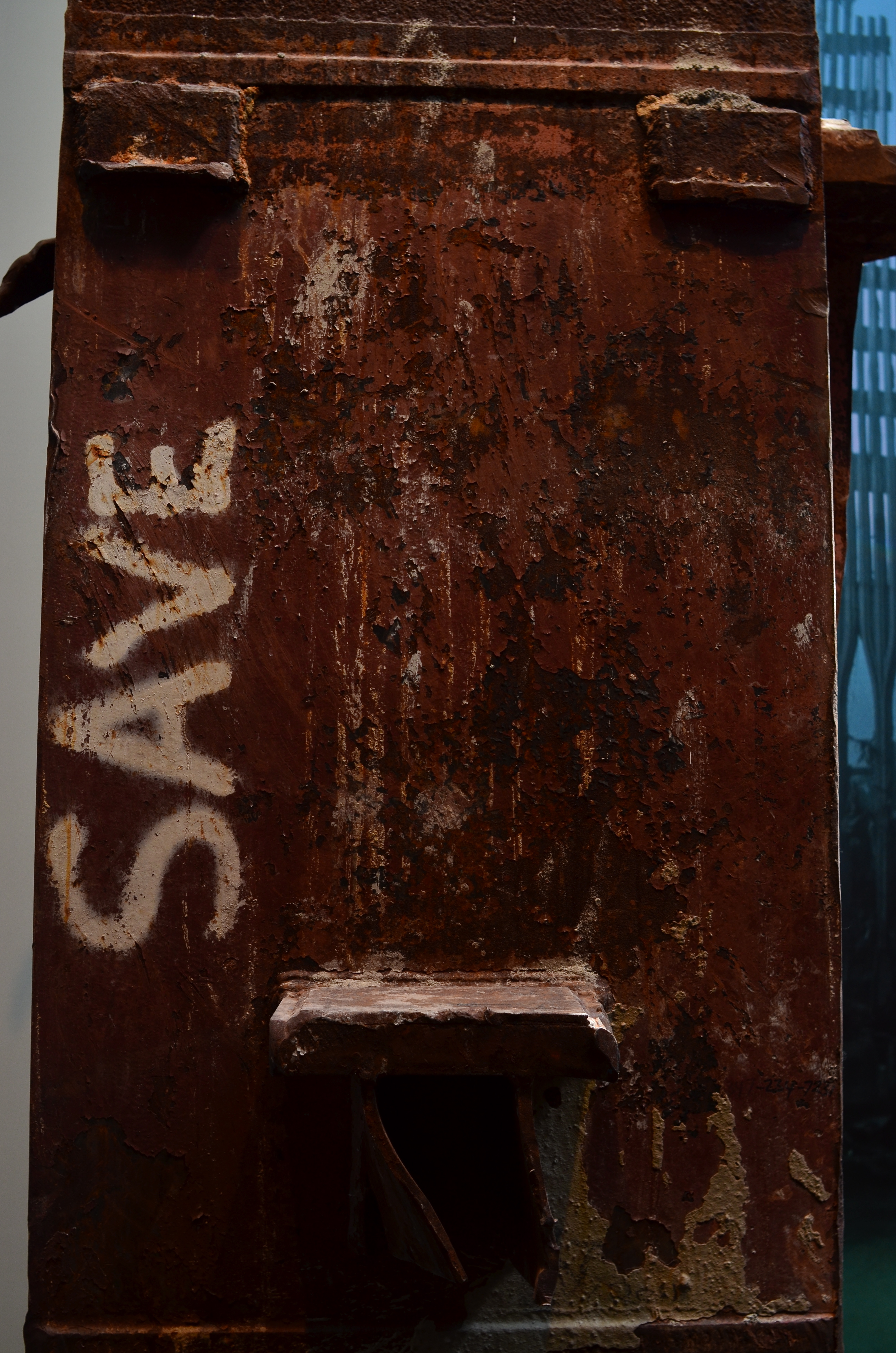 Firstly, they have guaranteed that the main central exhibits of debris, personal documents, voice messages and news video are completely off-limits to any kind of photography. Walk in there, and you’ll know why. Those who accidentally caught this epic horror in the moment of its occurrence will never be equaled or surpassed by anyone taking a casual snap on a smartphone anyway, and trying to do so would be like setting off sparklers at a requiem mass.
No, the real photographic opportunities are in the dark, cavernous spaces under the surface of the street, dim caves that make you feel as if you yourself, are, for a moment, trapped, running out of light and time. The enormous foundation known as the slurry wall, which, in surviving the titanic forces of the towers’ collapse, kept the Hudson River from flooding all of lower Manhattan. The rusted girder that, like a day-glo-autographed tombstone, bears the signature of every working company of first responders that slaved away at Ground Zero, first as rescuers, next as salvagers, always as heroes.
It is here, in the quiet arrangement of these incredibly scaled spaces, that the 9/11 Memorial Museum becomes more spiritual than any hour you will ever pass in church. It is in these dark, harrowing parts of the hall that you fully sense what a slender thread we all hang from, and understand that light and darkness struggle for the same real estate, now as then.
 thenormaleye