SUBDIVISIONS
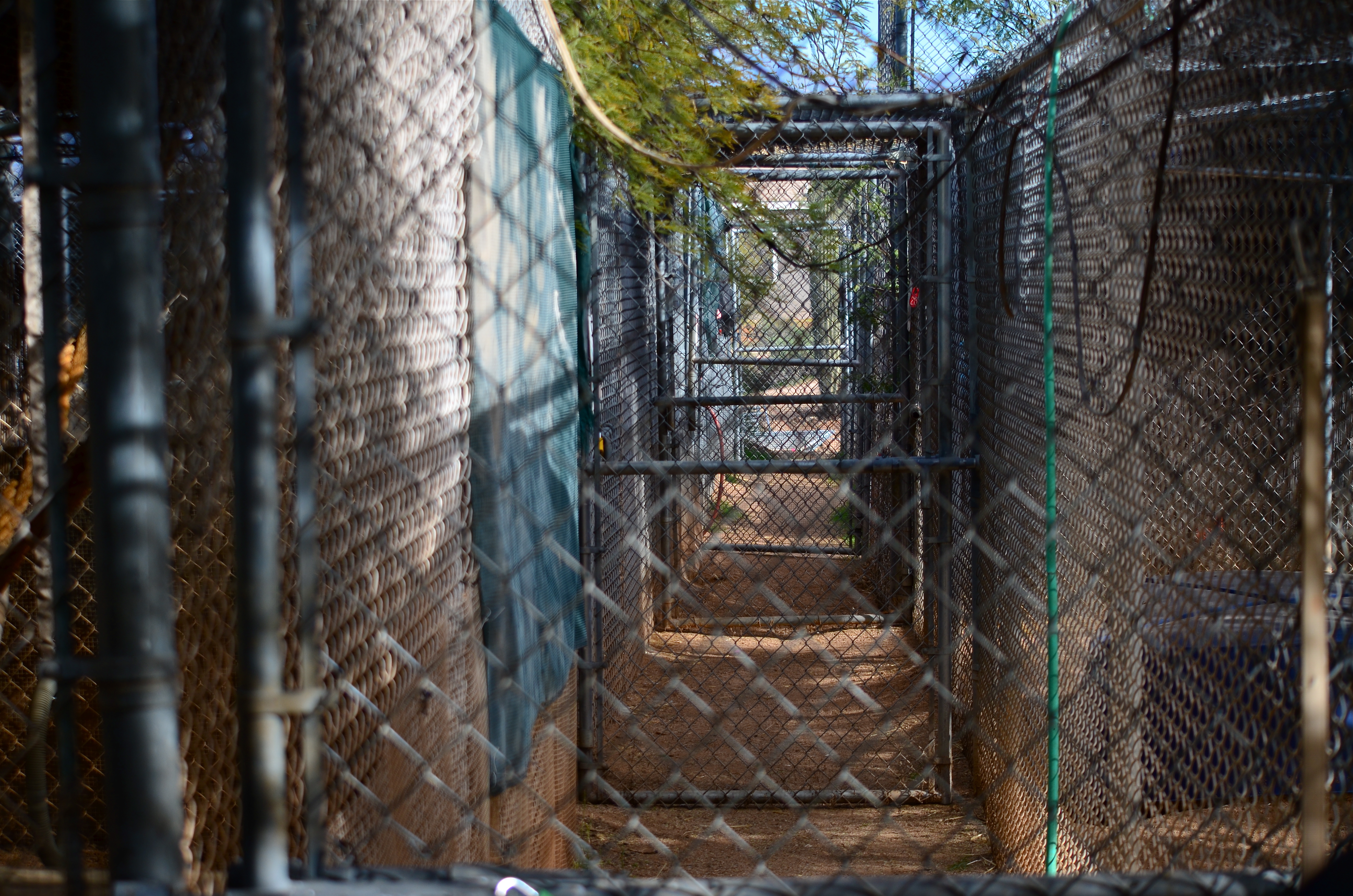
Compartments, 2014.
By MICHAEL PERKINS
SPACE, BY ITSELF, DOESN’T SUGGEST ITSELF AS A PHOTOGRAPHIC SUBJECT, that is, unless it is measured against something else. Walls. Windows. Gates and Fences. Demarcations of any kind that allow you to work space compelling into compositions. Arrangements.
Patterns.
I don’t know why I personally find interesting images in the carving up of the spaces of our modern life, or why these subdivisions are sometimes even more interesting than what is contained inside them. For example, the floor layouts of museums, or their interior design frequently trumps the appeal of the exhibits displayed on its walls. Think about any show you may have seen within Frank Lloyd Wright’s Guggenheim museum, and you will a dramatic contrast between the building itself and nearly anything that has been hung in its galleries.
What I’m arguing for is the arrangement of space as a subject in itself. Certainly, when we photograph the houses of long-departed people, we sense something in the empty rooms they once occupied. There is fullness there inside the emptiness. Likewise, we shoot endless images of ancient ruins like the Roman Coliseum, places where there aren’t even four walls and a roof still standing. And yet the space is arresting.
In a more conventional sense, we often re-organize the space taken up by familiar objects, in our efforts to re-frame or re-contextualize the Empire State, The Eiffel, or the Grand Canyon. We re-order the space priorities to make compositions that are more personal, less popular post card.
And yet all this abstract thinking can make us twitch. We worry, still, that our pictures should be about something, should depict something in the documentary sense. But as painters concluded long ago, there is more to dealing with the world than merely recording its events. And, as photographers, we owe our audiences a chance to share in all the ways we see.
Subdivisions and all.
BLACK IS THE NEW QUIET
By MICHAEL PERKINS
PERHAPS IT’S MY FATHER’S LOVE OF THOREAU AND EMERSON. Maybe it’s a late-in-life turn toward the meditational. It most certainly is due, in part, to a life-long adoration of all things bookish. Whatever the exact mix, I regard library space as far more sacred than the confines of any church or chapel. Many find their faith flanked by stained glass; I get centered in the midst of bookshelves.
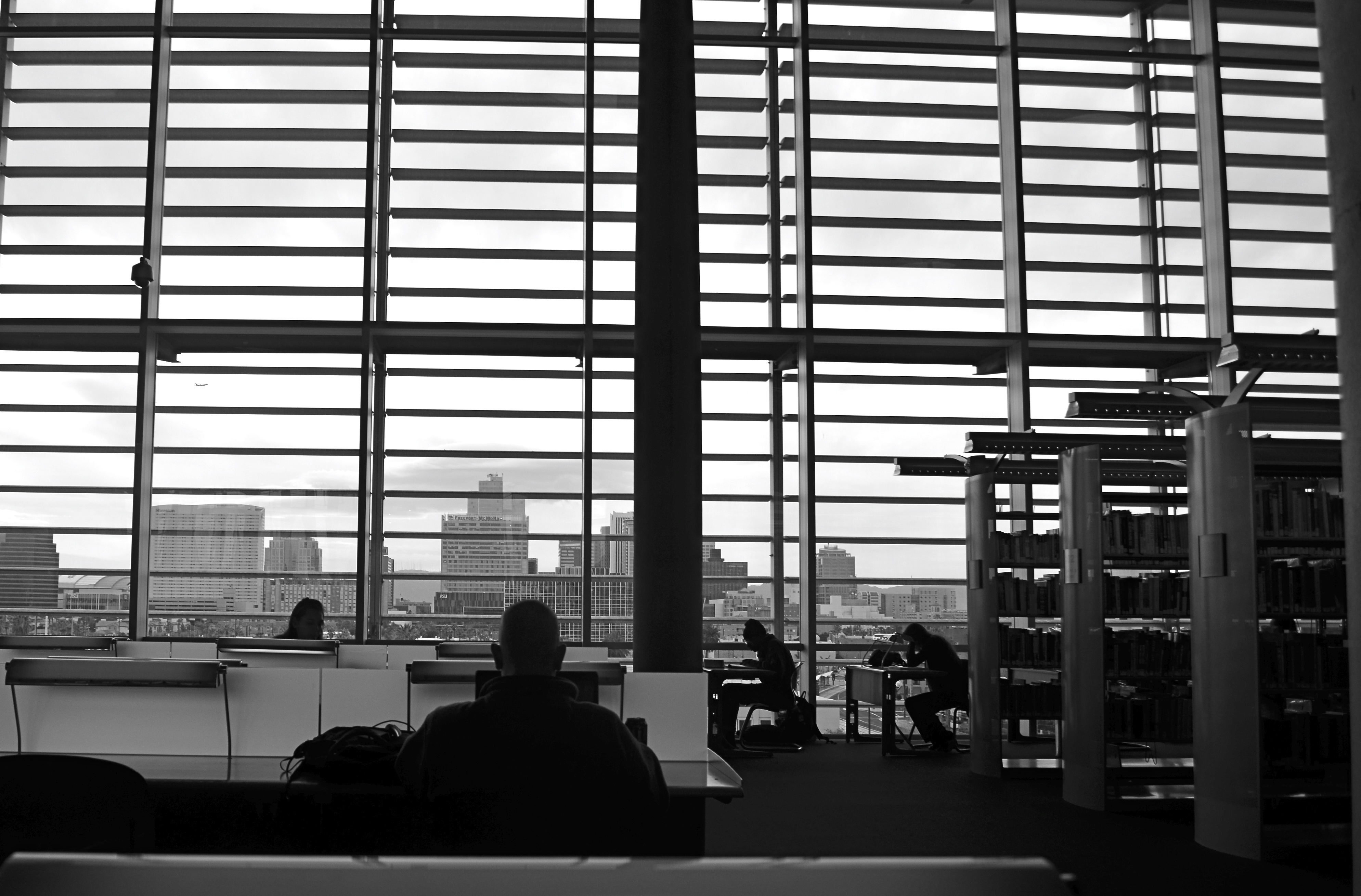
Solitude: An in-camera monochrome at 1/250 sec.,f/5.6, ISO 100, 18mm.
And if libraries are my churches, reading rooms are the sanctuaries, the places within which the mind can be channeled into infinite streams, and where, incidentally, perfect mental quiet can translate into visual quiet. And that, for me, means black and white images. Color can be too loud, proud, and garish, wherein monochrome is the language of privacy, intimacy, and a perfect kind of silence. You might say black is the new quiet.
Inside reading rooms, the faces and clothing of the patrons seems, well, irrelevant to the mood. They have all come seeking the same thing, so compositionally, they are, themselves, all alike, and seeing them in silhouette against the larger details of the room seems to enhance the feeling of reverent quiet. As for composing, letting the room’s massive window take up 3/4 of the frame kept the readers as a small understatement along the bottom baseline of the shot. And, since I was reluctant to ruin the atmosphere of the room, or risk my “invisibility” with more than one audible click to betray me, I chose to go for broke with a single black & white image. I exposed for the cityscape beyond the window, to guarantee that the readers would be rendered as shapes, and that was it.
Having successfully purloined a treasure from within the Church Of The Holy Book, I proceeded to beat it.
Quietly.
JUST ENOUGH
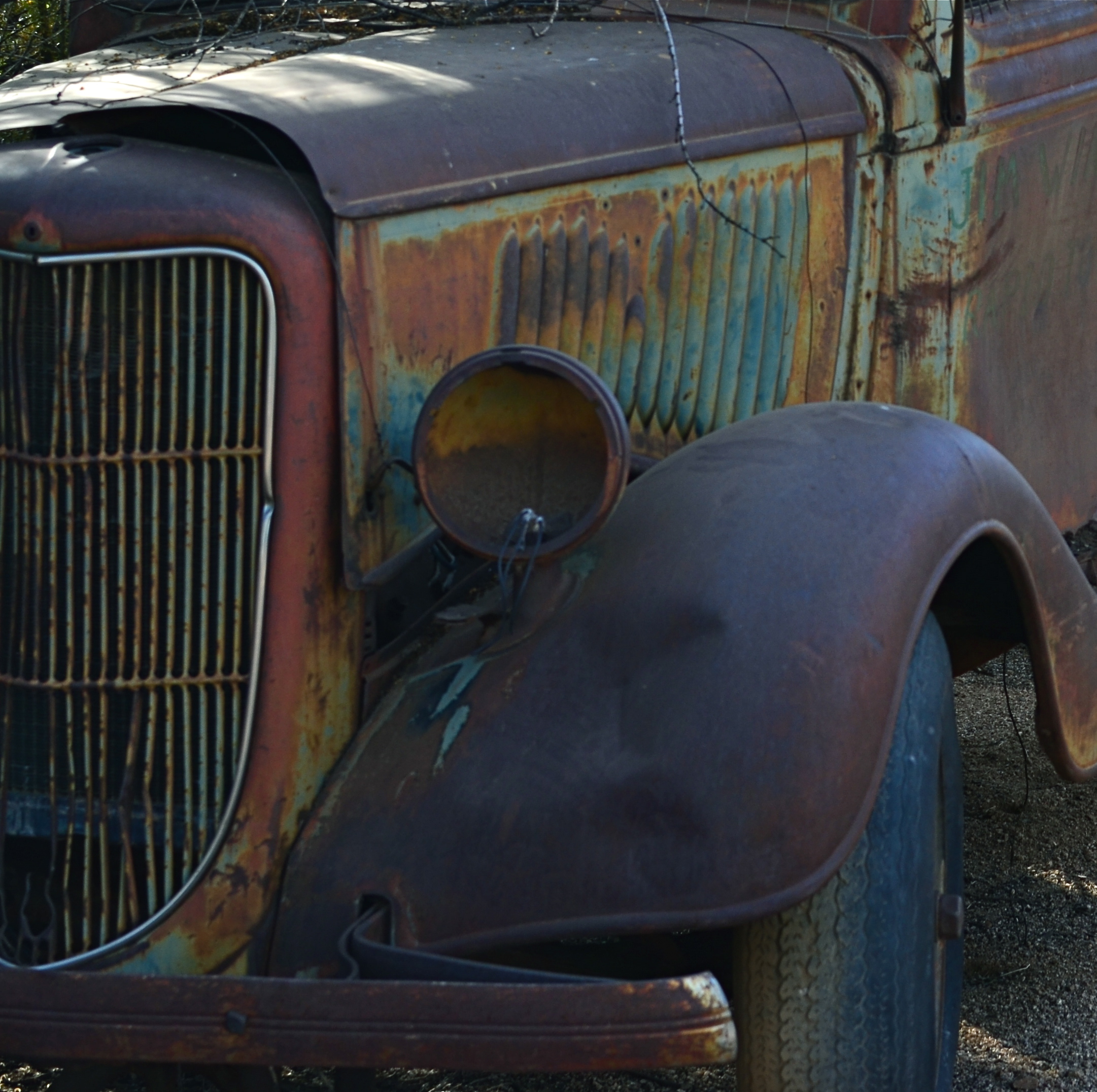
1/250 sec., f/5.6, ISO 100, 35mm.
By MICHAEL PERKINS
I’VE PROBABLY SCRIBBLED MORE WORDS, IN THESE PAGES, ABOUT OVERCROWDED SHOTS than about any other single photographic topic, so if I sound like I’m testifyin’ in the Church-Of-I-Have-Seen-The-Light, bear with me. If any single thing has been a common theme in the last five years of my photography (or a factor in my negligible growth), it’s been the quest to take pictures that tell just enough, then back off before they become cluttered with excess visual junk.
Composing a photograph, when we start out as young budding photogs, seems to be about getting everything possible into the frame. All your friends. All the mountains and trees. Oh, and that cute dog that walked by. And, hey, those clouds, aren’t they something? Then, as we grow grayer of beard and thinner of scalp, the dead opposite seems to be true. We begin looking for things to throw away in the picture. Extra visual detours and distractions that we can pare away and, not only still have a picture, but, ironically, have more of a picture, the less we include. It’s very Zen. Or Buddhist. Or Zen Buddhist. Or something. Hey, I ain’t Depak Chopra. I just get a smidge better, as I age, at not making every image into a Where’s Waldo tapestry.
Especially in an age of visual overload, it’s too easy to make photographs that make your eye wander like a nomad all over the frame, unsure of where to land, of what to fix upon. Unable to detect the central story of the shot. Professionals learn this before any of the rest of us, since they often have to submit their work to editors or other unfeeling strangers outside their family who will tell them where their photos track on the Suck-O-Meter. There’s nothing like having someone that you have to listen to crumple up about 90% of your “masterpieces” and bounce them off your nose. Humility the hard way, and then some. But, even without a cruel dictator screaming in your ear that you ought to abandon photography and take up sewer repair, you can train yourself to take the scissors to a lot of your photos, and thereby improve them.
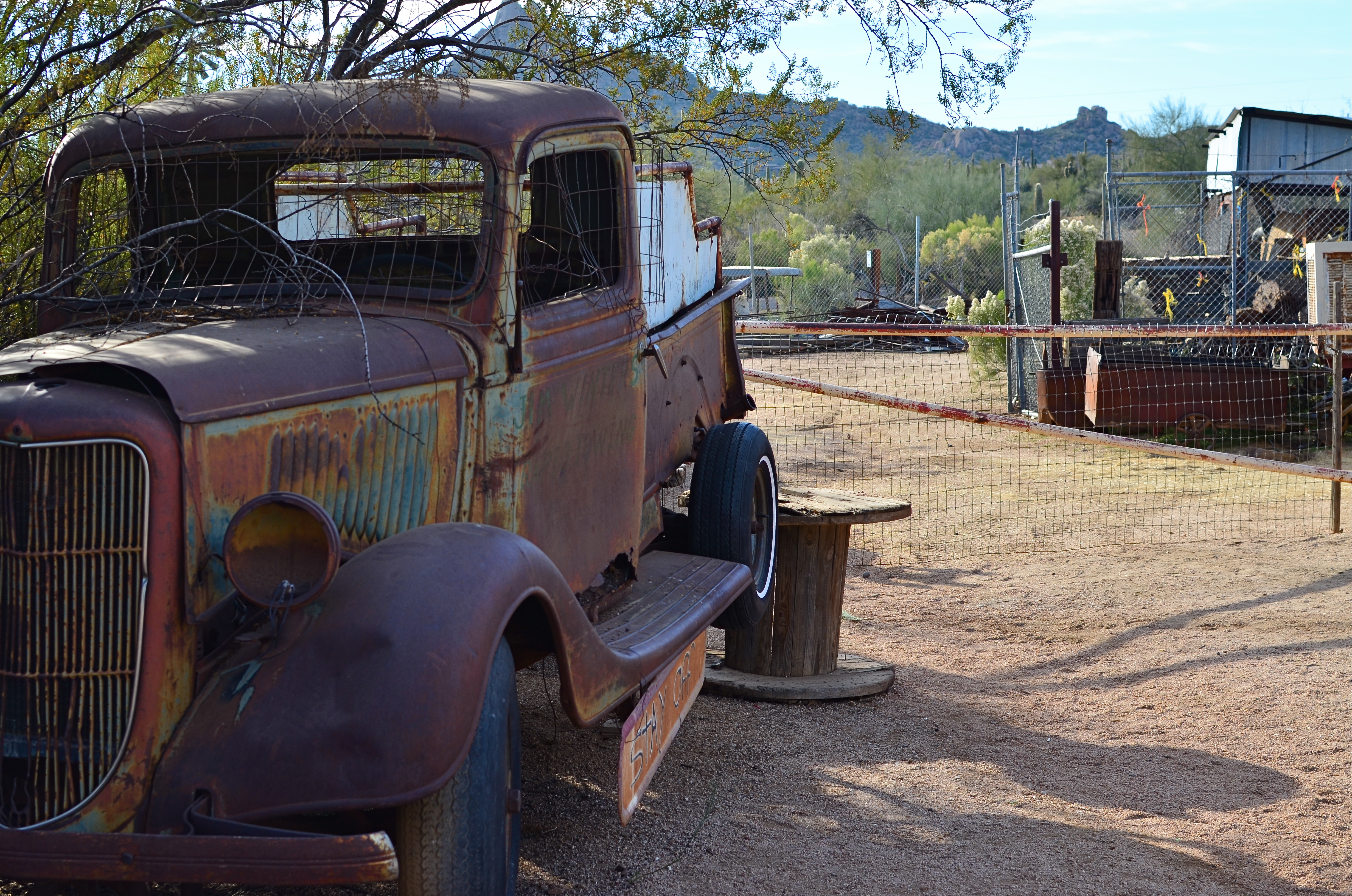
The original shot. Cool truck, but what’s all that lame junk off to the side?
The image up top began with the truck occupying just part of what I hoped would be a balanced composition, showing it in the context of a western desert scene. Only the truck is far more interesting a subject than anything else in the image, so I cropped until the it filled the entire frame. Even then, the grille of the truck was worthy of more attention than the complete vehicle, so I cut the image in half a second time, squaring off the final result and shoving the best part of the subject right up front.
The picture uses its space better now, and, strong subject or weak, at least there is no ambiguity on where you’re supposed to look. Sometimes that’s enough. That’s Zen, too.
I think.
BRIGHT SMILING LIES
By MICHAEL PERKINS
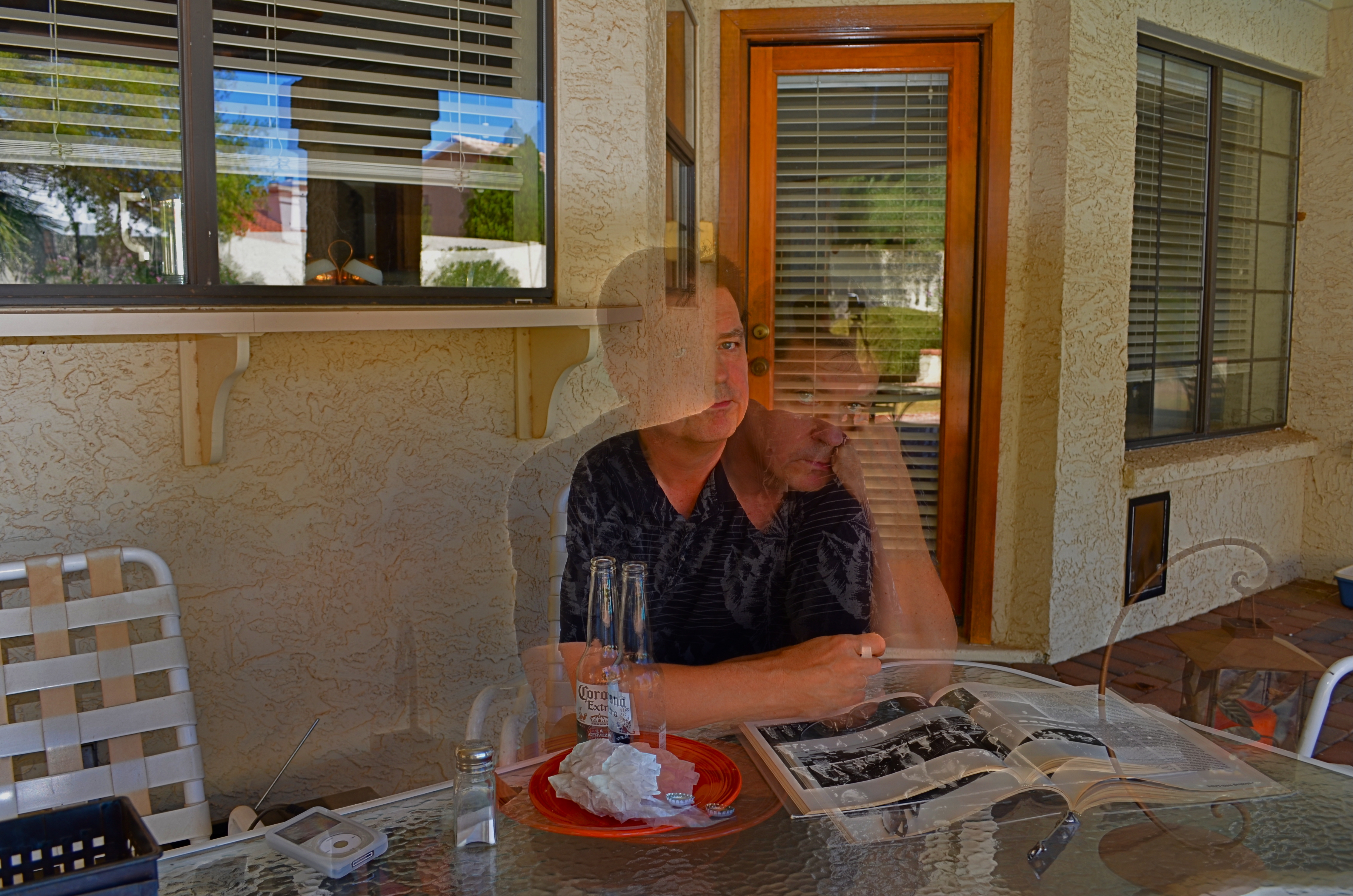
PHOTOGRAPHY HAS PRETTY MUCH INHERITED ITS CONCEPTION OF PORTRAITURE FROM THE TRADITIONS OF PAINTING. A portrait, to us, is something done on purpose, with purpose, deliberation, a plan. There is at least an attempt on the part of the photographer to strip away the studied facades of the modern world and reveal something of the real person within. And there is ample evidence that you can come compellingly close to doing just that.
Turn the camera around toward ourselves, however, and we all become liars. Bright, smiling liars.
This is not a burn per se on the current pandemic of “selfies” that litter the internet like crushed beer cans along the highway, although many of them deserve to be burned because they are banal or technically inept. No, the self-portrait process itself, cool camera or cheapie, invites deception, the creation of a mask designed only for public consumption. It is a license to hide.
Can anyone be so self-aware or confident that they are able (or willing) to present something raw and unvarnished for a camera lens in the same way we would seek that authenticity from another subject? Or will we come to the camera as if to the edge of a stage, our makeup and “serious” aspect pasted on for a performance?
Back for a moment to the tselfie tsunami of our current era, it’s easy to see this torrent of poses as play-acting, images that actually prevent us from understanding or knowing each other. You have to ask, at some point, is this how this person sees himself? Far from inviting the viewer deeper inside, selfies act as digital “Do Not Disturb” signs that, in fact, discourage discovery. And yet, let’s not let our brethren with tripods, studio lighting and stern demeanours escape blame, either, as their work can be just as riddled with artifice as any quickie-in-the-mirror Instagram. It’s said that people who act as their own lawyers have fools for clients, and the same holds for anyone who takes his own picture.
This is not necessarily cause for despair. All of photography is, after all, an interpretation of reality, not a representation of it. We don’t discount black & white simply because it doesn’t show the world “as it is”, nor do we rule out the “truth” of pictures made from a host of other techniques that are all, certainly interpretive in nature. So the self-portrait will always be a tough nut to crack.
There is nothing more penetrating than the idea of a camera. But, in the carapace we construct around our all-too-secret souls, it may have met its match.
THREE STEPS TO SOFT
By MICHAEL PERKINS
“But soft! What light through yonder window breaks…?” —Shakespeare
LIGHT IS A RAW RESOURCE, MUCH LIKE IRON ORE OR GOLD NUGGETS. It needs to be refined, alloyed for it to truly be a tool in picture making. For the purpose of photography, what we call “available” light means just that; it’s there, but not in its final form. Making images means becoming an active shaper of light–bouncing it, boosting it, adding or subtracting bits of it, harnessing it if you will. Turning “available” light into usable light is the true alchemy of photography.
That doesn’t mean you can’t benefit greatly from accidents.
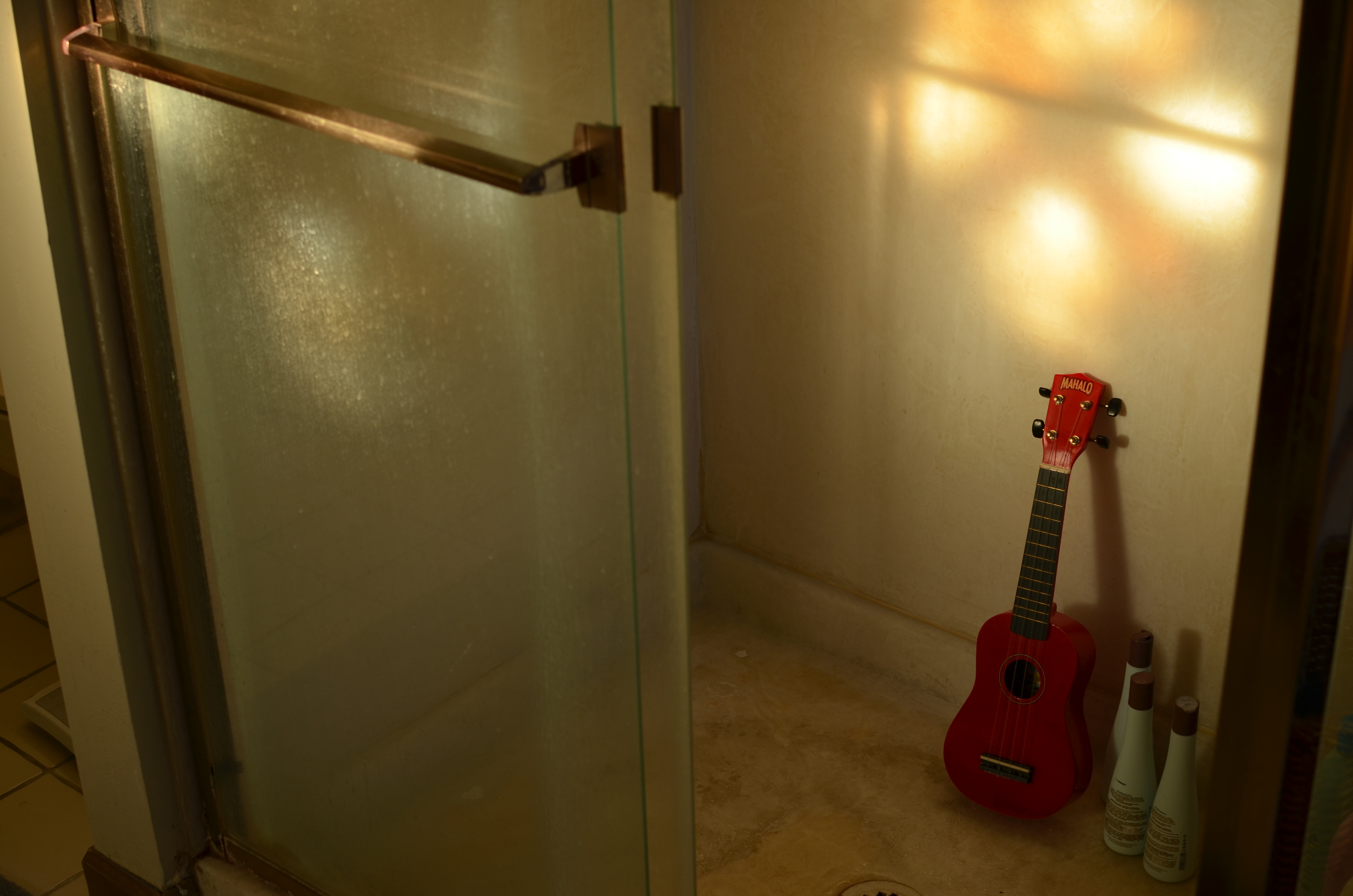
Uke can find good light showering down anywhere. 1/60 sec., f/4.5, ISO 100, 35mm.
The above image was the result of pure seat-of-the-pants whimsy, a momentary impulse to try an idea just to see what happens. However, it was a lucky reworking of available light that drew me to the location before the idea took shape.
I have written volumes on how very harsh the pure midday sunlight is in Arizona, and how it can only be of use if it is filtered or softened in some way. To that end, I have identified various sites around my house which get that done beautifully, depending on where the sun is in the sky during different parts of the day. Some of these sites occur just inside the garage, in the living room, and in a spare bedroom, and shoots will work wonderfully depending on when and where you schedule them. Best of all, the house apparently still holds a few more surprises.
Several days ago, I discovered a new and most unusual site…..a dense art window just to the left of our master bathroom shower stall, which turns out to be a triple softener for late afternoon light, just pre-golden hour. As light streams through the window, it gets softened for the first time, then hits the mirrored closet doors on the opposite wall, where it diffuses some more. Bouncing off the mirror, it then angle-bounces to the back wall of the shower stall, still fairly bright but now really fuzzed out and warm. And that’s where I saw it, as I was walking through the room.
As soon as I spotted the light, I started brainstorming about what kind of object I might stage in this little “studio”, and I hit on the idea of a ukulele, since I always have scads of them around the house, they’re colorful, and it’s kind of an absurd variation on the whole “singing in the shower” cliche. I liked the shot from a purely light effect standpoint, and the unique shaping of the glow in that space will definitely be back for a return engagement.
Maybe a saxophone….
ONE OUT OF FOUR
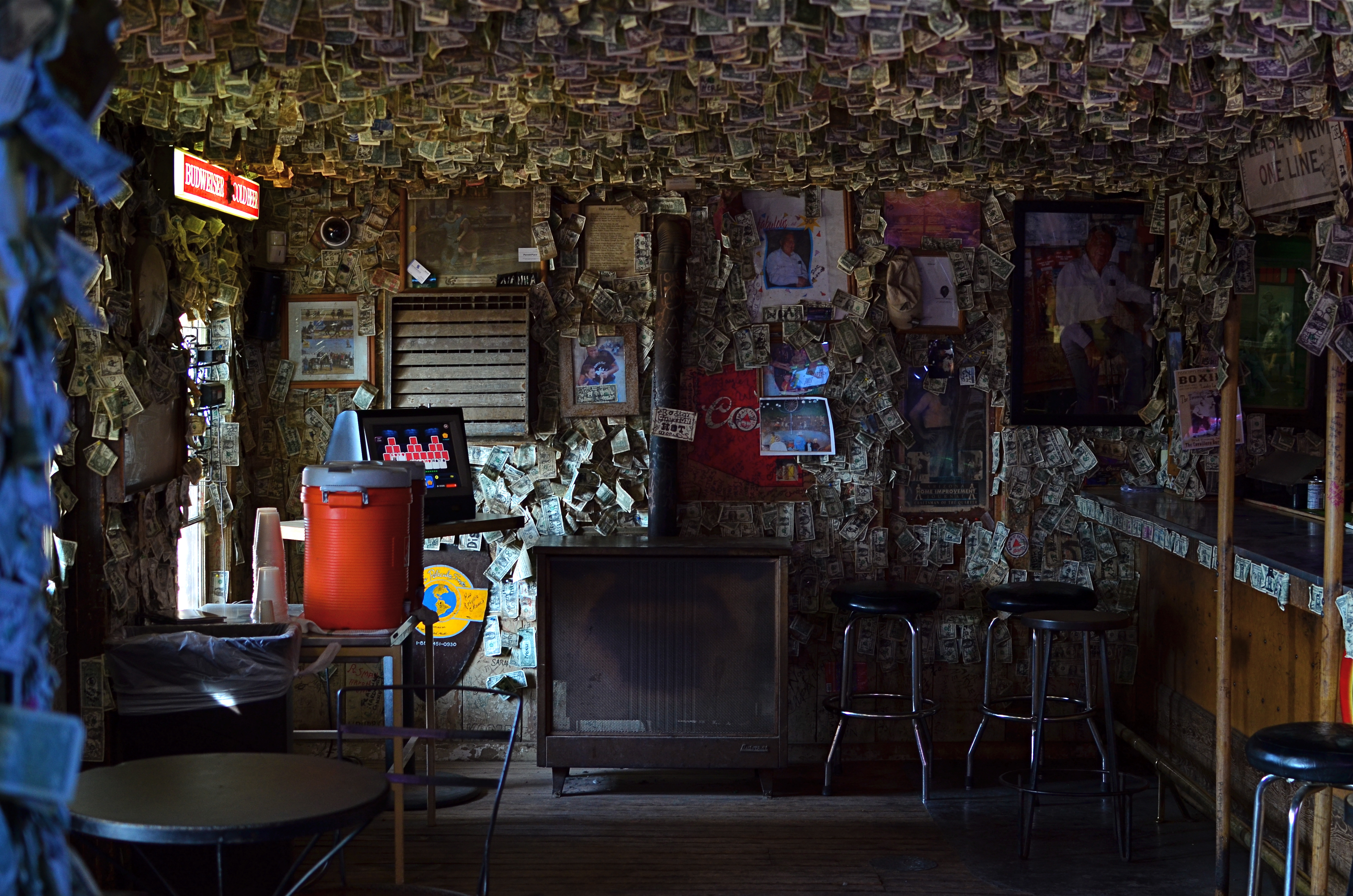
Main bar, Greasewood Flats, Arizona, 1/12/14. 1/30 sec., f/3.5, ISO 250, 35mm.
By MICHAEL PERKINS
IF YOU ARE DEPENDENT ON NATURAL LIGHT FOR YOUR ONLY SOURCE OF ILLUMINATION IN AN IMAGE, you have to take what nature and luck afford you. Making a photograph with what’s available requires flexibility, patience, and, let’s face it, a sizable amount of luck. It means waiting for your moment, hell, maybe your instant of opportunity, and it also means being able to decide quickly that now is the time (perhaps the only time) to press the button.
I recently had such a situation, measured in the space of several seconds in which the light was ready and adequate for a shot. And, as usual, the subject seemed as if it would serve up anything but acceptable conditions. The main bar of the classic western “joint” named Greasewood Flats, just outside of northern Scottsdale, Arizona, is anything but ideal in its supply of available light. Most of the room is a tomb, where customers become blobby silhouettes and fixtures and features are largely cloaked in shadow. I had squeezed off a few shots of customers queued up for bar orders, and they all registered as shifting shadows. The shots were unworkable, and I turned my attention to the fake-cowboy-ersatz-dude-ranch flavor of the grounds outside the bar, figuring that the hunt inside would be fruitless.
Minutes later, I was sent back inside the building to fetch a napkin, and found the bar empty of customers. I’m talking no human presence whatever. In an instant, I realized that the outside window light, which was inadequate to fill a four-sided, three-dimensional space, was perfectly adequate as it spread along just one wall. With crowds out of the way, the rustic detail that made the place charming was suddenly a big still-life, and the whole of that single wall was suddenly a picture. My earlier shots were too constrasty at f/5.6, so I tried f/3.5 and picked up just enough detail to fill the frame with Old West flavor. Click.
All natural light is a gift, but it does what it wants to do, and, to harness it for a successful shot, you need to talk nice, wait your turn, and remember to give thanks. And, in a dark room, be happy with one wall out of four that wants to work with you.
MORE BOUNCE TO THE OUNCE
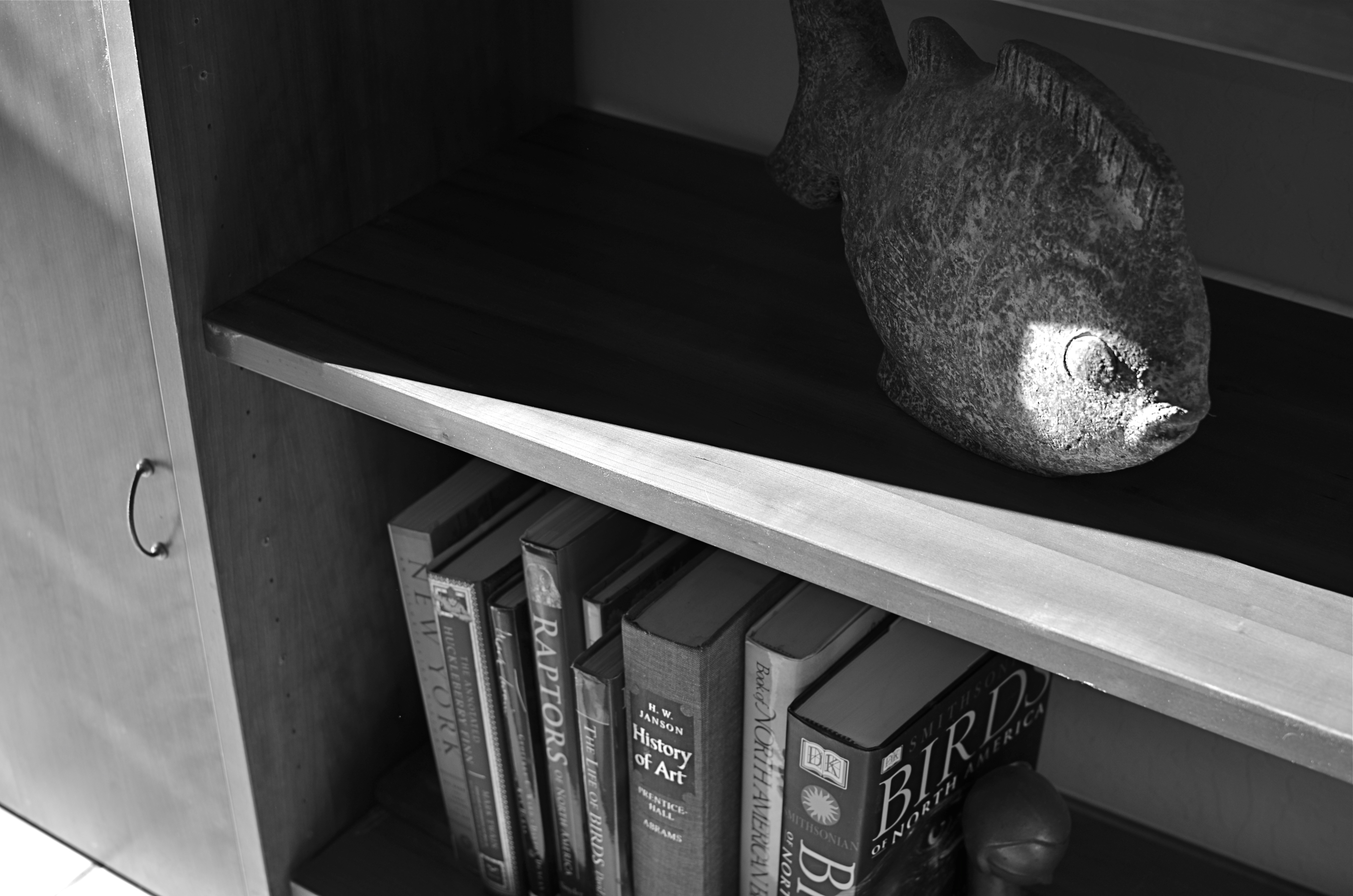
Fish ‘n’Books, 2013. 1/200 sec., f/3.5, ISO 100, 35mm.
By MICHAEL PERKINS
FOR THE MOST PART, THE USE OF ON-CAMERA FLASH SHOULD BE CONSIDERED A CRIME AGAINST HUMANITY. Scott Kelby, the world’s best-selling author of digital photography tutorials, famously remarked that “if you have a grudge against someone, shoot them with your pop-up flash, and it will even the score.” But, to be fair, let’s look at the pros and cons of using on-board illumination:
PROS : Cheap, handy
CONS: Harsh, Weak, Unflattering, Progenitor of Red-eye. Also, Satan kills a puppy every time you use it. Just sayin’.
There are, however, those very occasional situations where supplying a little bit of extra light might give you just the fill you need on a shot that is getting 90% of its light naturally. Even so, you have to employ trickery to harness this cruel blast of ouch-white, and simple bounces are the best way to get at least some of what you want.
In the above situation, I was shooting in a hall fairly flooded with bright mid-morning light, which was extremely hot on the objects it hit squarely but contrasty as an abandoned cave on anything out of its direct path. The fish sculpture in my proposed shot was getting its nose torched pretty good, but in black and white, the remainder of its body fell off sharply, almost to invisibility. I wanted the fish’s entire body in the shot, the better to give a sense of depth to the finished picture, but I obviously couldn’t flash directly into the shelf that overhung it without drenching the rest of the scene in superfluous blow-out. I needed a tiny, attenuated, and cheap fix.
Bending a simple white stationery envelope into a “L”, I popped up my camera’s flash and covered the unit with the corner of the envelope where the two planes intersected. The flash was scooped up by the envelope, then channeled over my shoulder, blowing onto the wall at my back, then bouncing back toward the fish in softened condition near the underside of the shelf, allowing just enough light to allow the figure’s bright nose to taper back gradually into shadow, revealing additional texture, but not over-illuminating the area. It took about five tries to get the thing to look as if the light could have broken that way naturally. Fast, cheap, effective.
The same principle can be done, with some twisting about, to give you a side or ceiling bounce, although, if high reflectivity is not crucial, I frankly recommend using your hand instead of the envelope, since you can twist it around with greater control and achieve a variety of effects.
Of course, the goal with rerouting light is to look as if you did nothing at all, so if you do save a picture with any of these moves, keep it to yourself. Oh, yes, you say modestly, that’s just the look I was going for.
Even as you’re thinking, whew, fooled ’em again.
ASSISTANTS AND APPROACHES
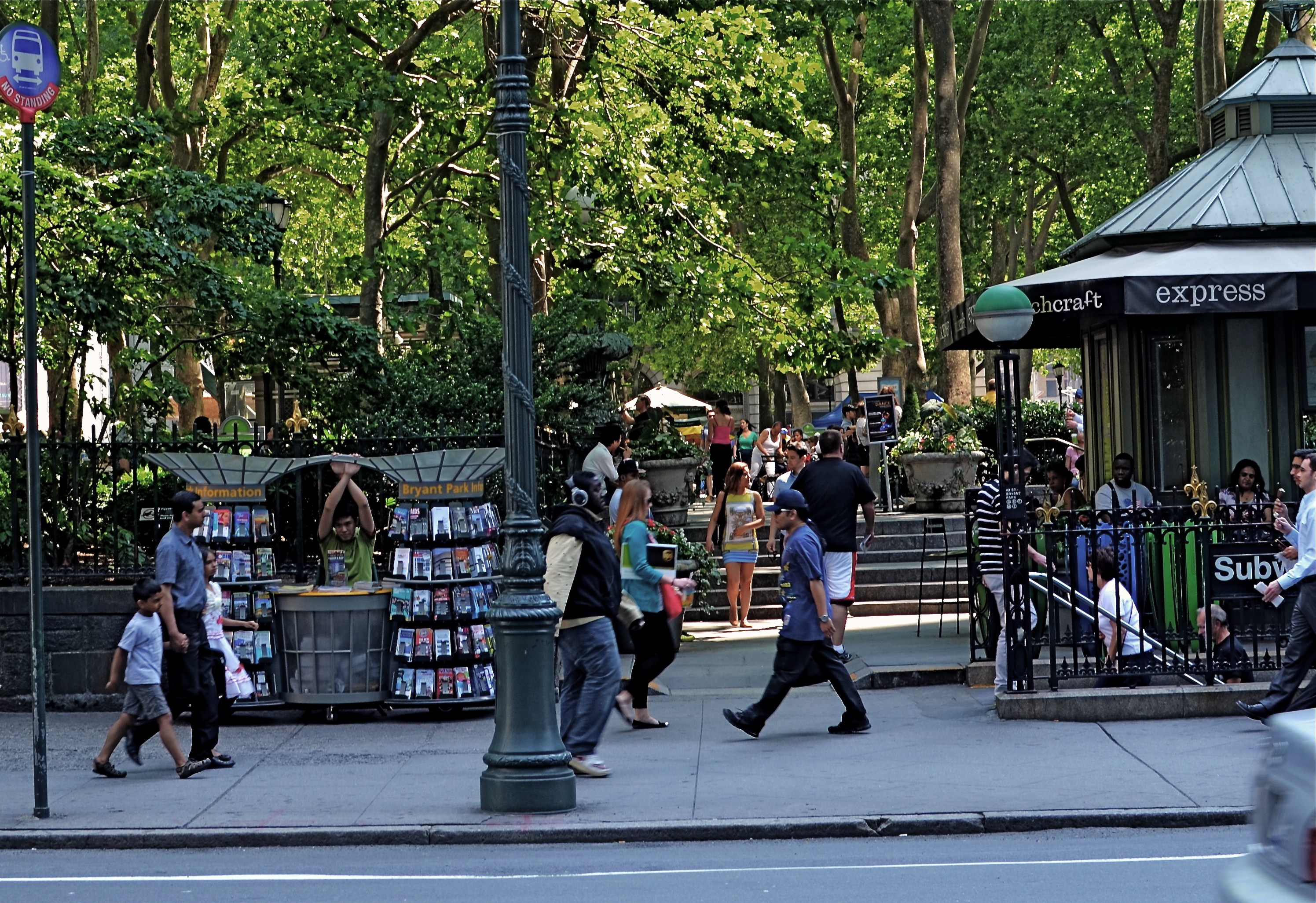
Bryant Park Tableau, 2013. 1/100 sec., f/5.6, ISO 100, 35mm.
By MICHAEL PERKINS
WHO CAN SAY WHY SOMETHING CALLS OUT TO US VISUALLY? I have marveled at millions of moments that someone else has chosen to slice off, isolate, freeze and fixate on, moments that have, amazingly, passed something along to me in their photographic execution that I would never have slowed to see in the actual world. It’s the assist, the approach, if you will, of the photographer that makes the image compelling. It’s the context his or her eye imposes on bits of nature that make them memorable, even unforgettable.
It’s occurred to me more than once that, given the sheer glut of visual information that the current world assaults us with, the greatest thing a photographer can do is at least arrest some of it in its mad flight, slow time enough to make us see a fraction of what is racing out of our reach every second. I don’t honestly know what’s more fascinating; the things we manage to freeze for further consideration, or the monstrous ocean of visual data that is lost, constantly.
There’s a reason photography has become the world’s most loved, hated, trusted, feared, and treasured form of storytelling. For the first time in human history, these last few centuries have afforded us to catch at least a few of the butterflies of our fleeting existence, a finite harvest of the flurrying dust motes of time. It’s both fascinating and frustrating, but, like spellbound suckers at a magic show, we can’t look away, even when the messages are heartbreaking, or horrible.
We are light thieves, plunderers on a boundless treasure ship, witnesses.
Assistants to the seeing eye of the heart.
It’s a pretty good gig.
THE PARTY’S OVER
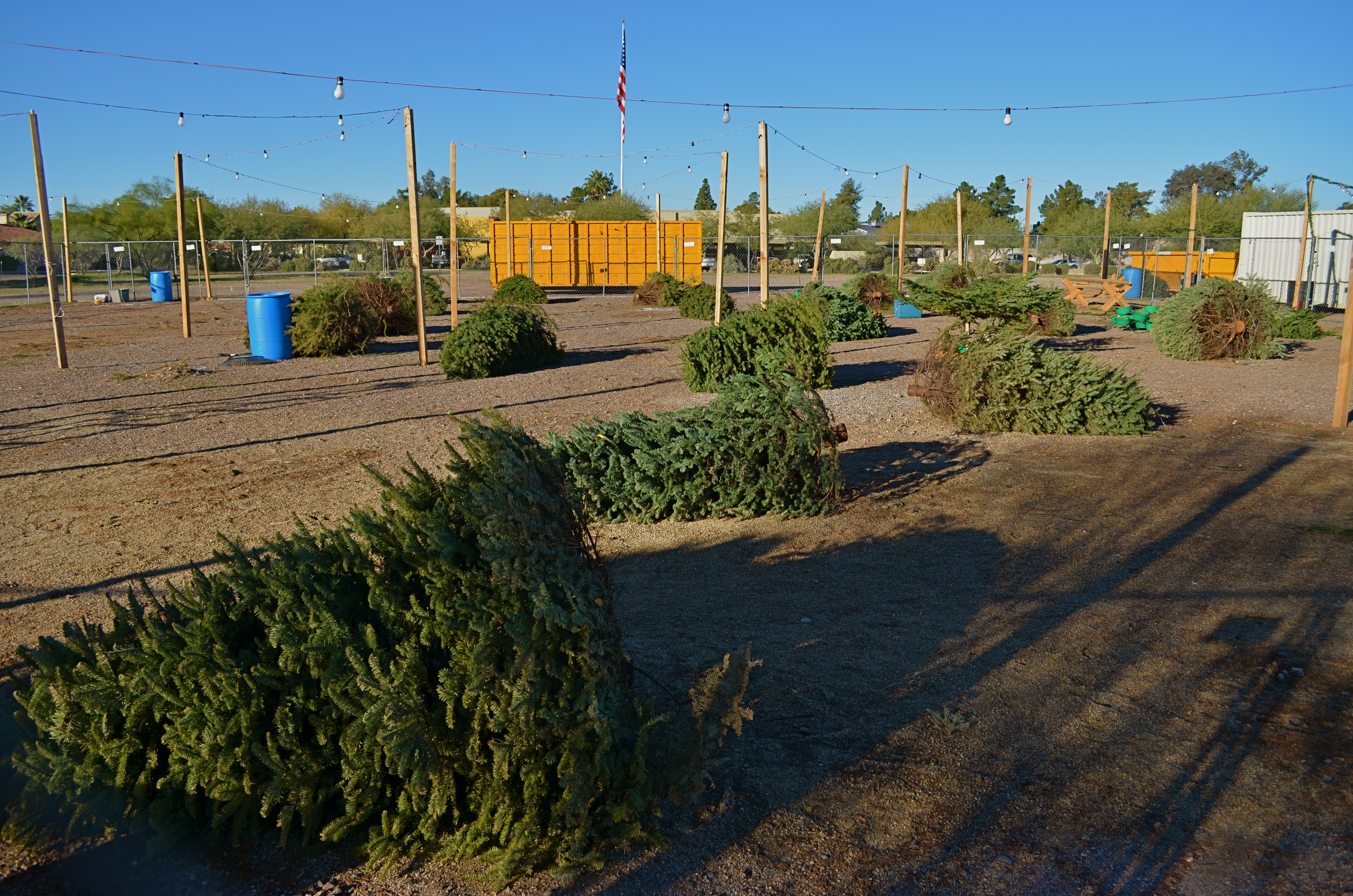
The Leavings: Christmas Tree Lot, Phoenix, AZ, 12/26/13. 1/500 sec., f/5.6, ISO 100, 18mm.
By MICHAEL PERKINS
PHOTOGRAPHY IS THE SCIENCE OF SECONDS. The seconds when the light plays past you. The seconds when the joy explodes. The seconds when maybe the building explodes, or the plane crashes. The micro moments of emotion’s arrivals and departures. Here it comes. There it goes. Click.
We are very good with the comings….the beginnings of babies, the opening of a rose, the blooming of a surprised smile. However, as chroniclers of effect, we often forget to also document the goings of life. The ends of things. The moment when the party’s over.
Christmas is a time of supreme comings and goings, and we have more than a month of ramp-up time each year during which we snap away at what is on the way. The gatherings and the gifts. The approaching joy. But a holiday this big leaves echoes and vacuums when it goes away, and those goings are photo opportunities as well.
This year, on 12/26, the predictably melancholy “morning after” found me driving around completely without pattern or design, looking for something of the magic day that had departed. I spun past the abandoned ruin of one of those temporary Christmas tree lots that sprout in the crevices of every city like gypsy camps for about three weeks out of the year, and something about all its emptiness said picture to me, so I got out and started bargaining with a makeshift cyclone fence for a view of the poles, lights and unloved fir branches left behind.
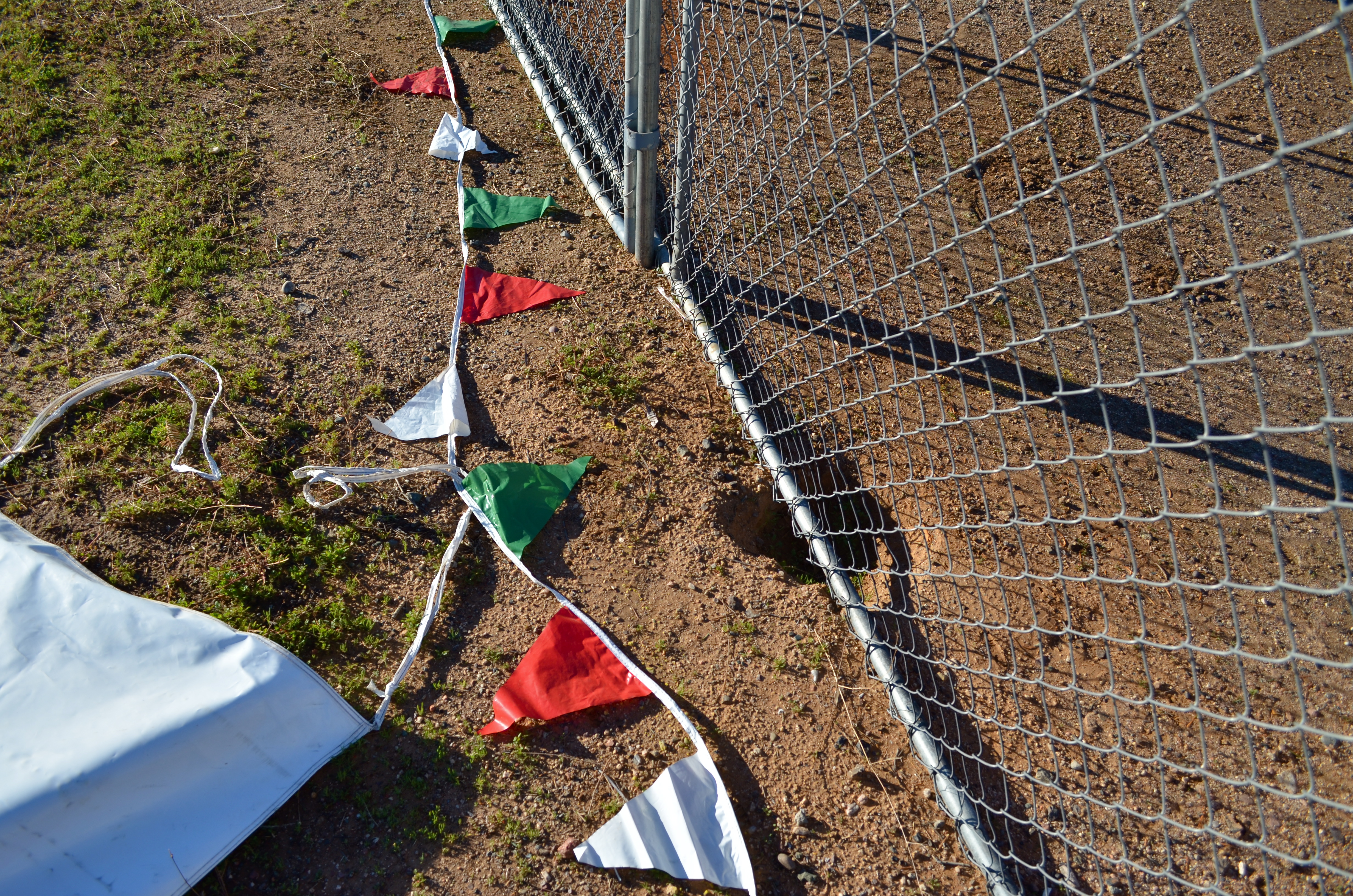
Pack up and get out of town.
The earliness of the hour meant that the light was a little warmer and kinder than would be the case later on in the bleached-out white of an Arizona midday, so the scene was about as nice as it was going to get. But what I was really after was the energy that goes out of things the day the circus drives out of town. The holidays are ripe with that feeling of loss, and, to me, it’s at least as interesting as recording the joy. Without a little tragedy you don’t appreciate triumph, and all that. Christmas trees are just such an obvious measure of that flow: one day you’re selling magic by the foot, the next day you’re packing up trash and trailer and making your exit.
Photographs come when they come, and, unlike us, they aren’t particular about what their message is. They just present chances to see.
Precious chances, as it turns out.
ANOTHER YEAR OUT THE WINDOW
By MICHAEL PERKINS
IF YOU WANT TO PUT A SMILE ON MY FACE WHEN I VISIT YOUR CITY, there is no sweeter sentence you can say to me than:
“I’ll drive”.
There is, for photographers, one way to maximize your time touring through other people’s towns, and that’s the time-honored tradition of “riding shotgun”. Drive me anywhere, but give me a window seat. I wasn’t trying to go for some kind of personal best in the area of urban side shots in 2013, but by good fortune I did snag a few surprises as I was ferried through various towns, along with a “reject” pile about a mile high. Like any other kind of shooting, the yield in window shooting is very low in terms of “killers per click”, but when you hit the target, you crack through a kind of “I’m new in town” barrier and take home a bit of the street for your own.
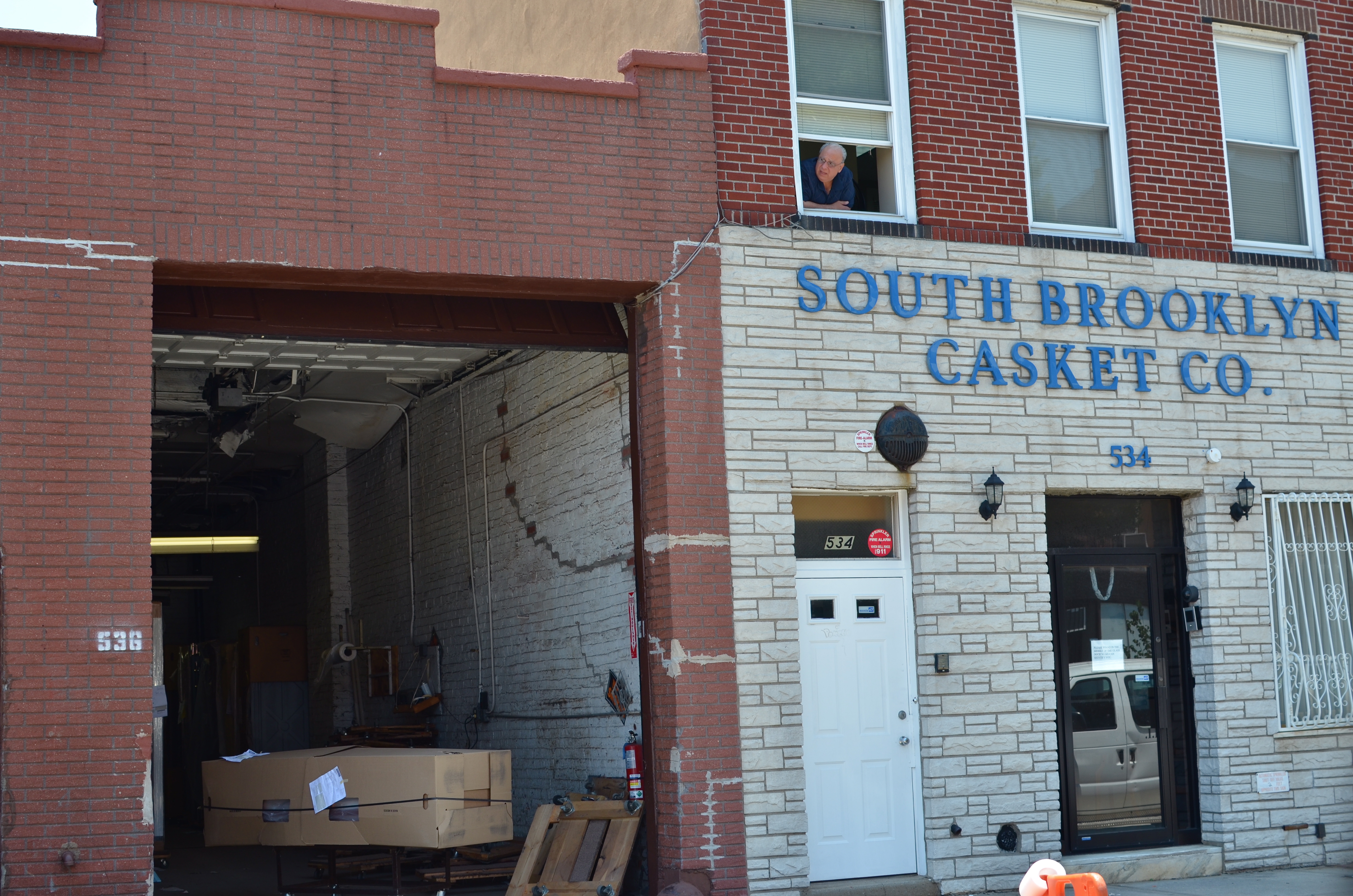
Business has been really dead lately. 1/250 sec., f/5.6, ISO 100, 35mm.
This guy just killed me (excuse the expression). He seemed like he was literally waiting for business to drop in (or drop dead), and meanwhile was taking in the view. Probably he didn’t even work for the casket company, in which case, what a bummer of neighbor to pick. Maybe he’s rent controlled.
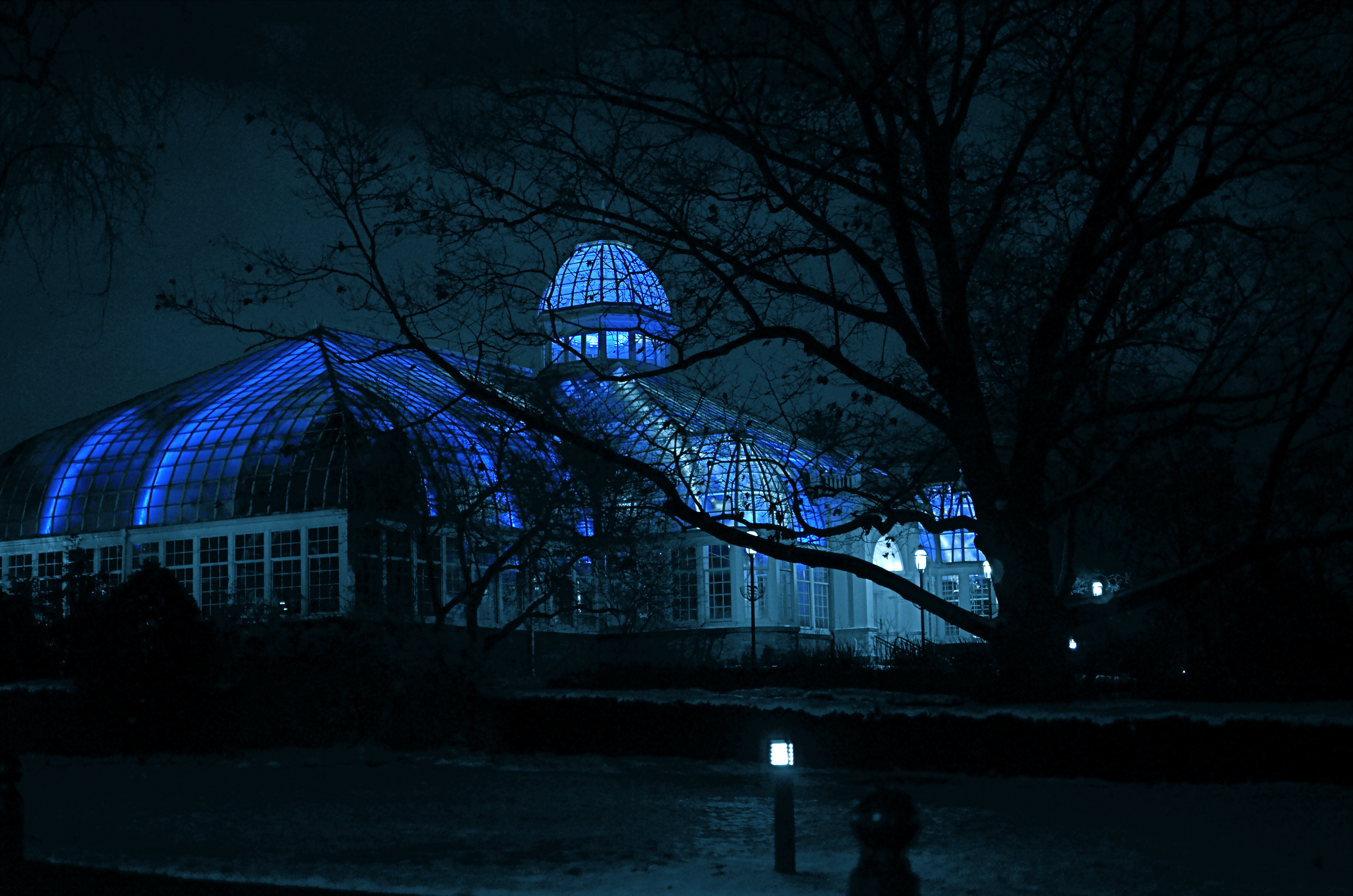
Franklin Park Conservatory, Columbus, Ohio. 1/40 sec., f/1.8, ISO 500, 35mm.
This one took a little tweaking. The building was actually blue, as you see here, lit with subdued mood for the holidays. However, in lightening this very dark shot, the sky registered as a muddy brown, so I made a dupe, desaturated everything except the conservatory, then added tint back in to make the surrounding park area match the building. All rescued from an “all or nothing” shot.
I’m also ashamed to admit that I bagged a few through-the-window shots while actually driving the car, all done at red lights and so not recommended. Don’t do as I do, do as I……oh, you know.
Here’s to long shots, at horse tracks or in viewfinders, and the few that finish in the money.
KICK-STARTING THE ENGINE
By MICHAEL PERKINS
THE POPULAR IMAGE OF A BLOCK-STRICKEN WRITER HELPLESSLY STARING AT A BLANK PAGE is enough to send an empathetic chill up the spine of anyone who has ever been haunted by a deadline or stymied by a narrative suddenly gone dry. And I am convinced, as both a writer and a photographer, that there is an equivalent “block” lurking in the shadows for any shooter, a visual desert that produces stretches of formless, pointless images, dry spells that are terrifying because they are open-ended. No one knows why, for everyone from time to time, the pictures stop coming, and no one can predict when they will come back.
It’s terrifying, because it’s as if vision or imagination were accounts that one can overdraw, bouncing artistic checks all over town and leaving you feeling, like Alice, that there is no bottom, only more hole. At least it’s terrifying to me.
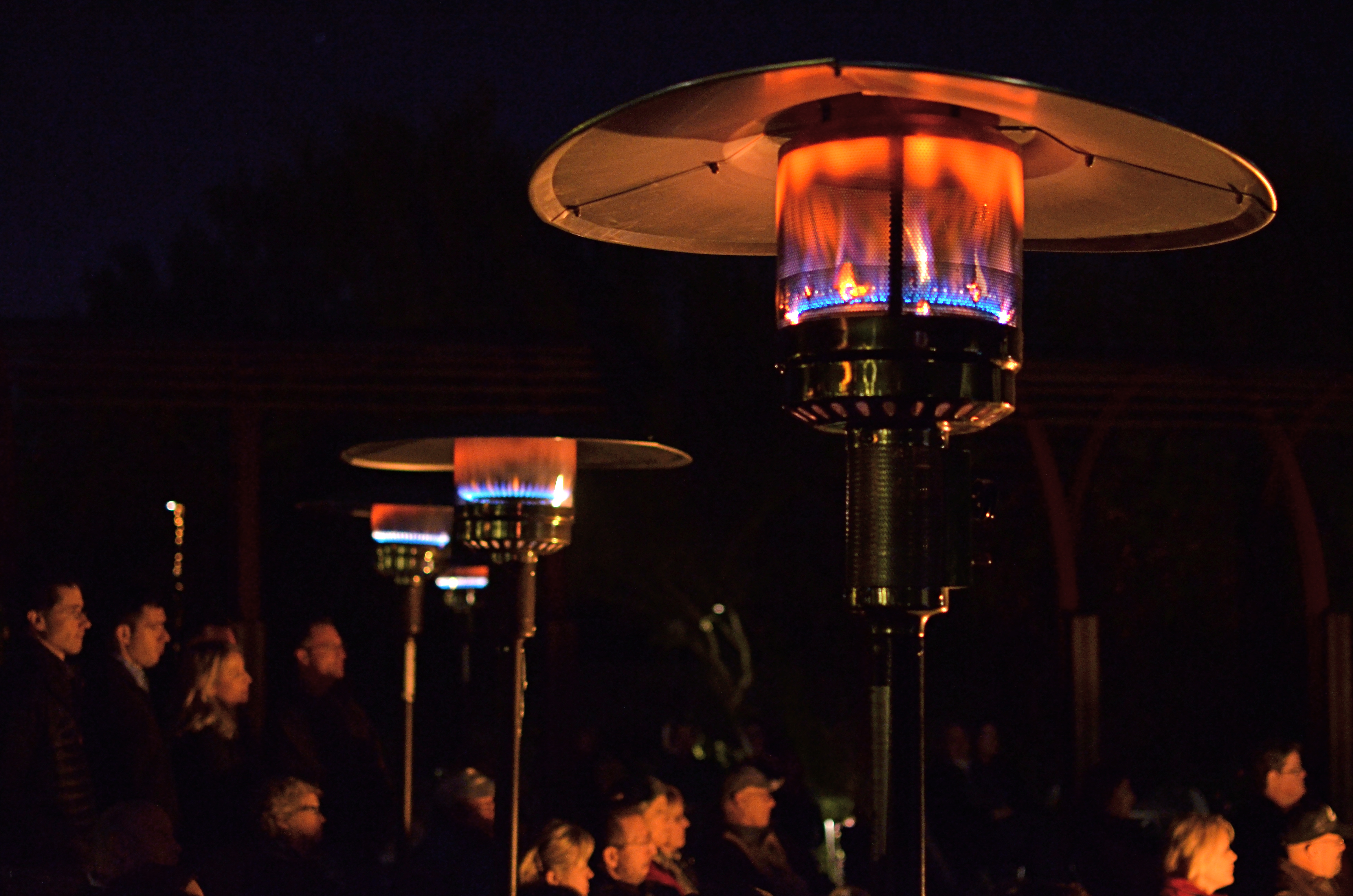
Torchlight Parade, 12/14/13. 1/40, f/2.5, ISO 1000, 35mm. You work your way through dry spells with what’s at hand.
As I write this, I have just come off several weeks of scrapings and scraps that should have been photographs but instead are equivalent to something smeared by an ape on his cage wall. I have seldom experienced such an extended period of mega-nothing, and it is only my unswerving oath to myself to shoot something, anything, every single day, that has allowed me to keep faith with the inevitable return of whatever eye I sometime possess. But, I have to admit, I am also suppressing strong urges to, like Norman Bates, lock my camera inside a car trunk and seek out the nearest swamp.
Okay, that’s a tad dramatic, but my current case of the “drys” is unnerving for a particular reason. I am typically able to conjure pictures out of nearly nothing, which is more liberating than having to wait for obvious or “big” projects. You can shoot daily if you can get off on still lifes of plastic spoons. You can’t shoot daily if you need a vacation, a birthday, or a mountain for inspiration. So it’s doubly troubling if you can’t even summon up the humble crumbs needed for some kind of image.
I know, that, at one point or another, something will demand my attention/obsession, and we’ll be off to the races again. But there is always the nagging question. What happens if I can’t kick-start the engine? Everything has a beginning and an end. So…?
Oh, wait, the light is doing something really cool just now…..
CROP YOUR WAY TO SUCCESS
By MICHAEL PERKINS
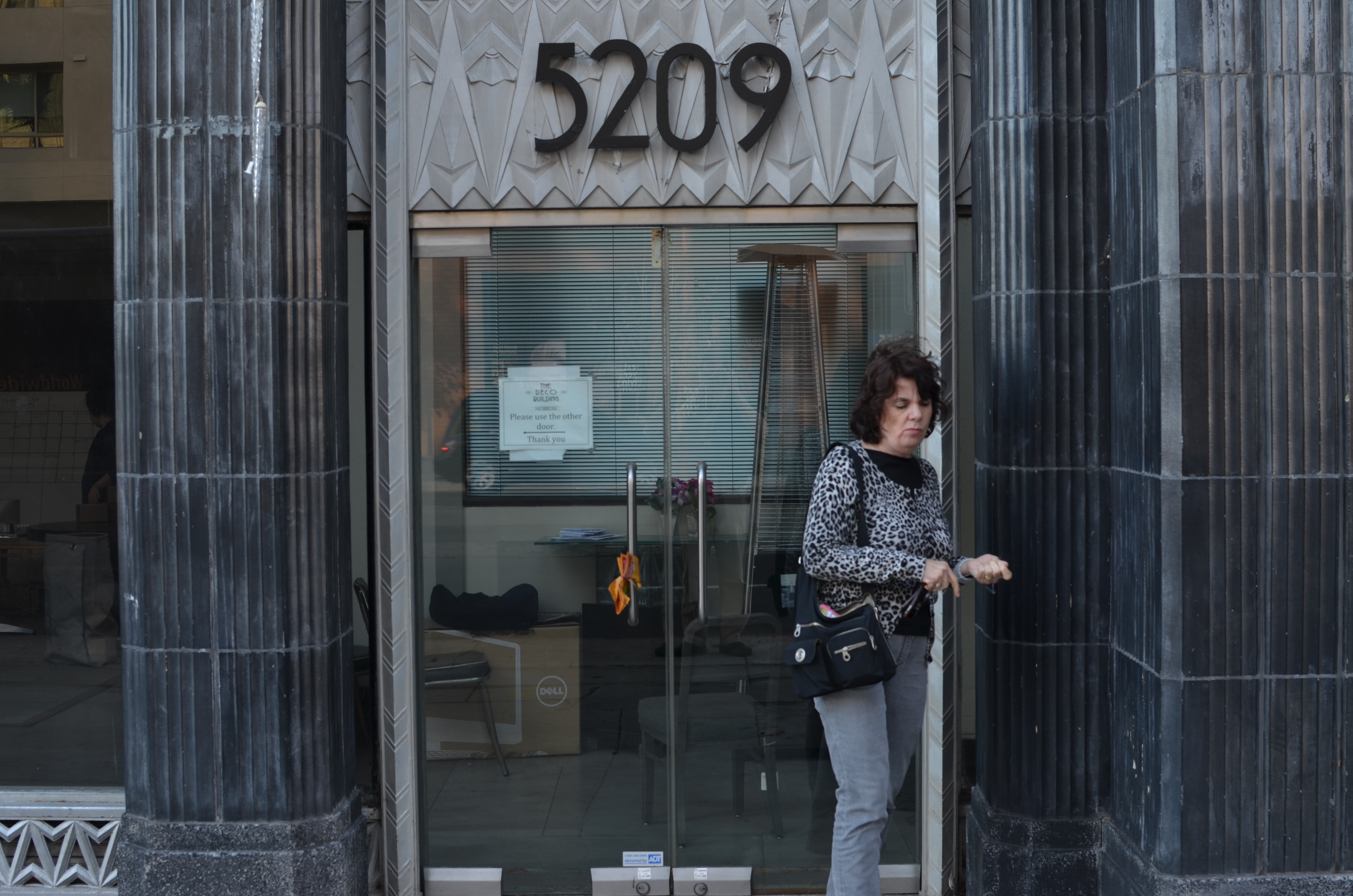
Whoops, I wasn’t ready. 1/100 sec., f/5.6, ISO 100, 35mm.
THOSE OF US WHO HAVE LOGGED SOME TIME IN THE WAITING ROOMS OF PEDIATRICIANS can recall struggling through the “Hidden Pictures” page of Highlights For Children magazine. I would love to tell you that I always found 100% of cartoonist John Gee’s camoflaged squiggles by the time the receptionist invited me into the examining room. But I would be lying.
That said, there are many times when, as photographers, we play the same game with our images, especially the ones in the “doesn’t work” pile. Loving at least the idea behind what we were originally after, we pore over every pixel in the frame, repeating the vain mantra there must be a picture in here somewhere. Often, the photo simply returns to the Hall of Shame despite our best efforts to redeem it. Sometimes, the crop tool is your unexpected best friend.
I recently looked at a failed candid of my wife outside one of my favorite buildings in Los Angeles, the “Deco” Building (real name) at the corner of La Brea and Wilshire near the museum district. A combination of wind and facial expression had spoiled the quickie portrait, but the address panel over Marian’s head contained something I could use if I re-purposed the picture.
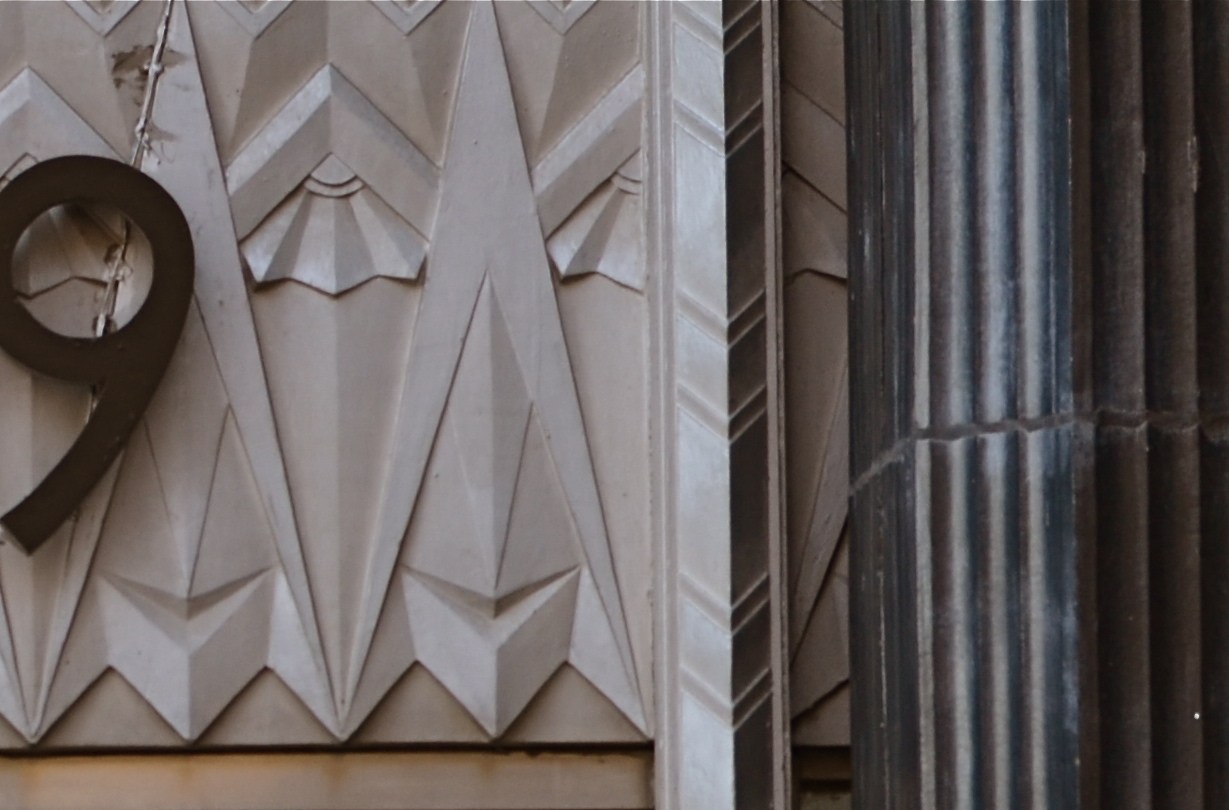
I gave the above shot a severe haircut and wound up with this. Hmm, maybe this was all the picture I needed in the first place.
In the space of a few inches of the building’s entrance was a miniature representation of the best features of the entire building; its wild pattern of chevrons and zigzags. I had already done a master shot of about 90% of the front of the place, but a study of its details started to sound appealing. Cropping away more than 2/3rds of the original shot reduced the sharpness a little, but since I always shoot at the highest file size possible, I just squeaked by.
For a moment, I found that I had redeemed all those failed sessions with Highlights.
Watch out, New York Times crossword. You’re next.
DO SOMETHING MEANINGLESS
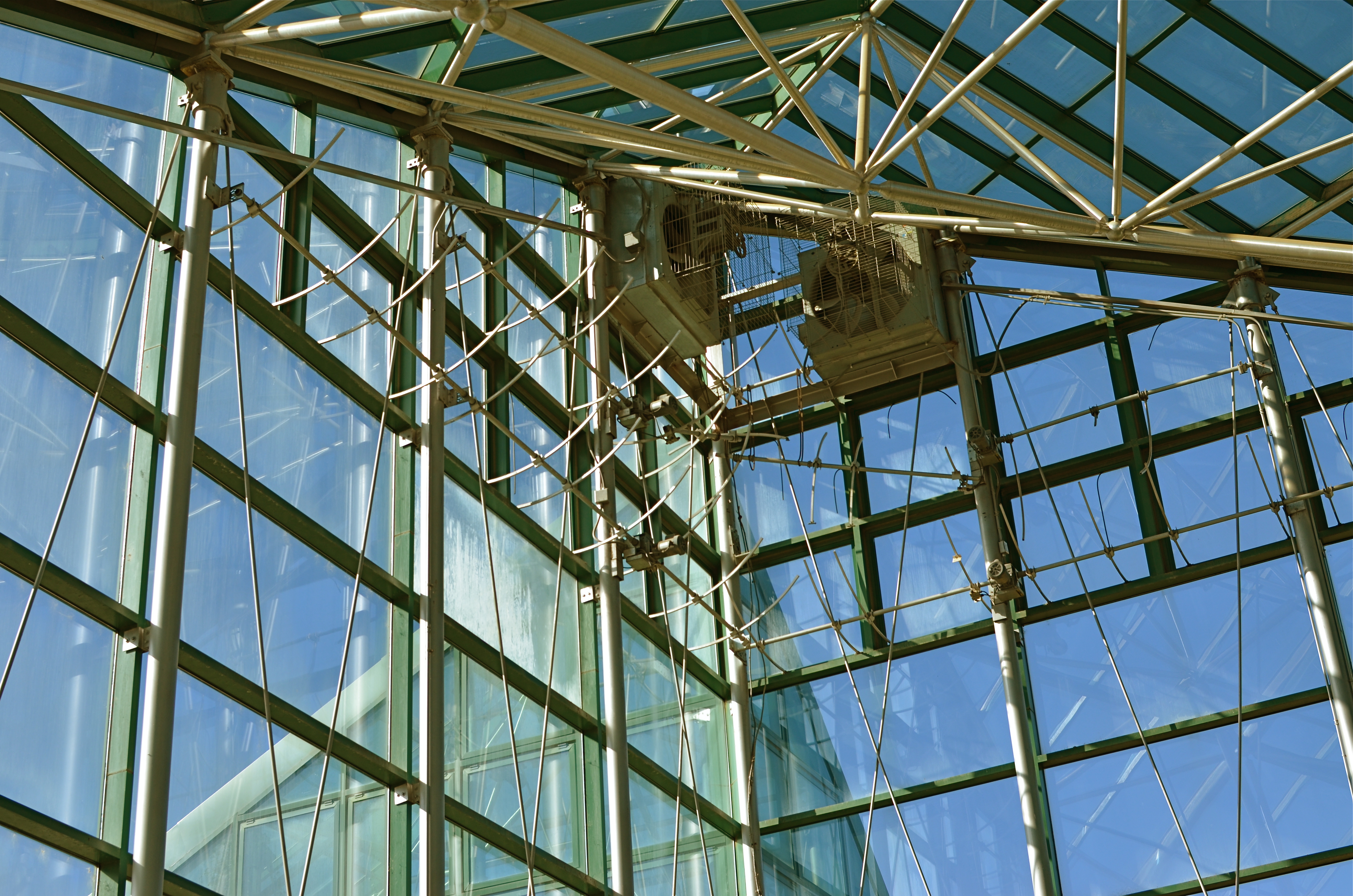
The subject matter doesn’t make the photograph. You do. A pure visual arrangement of nothing in particular can at least teach you composition. 1/400 sec., f/5.6, ISO 100, 35mm.
By MICHAEL PERKINS
SHOOT WHAT YOU KNOW. SHOOT WHAT YOU LOVE. Those sentences seem like the inevitable “Column A” and “Column B” of photography. And it makes a certain kind of sense. I mean, you’ll make a stronger artistic connection to subject matter that’s near and dear, be it loved ones or beloved hobbies, right? What you know and what you love will always make great pictures, right?
Well….okay, sorta. And sorta not.
I hate to use the phrase “familiarity breeds contempt”, but your photography could actually take a step backwards if it is always based in your comfort zone. Your intimate knowledge of the people or things you are shooting could actually retard or paralyze your forward development, your ability to step back and see these very familiar things in unfamiliar ways.
Might it not be a good thing, from time to time, to photograph something that is meaningless to you, to seek out images that don’t have any emotional or historical context for you? To see a thing, a condition, a trick of the light just for itself, devoid of any previous context is to force yourself to regard it cleanly, without preconception or bias.
Looking for things to shoot that are “meaningless” actually might force you to solve technique problems just for the sake of solving, since the results don’t matter to you personally, other than as creative problems to be solved. I call this process “pureformance” and I believe it is the key to breathing new life into one’s tired old eyes. Shooting pure forms guarantees that your vision is unhampered by habit, unchained from the familiarity that will eventually stifle your imagination.
This way of approaching subjects on their own terms is close to what photojournalists do all the time. They have little say in what they will be assigned to show next. Their subjects will often be something outside their prior experience, and could be something they personally find uninteresting, even repellent. But the idea is to find a story in whatever they approach, and they hone that habit to perfection, as all of us can.
Just by doing something meaningless in a meaningful way.
JUST SAY THANK YOU
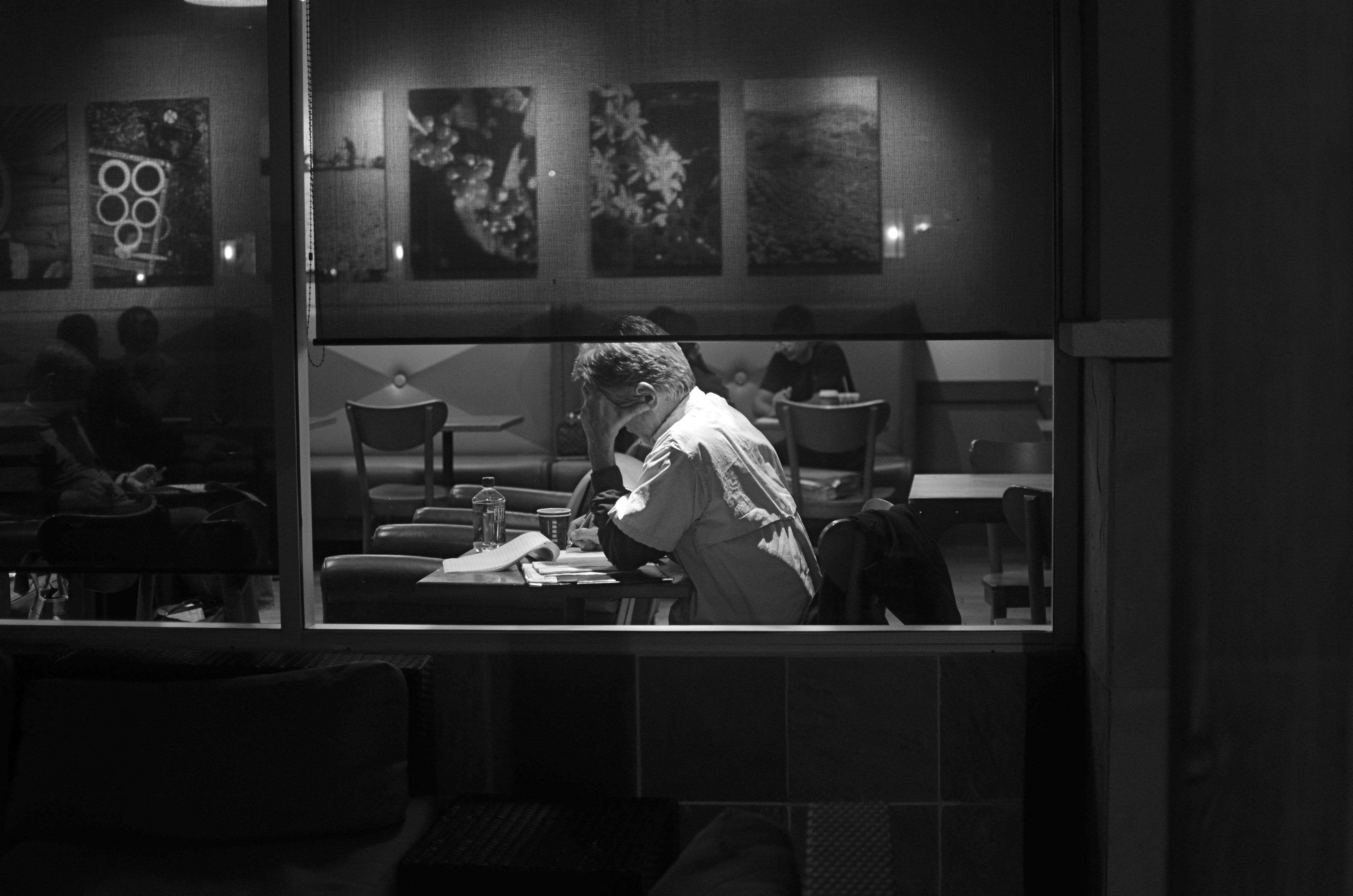
The All-Nighter: 1/60 sec., f/1.8, ISO 800, 35mm.
By MICHAEL PERKINS
PICTURES HAPPEN WHEN YOU’RE OUT TRYING TO TAKE “OTHER” PICTURES. Pictures happen when you didn’t feel like taking any pictures at all. And, occasionally, the planets align perfectly and you hold something in your hand, that, if you are honest, you know you had nothing to with.
Those are the pictures that delight and haunt. They happen on off-days, against the grain of whatever you’d planned. They crop up when it’s not convenient to take them, demanding your attention like a small insistent child tugging at your pants leg with an urgent or annoying issue. And when they call, however obtrusively, however bothersome, you’d better listen.
Don’t over-think the gift. Just say thank you….and stay open.
This is an overly mystical way of saying that pictures are sometimes taken because it’s their time to be taken. You are not the person who made them ready. You were the person who wandered by, with a camera if you’re lucky.
I got lucky this week, but not with any shot I had set out on a walkabout to capture. By the time I spotted the scene you see at the top of this post, I was beyond empty, having harvested exactly zip out of a series of locations I thought would give up some gold. I couldn’t get the exposures right: the framing was off: the subjects, which I hoped would reveal great human drama, were as exciting as a bus schedule.
I had just switched from color to monochrome when I saw him: a young nighthawk nursing some eleventh-hour coffee while poring over an intense project. Homework? A heartfelt journal? A grocery list? Who could tell? All I could see, in a moment, was that the selective opening and closing of shades all around him had given me a perfect frame, with every other element in the room diffused to soft focus. It was as if the picture was hanging in the air with a big neon rectangle around it, flashing shoot here, dummy.
My subject’s face was hidden. His true emotion or state of mind would never be known. The picture would always hide as much as it revealed.
Works for me. Click.
Just like the flicker of a firefly, the picture immediately went away. My target shifted in his chair, people began to walk across the room, the universe changed. I had a lucky souvenir of something that truly was no longer.
I said thank you to someone, packed up my gear, and drove home.
I hadn’t gotten what I originally came for.
Lucky me.
related articles:
- Crop and turn a bad picture into a good one (weliveinaflat.wordpress.com)
FRAGMENTING THE FRAME
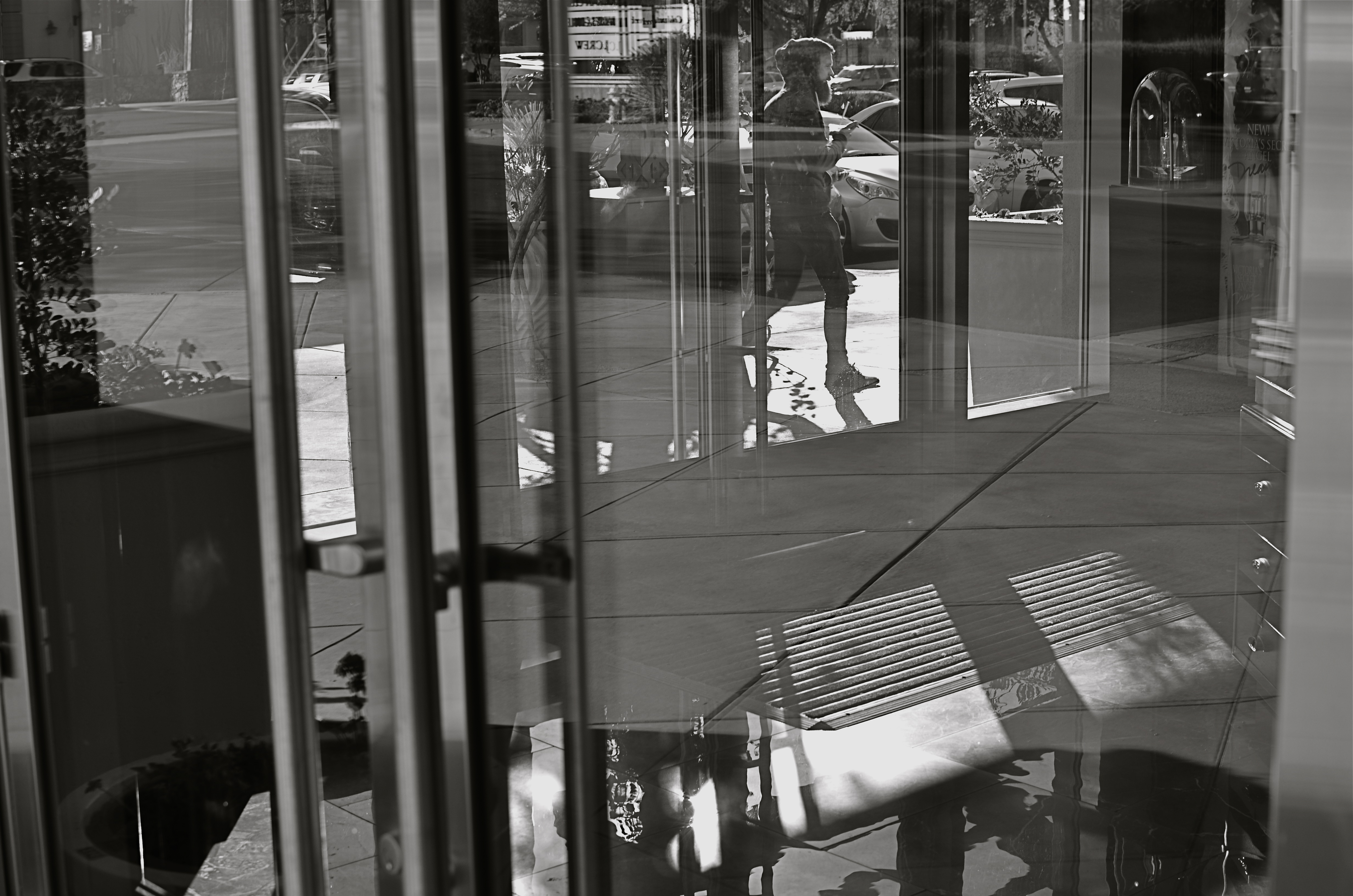
1/160 sec., f/5.6, ISO 100, 35mm.
By MICHAEL PERKINS
I HAVE MADE A CONSCIOUS EFFORT, IN RECENT YEARS, TO AVOID TAKING A “STRAIGHT SHOT” OUT OF, OR THROUGH A WINDOW, of using that rectangle or square as a conventional means of bordering a shot. Making a picture where a standard view of the world is merely surrounded by a typical frame shows my eye nothing at all, whereas the things that fragment that frame, that break it into smaller pieces, bisecting or even blocking information…..that’s fascinating to me.
This is not an arbitrary attempt to be “arty” or abstract. I simply prefer to build a little mystery into my shots, and a straight out-the-window framing defeats that. My showing everything means the viewer supplies nothing of his own. Conversely, pictures that both reveal and conceal, simultaneously, invite speculation and encourage inquiry. It’s more of a conversation.
Think about it like a love scene in a movie. If every part of “the act” is depicted, it’s not romantic, not sexy. It’s what the director leaves out of the scene that fires the imagination, that makes it a personal creation of your mind. Well-done love scenes let the audience create part of the picture. Showing everything is clinical….boring.
With that in mind, The Normal Eye’s topside menu now has an additional image gallery called Split Decisions, featuring shots that attempt to show what can result when you deliberately break up the normal framing in and out of windows. Some of the shots wound up doing what I wanted: others came up short, but may convey something to someone else.
As always, let us know what you think, and thanks for looking.
Related articles
- Framing Framing Framing!!! (destynimcbeth.wordpress.com)
GOING OFF-MENU
By MICHAEL PERKINS
I AM ALREADY ON RECORD AS A CHAMPION OF THE ODD, THE OFF-KILTER, AND THE JOYFULLY STRANGE IN AMERICAN RETAIL. As a photographer, I often weep over the endangered status of the individual entrepreneur, the shopkeeper who strikes out in search of a culturally different vibe, some visual antidote to the tsunami of national chains and marts that threatens to drown out our national soul. Sameness and uniformity is a menace to society and a buzzkill of biblical proportions for photography. Art, like nature, abhors a vacuum.
It is, of course, possible that someone might have created a deathless masterpiece of image-making using a Denny’s or a Kohl’s as a subject, and, if so, I would be ecstatic to see the results, but I feel that the photog’s eye is more immediately rewarded by the freak start-ups, the stubborn outliers in retail, and nowhere is this in better evidence than in eateries. Restaurants are like big sleeves for their creators to wear their hearts on.
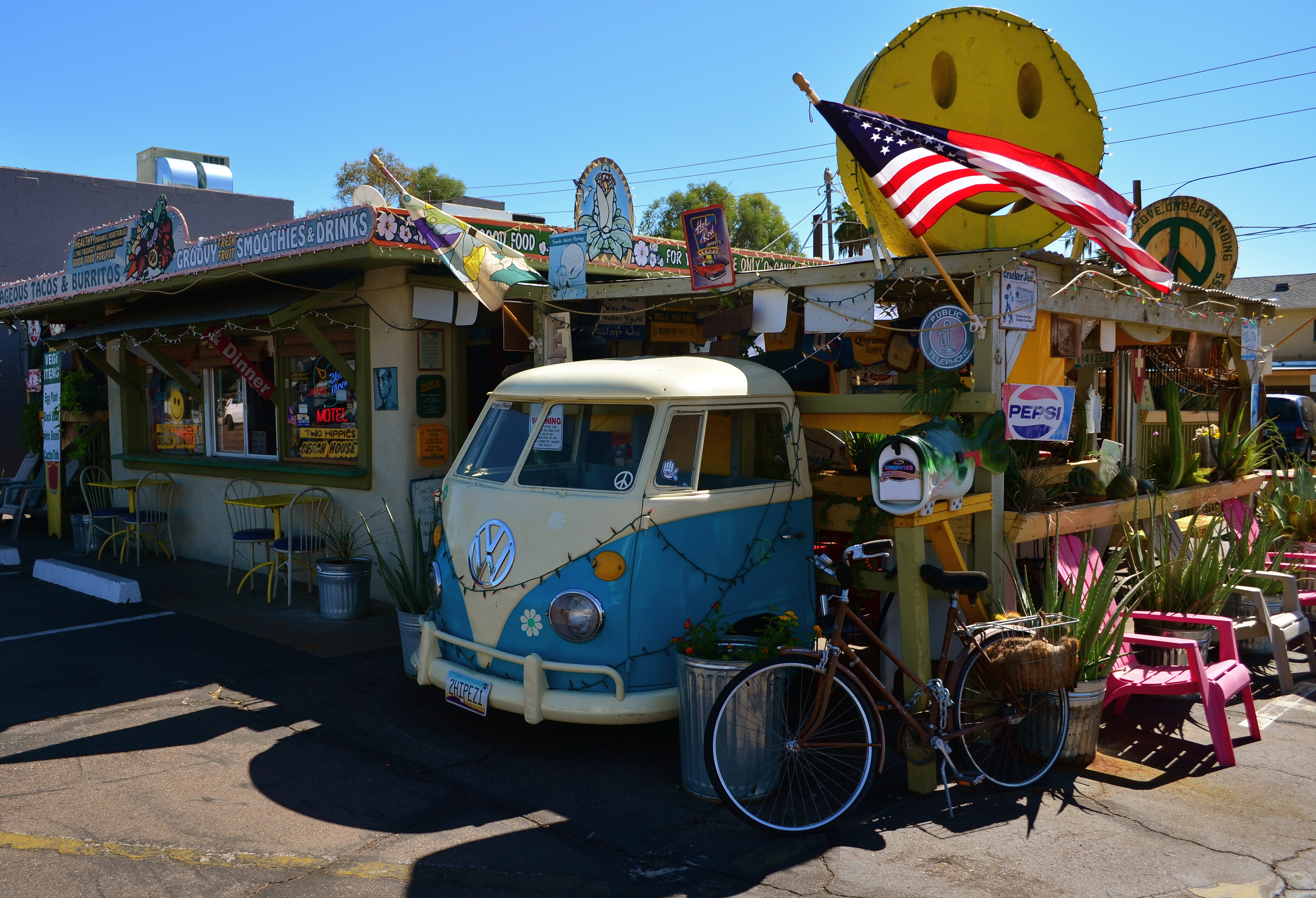
The surf is seldom “up” at the Two Hippies’ Beach House Restaurant in Phoenix, AZ, but the joint is “awash” in mood. 1/640 sec., f/5.6, ISO 100, 18mm.
That’s why this divinely misfit toy of a diner, which was hidden in plain sight on one of the main drags in central Phoenix, has given me such a smile lately. I have never eaten at the swelegant Two Hippies’ Beach House, but I have visually feasted on its unabashed quirkiness. And if the grub is half as interesting as the layout, it must be the taste equivalent of the Summer of Love.
Even if the food’s lousy, well, everyone still gets a B+ anyway for hooking whoever is induced to walk in the door.
On the day I shot this, the midday sun was (and is) harsh, given that it’s, duh, Arizona, so I was tempted to use post-processing to even out the rather wide-ranging contrast. Finally, though, I decided to show the place just as I discovered it. Amping up the colors or textures would have been overkill, as the joint’s pallette of colors is already cranked up to 11, so I left it alone. I did shoot as wide as I could to get most of the layout in a single frame, but other than that, the image is pretty much hands-off.
Whatever my own limited skill in capturing the restaurant, I thank the photo gods for, as the old blues song goes, “sending me someone to love.”
Trippy, man.
Follow Michael Perkins on Twitter @MPnormaleye.
TAKE WHAT YOU NEED AND LEAVE THE REST
By MICHAEL PERKINS
LOOKING OVER MY LIFETIME “FAIL” PHOTOGRAPHS, FROM EARLIEST TO LATEST, it’s pretty easy to make a short list of the three main problems with nearly all of them, to wit:
Too Busy.
Too Much Stuff Going On.
I Don’t Know Where I’m Supposed To Be Looking.
Okay, you got me. It’s the same problem re-worded three ways. And that’s the point, not only with my snafus but with nearly other picture that fails to connect with anybody, anywhere. As salesmen do, photographers are always “asking for the order”, or, in this case, the attention of the viewer. Often we can’t be there when our most earnest work is seen by others. If the images don’t effectively say, this is the point of the picture, then we haven’t closed the deal.
It’s not simple, but, yeah, it is that simple.
If we don’t properly direct people to the main focus of our story, then we leave our audiences wandering in the woods, looking for a way out. Is it this path? Or this one?
In our present era, where it’s possible to properly expose nearly everything in the frame, we sometimes lose a connection to the darkness, as a way to cloak the unimportant, to minimize distraction, to force the view into a succinct part of the image. Nothing says don’t look here like a big patch of black, and if we spend too much time trying to show everything in full illumination, we could be throwing away our simplest and best prop.
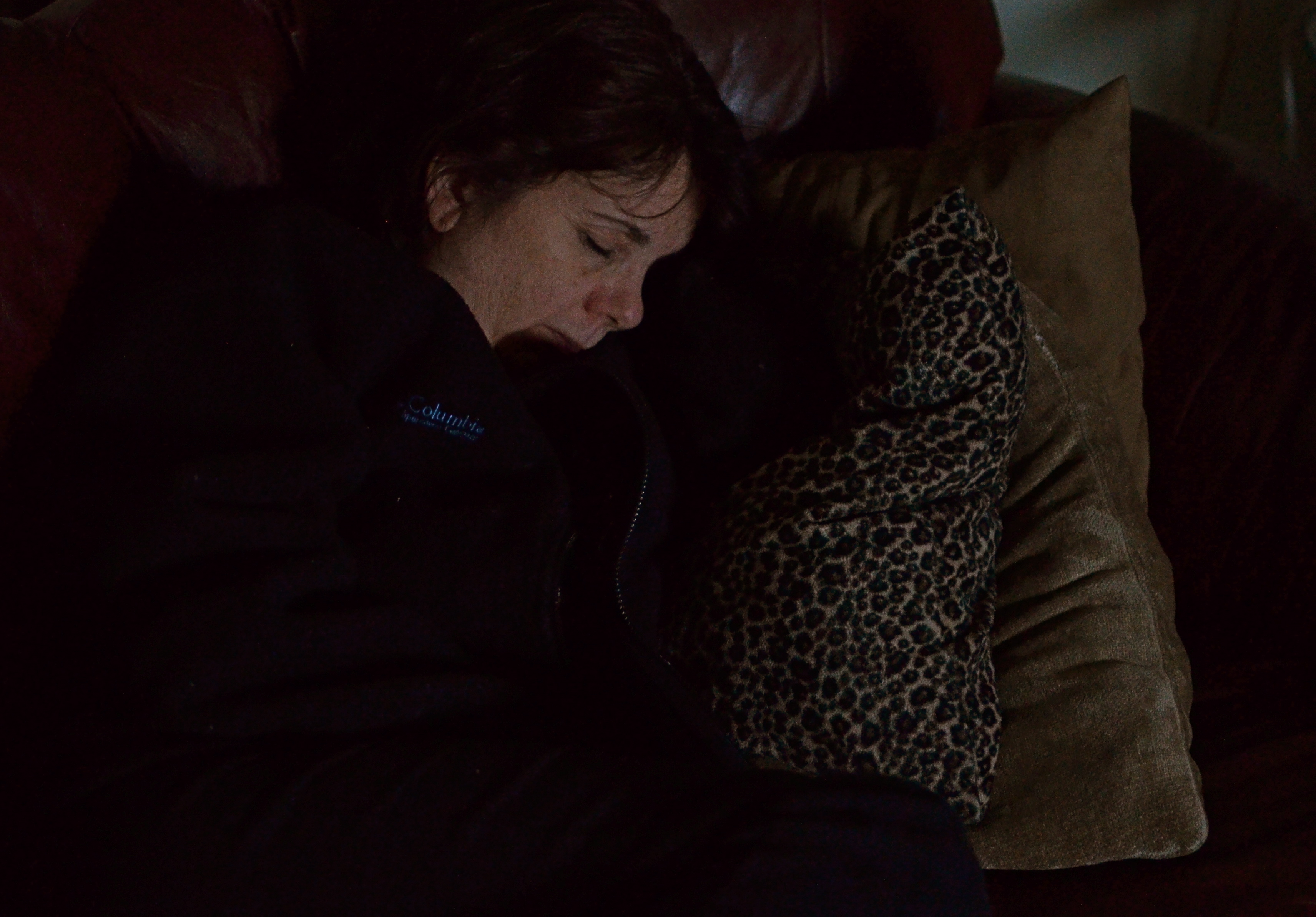
Let sleeping wives lie. Work the darkness like any other tool. 1/40 sec., f/1.8, ISO 1250 (the edge of pain), 35mm.
In the above picture of my beautiful Marian, I had one simple mission, really. Show that soft sleeping face. A little texture from the nearby pillows works all right, but I’m just going to waste time and spontaneity rigging up a tripod to expose long enough to show extra detail in the chair she’s on, her sweatshirt, or any other surrounding stuff, and for what? Main point to consider: she’s sleeping, and (trust me) sleeping lightly, so one extra click might be just enough to end her catnap (hint: reject this option). Other point: taking extra trial-and-error shots just to show other elements in the room will give nothing to the picture. Make it a snapshot, jack up the ISO enough to get her face, and live with the extra digital noise. Click and done.
For better or worse.
Composition-wise, that’s often the choice. If you can’t make it better, for #%$&!’s sake don’t make it worse.
Follow Michael Perkins on Twitter @MPnormaleye.
THE INVISIBLE ARMIES
By MICHAEL PERKINS
WE LEARN, OVER A LIFETIME, NOT TO SEE THEM. The sweepers, the washers, those who clean up, clear away and reassemble our daily environment. They are hidden in plain sight, these silent crews of keepers and caretakers. They are the reason there are towels in the restrooms, liners in the trash bins, forks on the table. A silent machine of constantly moving gears readies our way in so many unseen ways each days, tended by the invisible armies of our cities.
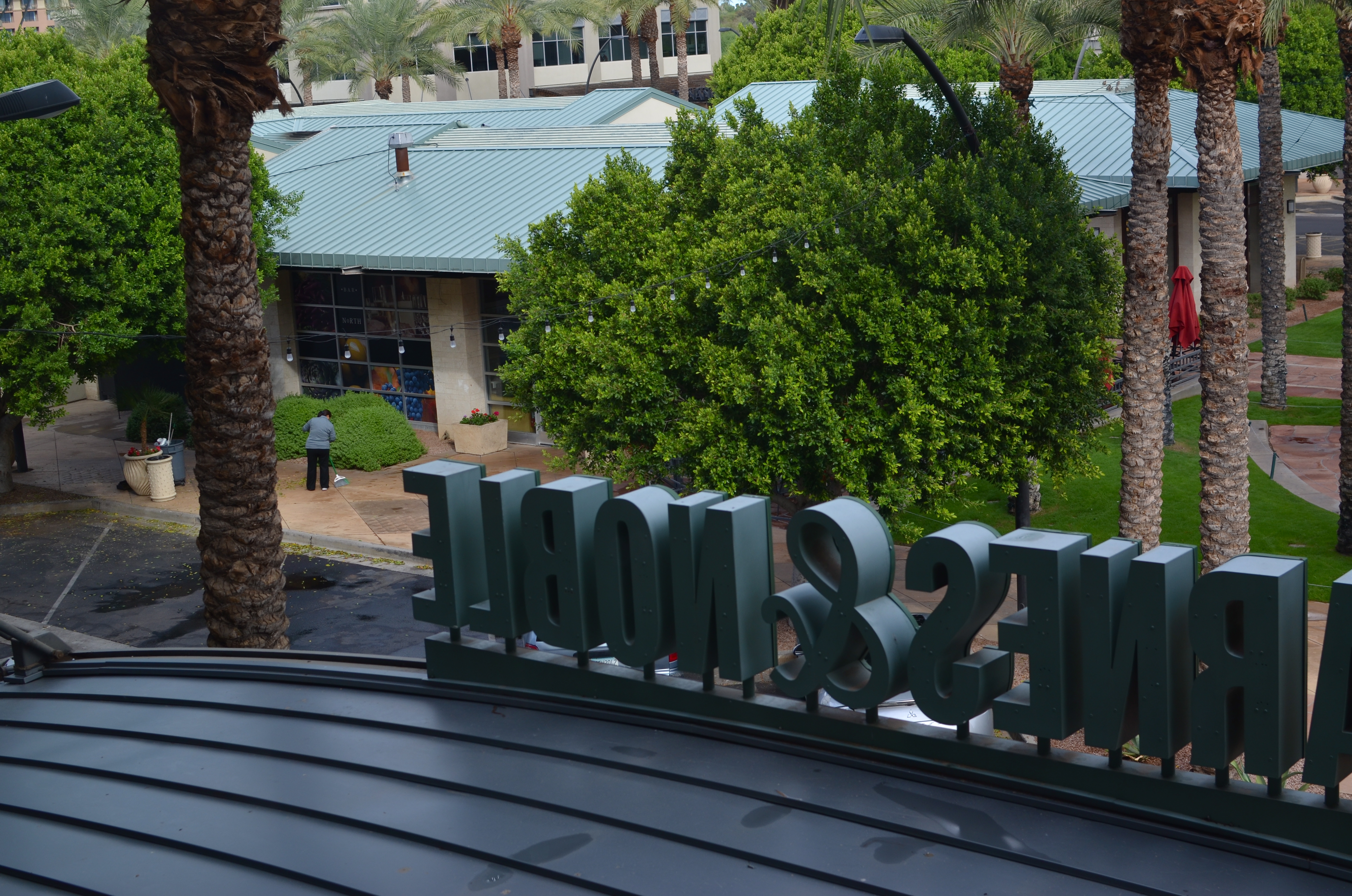
Morning Rounds. 1/125 sec., f/5.6, ISO 100, 35mm.
They start early, finish late, glide by silently, and move on to the next task. Busy as we are, once we first hold a camera, they are stories dying to be revealed, wondered at, worried over.
The unnamed lady at the broom in the above image came into my view just because I had chosen, at a particular moment, to cross the window side of the second floor of a bookstore. Framed naturally between a giant rooftop sign and a tree, she was served up as a ready-made subject for me, and would have been completely unseen had I not visited the store at the very moment it opened.
The invisible armies roll in and out, like some silent tide, and their work is usually done before we crank up our day. Their world and ours can dovetail briefly, but in large part we occupy difference spaces in time. I love catching people in the act of prepping the morning.
The best images are the ones you dig for a bit.
Follow Michael Perkins on Twitter @MPnormaleye.
MAKING THE MIRACLES MUNDANE
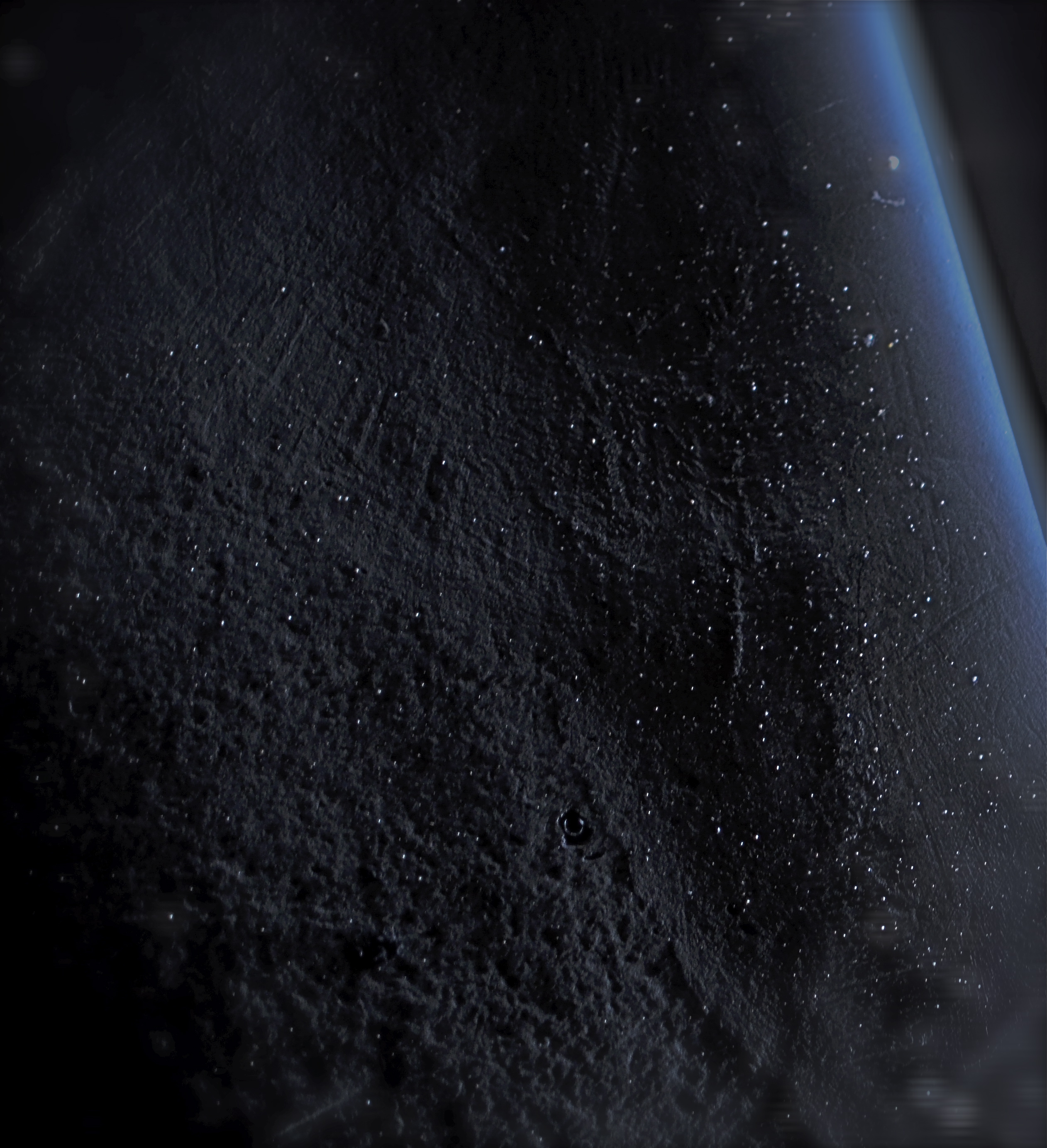
Connection outranks context.
By MICHAEL PERKINS
GIVEN OUR USUAL HUMAN PROPENSITY FOR USING PHOTOGRAPHY AS A LITERAL RECORDING MEDIUM, most of our pictures will require no explanation. They will be “about” something. They will look like an object or a person we have learned to expect. They will not be ambiguous.
The rest, however, will be mysteries…..big, uncertain, ill-defined, maddening, miraculous mysteries. Stemming either from their conception or their execution, they may not immediately tell anyone anything. They may ring no familiar bells. They may fail to resemble most of what has gone before. These shots are both our successes and failures, since they present a struggle for both our audiences and for ourselves. We desperately want to be understood, and so it follows that we also want our brainchildren to be understood as well. Understood…and embraced.
It cannot always be, and it should not always be.
No amount of explanatory captioning, “backstory” or rationalization can make clear what our images don’t. It sounds very ooky-spooky and pyramid- power to say it, but, chances are, if a picture worked for you, it will also work for someone else. Art is not science, and we can’t just replicate a set of coordinates and techniques and get a uniform result.
There is risk in making something wonderful….the risk of not managing to hit your mark. It isn’t fatal and it should not be feared. Artistic failure is the easiest of all failures to survive, albeit a painful kick in the ego. I’m not saying that there should never be captions or contextual remarks attached to any image. I’m saying that all the verbal gymnastics and alibis in the world won’t make a space ship out of a train wreck.
The above image is an example. If this picture does anything for you at all, believe me, my explanation of how it was created will not, repeat, not enhance your enjoyment of it one particle. Conversely, if what I tried is a swing and a miss, in your estimation, I will not be able to spin you a big enough tale to see magic where there is none. I like what I attempted in this picture, and I am surprisingly fond of what it almost became along the way. That said, I am perfectly fine with you shrugging your shoulders and moving on to the next item on the program.
Everything is not for everybody. So when someone sniffs around one of your photographs and asks (brace for it), “What’s that supposed to be?”, just smile.
And keep taking pictures.
Follow Michael Perkins on Twitter @MPnormaleye.
Related articles
- Weakness as Potential Strength (munchow.wordpress.com)
- Hidden Surprises in the Mundane (piconomy.wordpress.com)
ON THE ROAD TO FINDOUT
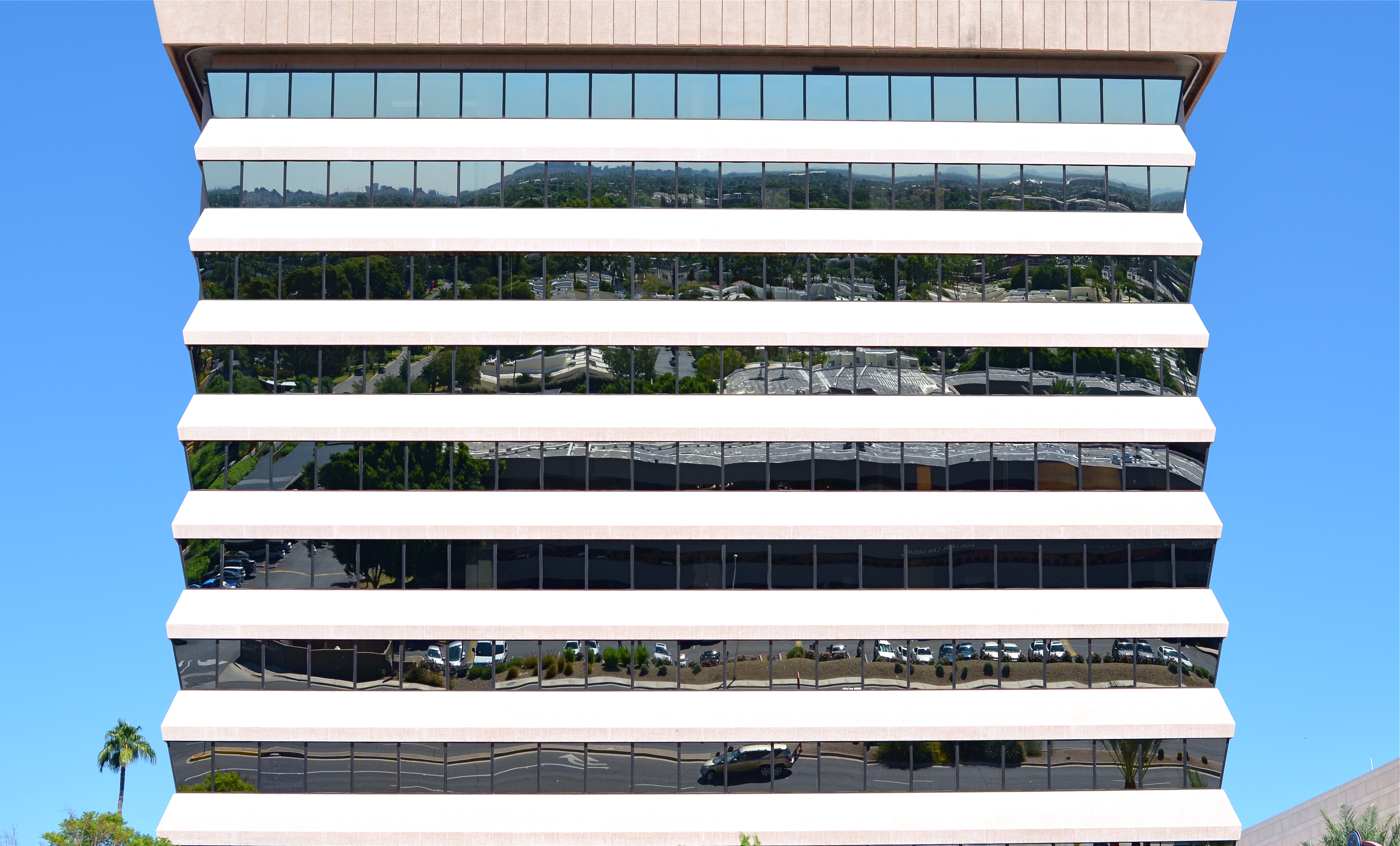
A box of mirrors: 1/500 sec., f/5.6, ISO 100, 35mm.
By MICHAEL PERKINS
LATELY I’VE TAKEN TO GRABBING LYRICS OR TITLES FROM POP SONGS TO SUM UP WHAT I WANT TO SAY IN A GIVEN POST, and apparently I haven’t yet kicked the habit. Like the searcher in Cat Stevens’ early ’70’s tune, I am sure that (a) I don’t really know where I’m going most of the time, and (b) the place I’m eventually going to will explain all, eventually. Pretty sunny outlook for a burned out old flower child, I’ll admit, but, especially in photography, the journey is the quest. What we encounter “on the road to findout” is worth the price of the trip.
That’s a fancy-pants way of saying that, frequently when I’m on a photo walkabout, I only think I know what I’m looking for. Sometimes I actually snag the object of the expedition, then find that it’s as disappointing as winning that cheap plush toy that looked so wonderful behind the carnival barker’s counter. Such a thing happened this week, when I drove five miles out of my way to revisit a building that had grabbed my attention several months prior. Short term result: mission accomplished…building located and shot. Long term result: what did I think that was going to be? Ugh.
I was walking off my mild disappointment, heading back to my car, and then the mundane act of stowing my camera forced me to rotate my gaze just far enough to see what the midday light was doing to the building across the street. It’s masses of glass looks rather flat and dull by morning, but, near noon, it becomes a slatted mirror, kind of a giant venetian blind, reflecting the entire street scene below and across from itself. The temporary light tilt transforms the place into a surreal display space for about thirty minutes a day, and, had I not been standing exactly where I was across the street at that moment, I would have missed it, and missed the building as a subject for the next, oh, 1,000 years.
Kurt Vonnegut had a dear friend from Europe who always parted from him by hoping that they would meet again in the future if the fates allowed. Only the idiom got crumpled a little in translation, coming out as “if the accident will”. Vonnegut loved that, and so do I.
On the road to findout, we may take wonderful pictures.
If the accident will.
Follow Michael Perkins on Twitter @MPnormaleye.

