WHAT IS HIP?
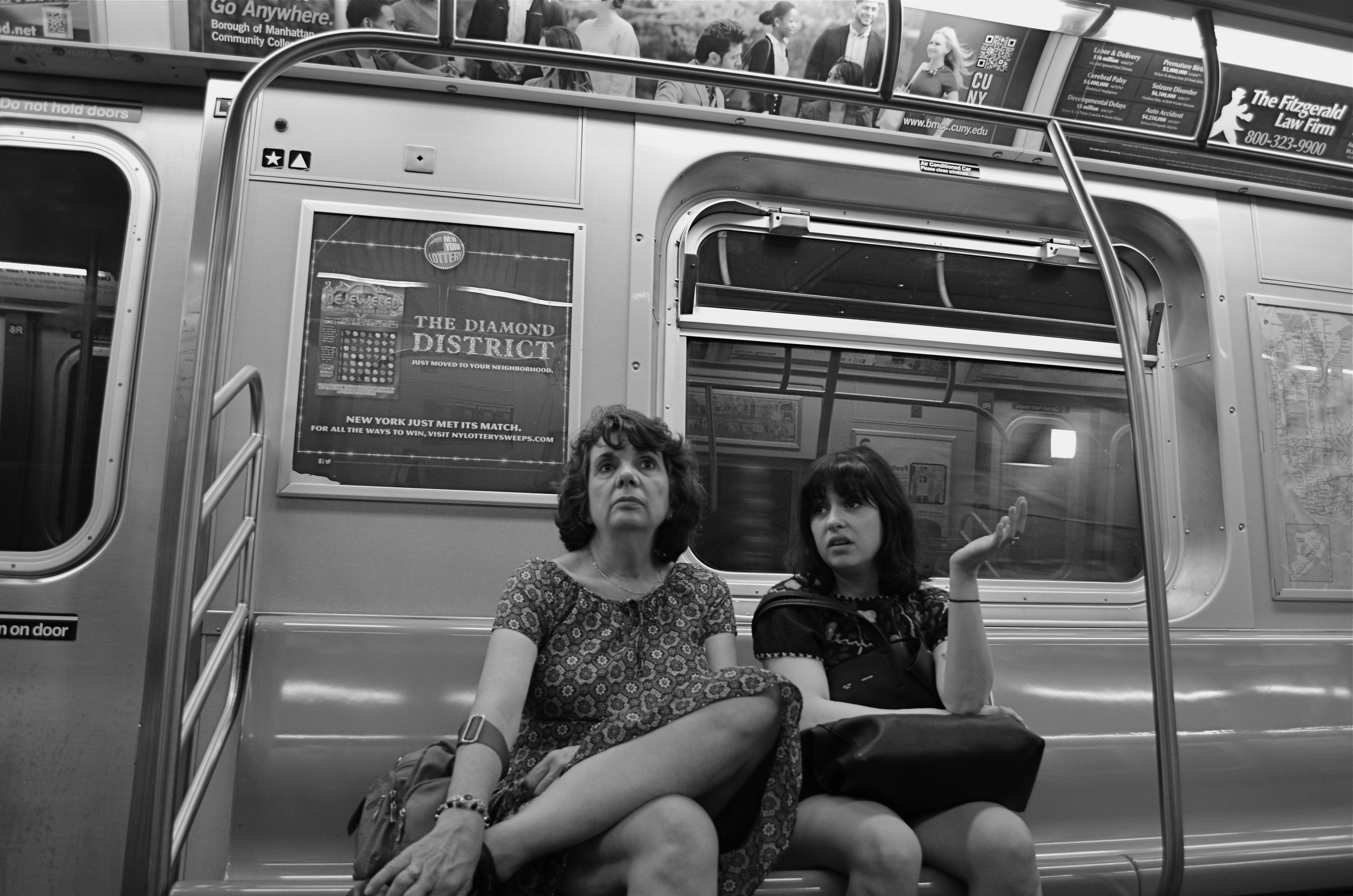
Shooting “from the hip” can be an urban photographer’s secret weapon. 1/40 sec., f/3.5, ISO 500, 18mm.
By MICHAEL PERKINS
WHEN FACED WITH A COMPLETELY DIFFERENT APPROACH TO OUR PHOTOGRAPHY, the crabbier among us are liable to utter one of two responses. Both sound negative, but one could be positive:
Response #1: “I’d never do that!” (Emphatically negative. Discussion over. You will not persuade me.)
Response #2:”Why would I want to do that???” (Possibly as close-minded as response #1, but the person could be asking a legitimate question, as in, ‘show me the benefit in doing it your way, because I can’t imagine a single reason why I should change’.)
When first reading about the street photography technique of “shooting from the hip”, I was a definite response #2. Wasn’t going to slam the door on trying it, but failed to see what I would get out of it. The phrase means just what you’d think it does, referring to people with obvious cameras who do “street” work, shooting with the camera hanging at waist level, never bringing the viewfinder up to their eye. Subjects don’t cringe or lock up because you don’t “seem” to be taking a picture, and thus your images of them are far more unguarded and natural.
Now, suggesting this to a person who has never even owned a camera that didn’t have a viewfinder is a little like asking him to try to take pictures from the inside of a burlap sack. Kinda makes my inner control freak throw a bratrum (a brat tantrum). Think of it from my point of view. If I shoot manually all the time (I do) and if I need my viewfinder like Linus needs his blanket (cause, hey, I’m a tortured and insecure artist), then squeezing off a shot without even knowing if it’s in frame is, to say the least, counter-intuitive (French for “nuts”).
So there you have your honestly expressed Response #2.
Some things that finally made it worth at least trying:
It don’t cost nothin’.
I can practice taking pictures that I don’t care about. I wouldn’t be shooting these things or people even with total control, so what’s to lose?
Did I mention it don’t cost nothin’?
Shooters beware: clicking from the hip is far from easy to master. Get ready to take lots of photos that look like they came from your Urban Outfitter Soviet Union-era Plastic Toy Hipsta Camera. You want rakish tilt? You got it. You like edgy, iffy focus? It’s a given. In other words, you’ll spend a lotta time going through your day’s work like the Joker evaluating Vicki Vale’s portfolio (….”crap….crap….crap….” ). But you might eventually snag a jewel, and it feels so deliciously evil to procure truly candid shots that you may develop an addiction to the affliction. Observe a few basics: shoot as wide as you can, cause 35s, 50s and other primes won’t give you enough scope in composition at close range: go with as fast a shutter speed as the light will allow (in low light, compromise on the ISO): if possible, shoot f/5.6 or smaller: and, finally,learn how to pre-squeeze the autofocus and listen for its quiet little zzzz, then tilt the camera just far enough up to make sure everyone has a head, and go.
At worst, it forces you to re-evaluate the way you “see” a shot, since you have no choice but to accept what the camera could see. At best, you might see fewer bared fangs from people snarling, “hey is that a $&@*! camera?” inches from your nose. And that’s a good thing.
THE JOY OF BEING UNIMPORTANT
By MICHAEL PERKINS
I HAVE AT LEAST TWO WOMEN IN MY LIFE WHO WORRY if I am sufficiently entertained whenever I am borne along on their ventures into various holy lands of retail. Am I waiting too long? Am I bored at being brought along? Would I like to go somewhere else and rejoin them later at an appointed time and place?
Answers: No to questions 1, 2 and 3…so long as I have my hands on a camera.
I can’t tell you how many forays into shoe emporiums, peeks into vintage stores and rambles through ready-to-wear shops have provided me with photographic material, mainly because no one would miss me if I were to disappear for a bit, or for several days. And, as I catalogue some of the best pickings I’ve plucked from these random wanderings, I find that many of them were made possible by the simple question, “do you mind amusing yourself while I try this on?” Ah, to have no authority or mission! To let everything pale in importance when compared to the eager search for pictures! To be of so little importance that you are let off the leash.
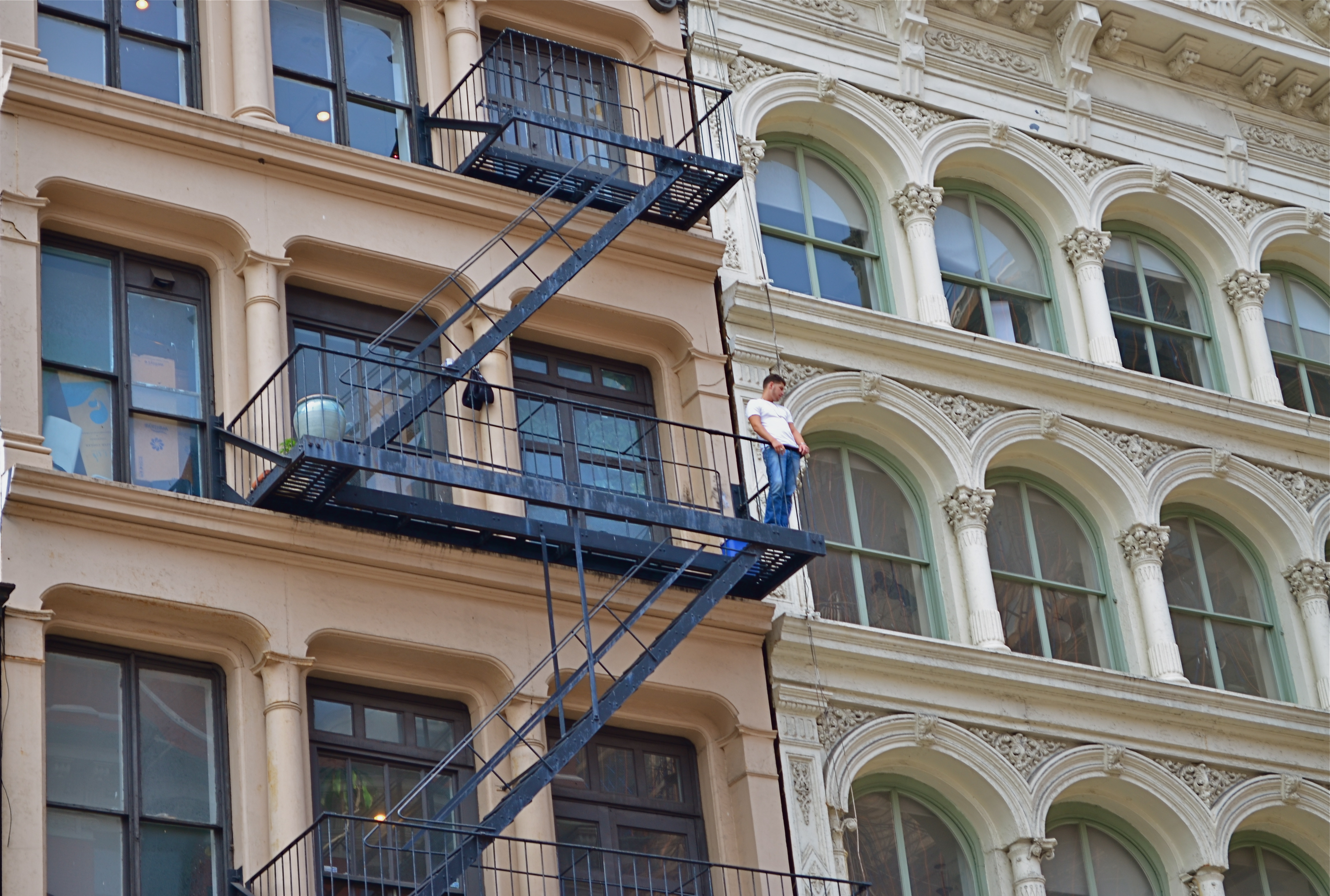
The above image happened because I was walking with my wife on the lower east side of Manhattan but merely as physical accompaniment. She was looking for an address. I was looking for, well, anything, including this young man taking his cig break several stories above the sidewalk. He was nicely positioned between two periods of architecture and centered in the urban zigzag of a fire escape. Had I been on an errand of my own, chances are I would have passed him by. As I was very busy doing nothing at all, I saw him.
Of course, there will be times when gadding about is only gadding about, when you can’t bring one scintilla of wisdom to a scene, when the light miracles don’t reveal themselves. Those are the times when you wish you had pursued that great career as a paper boy, been promoted to head busboy, or ascended to the lofty office of assistant deacon. I’m telling you: shake off that doubt, and celebrate the glorious blessing of being left alone…to imagine, to dream, to leave the nest, to fail, to reach, to be.
Photography is about breaking off with the familiar, with the easy. It’s also having the luck to break off from the pack.
GREAT DAY IN BROOKLYN
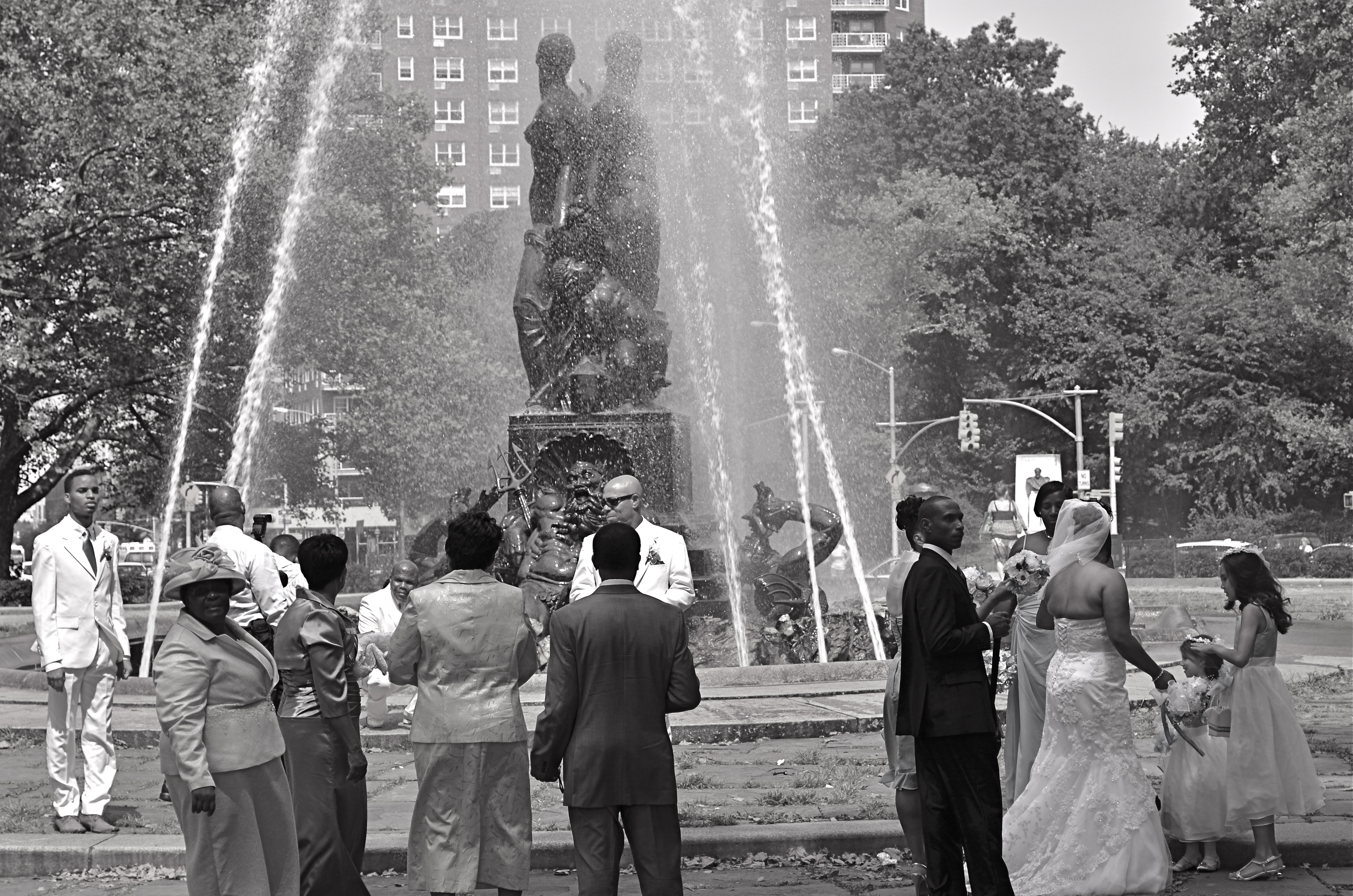
Wedding Party, 2012.
By MICHAEL PERKINS
IT STARTED OFF AS WHAT IS CURRENTLY REFERRED TO AS A FAIL: I was clicking away throughout the park areas in Brooklyn’s Grand Army Plaza, trying to make some kind of epic composition out of the beautiful Bailey Foundation near the war memorial arch. It features several heroic figures standing on the prow of a ship, under which can be seen several mythical denizens of the deep including Neptune himself. It’s a strong piece of sculpture, crowning a plaza that was designed by the great Frederick Law Olmstead, the mastermind behind Manhattan’s Central Park, and I should have been able to do something with it. Something.
Problem with the fountain is the water itself, which, instead of a wonderfully flowing cascade is something between a Jacuzzi shower head and a resort sprinkler system. Its renders the statuary nearly impossible to get in focus, and sends refracted rainbows and hotspots dancing gaily into your lens. Suddenly the impulse of a moment is a day’s work, and, just as I was beginning to check this particular world wonder off my to-do list, in moved the people you see here.
I don’t shoot weddings but the group you see here was, in fact, a shoot of a wedding, something else altogether, since there is a more relaxed dynamic than will ever be present during an actual ceremony. Photographically, rehearsals are more fruitful than actual play performances, and, in that vein, wedding prep holds more pictorial potential, for me, than weddings with a capital W. There is a looser feel, an air of celebration that somehow gets starched out of the final product. Do I stand here? You want me holding the flowers? Shouldn’t the tall people be at the back? Best thing of all, these folks were already taking direction from their “official” photog, so I was the last thing on their mind. There’s no better role at a wedding than that of The Invisible Man.
My glorious fountain had been reduced to a prop, which means the wedding party saw its potential, as I had. The difference is, they gave me what I hadn’t been able to find for myself.
A picture.
SETTING THE CAPTIVES FREE
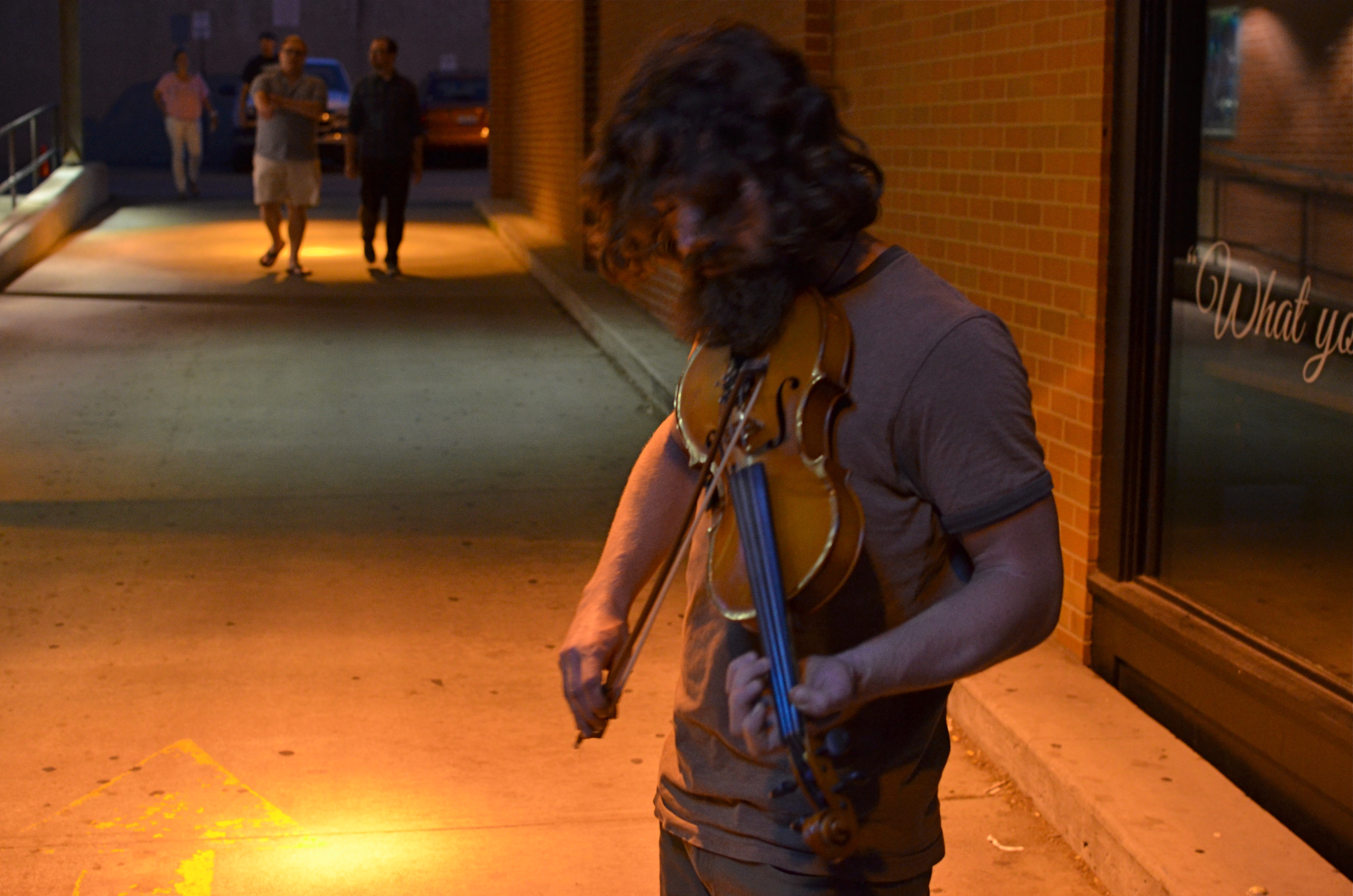
Fiddler, 2014. Too soft? Too dark? True? False? 1/50 sec., f/3.5, ISO 1000, 35mm.
By MICHAEL PERKINS
I’D LIKE TO ERADICATE THE WORD “CAPTURE” FROM MOST PHOTOGRAPHIC CONVERSATIONS. It suggests something stiff or inflexible to me, as if there is only one optimum way to apprehend a moment in an image. Especially in the case of portraits, I don’t think that there can be a single way to render a face, one perfect result that says everything about a person in a scant second of recording. If I didn’t capture something, does that mean my subject “got away” in some way, eluded me, remains hidden? Far from it. I can take thirty exposures of the same face and show you thirty different people. The word has become overused to the point of meaningless.
We are all conditioned to think along certain bias lines to consider a photograph well done or poorly done, and those lines are fairly narrow. We defer to sharpness over softness. We prefer brightly lit to mysteriously dark. We favor naturalistically colored and framed recordings of subjects to interpretations that keep color and composition “codes” fluid, or even reject them outright. It takes a lot of shooting to break out of these strictures, but we need to make this escape if we are to move toward anything approaching a style of our own.
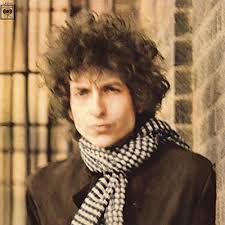
Jerry Schatzberg’s iconic portrait of Bob Dylan from the cover of Blonde On Blonde.
I remember being startled in 1966 when I first saw Jerry Schatzberg’s photograph of Bob Dylan on the cover of the Blonde On Blonde album. How did the editor let this shot through? It’s blurred. It’s a mistake. It doesn’t…..wait, I can’t get that face out of my head. It’s Bob Dylan right now, so right now that he couldn’t be bothered to stand still long enough for a snap. The photo really does (last time I say this) capture something fleeting about the electrical, instantaneous flow of events that Dylan is swept up in. It moves. It breathes. And it’s more significant in view of the fact that there were plenty of pin-sharp frames to choose from in that very same shoot. That means Schatzberg and Dylan picked the softer one on purpose.
There are times when one 10th of a second too slow, one stop too small, is just right for making the magic happen. This is where I would usually mention breaking a few eggs to make an omelette, but for those of you on low-cholesterol diets, let’s just say that n0 rule works all the time, and that there’s more than one way to skin (or capture) a cat.
A PLACE APART
By MICHAEL PERKINS
PHOTOGRAPHERS USUALLY USE FACES AS THE SOLE BAROMETER OF EMOTION. It’s really easy to use a person’s features as the most obvious cues to one’s inner mind. Scowls, smiles, smirks, downcast eyes, sidelong glances,cries of anguish….these are standard tools in depicting someone as either assimilated into the mass of humanity or cast away, separate and alone.
But faces are only one way of showing people as living in a place apart. Symbolically, there is an equally dramatic effect to be achieved by the simple re-contextualizing of that person in space. The arrangement of space near your subject forces the viewer to conclude that he or she is either in harmony with their surroundings or lonely, solitary, sad even, and you do it without showing so much as a raised eyebrow. This is where composition isn’t just a part of the story, but the story itself.
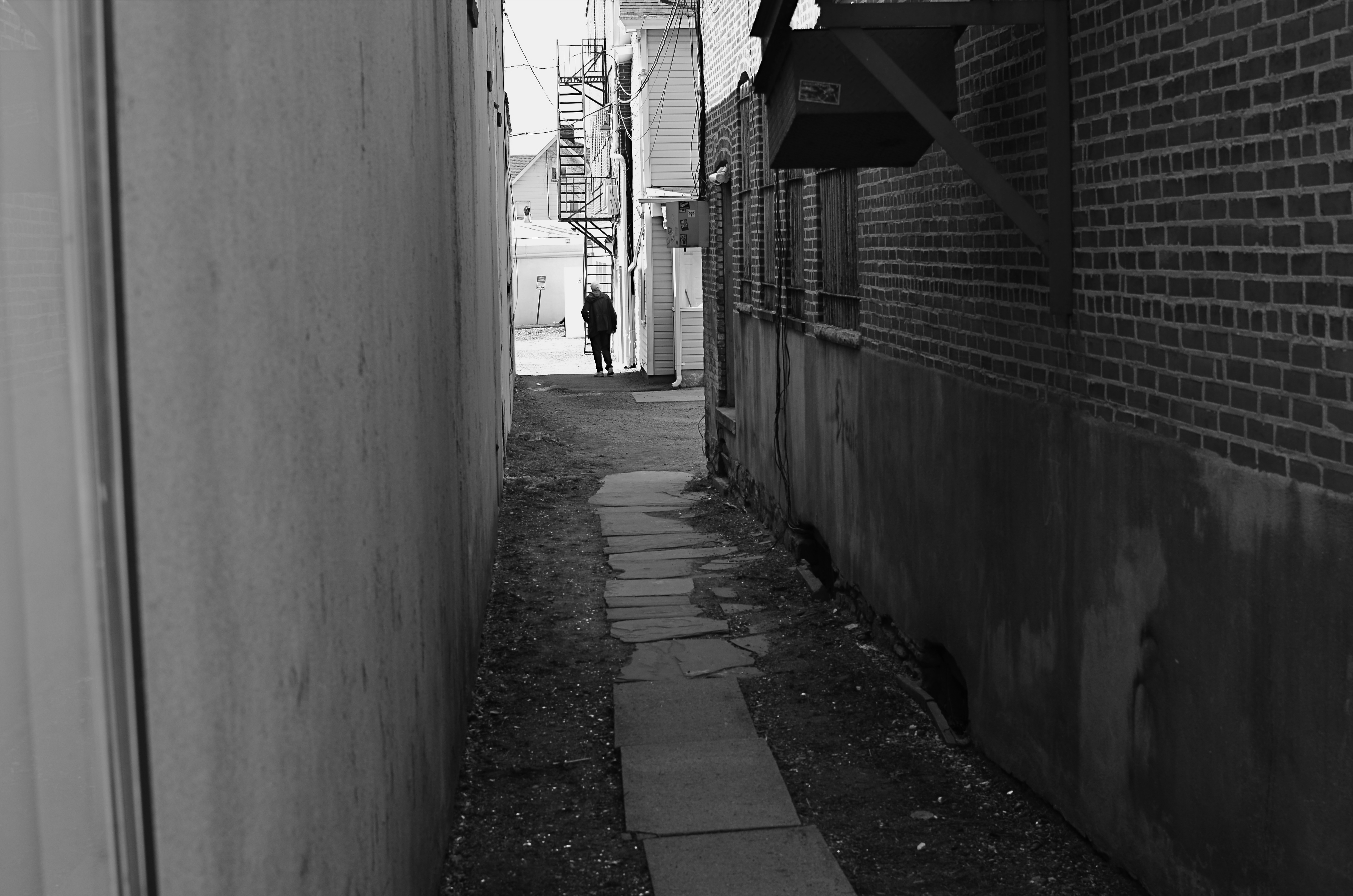
Context is all.
The woman shown here is most likely just walking from point A to point B, with no undercurrent of real tragedy. But once she takes a short cut down an alley, she can be part of a completely different, even imaginary story. Here the two walls isolate her, herding her into a context where she could be lonely, sad, afraid, furtive. She is walking away from us, and that implies a secret. She is “withdrawing” and that implies defeat. She is without a companion, which can symbolize punishment, banishment, exile. From us? From herself? From the world? Once you start to think openly about it, you realize that placing the subject in space lays the foundation for storytelling, a technique that is easy to create, recalibrate, manipulate.
The space around people is a key player in the drama an image can generate. It can mean, well, whatever you need it to mean. People who exist in a place apart become the centerpieces in strong photographs, and the variability of that strength is in your hands.
SUBMERGED IN BEING
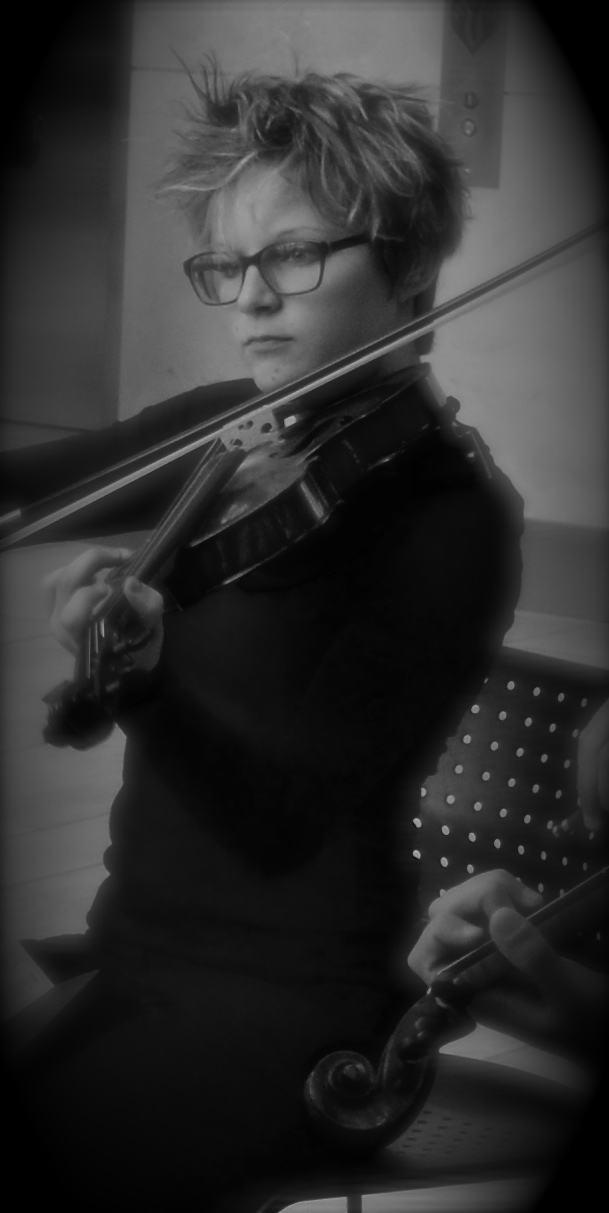
Cropped and enhanced from a group shot. I could sit this young woman in a studio for a thousand years and not get this expression.
By MICHAEL PERKINS
CANDID PORTRAITURE IS VOLATILE, THE DEAD OPPOSITE OF A FORMAL SITTING, and therefore a little scarier for some photographers. We tell ourselves that we gain more control over the results of a staged portrait, since we are dictating so many terms within it…the setting, the light, the choice of props, etc. However, can’t all that control also drain the life out of our subjects by injecting self-consciousness ? Why do you think there are so many tutorials written about how to put your subjects at ease, encourage them to be themselves, persuade them to unclench their teeth? Getting someone to sit where we tell them, do what we tell them, and yet “act naturally” involves a skill set that many photographers must learn over time, since they have to act as life-coach, father-confessor, camp counselor, and seducer, all at once. Also helps if you hand out lollipops.
Then again, shooting on the fly with the hope of capturing something essential about a person who is paying you zero attention is also fraught with risk, since you could crank off fifty frames and still go home without that person revealing anything real within the given time-frame. As with most issues photographic, there is no solution that works all of the time. I do find that one particular class of person affords you a slight edge in candid work, and that is performers. Catch a piece of them in the act of playing, singing, dancing, becoming, and you get as close to the heart of their essence that you, as an outsider, are ever going to get. If they are submerged in being, you might be lucky enough to witness something supernatural.
The more people lose themselves in a quest for the perfect sonata, the ultimate tap step, or the big money note, the less they are trying to give you a “version” of themselves, or worse yet, the rendition of themselves that they think plays well for the camera. As for you, candids work like any other kind of street photography. It’s on you to sense the moment as it arrives and grab it. It’s anything but easy, but better, when it works, then sitting someone amidst props and hoping they won’t freeze up on you.
There are two ways to catch magic in a box when it comes to portraits. One is to have a tremendous relationship with the person who is sitting for you, and the other is to be the best spy in the world when plucking an instant from a real life that is playing out in front of you. You have to know which tack to take, and where the best image can be extracted.
BEYOND THE “OWIE”
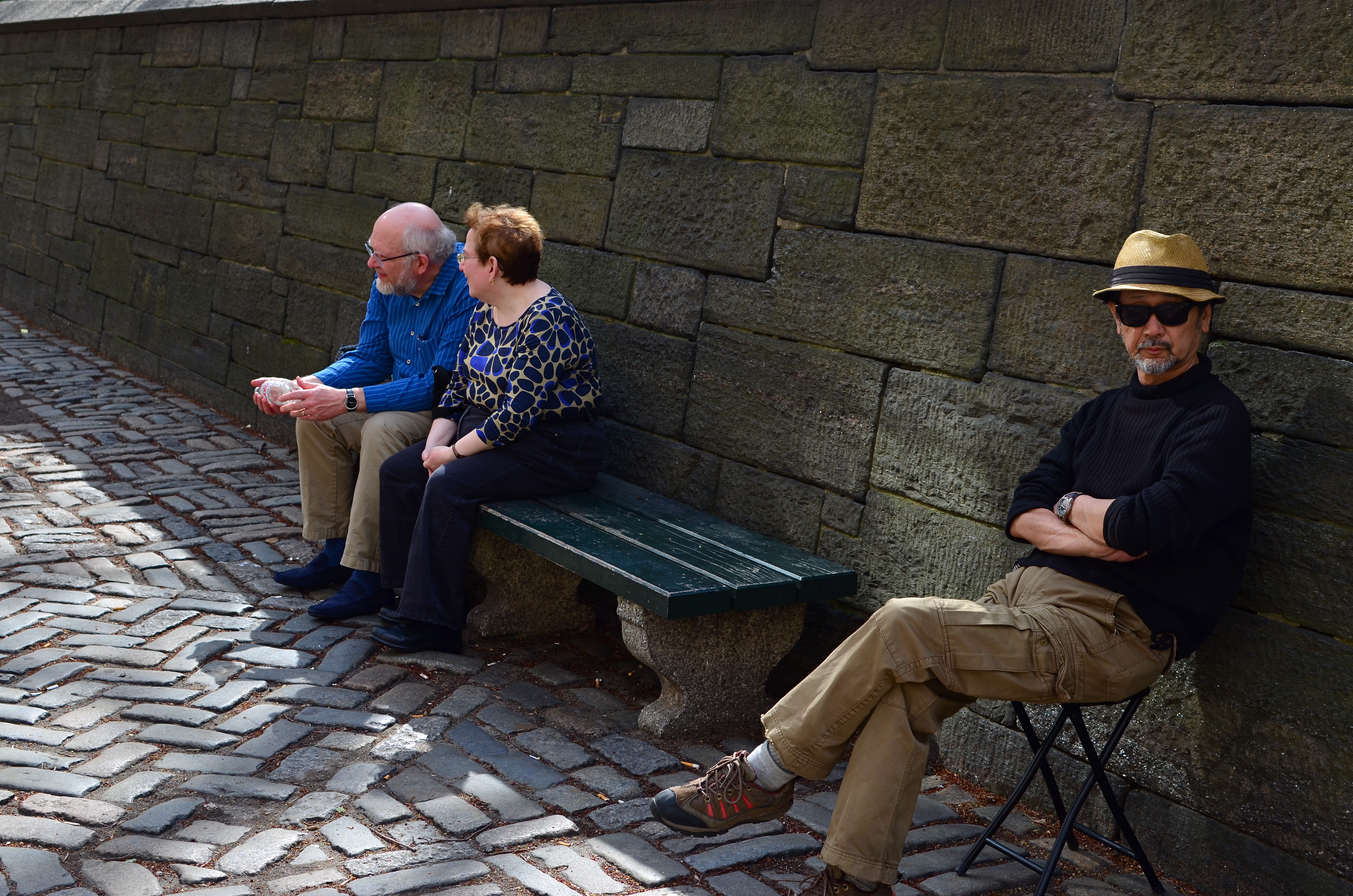
Even if the people in the picture are not drunk, desperate, or dying, it’s still street photography.
By MICHAEL PERKINS
SINCE THE CAMERA IS, FIRST AND FOREMOST, A RECORDING INSTRUMENT, it has always defaulted to the function of a journalist’s device, a reportorial machine for bearing witness to events. Certainly, it was inevitable that newspapers and magazines would, over time, turn to the camera as a way of marking or defining events, of making a visual document of things. And soon, of course, that simple recording process gave way to overt commentary, to an event being imbued with as much personal bias by a photographer as had always been the case with prose writers. It was possible for the camera to have an opinion.
Street photography, which allowed the amateur to stamp his view on what he saw no less than the professional journalist, should, certainly, have developed a judgemental eye toward the tragic, the awful in life. But, as often happens, it has spawned a school of thought in which people who fancy themselves “serious” artists reflect only rotting cities or crying children. This promotes a dishonest view of the world, since, sometimes, as Elton John once wrote, “the boulevard is not that bad.” And that makes our art lopsided. I call it “photographing OWIEs” (Orphans, Winos, Idiots and Eccentrics), and it has become something of a runaway industry.
It’s a popular conceit: only dour poets are “real” poets. Only depressed writers know anything of life. And only photographers who depict abject misery really “get” the human condition. This is flawed thinking, but invariably catches hold in every “authentic” gallery exhibit, every “honest” critical essay, and every other place pretentious humans congregate to celebrate their shared gravitas.
Street photography that reflects hope, or, God spare us, even a modicum of human normalcy should never be discounted or marginalized. Artists are charged with embracing both light and shadow. And certainly, for purely scientific reasons, photographs are impossible without taking both into account.
THE POLAROID EFFECT
BY MICHAEL PERKINS
I’VE BEEN TRYING TO FIND A WAY TO DESCRIBE THE COMBINATION OF HOPE AND ANXIETY THAT ATTENDS MY EVERY USE OF A SMARTPHONE CAMERA. Coming, as do many geezers of my era, from a tradition of full-function, hands-on, manual cameras, I have had a tough time embracing these miraculous devices, simply because of the very intuitive results that delight most other people.
But: it’s a little more complicated than my merely being a control freak or a techno-snob.
What’s always perplexing to me is that I feel that the camera is making far too many choices that it “assumes” I will be fine with, even though, in many cases, I am flat-out amazed at how close the camera delivers the very image I had in mind in the first place. It doesn’t exactly make one feel indispensable to the process of picture-making, but that’s a bug inside my own head and I gotta deal with it.
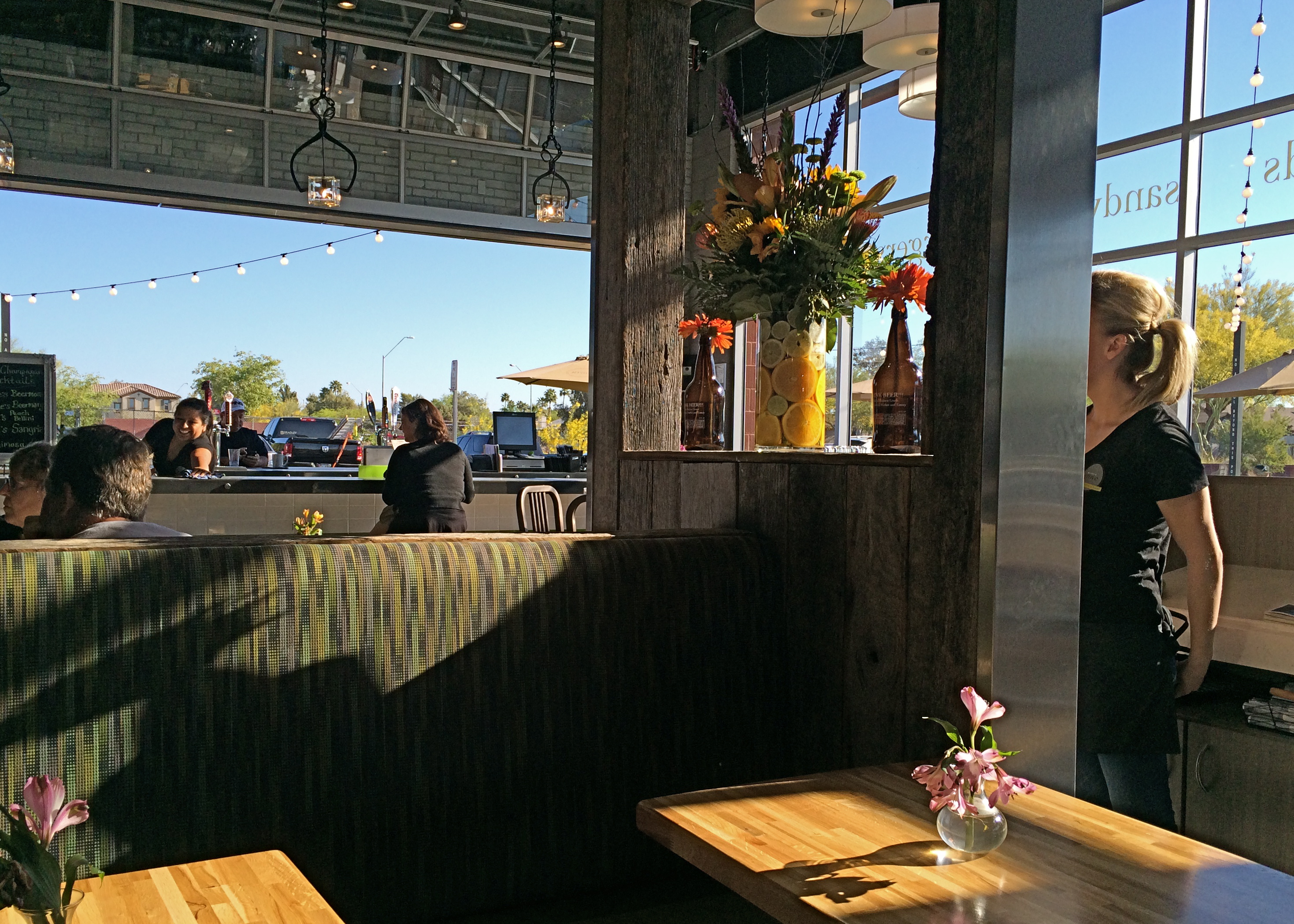
Stealthy and readily at hand: smartphone cameras keep opportunities from being lost.
I think what I’m feeling, most of the time, is what I call the “Polaroid Effect”. To crowd around family or friends just moments after clicking off a memory with the world’s first true instant film cameras, those bulky bricks of the Mad Men era, was to share a collectively held breath: would it work? Did I get it right? Then as now, many “serious” photographers were reluctant to trust a Polaroid over their Leicas or Rolliflexes. Debate raged over the quality of the color, the impermanence of the prints, the limited lenses, the lack of negatives, and so on. Well, said the experts, any idiot can take a picture with this.
Well, that was the point, wasn’t it? And some of us “idiots” learned, eventually, to take good pictures, and moved on to other cameras, other lenses, better pictures, a better eye. But there was that maddening wait to see if you had lucked out with those square little glimpses of life. The uncertainty of trusting this…machine to get your pictures right.
And yet look at the above image. I asked a lot in this frame, with wild amounts of burning hot sunlight, deep shadows, and every kind of contrast in between just begging for the camera to blow it. It didn’t. I’m actually proud of this picture. I can’t dismiss these devices just because they nudge me out of my comfort zone.
Smartphone cameras truly extend your reach. They go where bulkier cameras don’t go, prevent more moments from being lost, and are in a constantly upward curve of technical improvement. People can and do make astounding pictures with them, and I have to remind myself that the ultimate choice…that of what to shoot, can never be taken away just because the camera I’m holding is engineered to protect me from my own mistakes.
MINUTE TO MINUTE
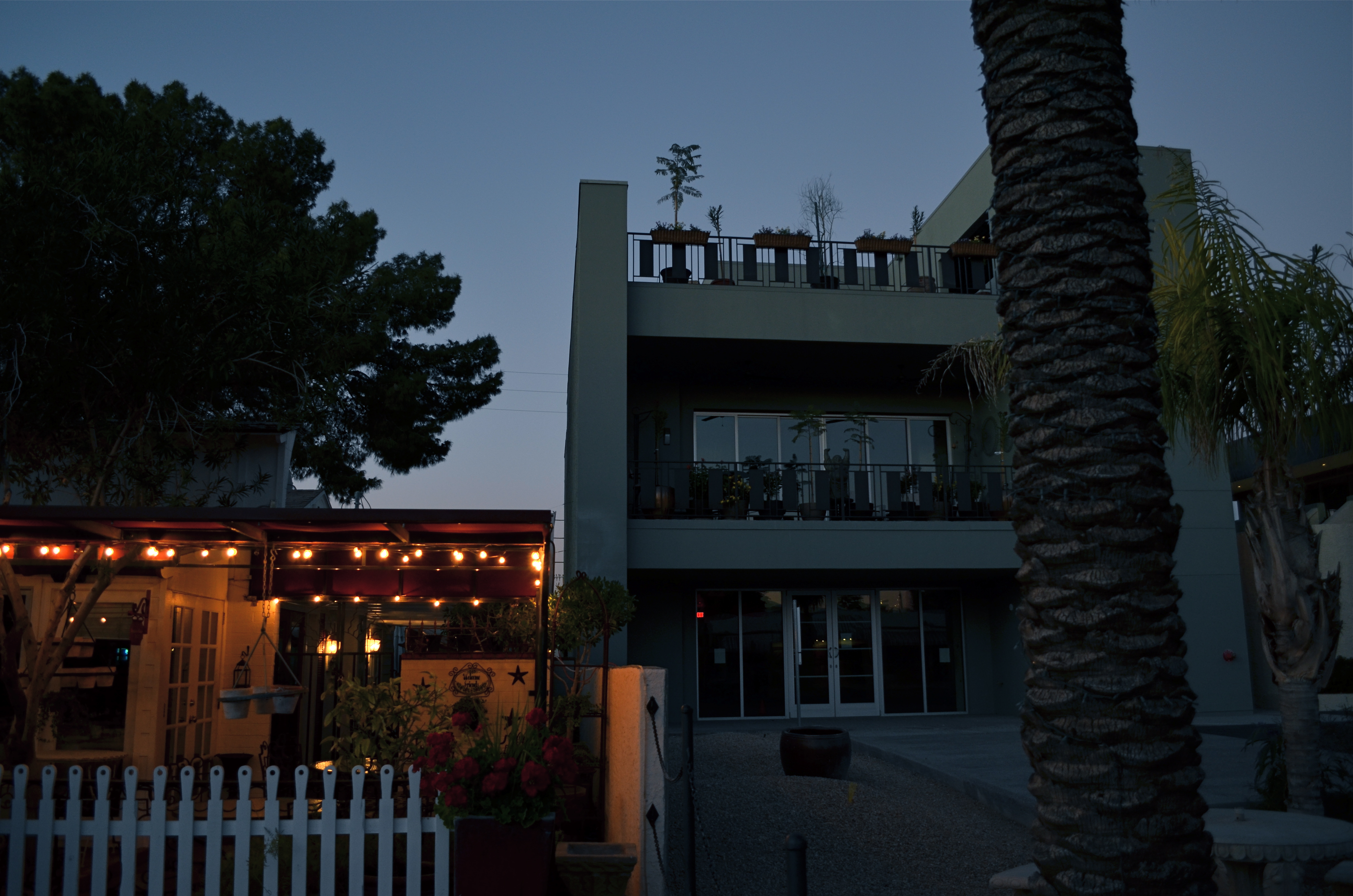
Going, Going: Dusk giveth you gifts, but it taketh them away pretty fast, too. 1/40 sec., f/3.5, ISO 200, 18mm.
By MICHAEL PERKINS
VOLUMES HAVE BEEN WRITTEN ABOUT THE WONDROUS PHENOMENON OF “GOLDEN HOUR“, that miraculous daily window of time between late afternoon and early evening when shadows grow long and colors grow deep and rich. And nearly all authors on the subject, whatever their other comments, reiterate the same advice: stay loose and stay ready.
Golden hour light changes so quickly that anything that you are shooting will be vastly different within a few moments, with its own quirky demands for exposure and contrast. Basic rule: if you’re thinking about making a picture of an effect of atmosphere, do it now. This is especially true if you are on foot, all alone in an area, packing only one camera with one lens. Waiting means losing.
The refraction of light through clouds, the angle of the sun as it speeds toward the horizon, the arrangement between glowing bright and super-dark….all these variables are shifting constantly, and you will lose if you snooze. It’s not a time for meditative patience. It’s a time for reactivity.
I start dusk “walkarounds” when all light still looks relatively normal, if a bit richer. It gives me just a little extra time to get a quick look at shots that may, suddenly, evolve into something. Sometimes, as in the frame above, I will like a very contrasty scene, and have to shoot it whether it’s perfect or not. It will not get better, and will almost certainly get worse. As it is, in this shot, I have already lost some detail in the front of the building on the right, and the lighted garden restaurant on the left is a little warmer than I’d like, but the shot will be completely beyond reach in just a few minutes, so in this case, I’m for squeezing off a few variations on what’s in front of me. I’ve been pleasantly surprised more than once after getting back home.
What’s fun about this particular subject is that one half of the frame looks cold, dead, “closed” if you will, while there is life and energy on the left. No real story beyond that, but that can sometimes be enough. Golden hour will often give you transitory goodies, with its more dramatic colors lending a little more heft to things. I can’t see anything about this scene that would be as intriguing in broad daylight, but here, the hues give you a little magic.
Golden hour is a little like shooting basketballs at Chuck E. Cheese. You have less time than you’d like to be accurate, and you may or may not get enough tickets for a round of Skee-Ball.
But hey.
BALLET OF HORROR
By MICHAEL PERKINS
THERE USED TO BE A MOVEMENT IN FINE ARTS CALLED THE “ASHCAN SCHOOL”, WHICH SOUGHT TO SHOW POWER AND BEAUTY in banal or even repellent urban realities. It posed a question that continues to stoke debate within photography to this day: how much should art engage with things that are horrible? Is the creative act vital when it shows us ugliness? More importantly, is it vital because it shows us these things? And, if we choose to depict beauty to the exclusion of the ugly, is our art somehow less authentic?
The whole matter may come down to whether you see photography as a constructed interpretation of the world, kind of a visual poem, or as a sort of journalism. Of course, the medium has been shown to be wide enough for either approach, and perhaps the best work comes from struggling to straddle both camps. A world of gumdrops and lollipops can be just as pretentious and empty as a world constructed exclusively of the grisly, and I think each image has to be defined or justified as a separate case. That said, finding a ying/yang balance between both views within a single image is rare.
Falling, as I did, under the influence of landscape photographers at a really early age, I have had to learn to search for a kind of rough ballet in things that I find disturbing. I’m not saying that it’s hampered my work: far from it. Look at it another way: as a missionary, you can plant crops and build hospitals for your village, but you still have to address the area’s cholera and dysentery. It’s just a part of its life.
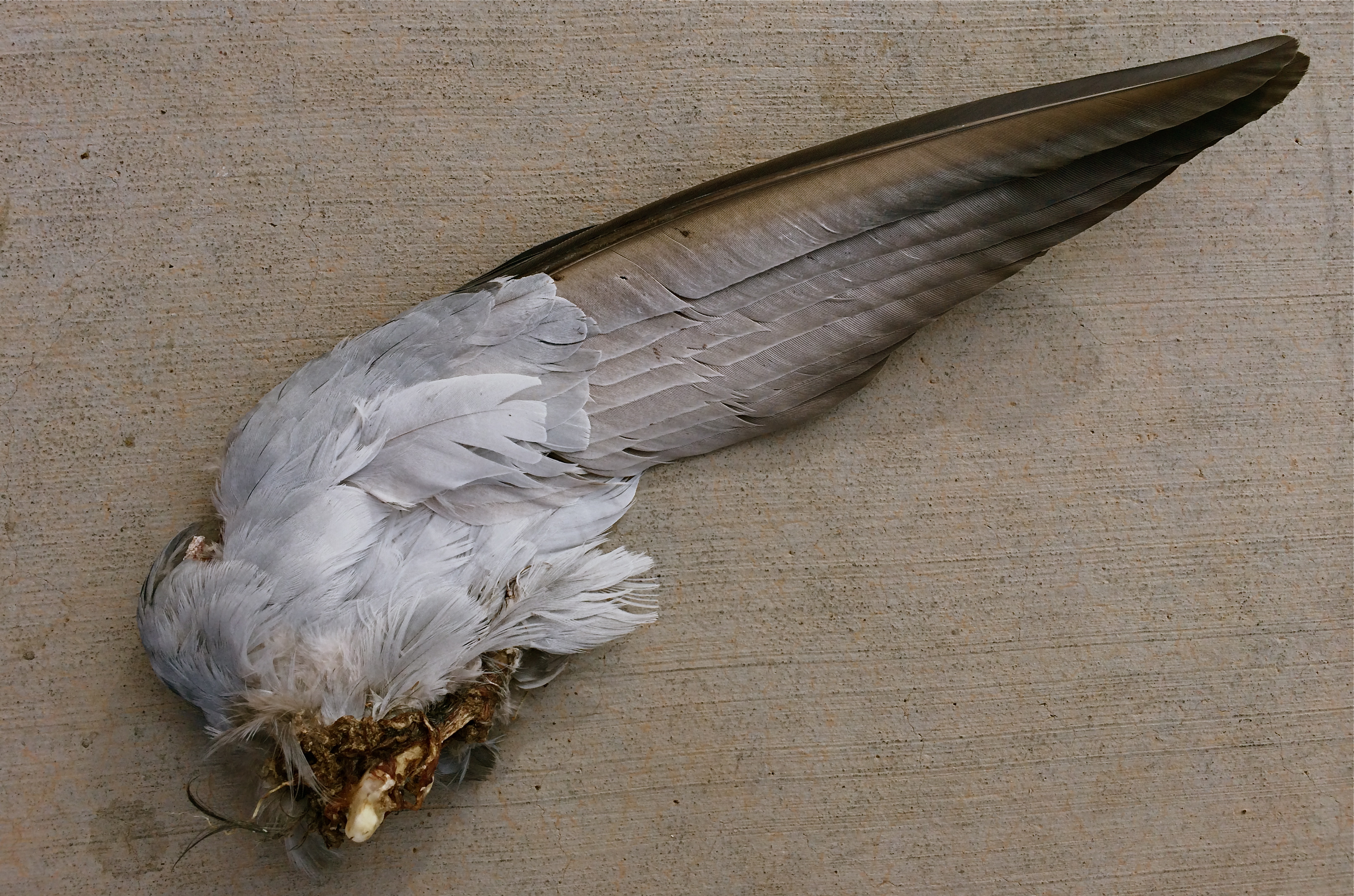
Death On The Wing: 1/900 sec., f/2.2, ISO 32, 4.12mm
The image above was pretty much placed right in my path the other day as I walked to enter an urban drugstore, and, as horrified as I was by the likely origin of this savage souvenir, I had to also acknowledge it as a Darwinian study of beauty and design. The virtually intact nature of the wing, contrasted with the brutal evidence of its detachment from its owner, made for an unusual transition from poetry to chaos within a single image. Many might ask, how could you make that picture? And it’s a hard question to answer. Another question that would be just as difficult to answer: how could I not?
Certainly, I won’t be entering this in Audubon magazine’s annual photo contest: it’s also no one’s idea of cutest kitty or beautiful baby. But it is one of the most unique combinations of sensation I have ever seen, and I did not want to forget it, nightmares and all. Because we live, and take pictures in, the world at large.
Not just the world we want.
DESTROY IT TO SAVE IT
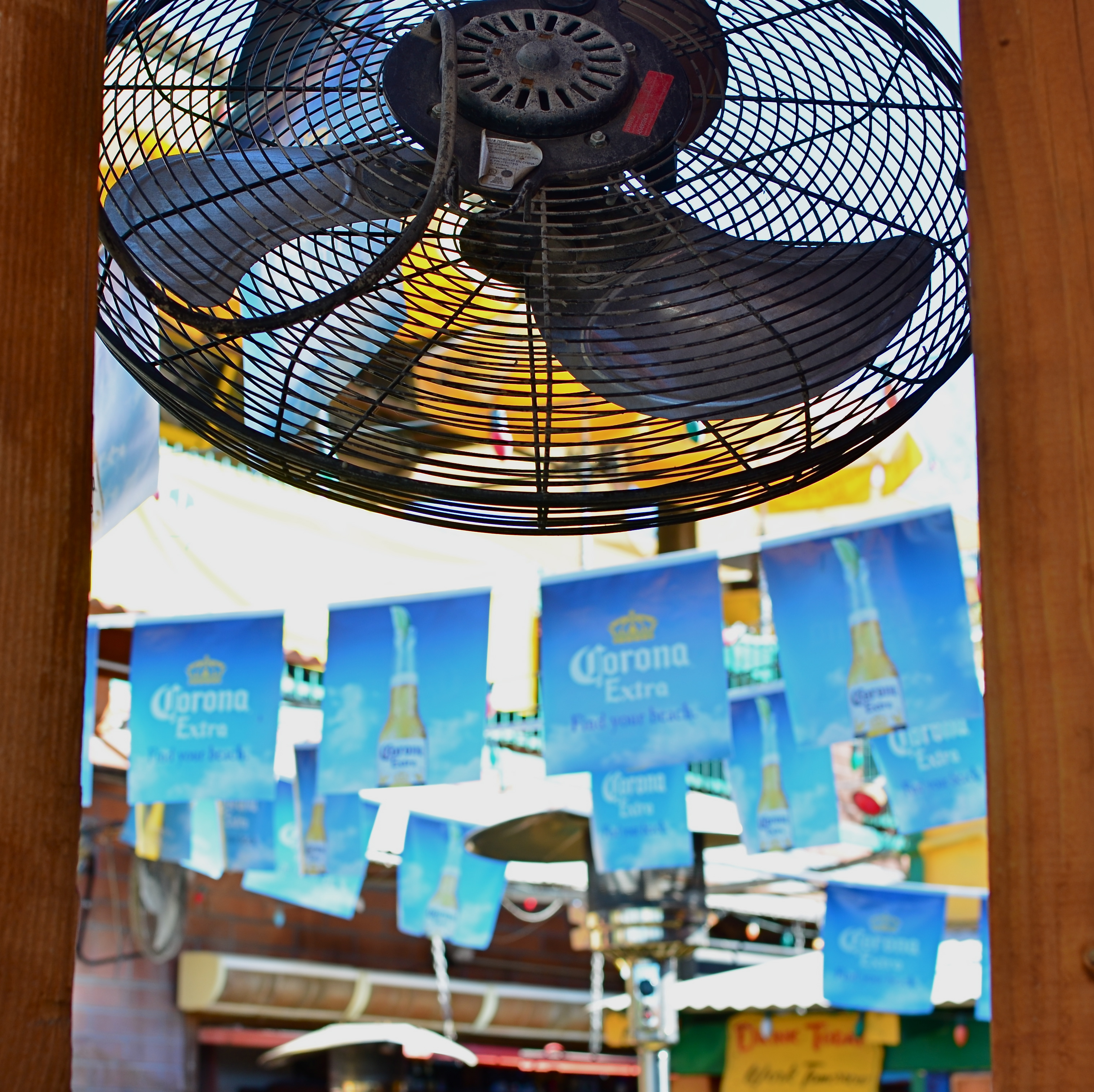
Fan photo: 1/80 sec., ISO 100, 35mm.
By MICHAEL PERKINS
THERE ARE TIMES WHEN THE RAW VISUAL FLOOD OF INTENSE COLOR IS THE MOST INTOXICATING DRUG ON THE PLANET, at least for photographers. Sometimes you are so overcome with what’s possible from a loud riot of hues that you just assume you are going to be able to extract a coherent image from it. It happens the most, I find, with large, sprawling events: festivals, open restaurants, street fairs, carnivals, anywhere your eyeballs just go into overload. Of course there must be a great picture in all this, you promise yourself.
And there may be. But some days you just can’t find it in the sheer “Where’s Waldo”-ness of the moment. Instead, you often wind up with a grand collection of clutter and no obvious clues as to where your viewer should direct his gaze. The technical term for this is “a mess”.
I stepped in a great one the other day. It’s a local college-crowd bar in Scottsdale, Arizona, where 99% of the customers sit outside on makeshift benches, shielded from the desert sun by garish Corona umbrellas, warmed by patio heaters, and flanked by loud pennants, strings of aerial lightbulbs and neon booze ads. The place radiates fun, and, even during the daylight hours before it opens, it just screams party. The pictures should take themselves, right?
Well, maybe it would have been better if they had. As in, “leave me out of it”. As in, “someone get me a machete so I can hack away half of this junk and maybe find an image.” Try as I might, I just could not frame a simple shot: there was just too much stuff to give me a clean win in any frame. In desperation, I shot through a window to make a large cooling fan a foreground feature against some bright pennants, and accidentally did what I should have done first. I set the shot so quickly that the autofocus locked on the fan, blurring everything else in the background into abstract color. It worked. The idea of a party place had survived, but in destroying my original plan as to how to shoot it, I had saved it, sorta.
I have since gone back to the conventional shots I was trying to make, and they are still a vibrant, colorful mess. There are big opportunities in big, colorful scenes where showing “everything in sight” actually works. When it doesn’t, you gotta be satisfied with the little stories. We’re supposed to be interpreters, so let’s interpret already.
WORK AT A DISADVANTAGE
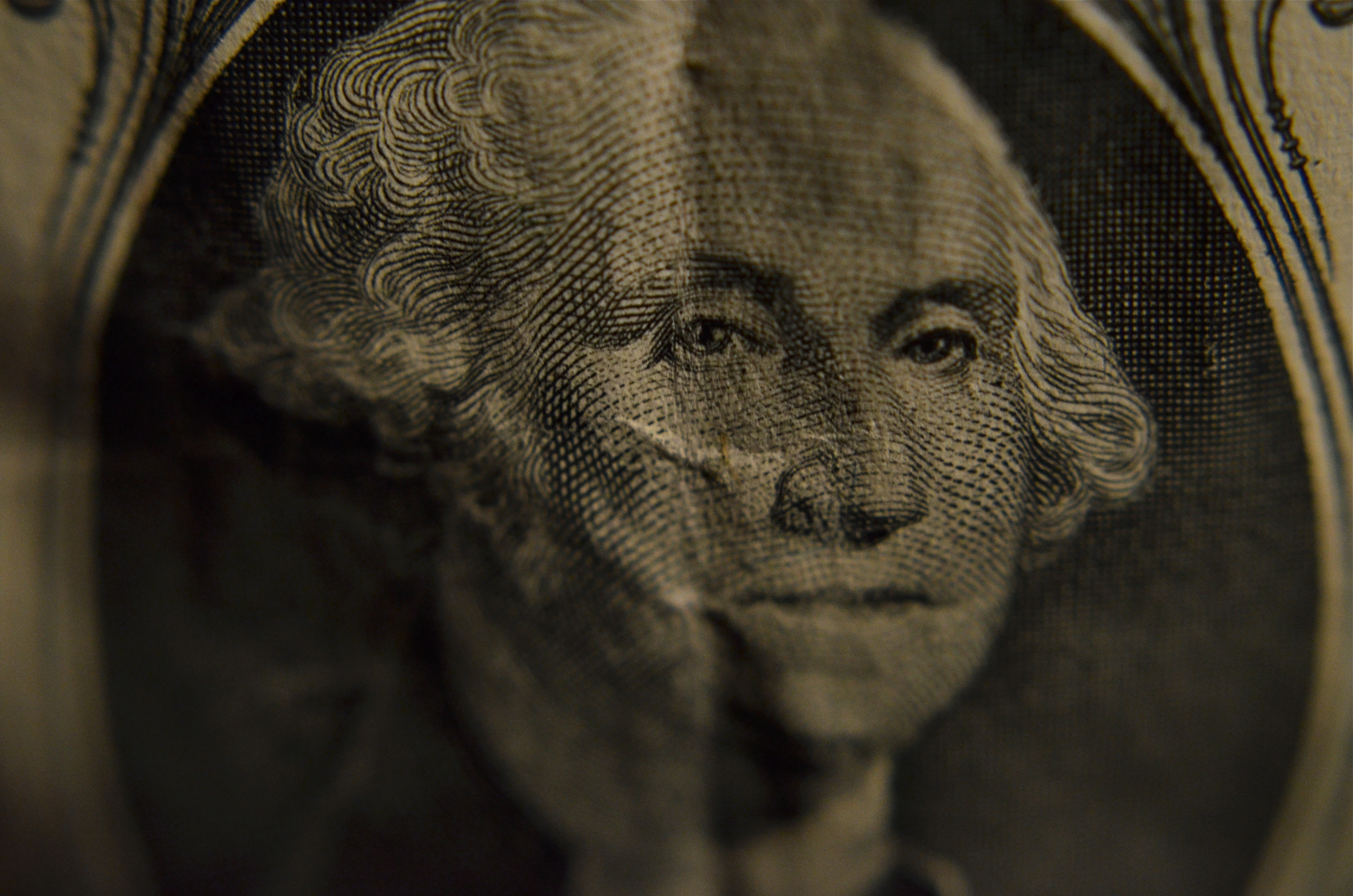
Focus. Scale. Context. Everything’s on the table when you’re trolling for ideas. 1/100 sec., f/5.6, ISO 800, 35mm.
By MICHAEL PERKINS
“IS THERE NO ONE ON THIS PLANET TO EVEN CHALLENGE ME??“, shouts a frustrated General Zod in Superman II as he realizes that not one person on Earth (okay, maybe one guy) can give him a fair run for his money. Zod is facing a crisis in personal growth. He is master of his domain (http://www.Ismashedtheworld.com), and it’s a dead bore. No new worlds to conquer. No flexing beyond his comfort zone. Except, you know, for that Kryptonian upstart.
Zod would have related to the average photographer, who also asks if there is “anyone on the planet to challenge him”. Hey, we all walk through the Valley Of The Shadow Of ‘My Mojo’s Gone’. Thing is, you can’t cure a dead patch by waiting for a guy in blue tights to come along and tweak your nose. You have to provide your own tweak, forcing yourself back into the golden mindset you enjoyed back when you were a dumb amateur. You remember, that golden age when your uncertainly actually keened up your awareness, and made you embrace risk. When you did what you could since you didn’t know what you could do.
You gotta put yourself at a disadvantage. Tie one hand behind your back. Wear a blindfold. Or, better yet, make up a “no ideas” list of things that will kick you out of the hammock and make you feel, again, like a beginner. Some ways to go:
1.Shoot with a camera or lens you hate and would rather avoid. 2.Do a complete shoot forcing yourself to make all the images with a single lens, convenient or not. 3.Use someone else’s camera. 4.Choose a subject that you’ve already covered extensively and dare yourself to show something different in it. 5.Produce a beautiful or compelling image of a subject you loathe. 6.Change the visual context of an overly familiar object (famous building, landmark, etc.) and force your viewer to see it completely differently. 7.Shoot everything in manual. 8.Make something great from a sloppy exposure or an imprecise focus. 9.Go for an entire week straight out of the camera. 10.Shoot naked.
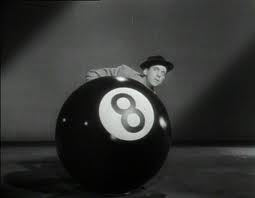
Put yourself behind the…. oh, you get the idea.
Okay, that last one was to make sure you’re still awake. Of course, if nudity gets your creative motor running, then by all means, check local ordinances and let your freak flag fly. The point is, Zod didn’t have to wait for Superman. A little self-directed tough love would have got him out of his rut. Comfort is the dread foe of creativity. I’m not saying you have to go all Van Gogh and hack off your ear. But you’d better bleed just a little, or else get used to imitating instead of innovating, repeating instead of re-imagining.
DARKNESS AS SCULPTOR
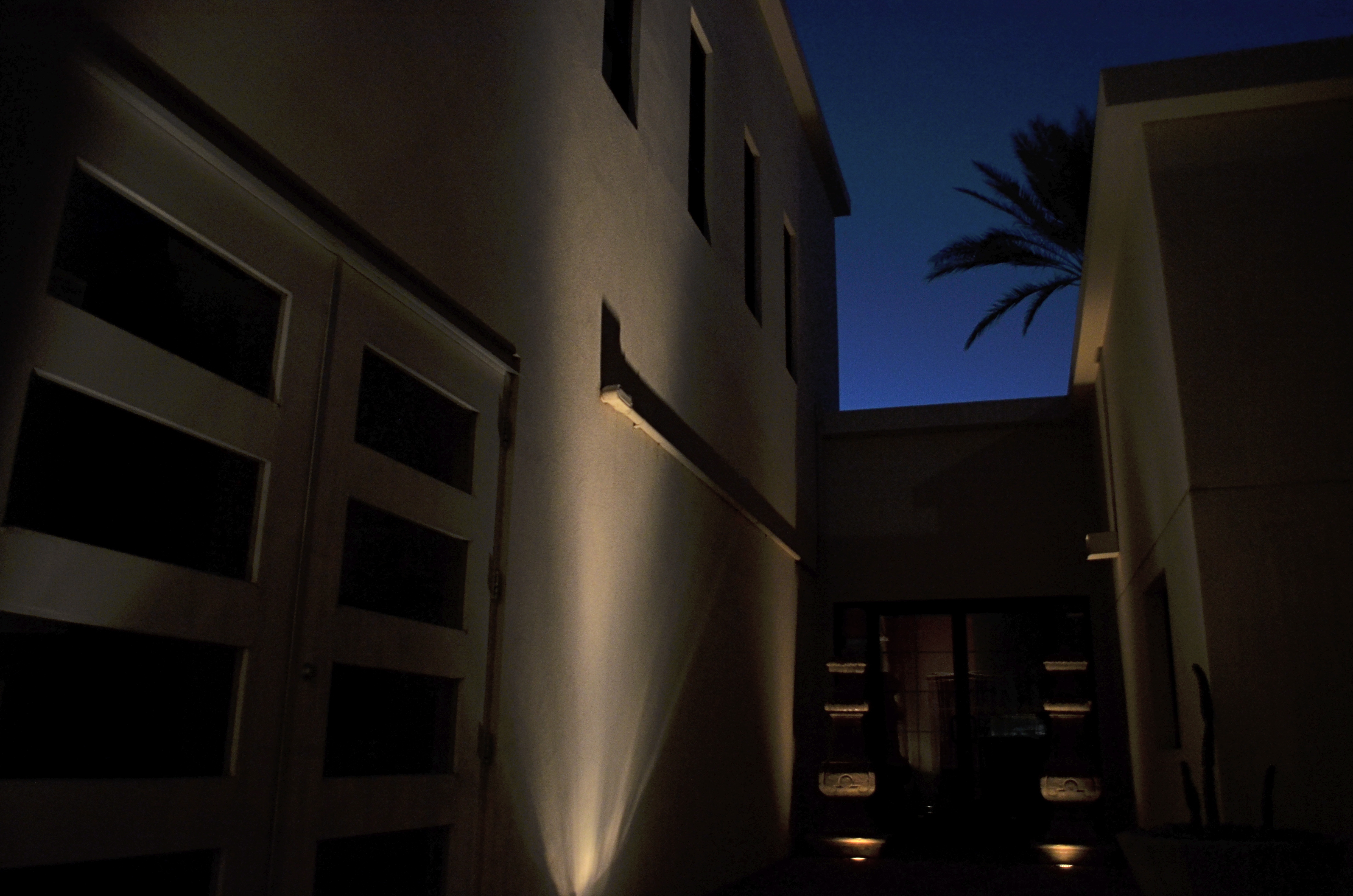
A dead end? Not once the sun goes down. 1/10 sec., f/3.5, ISO 500, 18mm
By MICHAEL PERKINS
IN DAYLIGHT PHOTOGRAPHY, THE DEFAULT ACTION TENDS TO BE TO SHOW EVERYTHING. Shadows in day scenes are a kind of negative reference to the illuminated objects in the frame, but it is those objects, and not the darkness, that defines space. In this way shady areas are a kind of decor, an aid to recognition of scale and depth.
At night, however, the darkness truly plays a defining role, reversing its daylight relationship to light. Dark becomes the stuff that night photos are sculpted from, creating areas that can remain undefined or concealed, giving images a sense of understatement, even mystery. Not only does this create compelling compositions of things that are less than fascinating in the daytime, it allows you to play “light director” to selectively decide how much information is provided to the viewer. In some ways, it is a more pro-active way of making a picture.
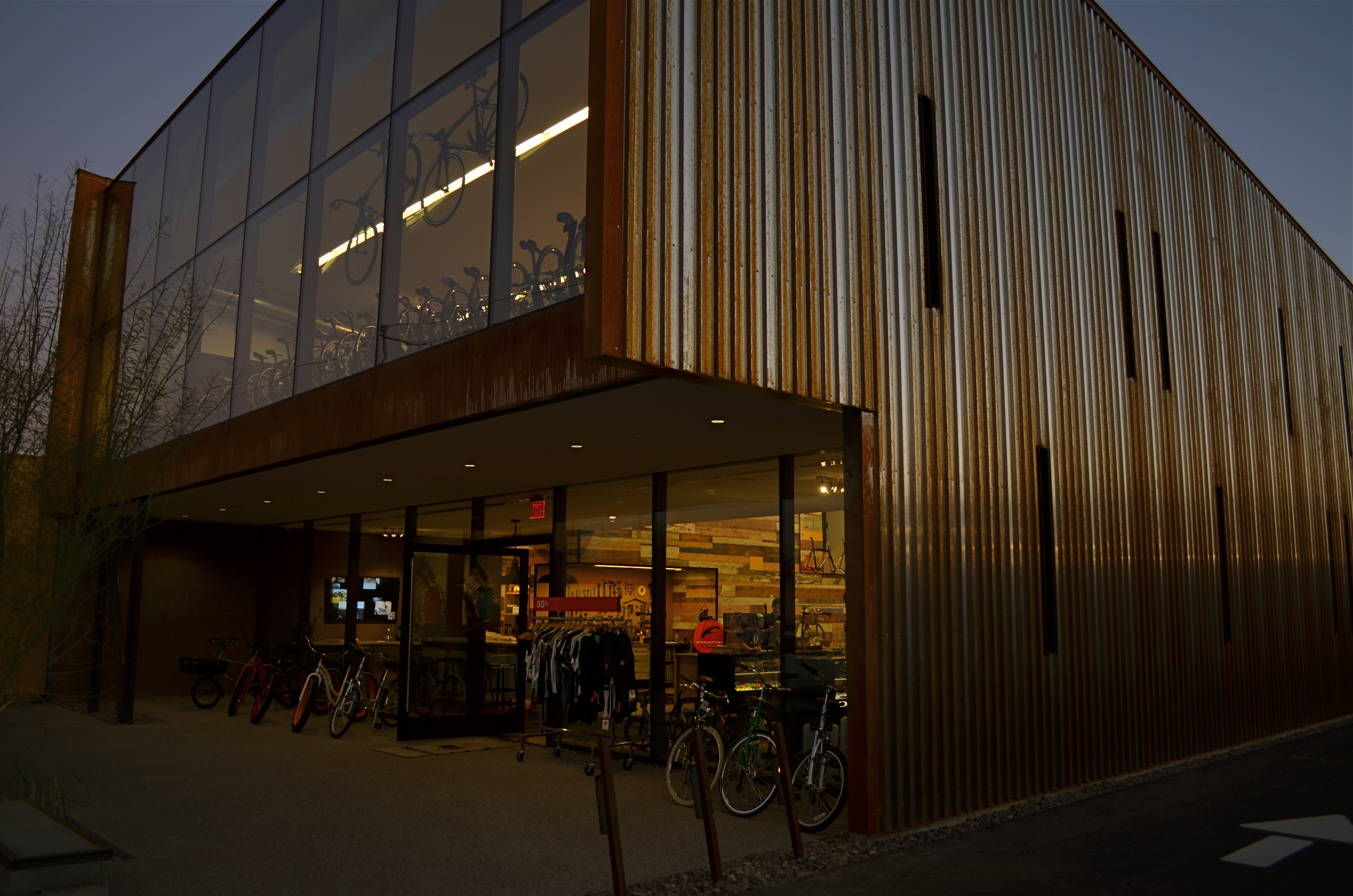
This bike shop took on drastically different qualities as the sun set. 1/40 sec., f/3.5, ISO 100, 18mm.
I strongly recommend walkabout shoots that span the complete transition from dusk to post-sunset to absolute night. Not only will the quickly changing quality of light force you to make decisions very much in-the-moment, it allows for a vast variance in the visual power of your subjects that is starkly easy to measure. It’s a great practice lab for shooting completely on manual, and, depending on the speed of your chosen lens (and greater ISO flexibility in recent cameras), makes relatively noise -free, stable handheld shots possible that were unthinkable just a few years ago. One British writer I follow recently remarked, concerning ISO, that “1600 is the new 400”, and he’s very nearly right.
So wander around in the dark. The variable results force you to shoot a lot, rethink a lot, and experiment a lot. Even one evening can accelerate your learning curve by weeks. And when darkness is the primary sculptor of a shot, lovely things (wait for the bad pun) can come to light (sorry).
ORPHANS
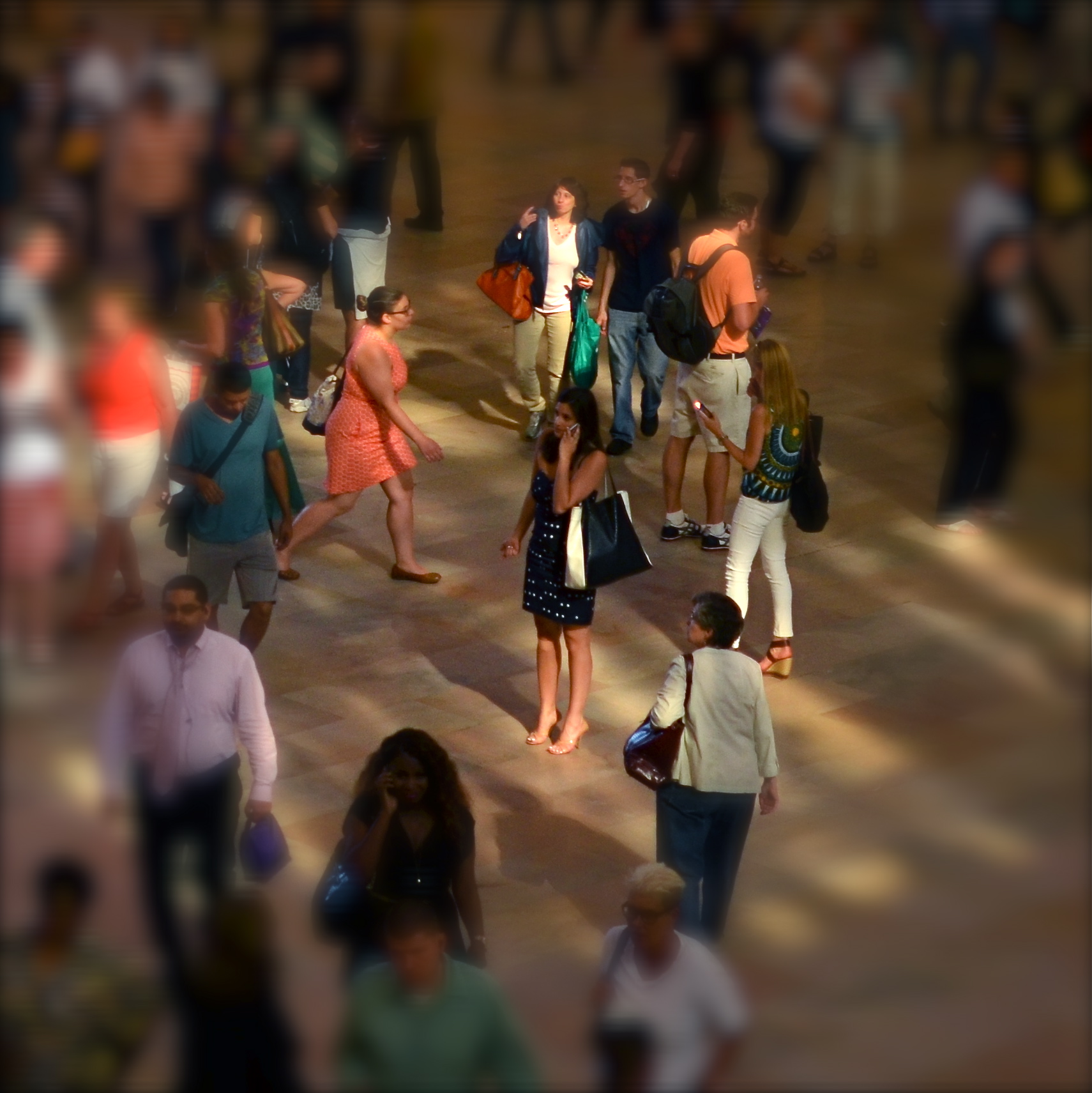
Grand Central, 2013. 1/160 sec., f/1.8, ISO 250, 35mm.
By MICHAEL PERKINS
IF YOU SHOOT ALL THE TIME, NEARLY EVERY DAY, THE SHEER TONNAGE of what you bring home guarantees that you will inevitably lose track of a large portion of your total output. Being that your alloted daily attention span is a finite number, you will literally run out of time before you can lavish affection on everything you’ve captured, on any occasion. Some shots will jump into your car like eager puppies, panting “take me home”, while others will be orphaned, tossed into the vast digital shoebox marked “someday”, many never seeing the light of day again.
The cure for this, oddly, lies in the days when no ideas emerge and no pictures are taken…the dreaded “drys”, those horrible, slow periods when you can’t buy an inspiration to save your life. In those null times, the intellectual equivalent of a snow day, you may find it useful to revisit the shoebox, to rescue at least a shot or two formerly consigned to the shadows.
Using your paralysis periods for reflection may get you off the creative dime (and it may not), but it will, at least, allow you to approach old experiments with a fresh eye, one seasoned by time and experience. Maybe you overlooked a jewel in your haste. You almost certainly left free lessons on either technique or humility by the wayside, wisdom that can be harvested now, since you’re currently watching your camera mock you from across the room (okay, mock is harsh).
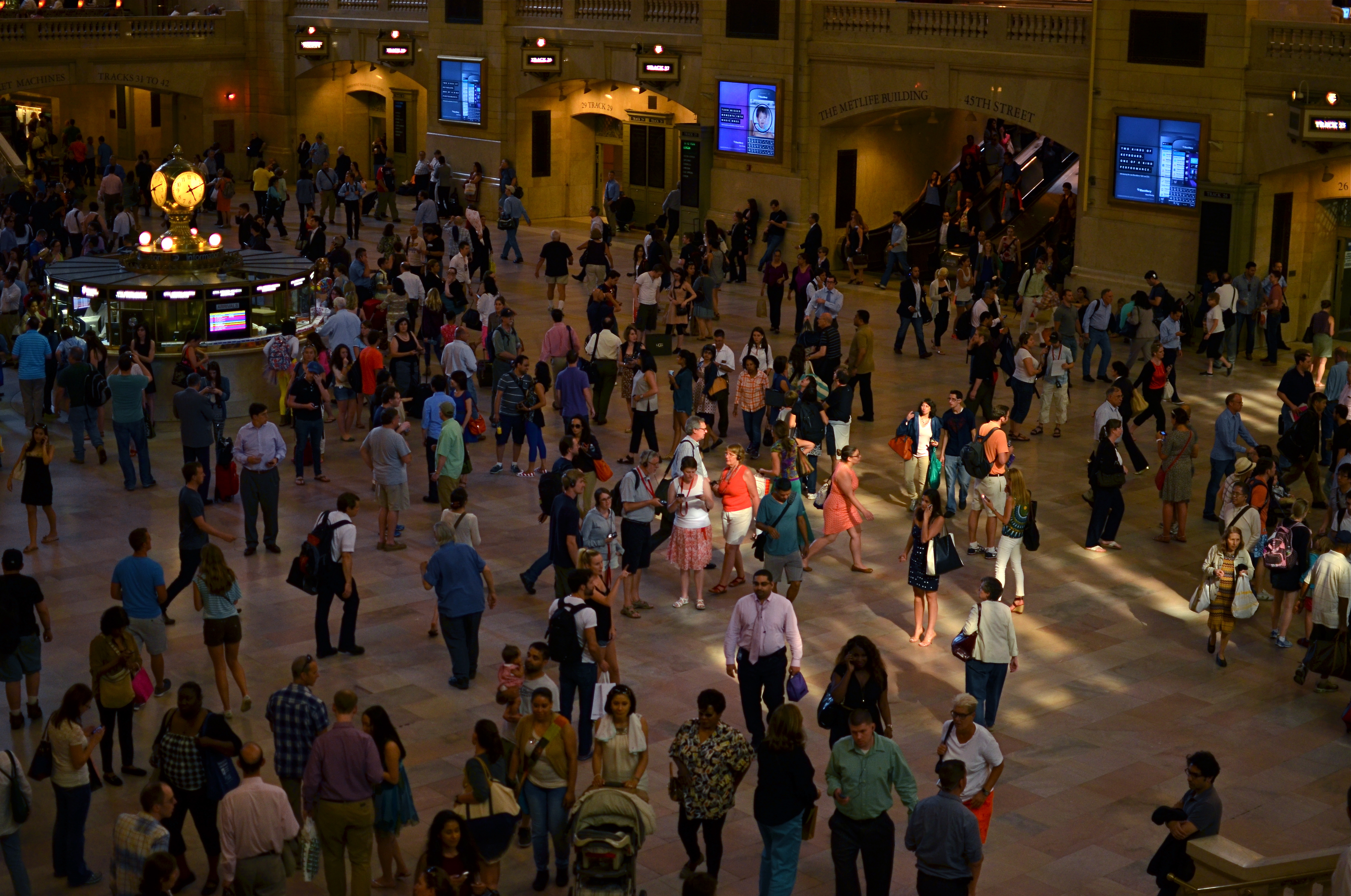
The master shot, before cropping.
During my last visit to Manhattan, I was determined to explore the limits of natural light streaming from the gigantic windows of the main terminal floor at Grand Central, and, for the most part, I framed the place’s architectural features in such a way as to dwarf the scurrying humanity heading to their various destinations. I did shoot a few floor shots as “crowd pieces”, but, upon editing, I failed to look within those big groupings for any kind of individual story or drama. I chose the gigundo-windows master shot I wanted, and left all the other frames in the dust.
Recently hitting a dead spot of several days’ duration, I decided to wander through The Ghosts Of Photo Attempts Past, and I saw a mix of bodies and light within the smallest 1/3 of a larger crowd shot that seemed worth re-framing, with a little softening effect to help the story along. Still not a masterpiece, but, since I was lucky enough to isolate it within a “Where’s Waldo” frame crammed with detail, it was something of a gift to salvage a chunk of it that I could actually care about.
Another orphan finds a home.
I MAY HAVE TO WORK LATE
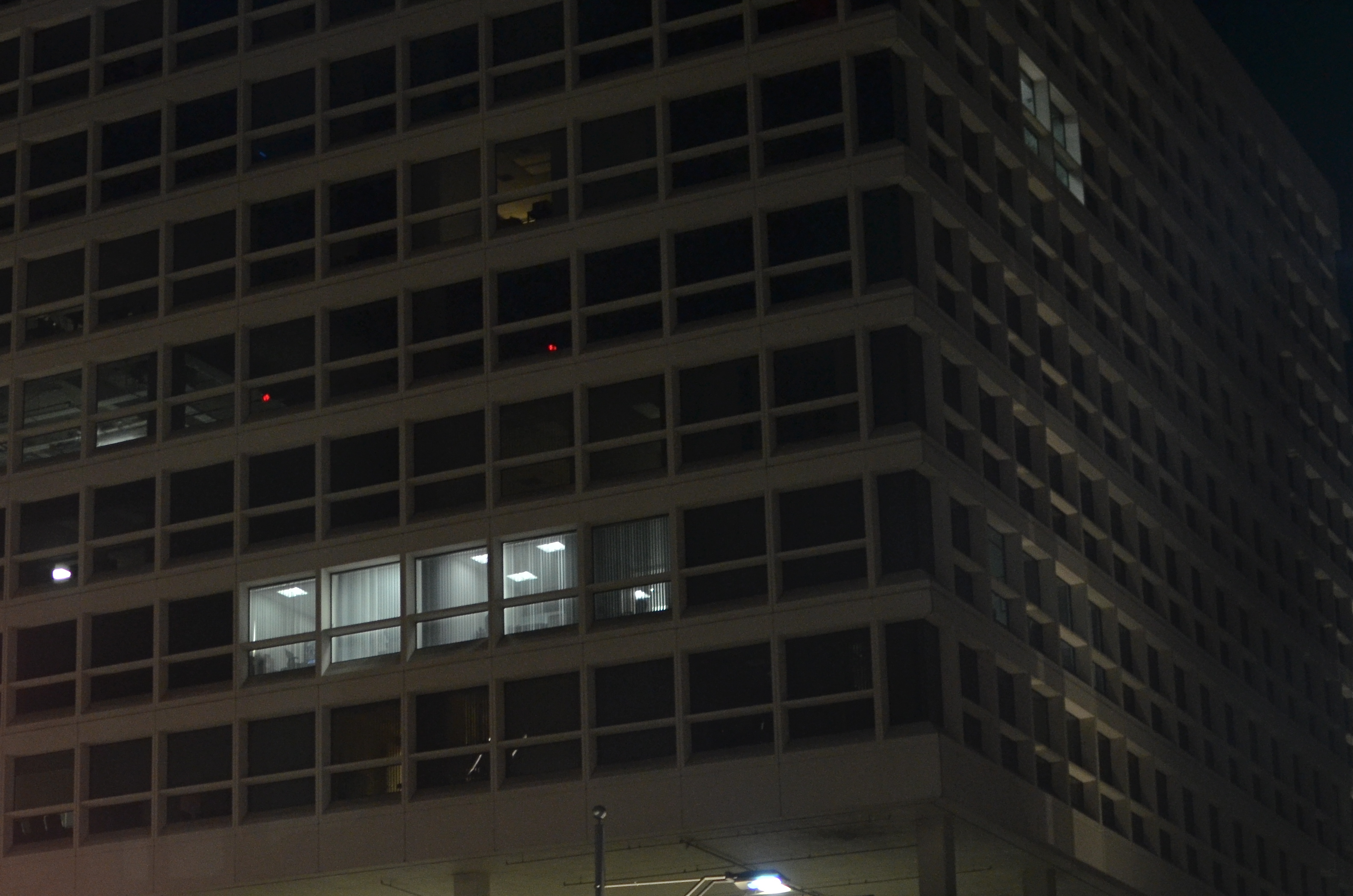
Say Hi To The Cleaning Crew: 1/50 sec., f/1.8, ISO 640, 35mm.
By MICHAEL PERKINS
SOME OF THE BEST HUMAN INTEREST STORIES, EVEN WITH A CAMERA, CAN ONLY BE VIEWED INDIRECTLY. There are many cases in which even the best of us have to merely hint or suggest something about people that we clearly cannot show (or cannot show clearly). Maybe that intractable bit of visual mystery actually bonds us to our audiences, united as we are in speculation about what is beyond that wall or behind that door. The visual tease such photos provide are part of the art of making pictures, in that we are challenged to do more with less, and “show” something beyond the visible.
One of the simplest such stories to capture is very urban in nature: the last remaining nighttime lights in largely dormant buildings. Many of us have been the “last man standing” at the end of an extended work day. Others flee to engagements, family, dinner, but there we sit, chained to our desks until the report/project/research/budget is ready to be put to bed. There’s a readily identifiable feeling of loneliness, plus a little bit of martyr complex, that we can share in the plight of these unknown soldiers of the night.
Whenever I am driving through a city at night, I deliberately seek out those bluish, tube-lit warrens within the cubes and grids of otherwise featureless glass boxes. Who is there? What private eureka or oh, no moments are they experiencing? Which of a million potential dramas are being acted out, and with whom? The uncertainty, even from a photograph with little detail, sparks the imagination, and suddenly our viewers are completing the picture we were forced to deliver unfinished.
It’s the ongoing paradox of photography: what you don’t show is as vital as what you do show.
BLACK IS THE NEW QUIET
By MICHAEL PERKINS
PERHAPS IT’S MY FATHER’S LOVE OF THOREAU AND EMERSON. Maybe it’s a late-in-life turn toward the meditational. It most certainly is due, in part, to a life-long adoration of all things bookish. Whatever the exact mix, I regard library space as far more sacred than the confines of any church or chapel. Many find their faith flanked by stained glass; I get centered in the midst of bookshelves.
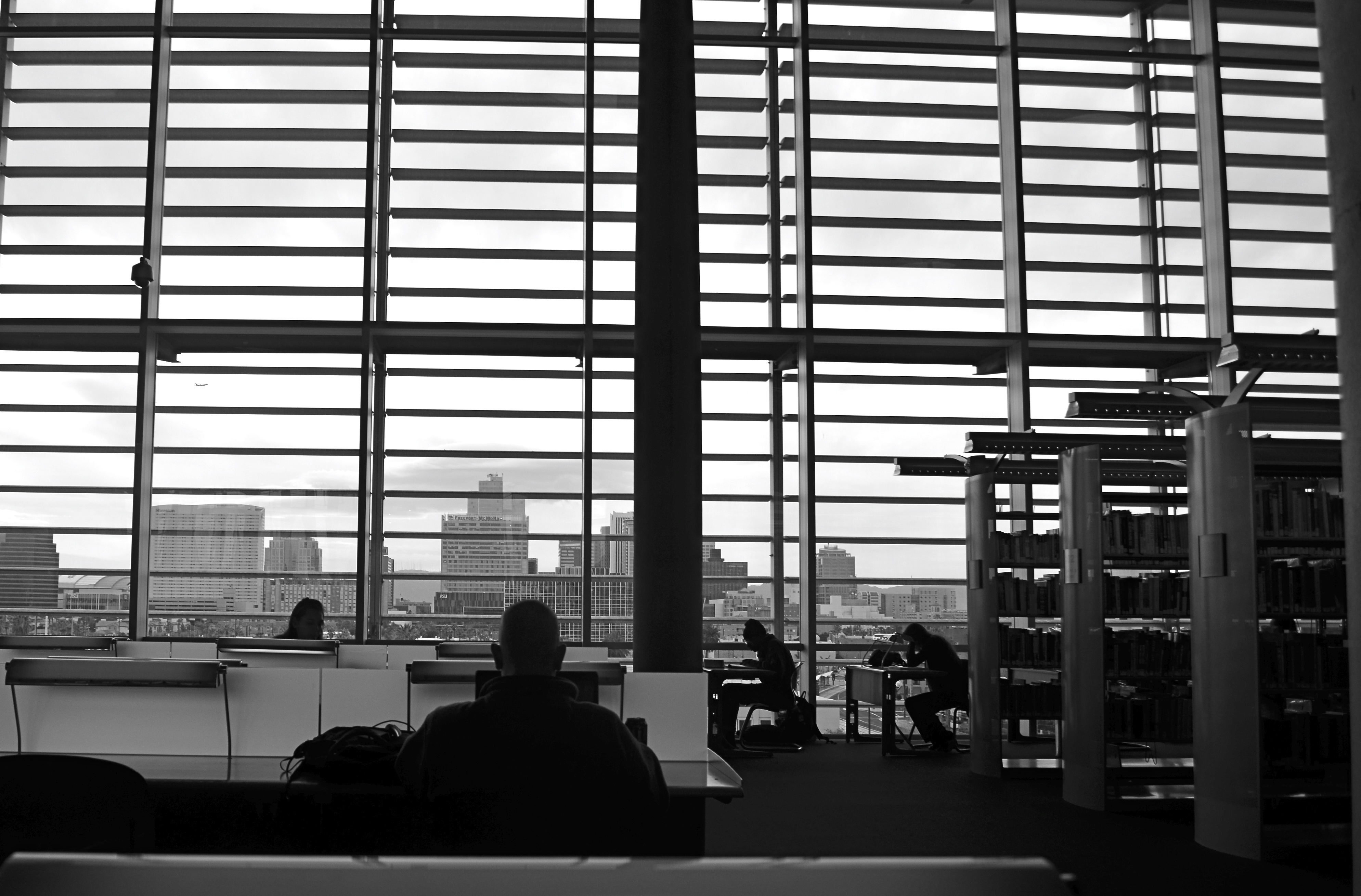
Solitude: An in-camera monochrome at 1/250 sec.,f/5.6, ISO 100, 18mm.
And if libraries are my churches, reading rooms are the sanctuaries, the places within which the mind can be channeled into infinite streams, and where, incidentally, perfect mental quiet can translate into visual quiet. And that, for me, means black and white images. Color can be too loud, proud, and garish, wherein monochrome is the language of privacy, intimacy, and a perfect kind of silence. You might say black is the new quiet.
Inside reading rooms, the faces and clothing of the patrons seems, well, irrelevant to the mood. They have all come seeking the same thing, so compositionally, they are, themselves, all alike, and seeing them in silhouette against the larger details of the room seems to enhance the feeling of reverent quiet. As for composing, letting the room’s massive window take up 3/4 of the frame kept the readers as a small understatement along the bottom baseline of the shot. And, since I was reluctant to ruin the atmosphere of the room, or risk my “invisibility” with more than one audible click to betray me, I chose to go for broke with a single black & white image. I exposed for the cityscape beyond the window, to guarantee that the readers would be rendered as shapes, and that was it.
Having successfully purloined a treasure from within the Church Of The Holy Book, I proceeded to beat it.
Quietly.
RE-FIXING THE FIX
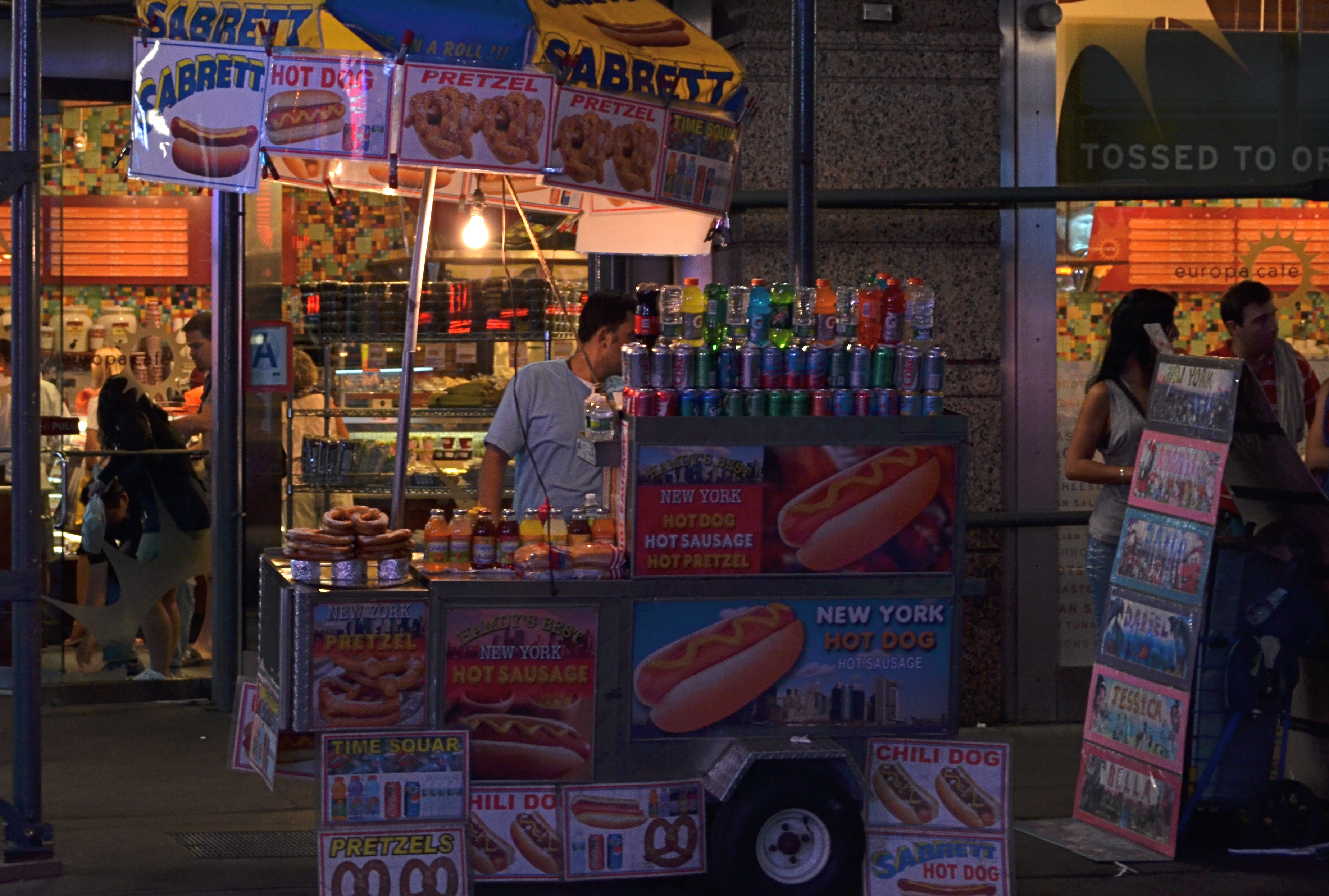
Think this picture’s bad now? Hey, wait til I start messing with it. 1/40 sec., f/8, ISO 320, 55mm.
By MICHAEL PERKINS
I CAN HEAR MY MOTHER NOW: “Don’t pick at it, you’ll get it infected”.
Okay, she usually was referring to a scab on a skinned knee. But often, when I can’t stop interfering needlessly with an image, I could swear she’s talking about photographs.
You know the ones I mean. The near misses that you would swear could be transformed into masterpieces with just one….more…tweak. Or maybe two. Or thirty. They are often the pictures we love most, like bad kids, simply because they had such potential, at least until we snapped the shutter. Then we stick them, flaws and all, on life support and start playing with things. Contrast. Color. Exotic filters. A spoonful of sugar. A pound and a half of good intentions.
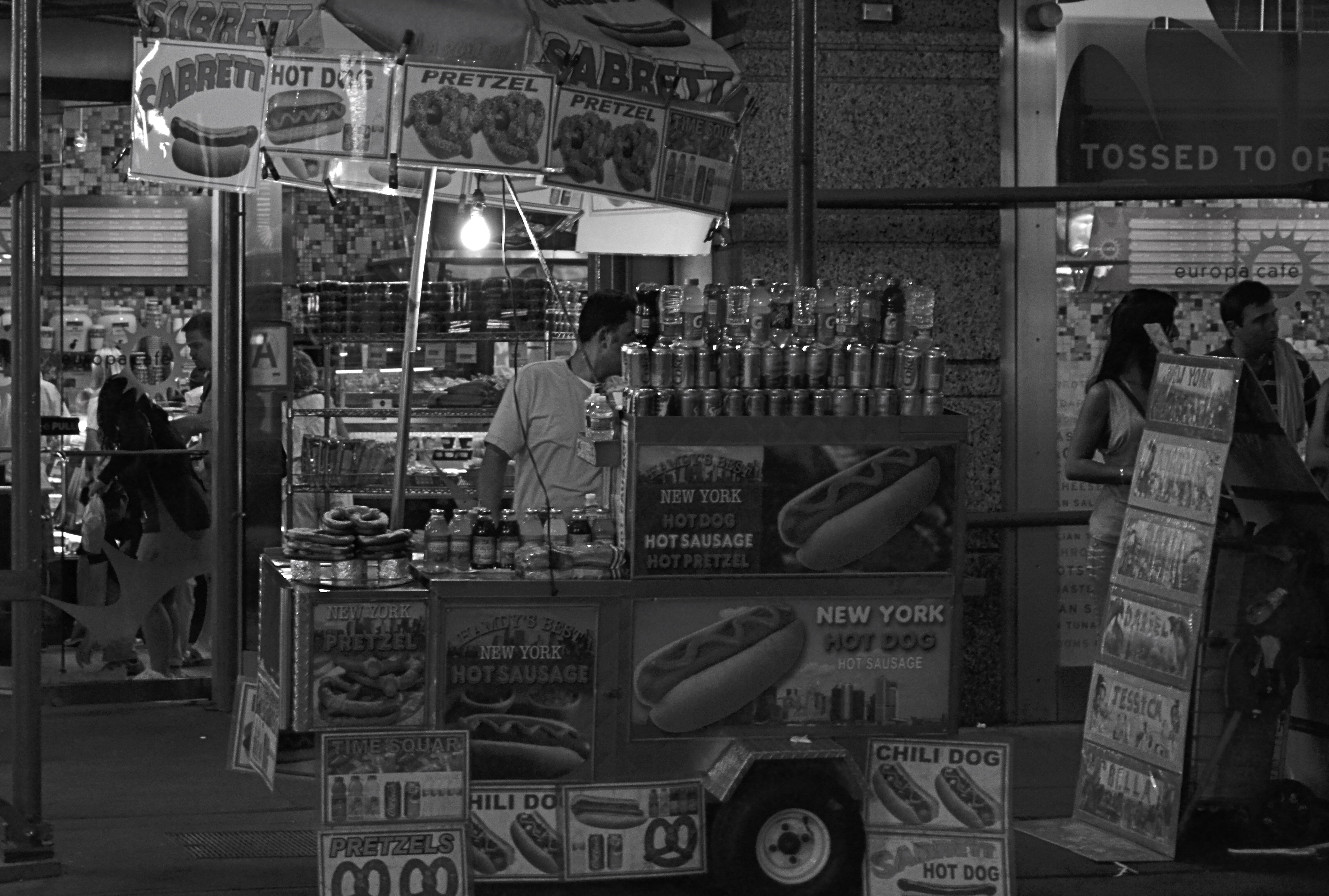
The same shot in monochrome. Yeah, less is sometimes just less.
And, sometimes, by getting our tweak on in a heavy-handed fashion, we make things worse. We render them garish, or glowing, or gooey, and still not what we intended. It’s like tutoring a kid that will never ever make the honor roll. It seems like we ought to be able to do something.
That’s the story of the above color street shot, taken just after sundown in Times Square. All the elements of a good picture are there, but the thing is just all right, nothing more, nothing less. At some point before I first posted it on Flickr, I got the brilliant notion that it would look more “authentic” if desaturated to black and white. Re-examining it more than a year later, I realized “authentic” was code for maybe I can distract people from the fact that I didn’t really bring it home in this shot. Once it was monochromed, the image was actually robbed of whatever minimal punch it might have originally had. All the zippy color of the signage and soda cans was banished, to replaced by….a really dull and narrow range of half-tones. All the depth and presence went out the same exit door as the color, but I went ahead and posted it anyway, trying to convince myself that I had made it much more “street”, when all I had really done was strip out the carnival hues that really said “Broadway”. I had worked against myself, and, worse, I had wasted time on a shot which should have gone in the reject pile from day one.
It’s not a miserable photo, and maybe that’s what really hard to accept. It might have been something. What I should have done, while I was there, was keep trying about ten more frames of this guy and maybe saving the concept. You know, try to get the photo right in the first place. Yeah, I know, how quaint. Thing is, once it was a mediocre picture inside the camera, all I could do was pick the scab.
And then it got infected.
Sorry, Mom.
DISTORTION AS DESIGN
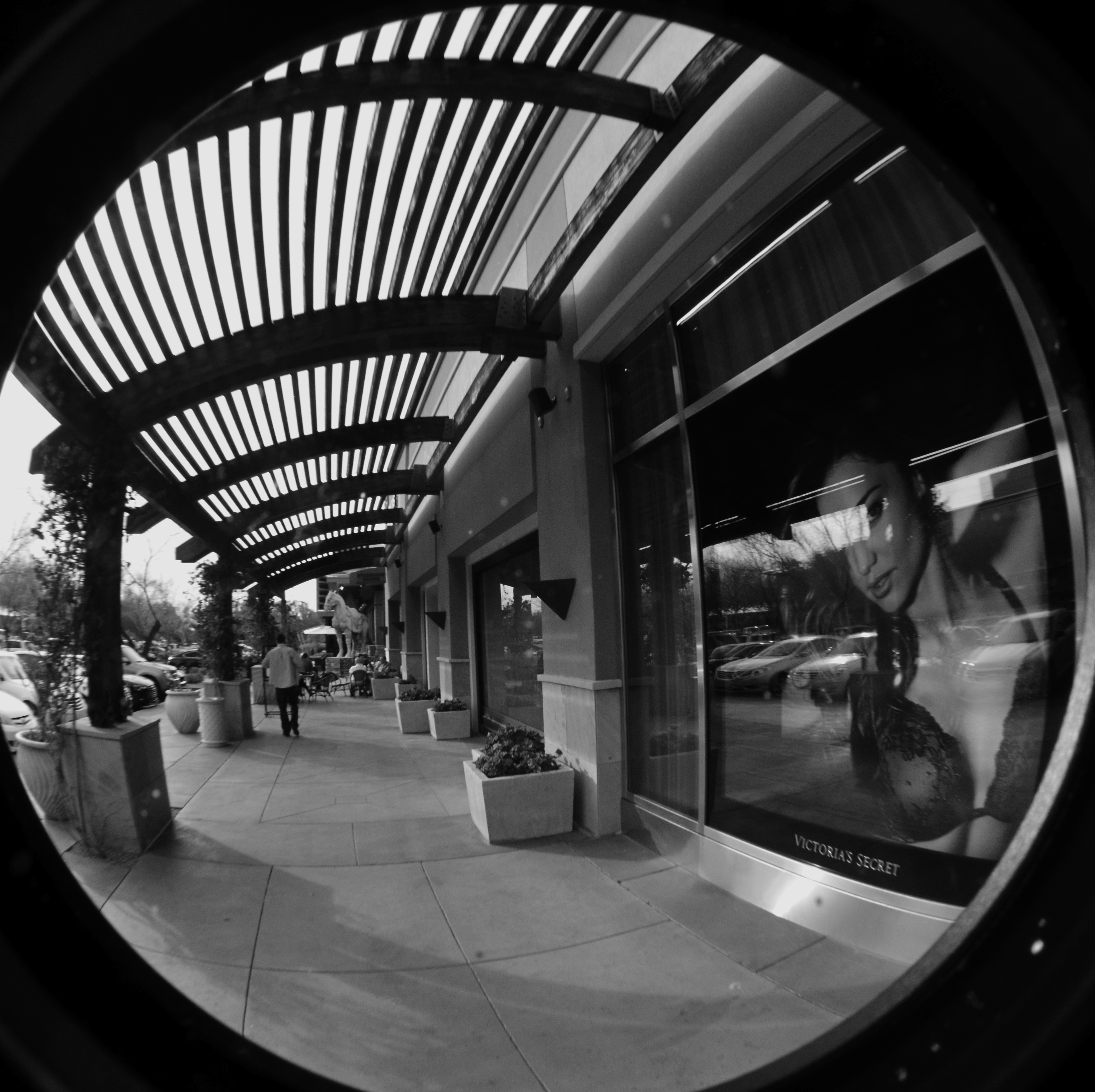
Overhead parallels bent with a fisheye to yank the eye for forcefully into the frame, maybe impose a little claustrophobia. 1/80 sec., f/22. ISO 640, 8mm
By MICHAEL PERKINS
BORN INTO A PAINTER’S WORLD, PHOTOGRAPHY NATURALLY INHERITED THAT DISCIPLINE’S BIAS TOWARD SHOWING THE WORLD “AS IT IS“, and, in fact, the first fifty years of photographic images seem to be in a neck-and-neck race with painting for the best rendering of the world at large. Then the 20th century kind of dope-slapped humanity’s collective sense of “reality”, as a world war, the onrush of science, and the rise of secular thought combined to question what the hell we needed with reality, anyway. The arts were shaken to their foundations, and photography and painting spiraled off onto wild new side roads. All bets for what defined a “picture” were off.
That’s not to say that photography has remained visually unbound through the decades. It almost acts like the flow and ebb of the surf. Photos surge toward pure documentation, then pull back into pure effect. They roll forward into an absolute deconstruction of the real world, then clamber back into the safety of literal pictorialism. One day we’re trying to recreate a wilderness landscape with perfect fidelity; the next day we’re reducing all “subjects” moot, reducing everything to shape and light.
I have had to spend many years getting comfortable with abstractions in my photography. It’s not like I don’t have ideas that wander far from the visual mainstream. If anything, I’ve had to learn to trust those visions, to stop worrying about whether they have “value” versus some rigid, if invisible,standard. While some shooters started with an absolutely open attitude toward the camera, pointing, framing and living completely by whim or instinct (the Instagram and Lomo kids of my Stone Age), I was absolutely, unwaveringly serious about arranging or capturing things as I literally saw them. It was a very clenched approach, even if it did teach me the physics of the medium. I had to learn to hold things very tightly before learning to let anything go.
And it took a very long time.
The great gift of the digital era is that many “accounting” issues (how much film do I have left? where can I go to get these processed? do they sell my kind of film in this end of town?) are just plain gone, and, with them, a little of the constipated approach that they imposed on me. At my age, it no longer matters a damn how long I shoot, how many times I “fail”, or who does or does not choose to anoint the results. There are no teachers or parents left to show off for, no competition with anyone except myself. I am free to use surfaces as straight lines or use distortion as a design element.
The truth speaks with forked tongue: in some ways I am glad that I am no longer young, since I have finally lived long enough to “age” into my photographic niche. And it also makes me sad that I am no longer young, because I really want to run with this ball, and I realize that Time might knock my legs out from underneath me before I make it all the way down the field. Still, we are here, and here is where we have to concentrate our energy. It’s the only control we have. Or, in the words of Edna St.Vincent Millay:
My candle burns at both ends; It will not last the night;
But ah, my foes, and oh, my friends— It gives a lovely light.
THE RELENTLESS MELT
By MICHAEL PERKINS
THERE ARE PEOPLE YOU PHOTOGRAPH BECAUSE THEY ARE IMPORTANT. Others are chosen because they are elements in a composition. Or because they are interesting. Or horrific. Or dear in some way. Sometimes, however, you just have to photograph people because you like them, and what they represent about the human condition.
That was my simple, solid reaction upon seeing these two gentlemen engaged in conversation at a party. I like them. Their humanity reinforces and redeems mine.
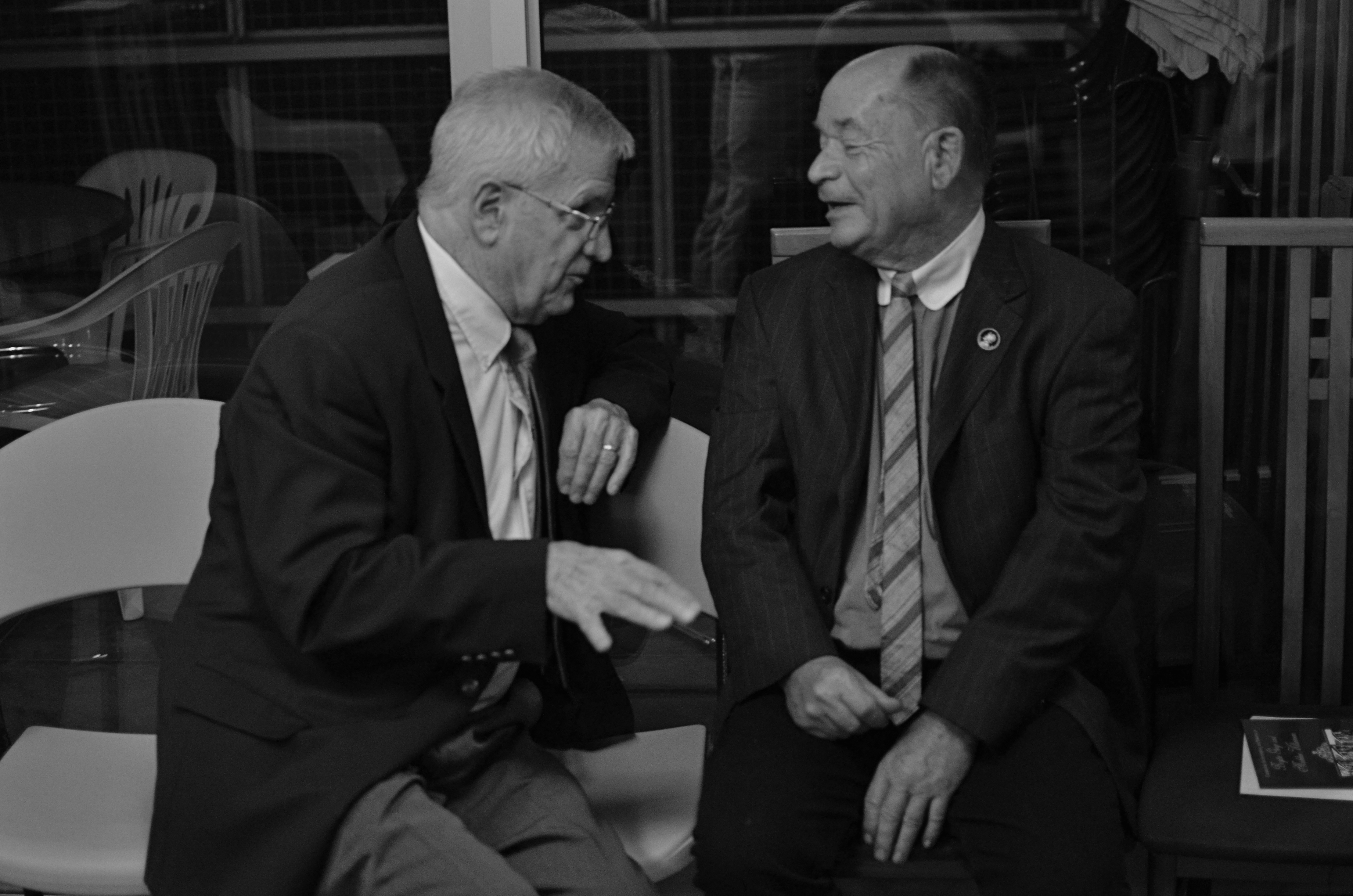
“Old friends sat on a park bench like bookends”: 1/80 sec., f/1.8, ISO 1000, 35mm.
This image is merely one of dozens I cranked out as I wandered through the guests at a recent reception for two of my very dearest friends. Given the distances many of us in the room traveled to be there, it’s unlikely I will ever see most of these people again, nor will I have the honor of knowing them in any other context except the convivial evening that herded us together for a time. Because I was largely eavesdropping on conversations between small groups of people who have known each other for a considerable time, I enjoyed the privilege often denied a photographer, the luxury of being invisible. No one was asked to pose or smile. No attempt was made to “mark the occasion” or make a record of any kind. And it proved to me, once more, that the best thing to relax a portrait subject is……another portrait subject.
I assume from the body language of these two men that they are friends, that is, that they weren’t just introduced on the spot by the hostess. There is history here. Shared somethings. I don’t need to know what specific links they have, or had. I just need to see the echoes of them on their faces. I had to frame and shoot them quickly, mostly to evade discovery, so in squeezing off several fast exposures I sacrificed a little softness, partly due to me, partly due to the animated nature of their conversation. It doesn’t bother me, nor does the little bit of noise suffered by shooting in a dim room at ISO 1000. I might have made a more technically perfect image if I’d had total control. Instead, I had a story in front of me and I wanted to possess it, so….
Susan Sontag, the social essayist whose final life partner was the photographer Annie Liebovitz, spoke wonderfully about the special theft, or what she called the “soft murder” of the photographic portrait when she noted that “to take a photograph is to participate in another person’s mortality, vulnerability, mutability. Precisely by slicing out this moment and freezing it, all photographs testify to time’s relentless melt.”
Melt though it might, time also leaves a mark.
Caught in a box.
Treasured in the heart.
Related articles
- Susan Sontag Musings Where You Least Expect Them (hintmag.com)
ANOTHER YEAR OUT THE WINDOW
By MICHAEL PERKINS
IF YOU WANT TO PUT A SMILE ON MY FACE WHEN I VISIT YOUR CITY, there is no sweeter sentence you can say to me than:
“I’ll drive”.
There is, for photographers, one way to maximize your time touring through other people’s towns, and that’s the time-honored tradition of “riding shotgun”. Drive me anywhere, but give me a window seat. I wasn’t trying to go for some kind of personal best in the area of urban side shots in 2013, but by good fortune I did snag a few surprises as I was ferried through various towns, along with a “reject” pile about a mile high. Like any other kind of shooting, the yield in window shooting is very low in terms of “killers per click”, but when you hit the target, you crack through a kind of “I’m new in town” barrier and take home a bit of the street for your own.
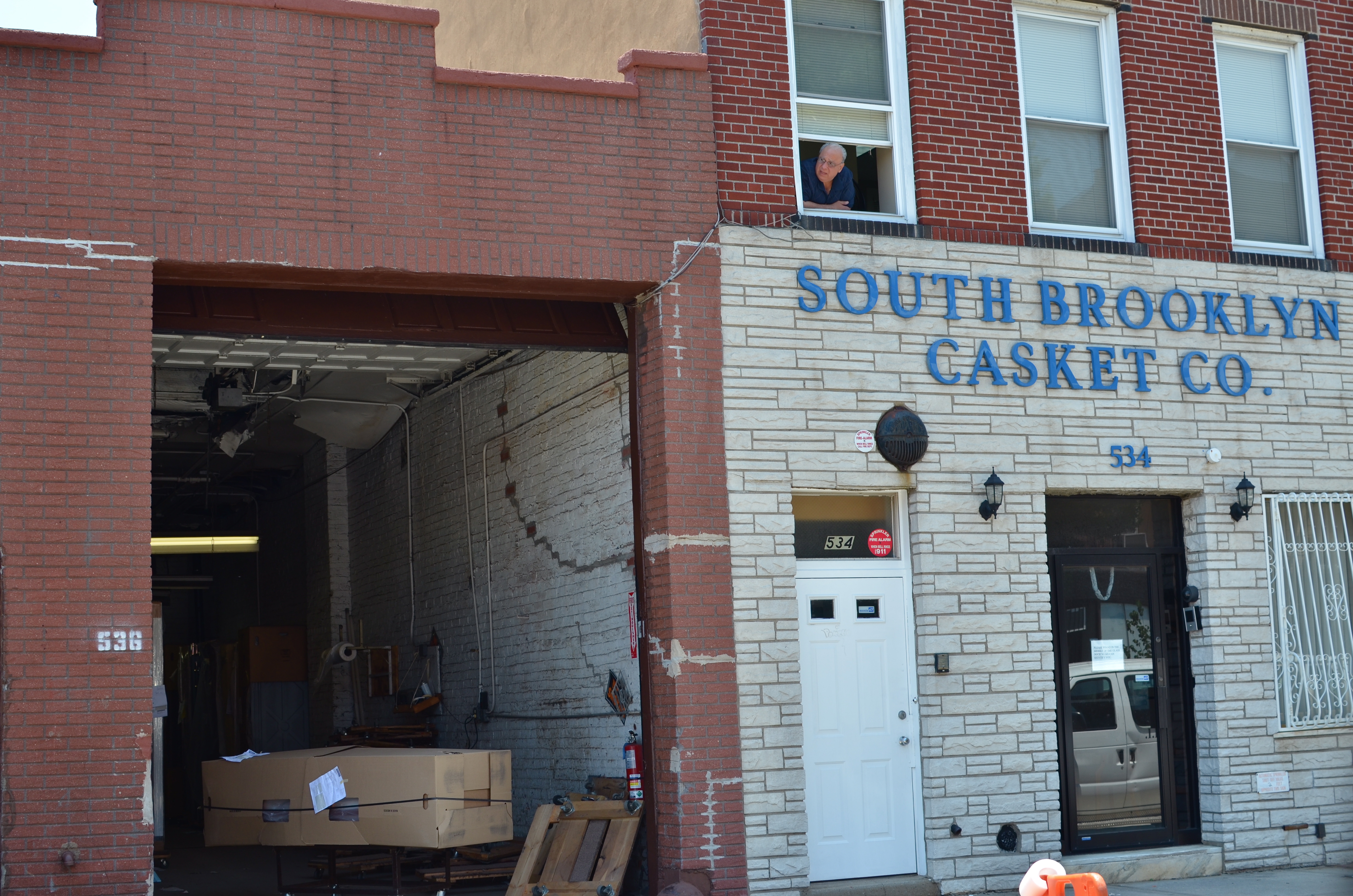
Business has been really dead lately. 1/250 sec., f/5.6, ISO 100, 35mm.
This guy just killed me (excuse the expression). He seemed like he was literally waiting for business to drop in (or drop dead), and meanwhile was taking in the view. Probably he didn’t even work for the casket company, in which case, what a bummer of neighbor to pick. Maybe he’s rent controlled.
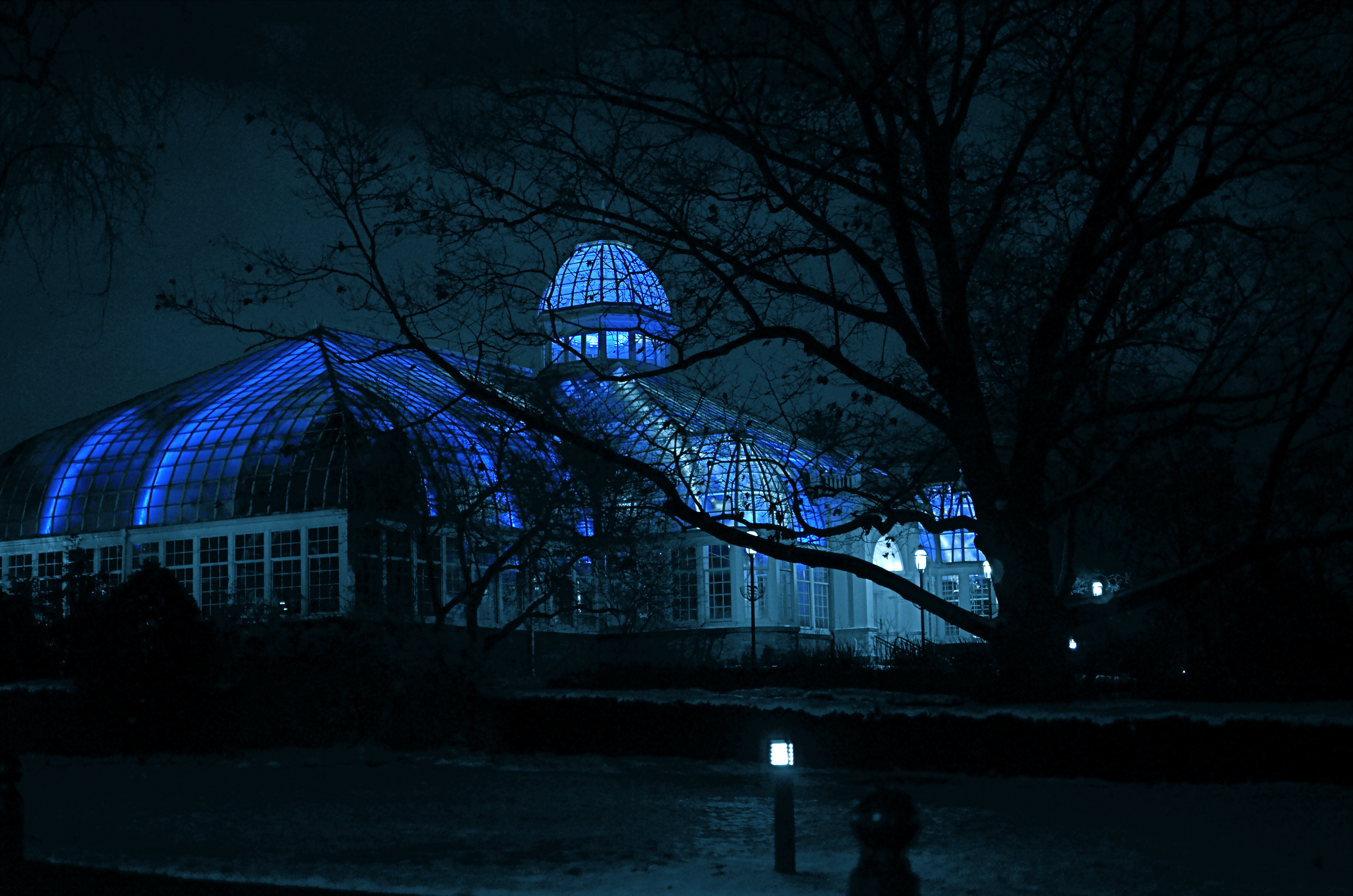
Franklin Park Conservatory, Columbus, Ohio. 1/40 sec., f/1.8, ISO 500, 35mm.
This one took a little tweaking. The building was actually blue, as you see here, lit with subdued mood for the holidays. However, in lightening this very dark shot, the sky registered as a muddy brown, so I made a dupe, desaturated everything except the conservatory, then added tint back in to make the surrounding park area match the building. All rescued from an “all or nothing” shot.
I’m also ashamed to admit that I bagged a few through-the-window shots while actually driving the car, all done at red lights and so not recommended. Don’t do as I do, do as I……oh, you know.
Here’s to long shots, at horse tracks or in viewfinders, and the few that finish in the money.
 thenormaleye