YOU ARE THE CAMERA
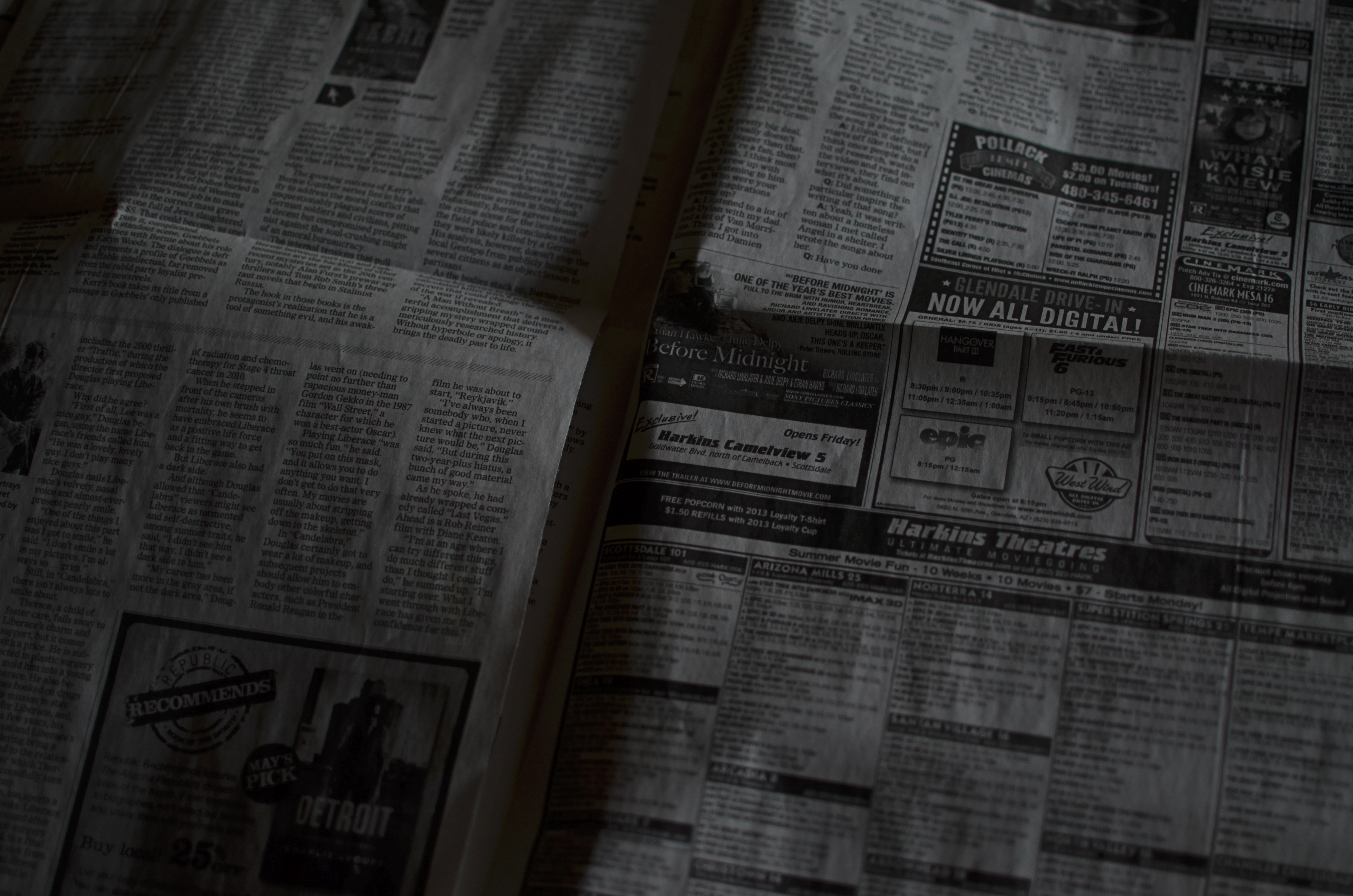
Dark Days for the printed page. 1/80 sec., f/1.8, ISO 100, 35mm.
By MICHAEL PERKINS
THE MOST ANNOYING COMMERCIAL ON TELEVISION AT PRESENT is the one from Apple reminding you that more people take pictures with the iPhone5 than with any other camera in the world. Now, I understand that The Men Who Would Be Steve at Apple need to assert their dominance in a rapidly accelerating race between smartphone camera brands. It’s just good business, and all that. Granting that, let’s agree that their statement is essentially meaningless for photography.
Apple can claim that their photo gadget is in more hands than anyone else’s? Ho-hum. The Kodak Brownie was able to make the same claim over 100 years ago, and successfully defend it for almost another fifty. We’re number one, sis-boom-bah, and what does that have to do with the kind of pictures that are being taken? The iPhone5 is a technical marvel on many levels, and it contains, among many other toys, a reasonably reliable, limited point-and-shoot-camera. You will always be able to get some kind of image on it under nearly any circumstances.
However, the Apple TV ad, while factually accurate, is artistically false, since it leads one to the spurious conclusion that more iPhone5 pictures means more excellent pictures. And there isn’t a camera, cheap or cherry, that can make that statement. I get just as agitated when trendo camera mags try to imply that if your gear costs thousands, your pictures will look like a million.
We’ve had almost two hundred years to shake off this childish notion. Equipment does not equal excellence. Convenience, speed, affordability, flexibility…cameras can make all these claims. But they do not confer the title of photographer on anyone.
Only you can do that.
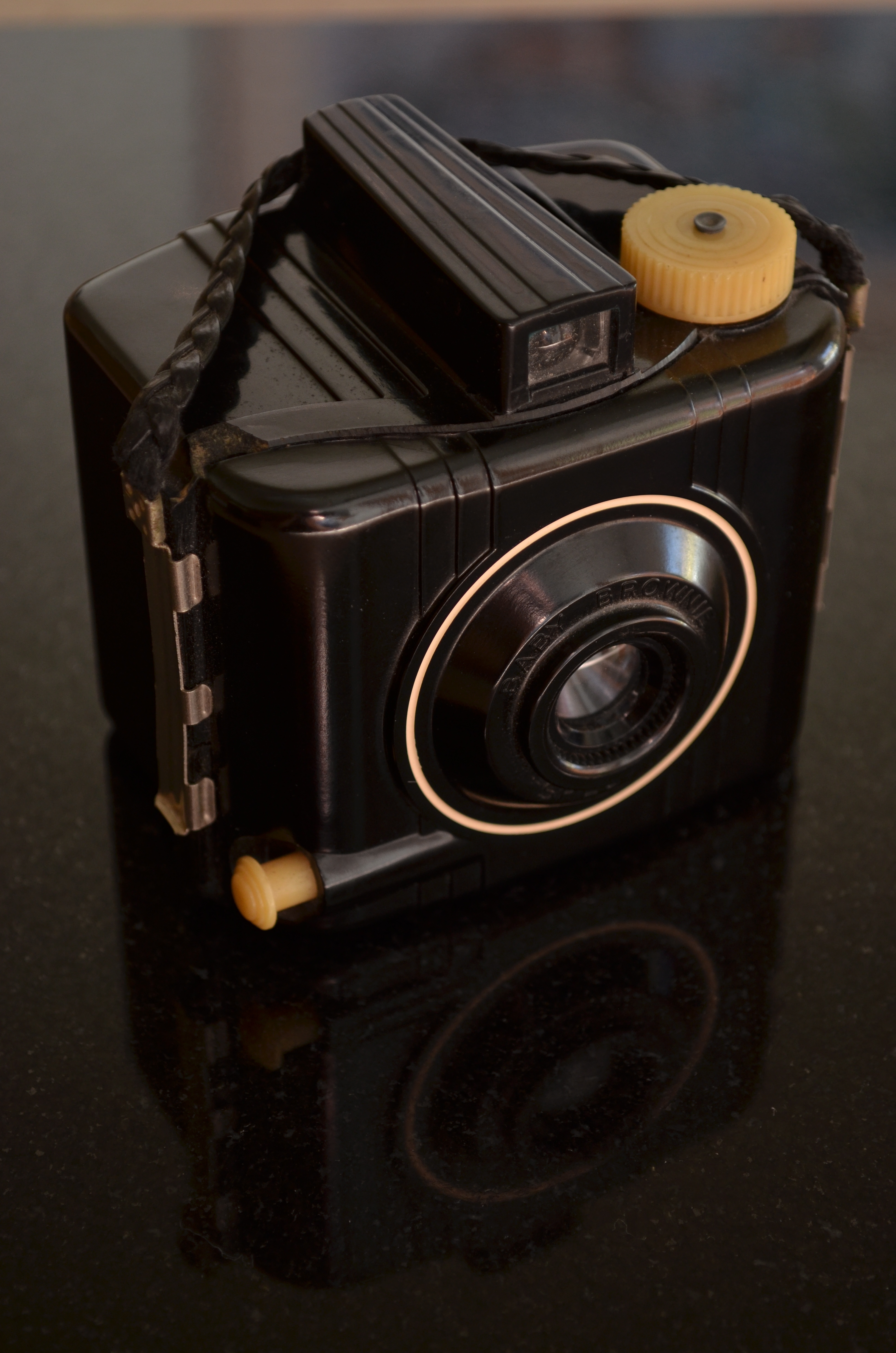
There used to be more of these than any other camera in the world, and so what?
And you can do it with a cheap piece of garbage, or a technical wonder, or any equipment stage in between. The idea is all. Everything else is just tinkering.
Here’s another piece of lunatic logic coming from another direction:
The idiotic recent decision of the Chicago Sun-Times to lay off all of its staff photographers, replacing them with freelancers (whom they will train on iPhones!), is not a lousy idea because there aren’t enough low-cost cameras out there to afford them some kind of coverage on their stories. It’s a lousy idea because it’s based on a flawed concept: the belief that photography is a universal skill, and that bystanders with smartphones are the equal of seasoned visual journalists, imbedded in their communities and schooled in its sources. They are not, and can never be.
Sadly,you can bet that editors across the nation are watching to see if the Sun-Times gets away with it. And they just might. Of course the quality of image reporting will take a hit, but since people are leaving the traditional newspaper as if it has leprosy anyway, will the customers know the difference? Look for this horrible move to be duplicated at a newspaper near you, since it’s (a) cheap, (b) easy to explain failure some other way, and (c) oh, yeah did I mention it’s cheap? Ironic sidebar: this is, officially the first time a newspaper has opted for less technology to become more competitive.
Expensive cameras and decent salaries are certainly no guarantee of good news coverage, but a staff loaded with veterans of wars, uprisings, elections, disasters and human interest is. The fact that several of them are Pulitzer Prize winners isn’t exactly a disqualifier, either.
You are the camera. You make the picture, regardless of the technology at hand. Forget that, and you might as well be holding a canned ham.
follow Michael Perkins on Twitter @MPnormaleye.com
Related articles
MUTATION
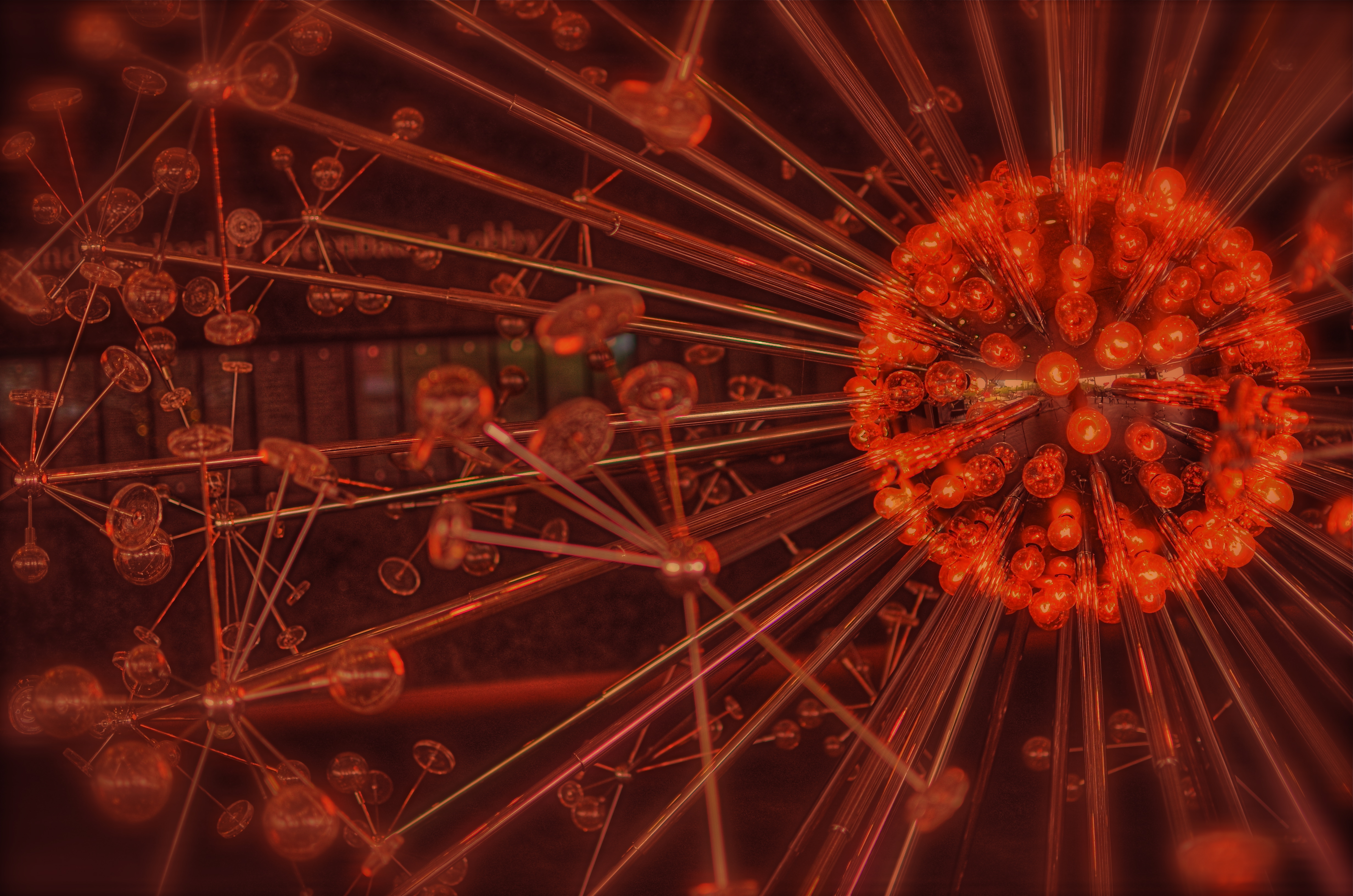
Okay, this has a LOT of processing. Love me or hate me based on whether it worked. 1/500 sec., f/1.8, ISO 100, 35mm.
BY MICHAEL PERKINS
NOT CONTENT TO BE AN ART ON ITS OWN TERMS, PHOTOGRAPHY IS ALSO CONSTANTLY RE-INTERPRETING ALL THE OTHER ARTS AS WELL. Ever since imaging fell out of the cradle in the early 1800’s, several of us have always been looking at the works of others and saying, “eh, I can probably do something with that.”
Yeah, not too presumptuous, right? And the trend has continued (some say worsened) to the present day. Half the time we are creating something. The other half of the time we are tweaking, mocking, honoring, loving, hating, shredding, re-combining, or ragging on somebody else’s work. Are these mashups also art? Are we co-creators or just cheesy thieves?
And does it matter?
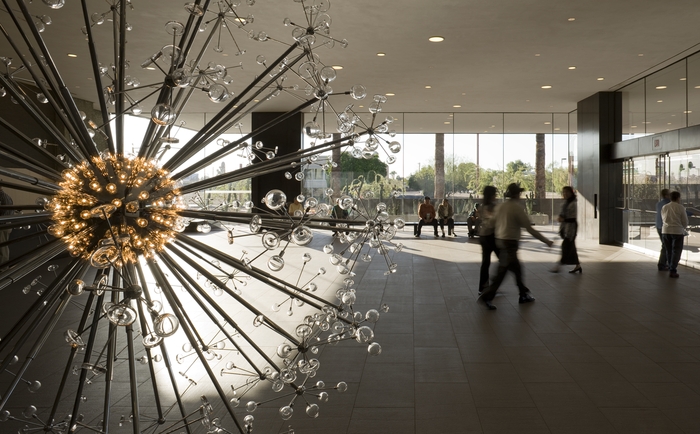
The Last Scattering Surface as it appears in the lobby of the Phoenix Art Museum.
The Phoenix Art Museum greets customers with a stunning original sculpture in glass and plexi right at the entrance to its ticket lobby. A huge installation of light bulbs, mirrored surfaces and reflective discs, Josiah McIlheny’s The Last Scattering Surface resembles a brightly burning orb (planet? asteroid? dwarf star?) surrounded by jutting rods that carry the central sphere’s light along “rays” to a series of circular satellites (moons? craft? debris?) Like many examples of pure design it is both everything and nothing, that is, it is mutative based on your observation. So, in a way, as in the manner of a photographer, you are already a participant in the co-creation of this object just by looking at it. Does this mean that it’s less theif-ish to go ahead and mutate the man’s work?
Well, there’s probably a lively back-and-forth on that.
For my own “take”, I wanted to remove the background walls, visitors, ambient blurry light from other junk, to isolate this nova-like work in “space”. I only had one frame that I liked from my short blast of shots, so I duped it, slammed the contrast real light/real dark on the pair, and did an exposure fusion in Photomatix. Adding a little edge blur and a re-tinting to the composite gave me the look of an interstellar explosion.
I freely advertise that I am making a semi-original re-mix on a completely original work. It’s not much more radical than shooting with a filter on the lens, or choosing black and white for a color subject, and yet, it always feels funny to try and make something beautiful that was beautiful in the first place.
But art is supposed to be about starting conversation, so consider this mine.
I just did my talking with a box instead of a mouth.
follow Michael Perkins on Twitter @ mpnormaleye.com
JOINTS
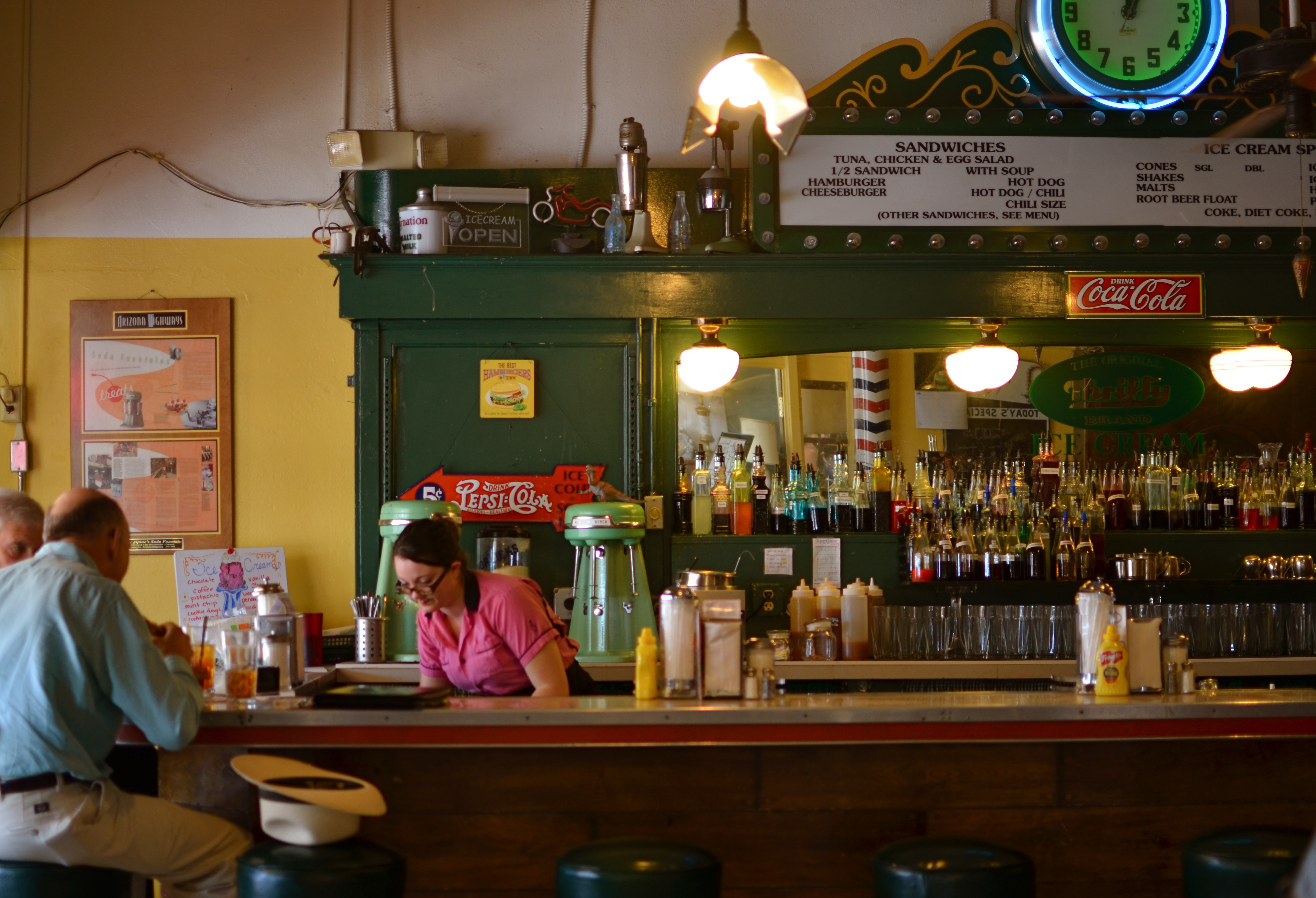
Try the special. Heck, it’s all special at the lunch counter at McAlpine’s Soda Fountain in Phoenix. 1/100 sec., f/1.8, ISO 100 35mm.
By MICHAEL PERKINS
BETTER MINDS THAN MINE HAVE LAMENTED THE HOMOGENIZING OF URBAN LIFE, that process by which uniqueness is gradually engineered out of human experience in buildings, businesses and products, to be replaced by the standardized, the research-proven, the chain-generated.
We all say we hate it. And we all put the lie to that statement by making the super-brands, all those golden arches and whole food superstores, more and more fabulously wealthy.
As a photographer, I feel a particular pang for the ongoing vanishing act that occurs in our cities. Who wants to aspire to take more and more pictures of less and less? Is a Starbucks in Kansas City really going to give me a profoundly different experience than a Starbucks in Jackson Mississippi? How, through creative location of the mug racks? And here, in the name of honesty, I have to catch myself in my own trap, since I also often default to something “safe” over something “unproven”. That is, I am as full of it as everyone else, and every day that I don’t choose to patronize someplace special is a day that such places come closer to the edge of the drain.
So.
It’s a delight to go someplace where fashion, and relevance, and context have all been rendered moot by time. Where, finally, just the fact that you have lasted this long means you can probably do so indefinitely. Such a place is McAlpine’s Soda Fountain Restaurant in central Phoenix. Birthed in 1926, the place was itself a part of America’s first huge surge of chain stores, originally housing a Rexall Pharmacy but centered around its fountain counter. The fare was, and remains, simple. No pondering over trans fats, no obsessing over sugar, no hair-raising tales of gluten reactions. Gourmet means you take your burger with both ketchup and mustard. “Soda” implies not mere fizzy water but something with a huge glob of ice cream in it. Thus your “drink” may also be your dessert, or you can just skip the meal pretense altogether and head right for the maraschino cherries.
McAlpine’s is a place where the woods of the booths are dark, and the materials of general choice are chrome, marble, neon, glass. Plastic comes later, unless you’re talking about soda straws. The place is both museum and active business, stacking odd period collectibles chock-a-block into every nook as if the joint itself weren’t atmosphere enough. But hey, when you’re a grand old lady, you can wear a red hat and white gloves and waist-length pearls, and if you don’t like it, take a hike, thankyouverymuch.
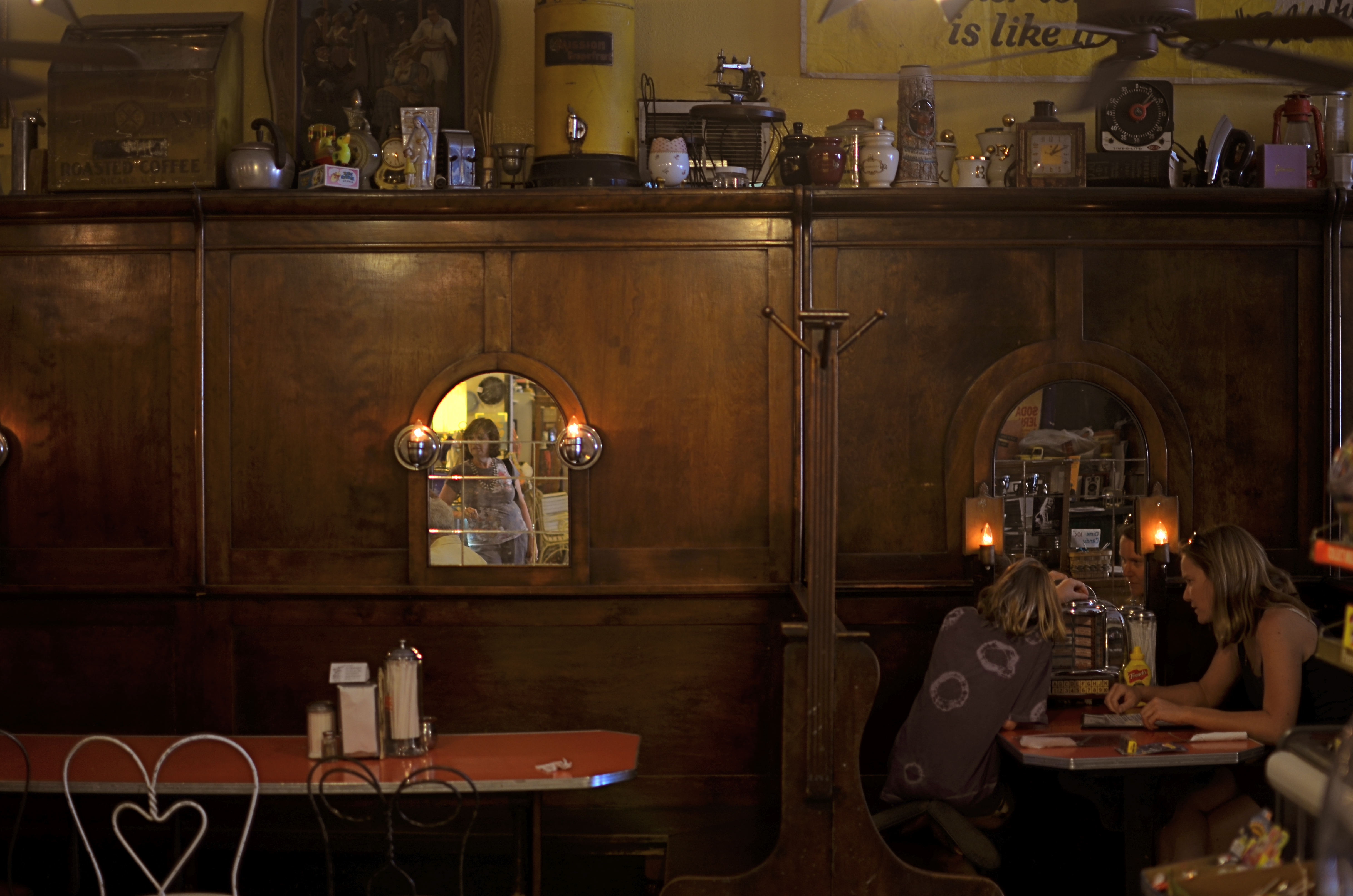
Three plays for a quarter, so you can eat “Tutti Fruiti” and listen to it, too. 1/40 sec., f/1.8, ISO 100, 35mm.
Graced with a 35mm prime lens opened all the way to f/1.8 and great soft midday light from the store’s front window, I could preserve the warm tones of the counter area pretty much as they are. For the booths, a little slower shutter speed was needed, almost too long for a handheld shot, but delivering a more velvety feel overall. Both shots are mere recordings, in that I was not trying to “sculpt” or”render” anything. McAlpine’s is enough just as she comes. It was only a question of light management and largely leaving the place to tell its own story.
What a treat when a subject comes to you in such a complete state that the picture nearly takes itself.
Even better when the subject offers 75 flavors of ice cream.
Especially when every other joint on the block is plain vanilla.
follow Michael Perkins on Twitter @mpnormaleye.
“SNAPSHOT” MOMENT, “SESSION” MINDSET
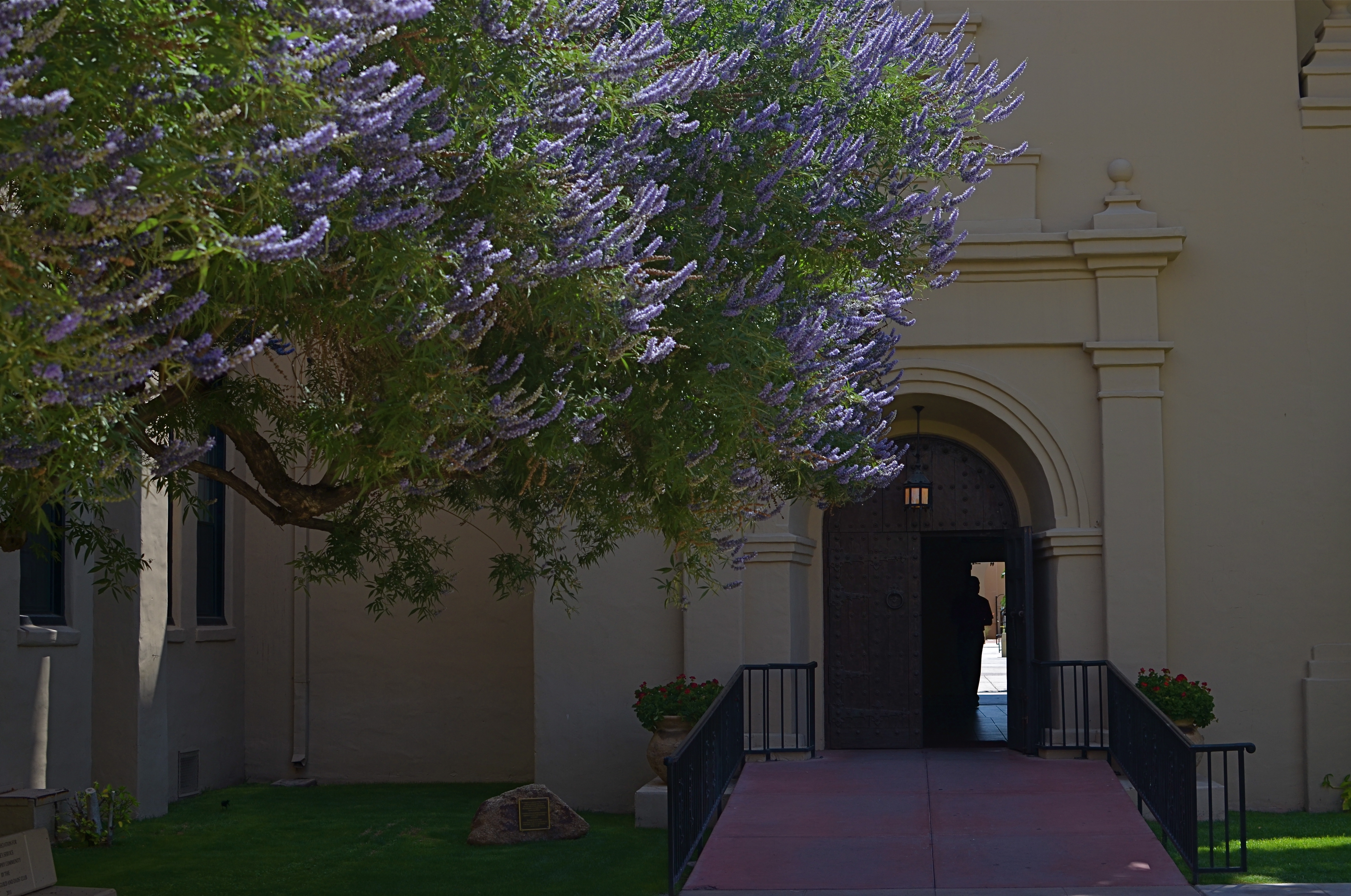
The light on the tree’s blossoms will be gone in three minutes. Best decision in the moment: slight underexposure to combat the mid-morning sun. 1/640 sec., f/5.6, ISO 100, 35mm.
By MICHAEL PERKINS
THE GREATEST ENEMY OF THE AMATEUR PHOTOGRAPHER IS TIME. Not the time spent perfecting our “eye”, nor the years invested in learning how to realize what we visualize. Sadly, the most tyrannical toll that time takes on us is in the meager number of moments in which we have to create most of our shots. Time…enough of it to work, to feel, and to act, is the only unbridgeable gap between ourselves and most of the pros.
I say “most” because some of the best photographers live absolutely in the moment, as in the case of imbedded journalists or sports shooters. No, what I’m talking about is the appointment that pros get to set for sessions, shoots that require set-up, tests, the issuance of permits, the re-routing of traffic. It’s not hard to see that a shooter for National Geo is at greater leisure planning his shot of a majestic waterfall than you are when your tour group is taking the tram from one Breathlessly Beautiful Natural Wonder to the next, all in time to rendezvous back at the terminal for a box lunch and precisely fifteen minutes in the gift shop. It’s not remarkable that millions of images are taken in Yellowstone each year. What’s amazing is that any of them work out.
Just saying.
Fact is, amateurs often can’t get the luxurious arrangements for creativity that are a given for the pros. And yet, since we don’t want our stuff to look like it was shot out the window at 55mph, we have to strive to combine the brief windows of our snapshot moments with the trained eye of a session mindset.
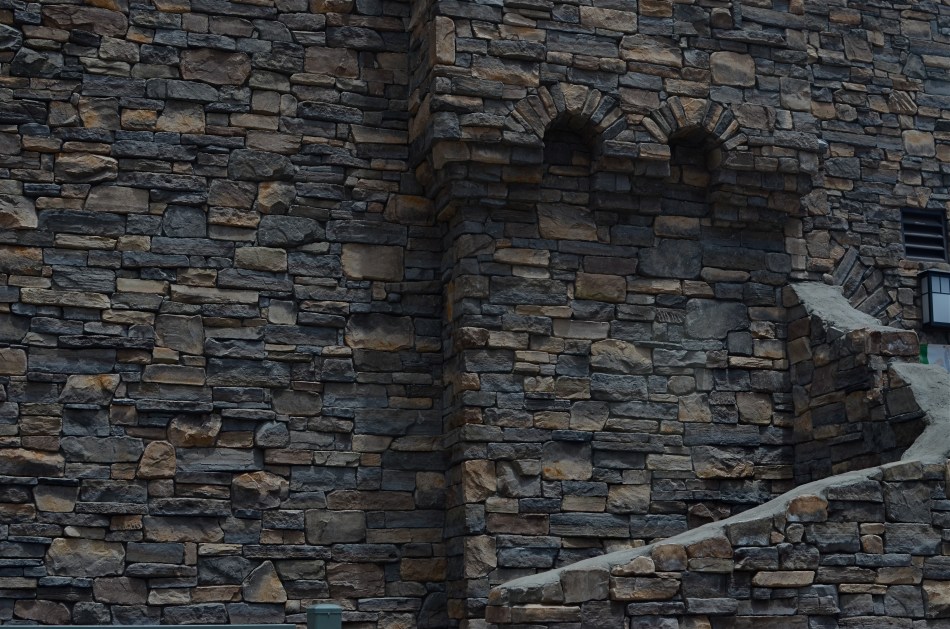
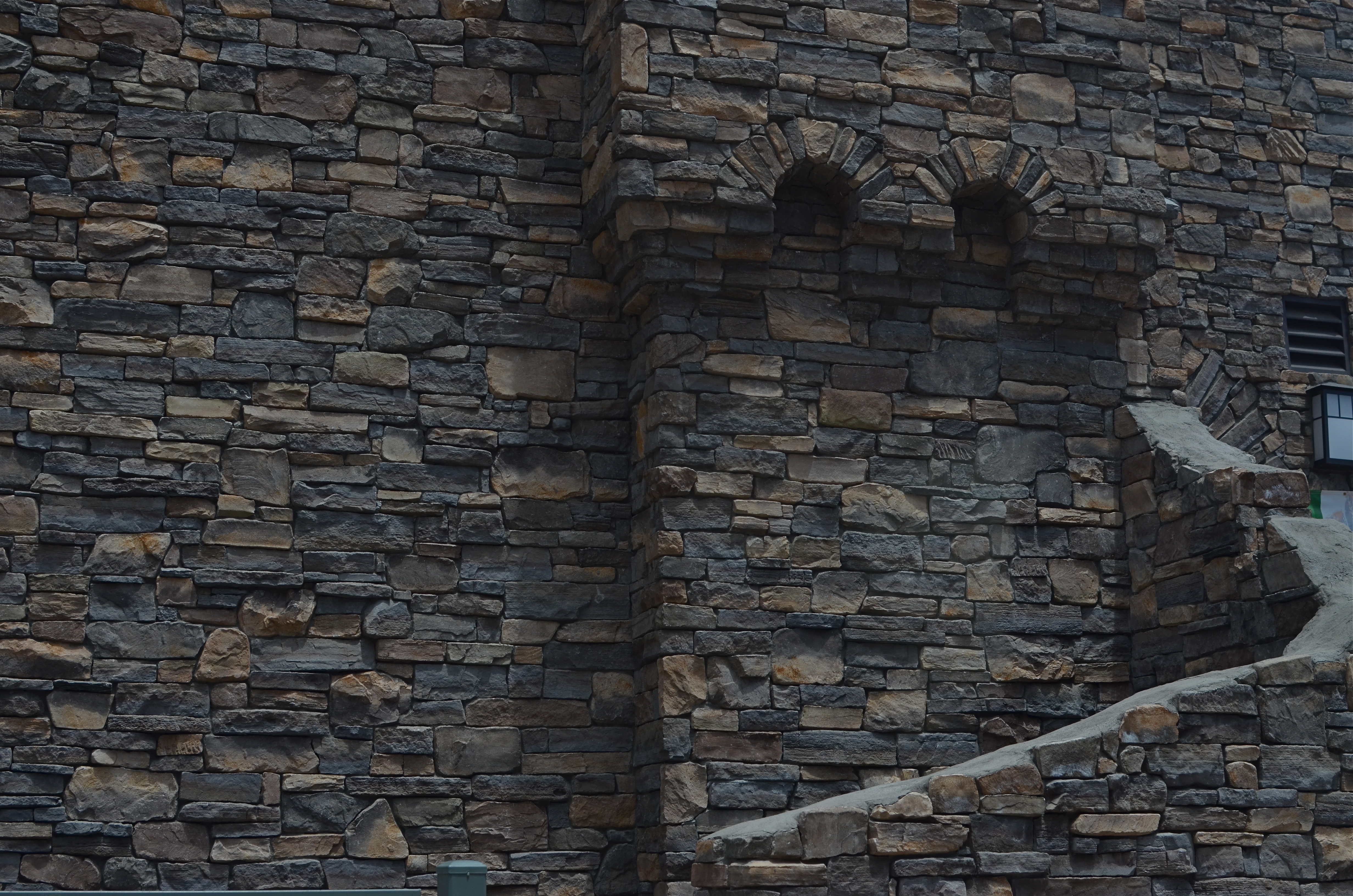
- Taken on pure impulse from a car as I was just about to drive off the property of this unique library. No planning except a fast exposure to give some depth to the stone textures. 1/640 sec., f/5.6, ISO 100, 35mm.
This is why it’s so important to always be shooting. Everyday. Good subject or bad. Great weather or lousy. Always. Because only the repetitive exercise of framing up and clicking off thousands of shots burns ways of seeing, ways of evaluating, into your brain, letting you make ever more complex calculations in increasingly shorter time. Shooting all the time speeds the arrival of the day when you can, in most cases, set and shoot and know that most of it will look intentional, done with some purpose in mind.
Repetition really is the best teacher, and the more direct control you take over your shooting, the more the universal laws emerge. At this focal length, certain things always happen. Under these lighting conditions, some things are always true. You’ll have your own truths, but, over time, they will be self-evident, because you will have faced these situations so many times that the essence of what you need for a shot will start to be as obvious as a glowing coal.
Time, or the lack of it, can rob us of the smart spontaneity we need in snapshot settings. However, the time we have invested learning how to shoot can give us a session mindset, and that affords us more control.
Are my snapshots better than anyone else’s? I doubt it. But over time, they are definitely better than my snapshots used to be.
Hey, I’ll take it.
follow Michael Perkins on Twitter @mpnormaleye
Related articles
- Snapshot (photography) (itscitrarizqinow.wordpress.com)
LET THE LIGHT BE THE STORY
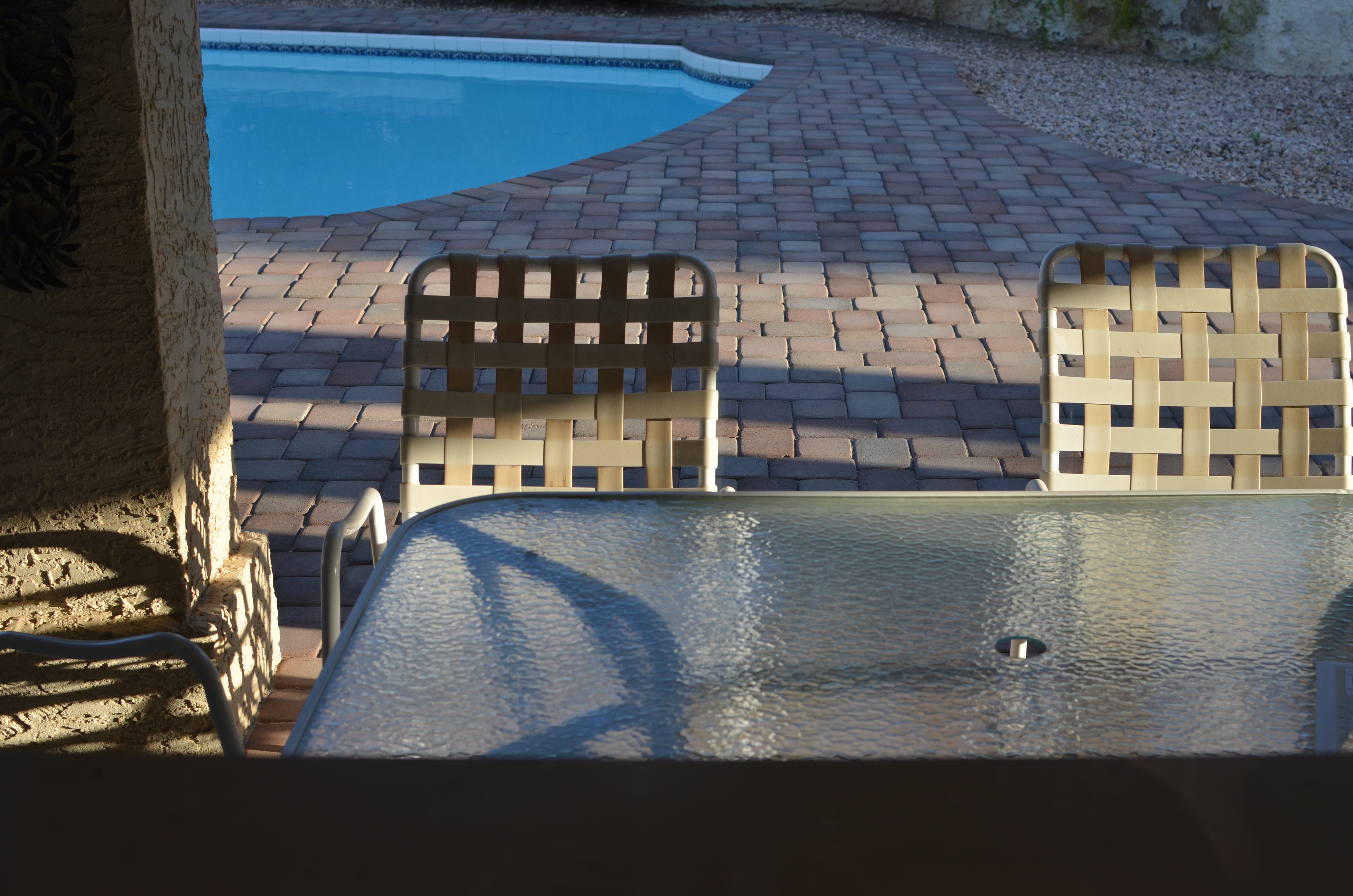
Ordinary, familiar objects, yes, but, for a few moments. their display of light was all the “subject” I needed. 1/200 sec., f/5.6, ISO 100, 35mm.
By MICHAEL PERKINS
ONE OF THE THINGS I OCCASIONALLY MISS ABOUT WORKING WITH PRIMITIVE CAMERAS is that the terms of success and failure are so stark. As Yoda says, you either do or do not…there is no “try”. If you have a limited piece of gear, it will always be capable (or incapable) of exactly the same things. That argument is settled, and so you have to find good pictures where they naturally occur….truly thinking outside (or without) the box.
The fact that you will get little or no extra help from the camera is initially limiting, but also, in a strange way, freeing.
On the other hand, the better your equipment, the more opportunities you have to counter iffy lighting conditions in your subjects. Photography today is about almost never having to say, “I couldn’t get the shot”…..at least not because of a lack of sufficient light. It’s just one more imperfect thing that shooting on full auto “protects” you from. But the argument could be made that ultra-smart cameras give you an output that, over time, can be stunningly average. The camera is making so many decisions of its own, in comparison to your measly little button flick, that every shot you “take” is pushing you further and further away from assuming active control of what happens.
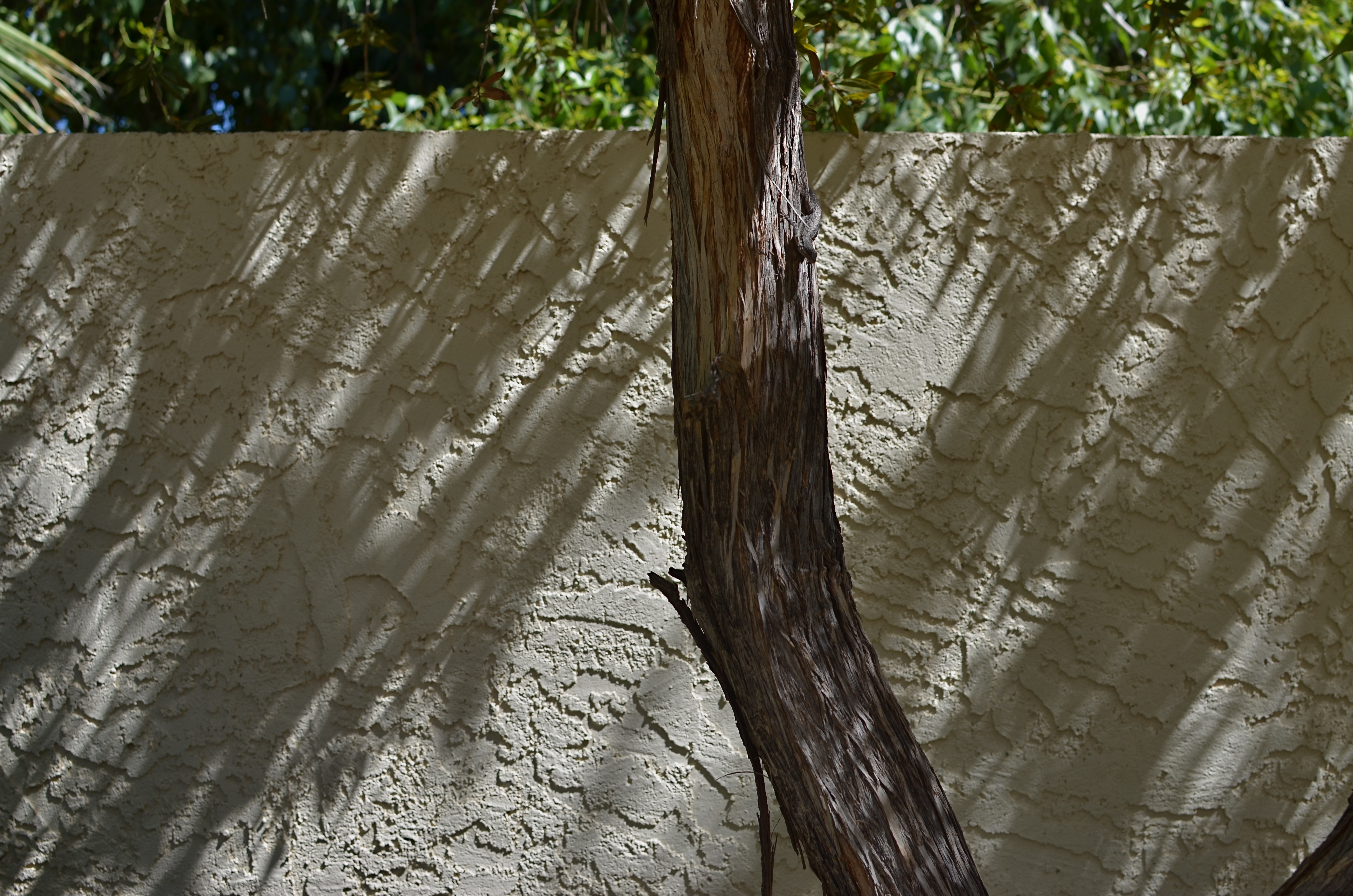
Early morning shadows shift suddenly, presenting many different ways to see the same subject. 1/400 sec., f/5.6, ISO 100, 35mm.
Hunting for images that you could capture with virtually no “help” from your camera is a more active process, since it involves planning. It means looking for pictures that your camera may not be able to grab without your specific input. And one great way is to shoot images that don’t matter in themselves, so that you are letting the light, and not the subject, be the entire story. That, and shooting on manual.
Back yards are great because they are convenient stages for light tracking. You can see the light conditions shift over the course of an entire day. Better still, it’s familiar territory that can only become more familiar, since it’s so close at hand, and available anytime. Since you will have more “what am I gonna shoot?” days than “amazing” days over a lifetime, fill them up by giving yourself a seminar in “this is what the light does”. Believe me, something worth keeping will happen.
Early morning, just after dawn, is the best time to work, because the minute-to-minute changes are so markedly unique. Wait too long and you lose your window. Or maybe you’re there in just another few minutes, when something just as good may present itself. I also like to work early because, living in the desert, I will have hours and hours of harsh, untamed light every day unless I plan ahead. It’s just too retina-roastingly bright, too much of the time.
Edward Steichen taught himself light dynamics by spending months shooting the same object in the same setting. Hundreds, sometimes thousands of frames where nothing changed but the light. He put in the time taking scads of images he knew he would never use, just to give him a fuller understanding of how many ways there were to render an object. He benefited, zillions of frames later, when he applied that knowledge to subjects that did matter.
The greatest photographer of the 20th century became “that guy” because he was willing to take more misses than anyone else in the game, in order to get a higher yield of hits down the road.
Shooting just for a better understanding of light is the best photo school there is, and it’s cheap and easy in the digital age. No chemicals, no glass plates, nothing in the way but yourself and what you are willing to try.
I like the odds.
(follow Michael Perkins on Twitter @mpnormaleye)
Related articles
- Street Photography Tips, Techniques and Inspirations (itscitrarizqinow.wordpress.com)
- How to break through the bottleneck of photography skills (ghjg85.wordpress.com)
IT’S NOT EASY BEIN’ GREEN
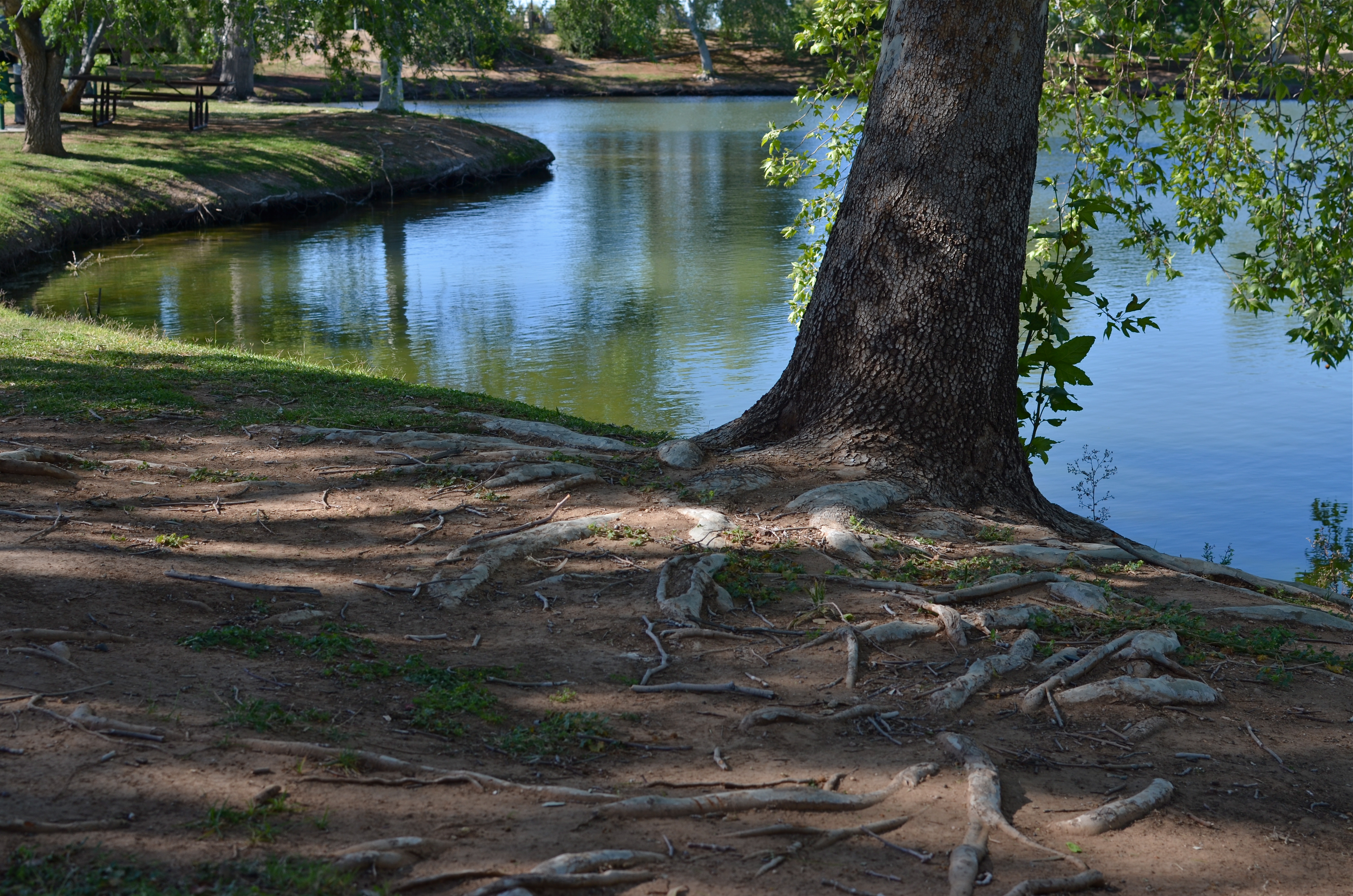
This is the desert? A Phoenix area public park at midday. There is a way around the intense glare. 1/500 sec., f/5.6, ISO 100, 35mm, straight out of the camera.
By MICHAEL PERKINS
FOR YEARS I HAVE BEEN SHOOTING SUBJECTS IN THE URBAN AREAS OF PHOENIX, ARIZONA, trying to convey the twin truths that, yes, there are greenspaces here, and yes, it is possible for a full range of color to be captured, despite the paint-peeling, hard white light that overfills most of our days. Geez, wish I had been shooting here in the days of Kodachrome 25. Slow as that film was, the desert would have provided more than enough illumination to blow it out, given the wrong settings. Now if you folks is new around here, lemme tell you about the brilliant hues of the Valley of the Sun. Yessir, if’n you like beige, dun, brown, sepia or bone, we’ve got it in spades. Green is a little harder to come by, since the light registers it in a kind of sickly, sagebrush flavor….kind of like Crayola’s “green-yellow” (or is it “yellow-green”?) rather than a deep, verdant, top-o-the-mornin’ Galway green.
But you can do workar0unds.
In nearby Scottsdale, hardly renowned for its dazzling urban parks (as opposed to the resort properties, which are jewels), Indian School Park at Hayden and Indian School Roads is a very inviting oasis, built around a curvy, quiet little pond, dozens of mature shade trees that lean out over the water in a lazy fashion, and, on occasion, some decorator white herons. Thing is, it’s also as bright as a steel skillet by about 9am, and surrounded by two of the busiest traffic arteries in town. That means lots of cars in your line of sight for any standard framing. You can defeat that by turning 180 degrees and aiming your shots out over the middle of the pond, but then there is nothing really to look at, so you’re better off shooting along the water’s edge. Luckily, the park is below street level a bit, so if you frame slightly under the horizon line you can crop out the cars, but, with them, the upper third of the trees. Give and take.
There is still a ton of light coming down between the shade trees, however, so if you want any detail in the water or trees at all, you must shoot into shade where you can, and go for a much faster shutter speed….1/500 up to 1/1000 or faster. It’s either that or shoot the whole thing at a small f-stop like f/11 or more. In desert settings you’ve got so much light that you can truly dance near the edge of what would normally be underexposure, and all it will do is boost and deepen the colors that are there. There will still be a few hot spots on projecting roots and such where the light hits, but the beauty of digital is that you can click away and adjust as you go.
It’s not quite like creating greenspace out of nothing, but there are ways to make things plausibly seem to be a representation of real life, and, since this is an interpretive medium, there’s no right or wrong. And the darker-than-normal shadows in this kind of approach add a little warmth and mystery, so there’s that.
It was “yellow-green”, wasn’t it?
Hope that’s not on the final.
(follow Michael Perkins on Twitter @mpnormaleye)
CONTAIN YOURSELF
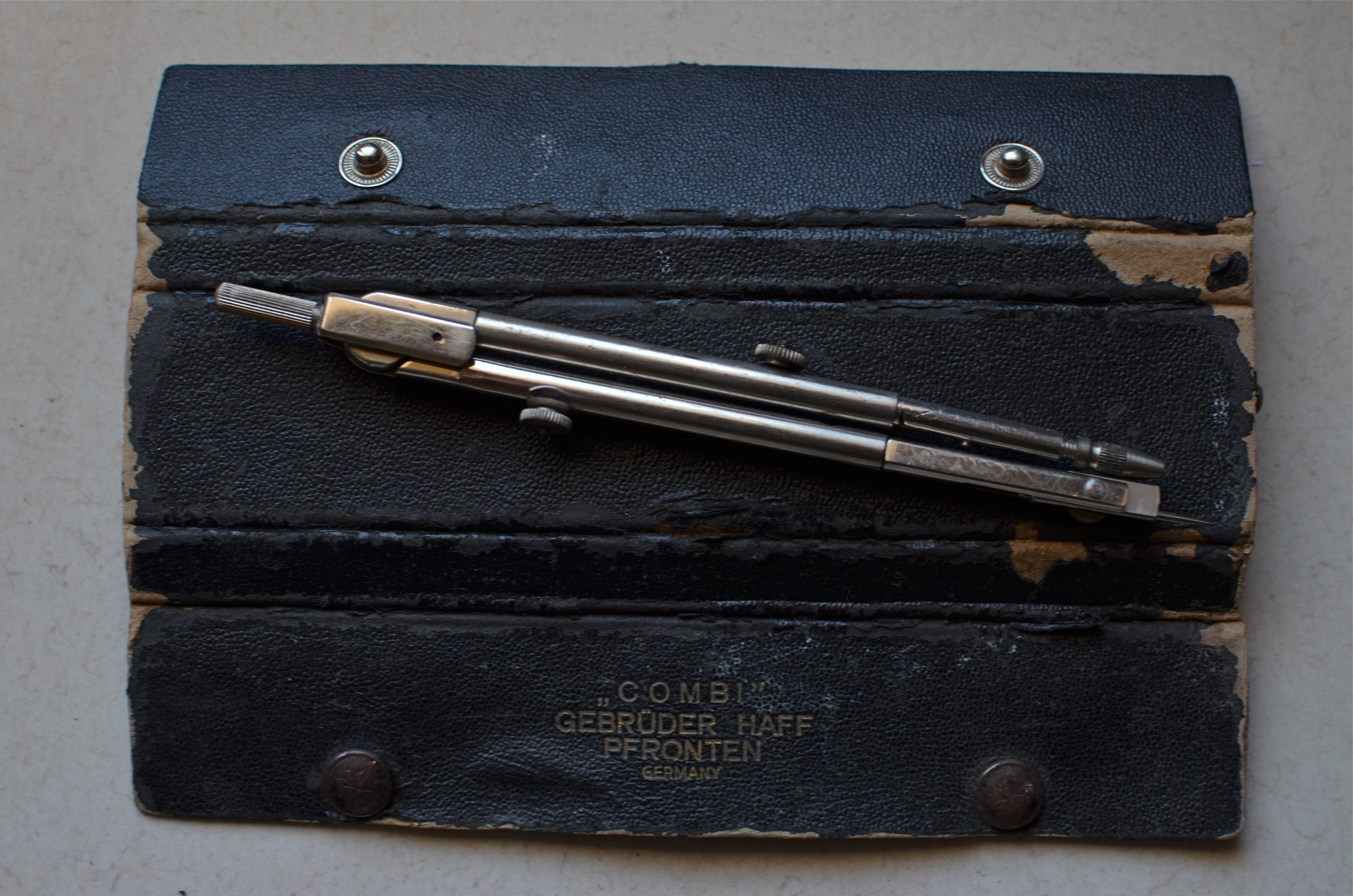
The Things They Carried: my wife’s father’s leather instrument case and compass. 1/60 sec., f/5.6, ISO 250, 35mm.
By MICHAEL PERKINS
WE LIVE IN AN AGE IN WHICH MOST OF OUR LIVES ARE EXHAUSTIVELY OVER-DOCUMENTED. We are, compared to our recent ancestors, photographically bitmapped from cradle to grave with a constellation of snaps that practically draw an outline around us and everything we do.
Globally, we will take more photographs in two minutes today than the entire world took over the entire 19th century.
That said, it’s amazing how few photos taken of, or by, us really look deeply into our souls, or whatever it is that animates us, makes us truly alive. It’s not that there aren’t enough pictures of us being taken: it’s how inarticulate so many of them are.
But go back just a generation or two, and observe the contrast. Far fewer images of most lives. And, with their increasing rarity or loss, more and more value attached to each and every one of those images that survives. Grandfather is gone, leaving only a handful of curled, cracked, and browning snapshots to mark his passing. But how rich the impact of those remaining pictures. The thirst for more, for a greatest number of clues to who this person was!
How to increase or deepen his spirit without having him here?
Explore the things he left behind. The tools he touched. The places where he invested his spirit, his aura. The parts of the world that he deemed important.
And I say: if you love someone, and have to let them go, use your camera to sniff around the found objects of their lives. It may not conjure them up like a holograph of Obi-Wan, but it will focus your thoughts about them in away which is nearly, well, visual.
I fell in love with the worn little instrument case you see at the top of this page. It belonged to my wife’s father, a man whose life was cut short by illness, a life under-represented in photographs. He made his living with his wits and with his hands. The compass which was carried in this case was a tool of survival, something he used to make his living, to measure out his skill and art. It’s a treasure to have it around to look at, and it’s a privilege to be able to photograph its worn corners, its tattered grain, its rusted buttons. Time has allowed it to speak, louder than its owner ever can, and to act as his visual proxy.
I’ve explored this theme in past posts, because I feel so strongly about the expressive power of things as emblems of lives. Long before our every action could be captured in an endless Facebook page of banal smartphone snaps, images had to work a lot harder, and say more. I’m not saying you should spend the next six months of your life raiding your closets for Ultimate Truth. I am saying you might be walking past a chunk of that Truth every day, and that it might just be worth framing up.
And thinking about.
(let’s help each other find amazing images! Follow Michael Perkins on Twitter @mpnormaleye.)
Related articles
- Behind the lens (theoriginalblogofthecentury.wordpress.com)
- Old Photographs Given New Life (modcloth.com)
PULL DOWN THE NOISE
by MICHAEL PERKINS
PHOTOGRAPHY OFTEN SPEAKS LOUDER IN A SOFTER VOICE. Think about it. If you accept the idea of visual information as a sort of “sound”, then it’s easy to see why some images don’t make a direct connection with viewers. They are busy, overloaded with information, or, in this metaphor, noisy, loud. Cachophonous. Chaotic. Too many “sounds” competing for attention. In a visual image, “noise” can be anything that keeps anyone from hearing the “voice” of your image. To be seen more clearly, pictures need to go soft, in order to be heard louder.
That usually means simplifying the image. Shaping its tone, its framing, its central message. In photography, we all make the mistake of trying to show everything, and, in the process, creating an overdose of data that sends the viewer’s eye wandering all around the picture, trying to find something, anything, to focus on. We present a three-ring circus where just one would be more than adequate.
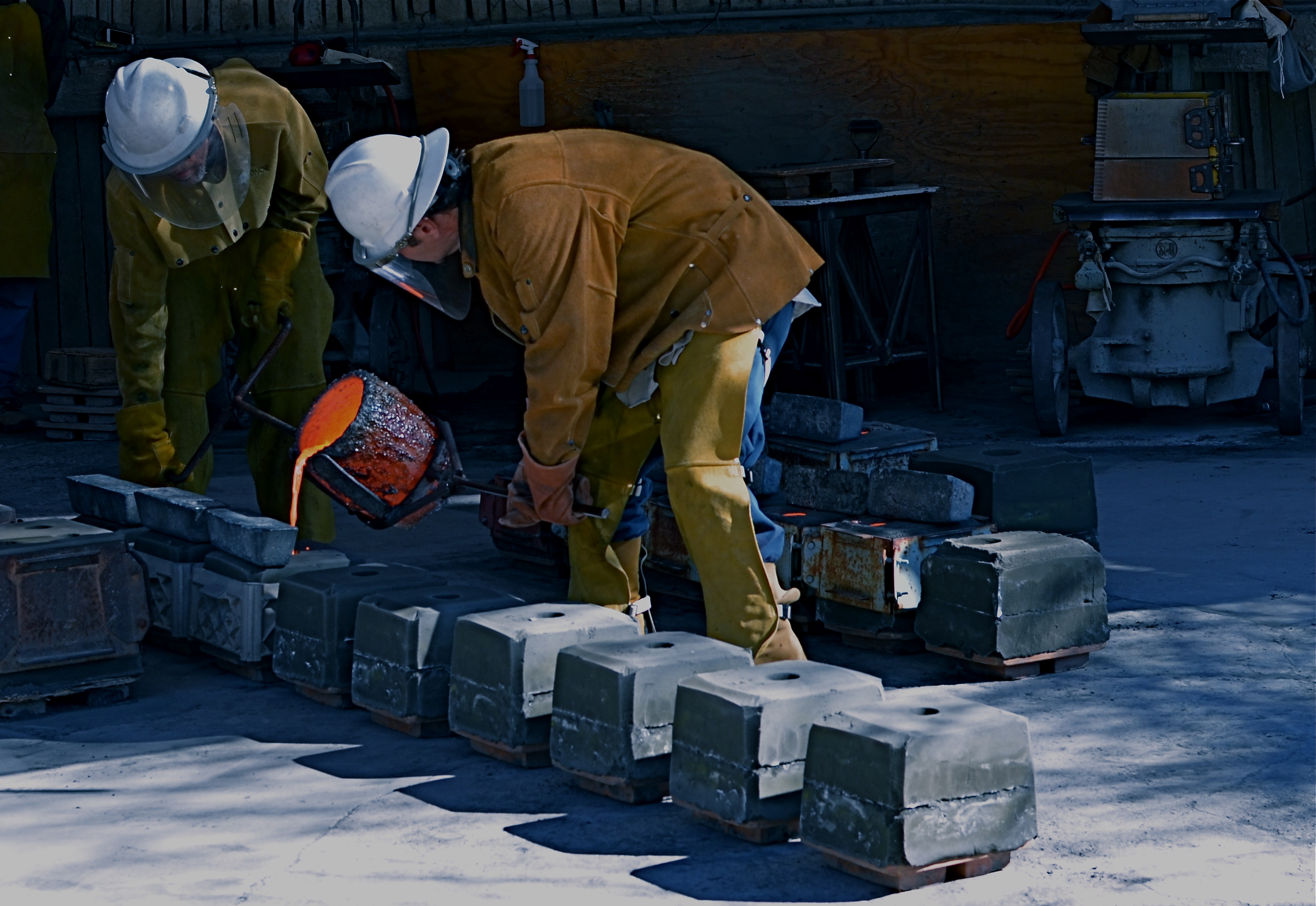
A “perfect” exposure would have inhibited the drama inherent in this situation. So we made it more imperfect.
On a recent trip to an art studio in Paradise Valley, Arizona, I was lucky enough to be present when artisans were pouring molten bronze into decorative molds for all us green “touristas”. Capturing the scene “as is” was easy, as I had plenty of time to calculate exposure and lighting. As a result, I got a lot of “acceptable” pictures good enough for the average postcard, but their storytelling quality was only so-so, since they were almost too full of color, detail and people/props. In the moment, I merely recorded a group of people in a crowded shop doing a job. The tonal balance was “perfect” according to the how-to books, as if I had shot the images on full auto. In fact, though, I had shot on manual, as I always do, so where was my imprint or influence on the subject? The pictures weren’t done.
Back home, when my brain had time to go into editor mode, I realized that the glowing cup of metal was the only essential element in the pictures, and that muting the colors, darkening the detail and removing extra visual clutter was the only way that the center of the shot could really shine.
With that in mind, I deepened the shadowy areas, removed several extraneous onlookers and amped up the orange in the cup. Seems absurdly simple, but as a result, the image was now a unique event instead of a generic “men at work” photo. The picture had to use a softer voice to speak louder.
Great picture? Not yet.
But, hey, I’m still young.
Best thing about the creative process, unlike banking, building or brain surgery, is the luxury of do-overs. And doing over the do-overs, over.
Related articles
- On the Nature + Purpose of Photography (statenislandstories.wordpress.com)
GET LOST
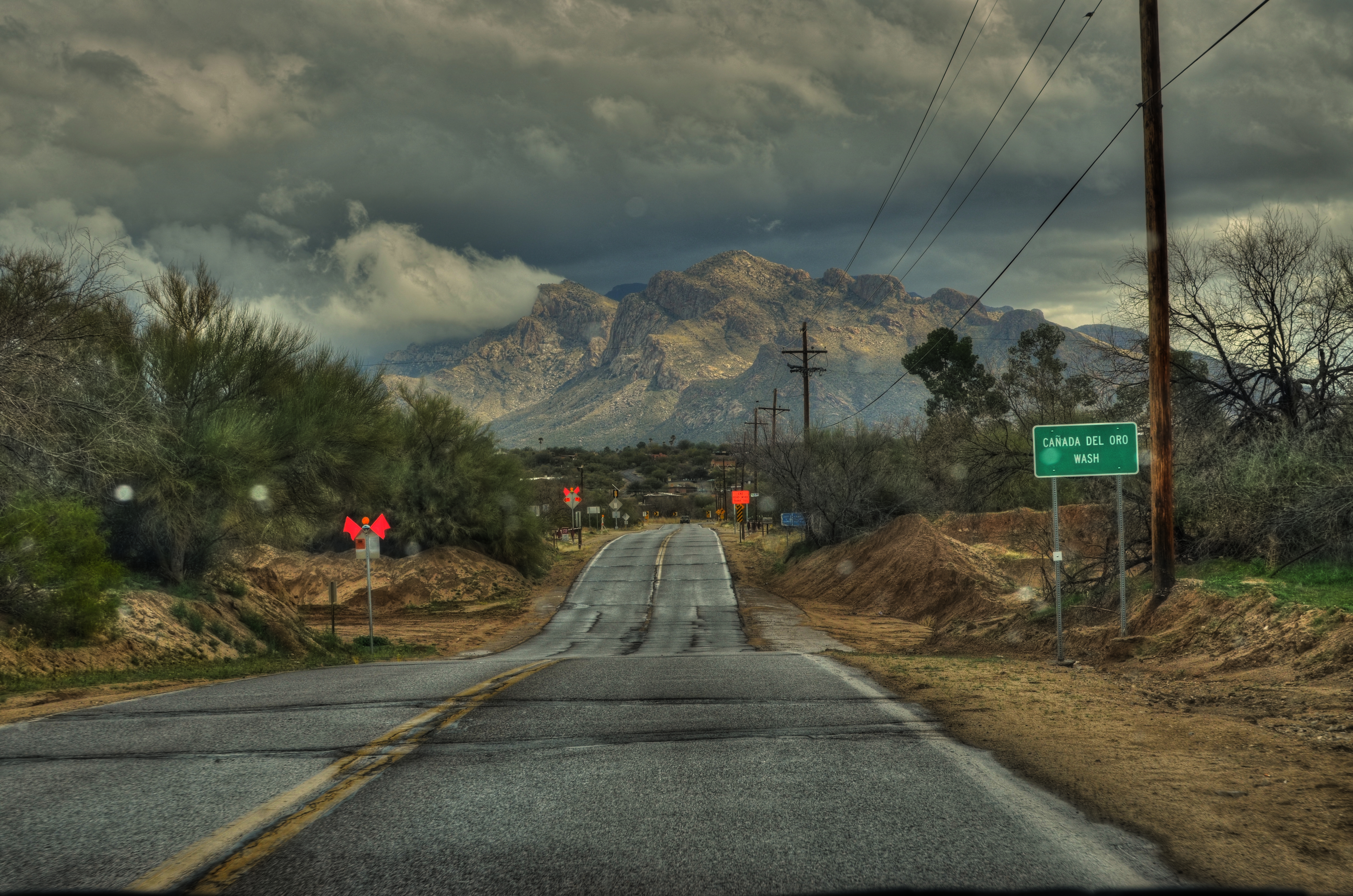
Straight through the windshield, using a technique I like to call “dumb luck”. Original shot specs: 1/320 sec., f/8, ISO 100, 35mm.
By MICHAEL PERKINS
PHOTOGRAPHY IS 10% PLANNING, 90% SERENDIPITY. Yes, I know. we would all rather believe that most of our images spring from brilliant conceptions, master plans, and, ahem, stunning visions. But a lot of what we do amounts to making the most of what fate provides.
There is no shame in this game. In fact, the ability to pivot, to improvise, to make the random look like the intentional…all of these things reveal the best in us. It exercises the eye. It flexes the soul. And, in terms of images, it delivers the goods.
Getting lost (geographically, not emotionally) is less an emergency than in ages past. Armed with smartphones, GPS, and other hedges against our own ignorance, we can get rescued almost as soon as we wander off the ranch. It is easier than ever to follow the electronic trail of crumbs back to where we belong, so drifting from the path of righteousness is no longer cause for panic. Indeed, for shooters, it’s pure opportunity.
Okay, so you’re not where you’re supposed to be. Fine. Re-group and start shooting. There is something in all these “unfamiliar” things that is worth your gaze.
Last week , my wife and I decided to trust her car’s onboard guidance system. The results were wrong but interesting. No danger, just the necessary admission that we’d strayed really far afield of our destination. We’re talking about twenty minutes of back-tracking to set things right.
But first….
One of the rural roads we drifted down, before realizing our error, led us to a stunning view of the back end of Tucson’s Catalina mountains, framed by small town activity, remnants of rainfall, and a portentous sky. I squeezed off a few shots straight out of the windshield and got what I call the “essence” exposure I needed. That single image was relatively well-balanced, but it wouldn’t show the full range of textures from the stormy sky and the mountains. Later, in post, I duplicated the one keeper frame that I got, modifying it in Photomatix, my HDR processing program. Adding underexposure, deeper contrast, and a slight rolloff of highlights on the dupe, I processed it with the original shot to get a composite that accentuated the texture of the clouds, the stone,, even the local foliage. A sheer “wild” shot had given me something that I would have totally missed if the car’s GPS had actually taken us to our “correct” destination.
What was ironic was that, once we got where we were going, most of the “intentional” images that I sweat bullets working on were lackluster, compared to the one I shot by the seat of my pants. Hey, we’ve all been there.
Maybe I should get lost more often.
Actually, people have been suggesting that to me for years.
Especially when I whip out a camera.
Related articles
NO TEACHER, NO GURU, NO METHOD
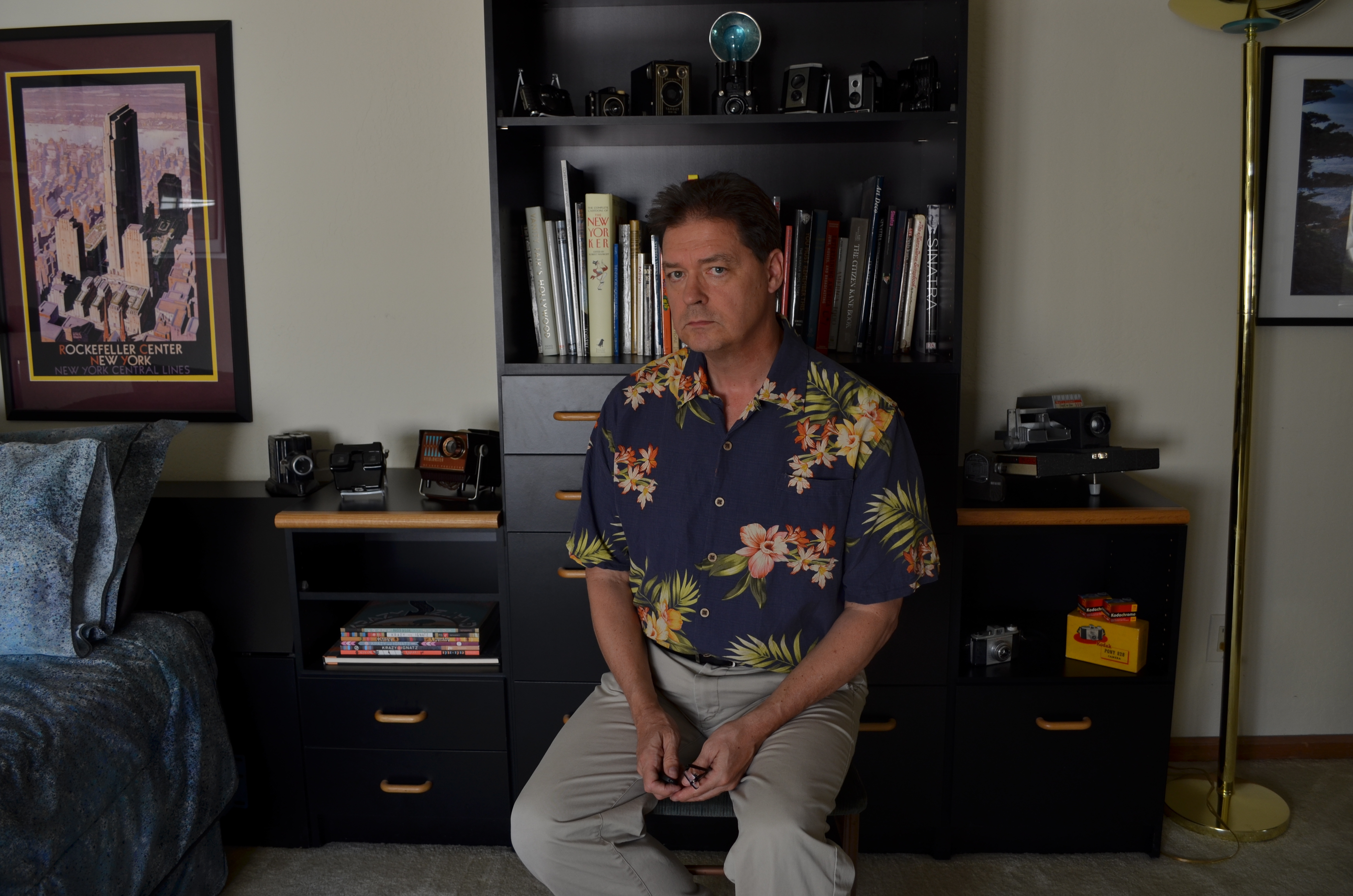
Waiting for inspiration. Yeah, how’s that workin’ out for ya?
By MICHAEL PERKINS
THERE MAY NOT BE SUCH A THING IN PHOTOGRAPHY AS “STYLE”.
Hmm? Come again? No way for the artist to brand his persona on his output, to accumulate a body of work stamped with his own exclusive, and wonderful, identity?
Well, given the special nature of photography, maybe not. Think about it. We all emerged as the quasi-legitimate spawn of painting. Yes, you can struggle and wriggle, but The Brush is essentially our aesthetic daddy, the most important shaper of our inherited rules on what to look at, how to see. Of course, we were no sooner whelped than we began dissing the old man, saying we were not at all like painting, that our means of measuring the world was distinct, different, revolutionary. The upshot is that the typical artists’ claim to a personal style, an identifiable visual signature, may not be, in image-making, how we do business at all.
Van Morrison (God’s gift to moody poets) summed it all up in the title of one of his classic albums, No Teacher, No Guru, No Method. And that means that, unlike the painters of antiquity, none of us shoots enough of any one approach to the world to claim that any of us has a “style”. Think about your own images. Is every one of them representative of one kind of thought? Or do you, like most of us, flit from one dynamic to another? Are any of you 100% committed to landscapes? Sacred subjects? Abstractions? Street? Cute kitties? No, and none of us ever were.
One of the most frustrating things about reviewing the careers of the greatest poets (there’s that word again) of photography is that there is no central thread, no typical image for many of the masters. What is the iconic signature of a Steichen, an Avedon, a Weston? Review forty years of photographs from Alfred Eisenstadt during his tenure at Life magazine and pick out one picture which defines him. You can’t. There is no Mona Lisa moment. And perhaps there shouldn’t be.
I’ve been shooting for over forty years, and if someone were to ask me to select one image that absolutely represented the essential me, I’d be dumbstruck. And maybe that’s to be expected. The world’s most democratic medium is also democratic toward its subject matter as well. In photography, unlike painting, everything can be a picture. Anything can be plucked out of the continuity of time and frozen for us to ponder, worship, objectify, or loathe.
We are all self-taught, self-created, without antecedent or influence. No Teacher, No Guru, No Method. It should make us feel free, and can, of course, make us terrified as well.
Here’s the central nugget of that freedom feeling: photography isn’t here “because of”, or “in order to”, or “so that”…..it’s just here.
And that is enough.
(follow Michael Perkins on Twitter @mpnormaleye.)
Related articles
- Edward Steichen’s great American Dream (japantimes.co.jp)
- Not your average photography book (audreysnaturequestphotography.wordpress.com)
STRING THEORY
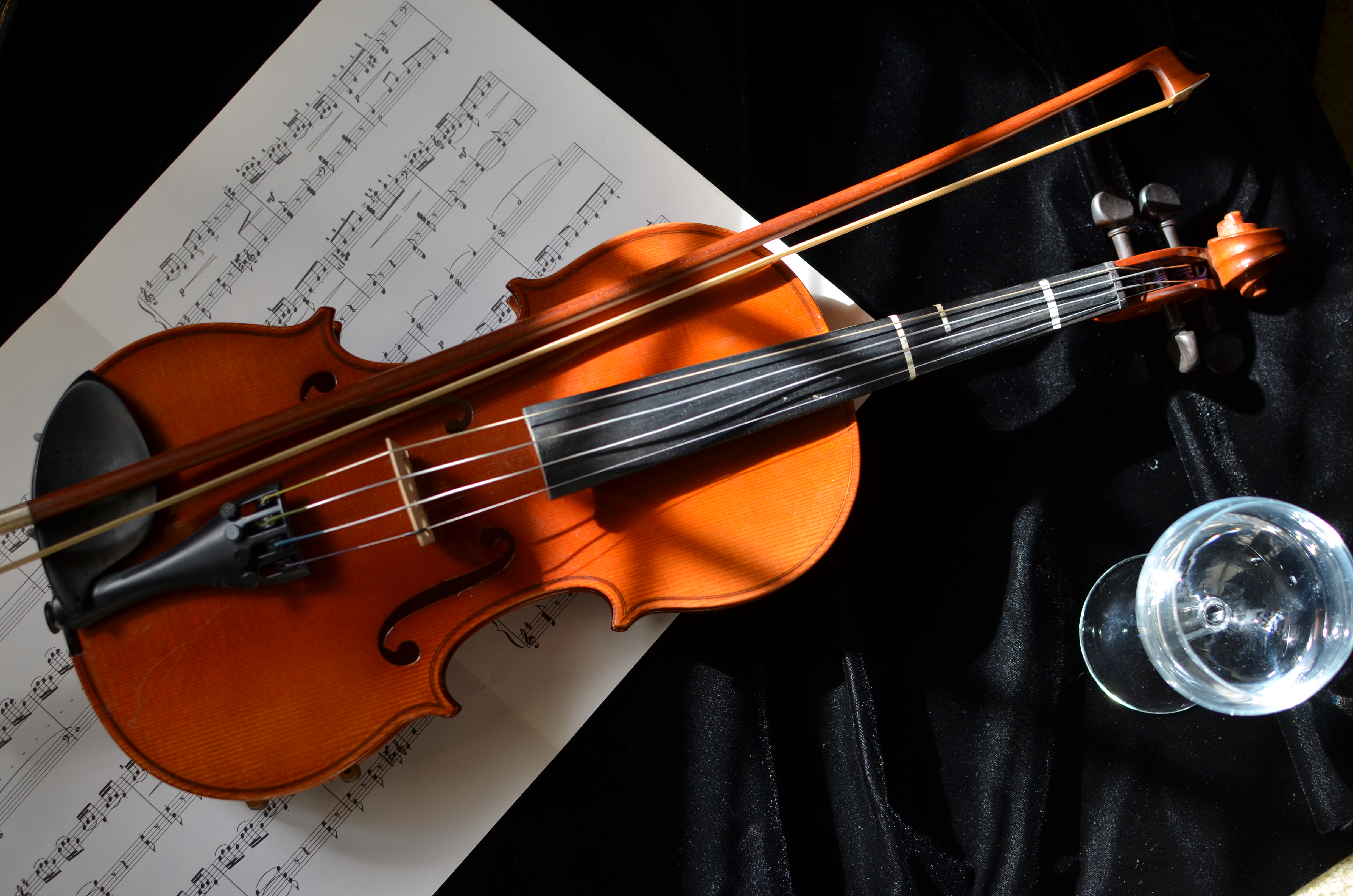
Repose. 1/250 sec., f/3.5, ISO 125, 35mm prime lens.
By MICHAEL PERKINS
CERTAIN INANIMATE OBJECTS INTERACT WITH THE LIVING TO SUCH A LARGE DEGREE, that, to me, they retain a certain store of energy
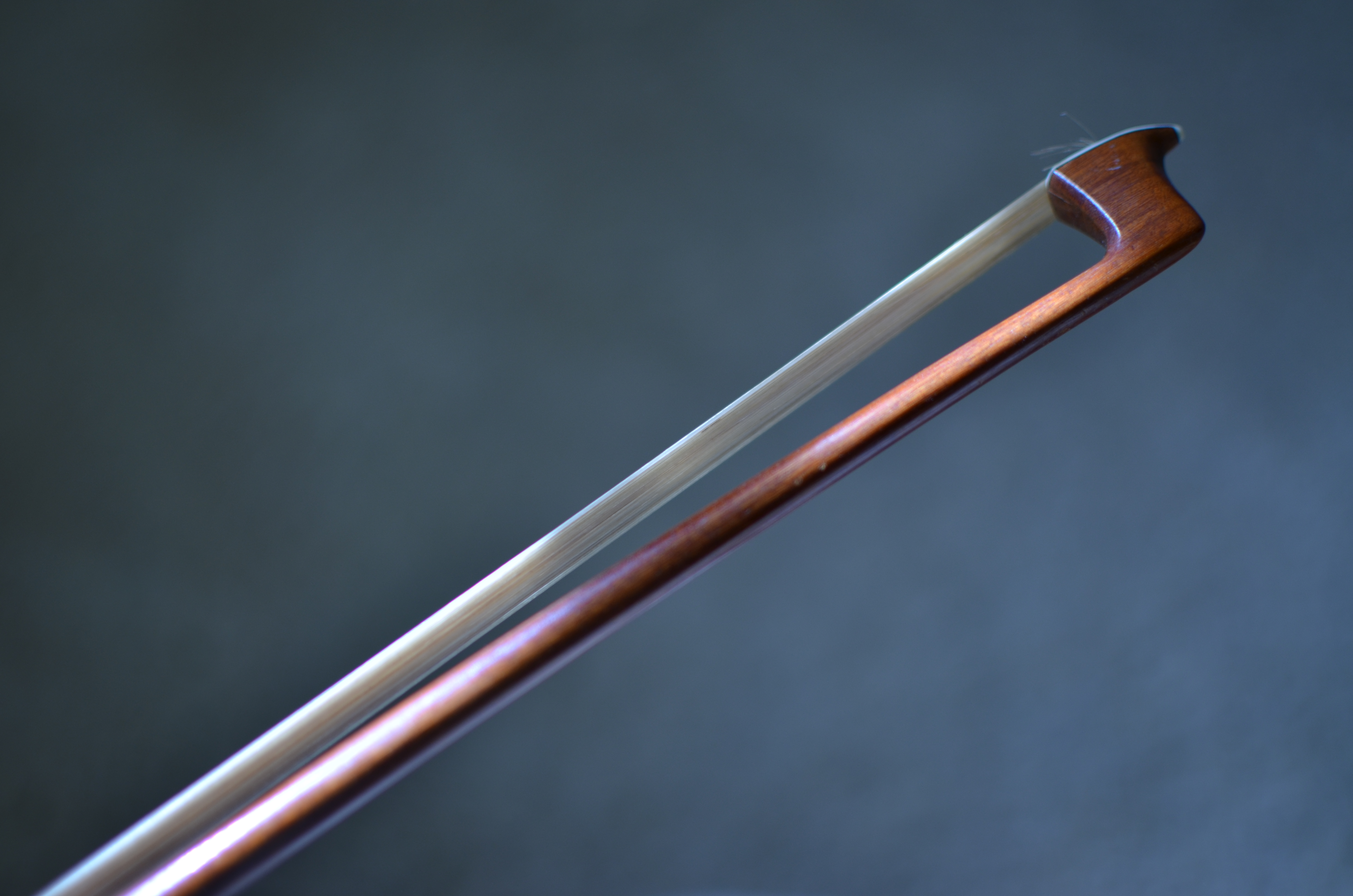
Just horsehair and wood, but it has an elegance all its own.
even when standing alone. Things that act in the “co-creation” of events or art somehow radiate the echo of the persons who touched them.
Musical instruments, for my mind’s eye, fairly glow with this force, and, as such, are irresistable as still life subjects, since, literally, there is still life emanating from them.
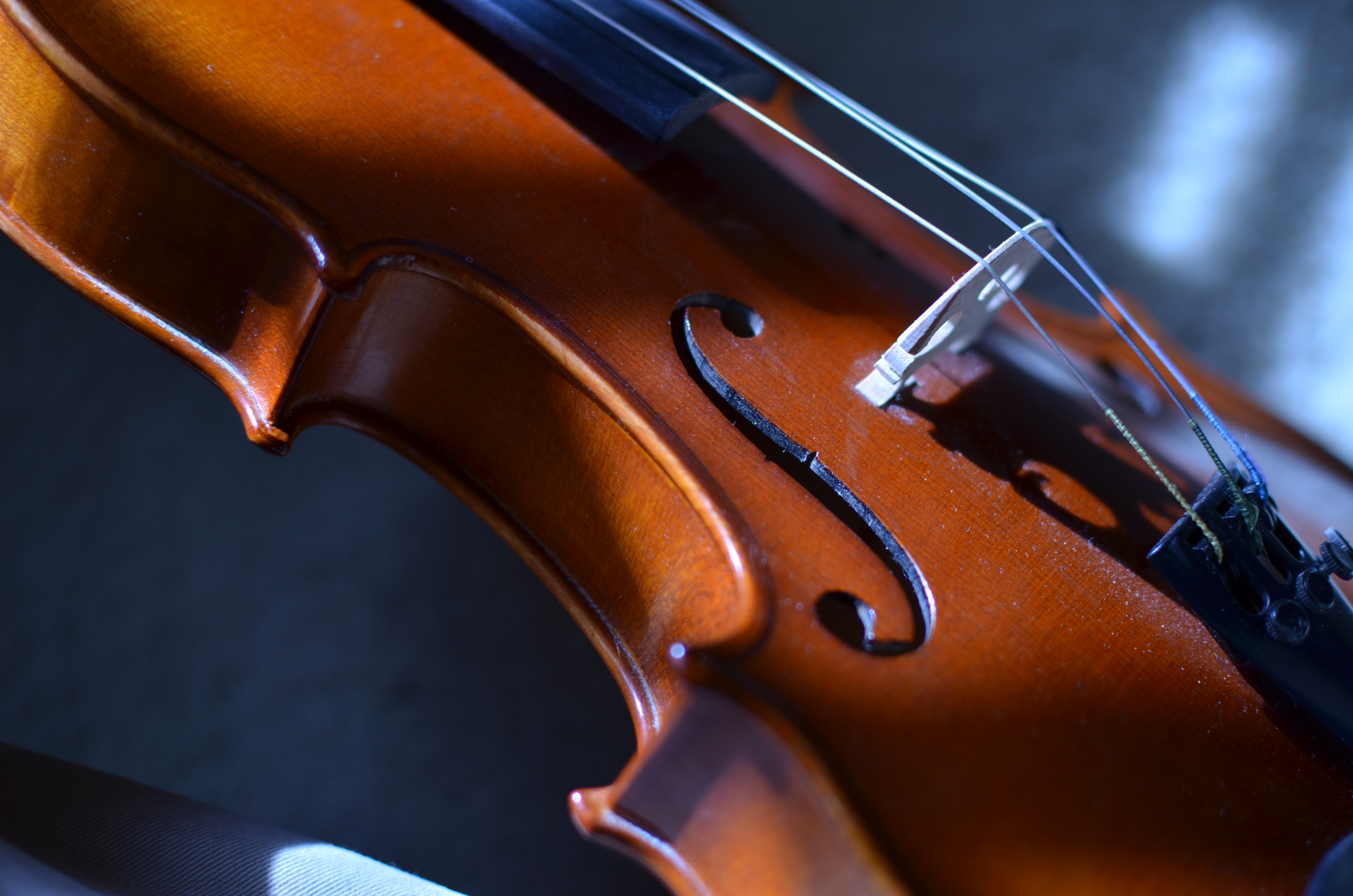
Staging the object just outside the reach of full light helped the violin sort of sculpt itself. 1/800 sec., f/2.5, ISO 100, 35mm prime lens.
A while back I learned that my wife had, for years, held onto a violin once used for the instruction of one of her children. I was eager to examine and photograph it, not because it represented any kind of technical challenge, but because there were so many choices of things to look at in its contours and details. There are many “sites” along various parts of a violin where creation surges forth, and I was eager to see what my choices would look like. Also, given the golden color of the wood, I knew that one of our house’s “super windows”, which admit midday light that is soft and diffused, would lend a warmth to the violin that flash or constant lighting could never do.
Everything in the shoot was done with an f/1.8 35mm prime lens, which is fast enough to illuminate details in mixed light and allows for selectively shallow depth of field where I felt it was useful. Therefore I could shoot in full window light, or, as in the image on the left, pull the violin partly into shadow to force attention on select details.
Although in the topmost image I indulged the regular urge to “tell a story” with a few arbitrary
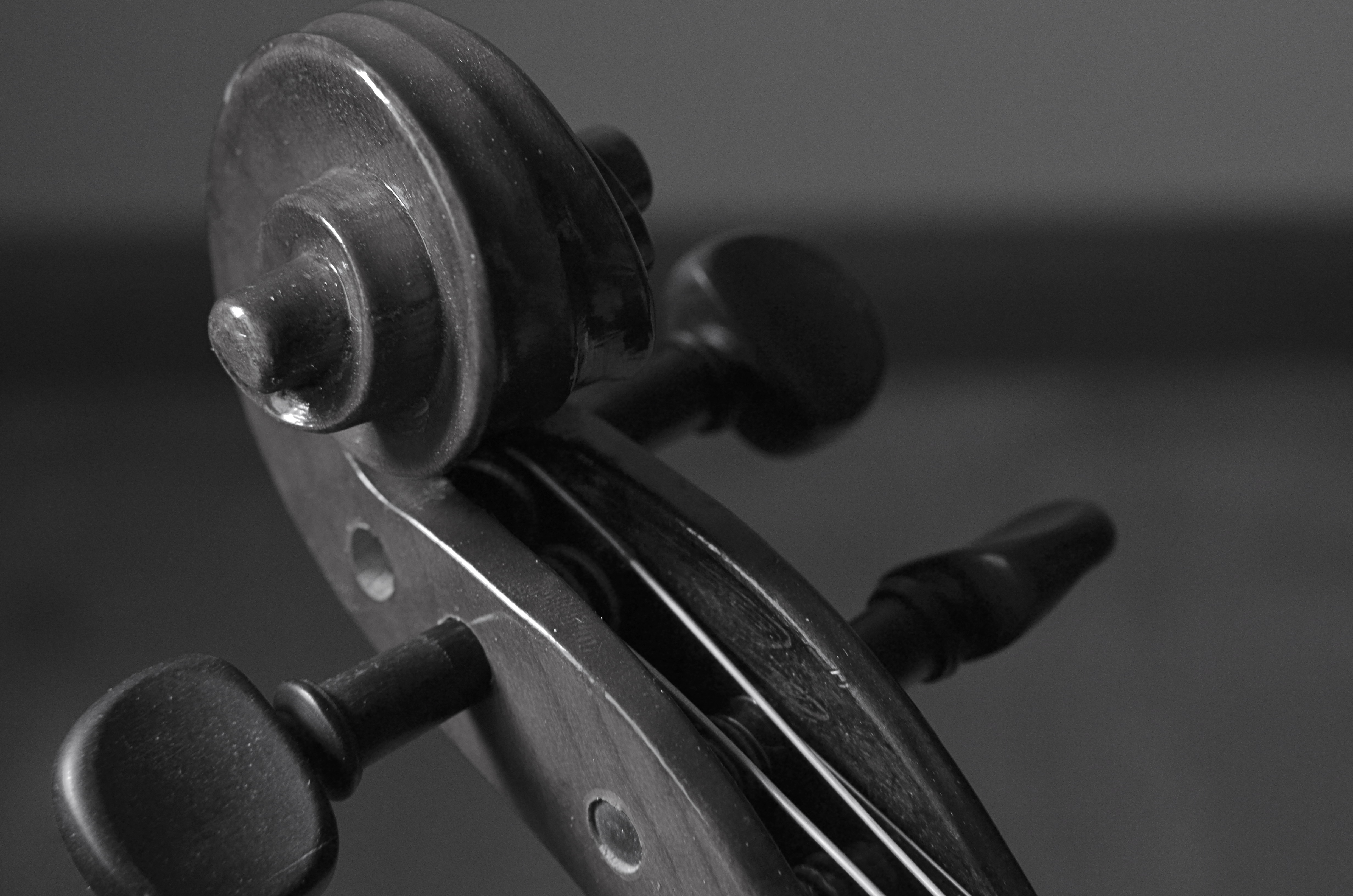
The delight is in the details.
props, I was eventually more satisfied with close-ups around the body of the violin itself, and, in one case, on the bow. Sometimes you get more by going for less.
One thing is certain: some objects can be captured in a single frame, while others kind of tumble over in your mind, inviting you to revisit, re-imagine, or more widely apprehend everything they have to give the camera. In the case of musical instruments, I find myself returning to the scene of the crime again and again.
They are singing their songs to me, and perhaps over time, I quiet my mind enough to hear them.
And perhaps learn them.
THE ROOMS DOWN THE HALL
By MICHAEL PERKINS
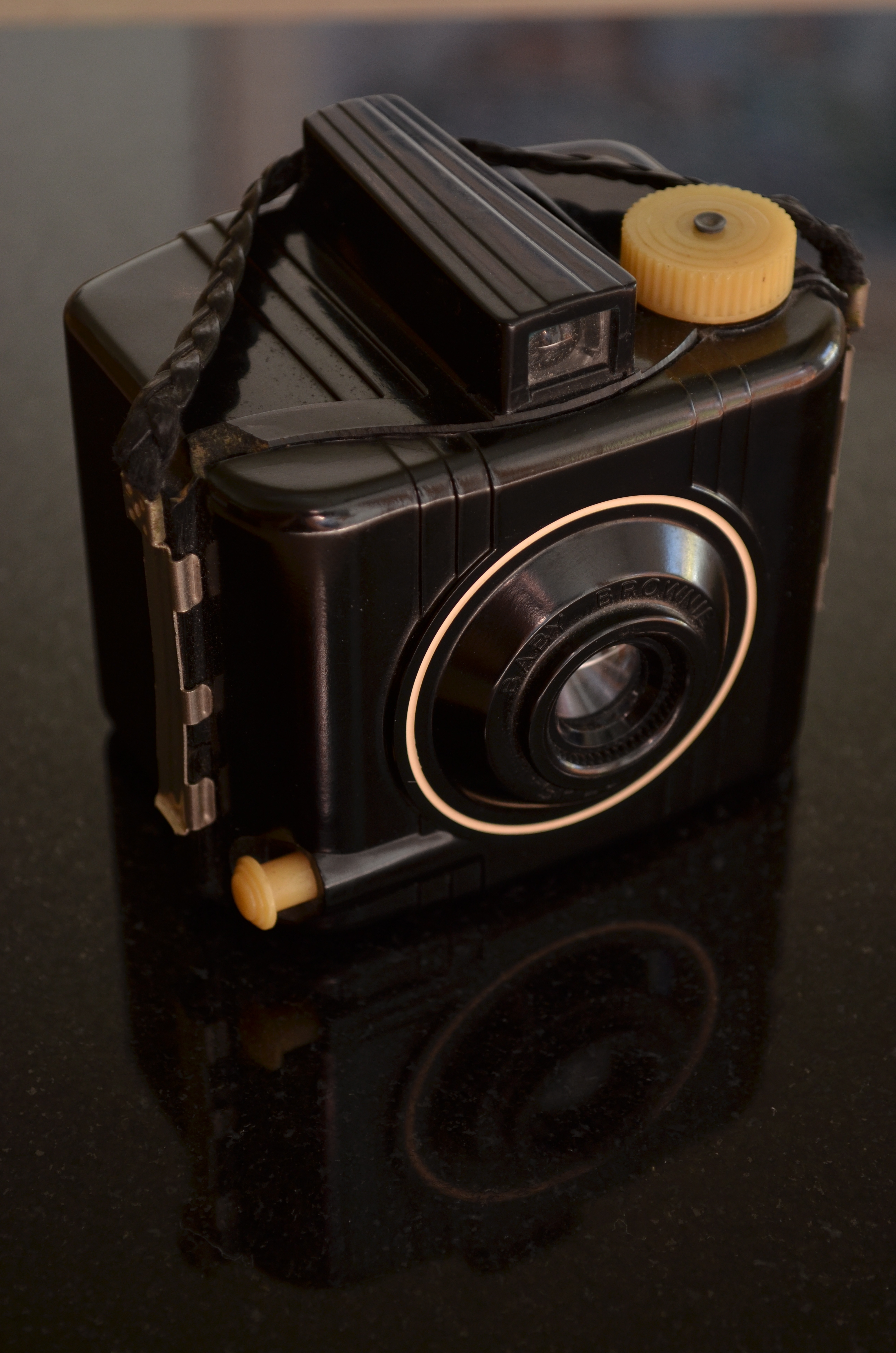 FOR THESE PAGES, IT WAS NEVER MY VISION TO MERELY POST PICTURES. Not, at least, without some kind of context. Just meeting a regular deadline with the “picture of the day” held as little interest for me as maintaining a diary, an oppressive regularity that I have resisted my entire life. For the most part, the images on THE NORMAL EYE are here to anchor my thoughts about what it feels like to be enticed, seduced, enthralled, and, yes, disappointed by photography, to caption the frames with some semblance of the creative process, at least as I had the poor power to see it at the time.Like all blogs, it is written on my own very personal terms. I am always thrilled to harvest reaction and comment, since, as Ike Turner once sang, “was my plan from the very began”. But the important thing is to get the thoughts right, or at least to use them as a guide to the shots. Thus, the mission is neither words nor pictures, but some kind of handshake symbiosis between the two.
However, since day one, I have reserved several gallery pages on which visual info is pretty much all there is, since I also believe that it is important to react to photographs on a purely visceral basis. If the blog is the main hall in the house, think of these as the rooms down the hall that you never thought to explore.
I have tried to give each gallery its own general feel, since there are different “themes” which motivate our taking of pictures, and I thought, for this post, it might be helpful to underscore those themes just enough to justify how they were organized. I have now also given them specific names instead of the A-B-C tags they had previously.
Here’s the new rundown:
Gallery A is now “HDR”, since I think that this process affords very specific benefits for reproducing the entire range of visible light in a way that, until recently, has been impracticable for many shooters. No tool is suitable for every kind of shooting situation, but HDR comes close to reproducing what the eye sees, and can enhance detail in fascinating ways. There is a lot controversy over its best use, so, like everywhere else on this blog, your opinions are invited.
The former B gallery is a collection of impulse shots. All of these images were taken in the moment, on a whim, with only instinct to guide me. No real formal prep went into the making of any of them, as they were the product of those instants when something just feels right, and you try to snag it before it vanishes. We’ll call these “SNAP JUDGEMENTS”.
And finally, the photos formerly known as Gallery “C” are now renamed “NATURAL STATE”, as these portraits are all shot using available light, captured without flash or the manipulation of light through reflectors, umbrellas, or other tools.
Let me state here that your participation in this forum was always the centerpiece of my doing it in the first place, and your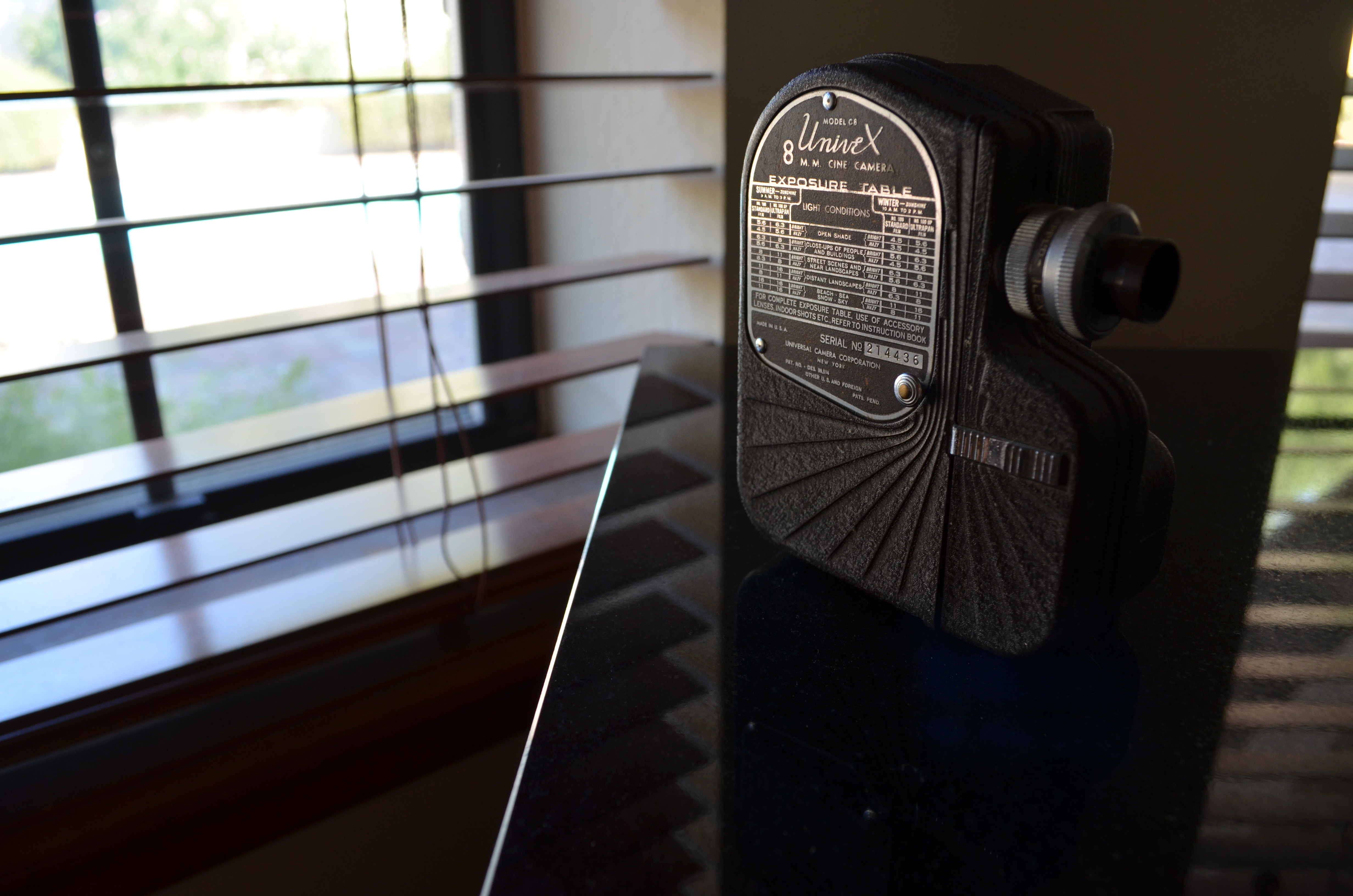 ideas and suggestions have always inspired me to try to be worthy of the space I’m taking up. I also have enjoyed linking back to your individual sites and visions. It’s a great way to learn.
So please know that, when you click the “like” button at the bottom of these posts, or take the time to type a comment, it does help me see what works, as well as what needs to be done better. I don’t believe that art can grow in a vacuum, and I thank everyone for giving these pages shape and form.
And thanks for exploring all the rooms in my house.
FLATTERY WILL GET YOU NOWHERE
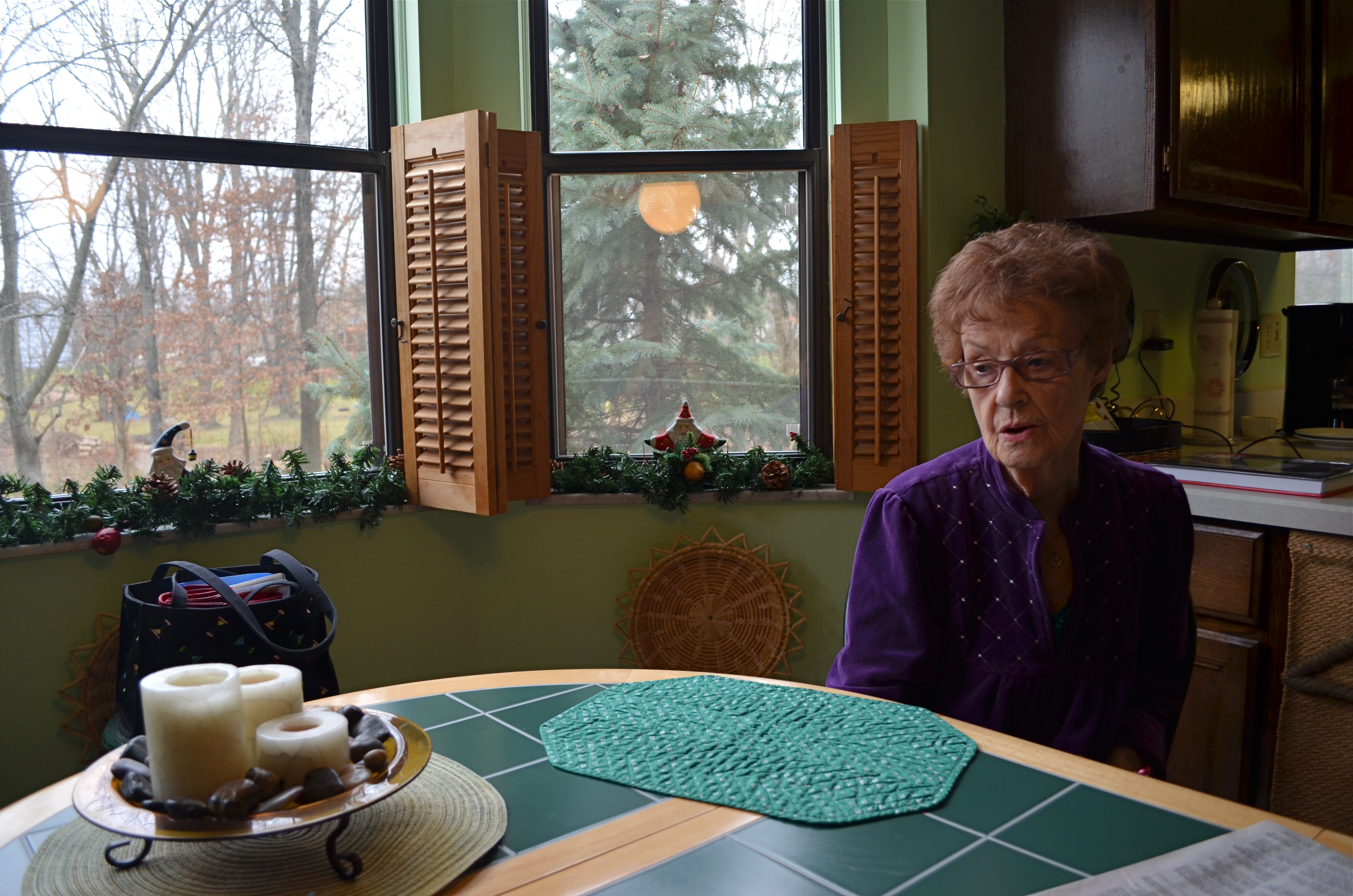
My beautiful mother, well past 21 but curator of a remarkable face. Window light softens, but does not erase, the textures of her features. 1/60 sec., f/4.5, ISO 200. 18mm.
By MICHAEL PERKINS
THE DEPICTION OF THE FACES OF THOSE WE LOVE IS AMONG THE MOST DIVISIVE QUESTIONS IN PHOTOGRAPHY. Since the beginning of the medium, thoughts on how to capture them “best” clearly fall into two opposing camps. In one corner, the feeling that we must idealize, glamorize, venerate the features of those most special in our lives. In the other corner, the belief that we should capture faces as effects of time and space, that is, record them, without seeking to impose standards of grace or beauty on what is in front of the lens. This leads us to see faces as objects among other objects.
The first, more cosmetic view of faces, which calls for ideal lighting, a flattering composition, a little “sweetening” in the taking, will always be the more popular view, and its resultant images will always be cherished for emotionally legitimate reasons. The second view is, let’s “face” it, a hard sell. You have to be ready for a set series of responses from your subjects, usually including:
Don’t take me. I just got up.
God, I look so old. Delete that.
I hate having my picture taken.
That doesn’t even look like me.
Of course, since no one is truly aware of what they “look like”, there is always an element of terror in having a “no frills” portrait taken. God help me, maybe I really do look like that. And most of us don’t want to push to get through people’s defenses. It’s uncomfortable. It’s awkward. And, in this photo-saturated world, it’s a major trick to get people to drop their instinctive masks, even if they want to.
Still.
As I visually measure the advance of age on my living parents (both 80+ ) and have enough etchings on my own features to mirror theirs, I am keener than ever to avoid limiting my images of us all to mere prettiness. I am particularly inspired by photographers who actually entered into a kind of understanding with their closest life partners to make a sort of document out of time’s effects. Two extreme examples: Richard Avedon’s father and Annie Leibovitz’ partner Susan Sontag were both documented in their losing battles with age and disease as willing participants in a very special relationship with very special photographers….arrangements which certainly are out of the question for many of us. And yet, there is so much to be gained by making a testament of sorts out of even simple snaps. This was an important face in my life, the image can say, and here is how it looked, having survived more than 3/4 of a century. Such portraits are not to be considered “right” or “wrong” against more conventional pictures, but they should be at least a part of the way we mark human lives.
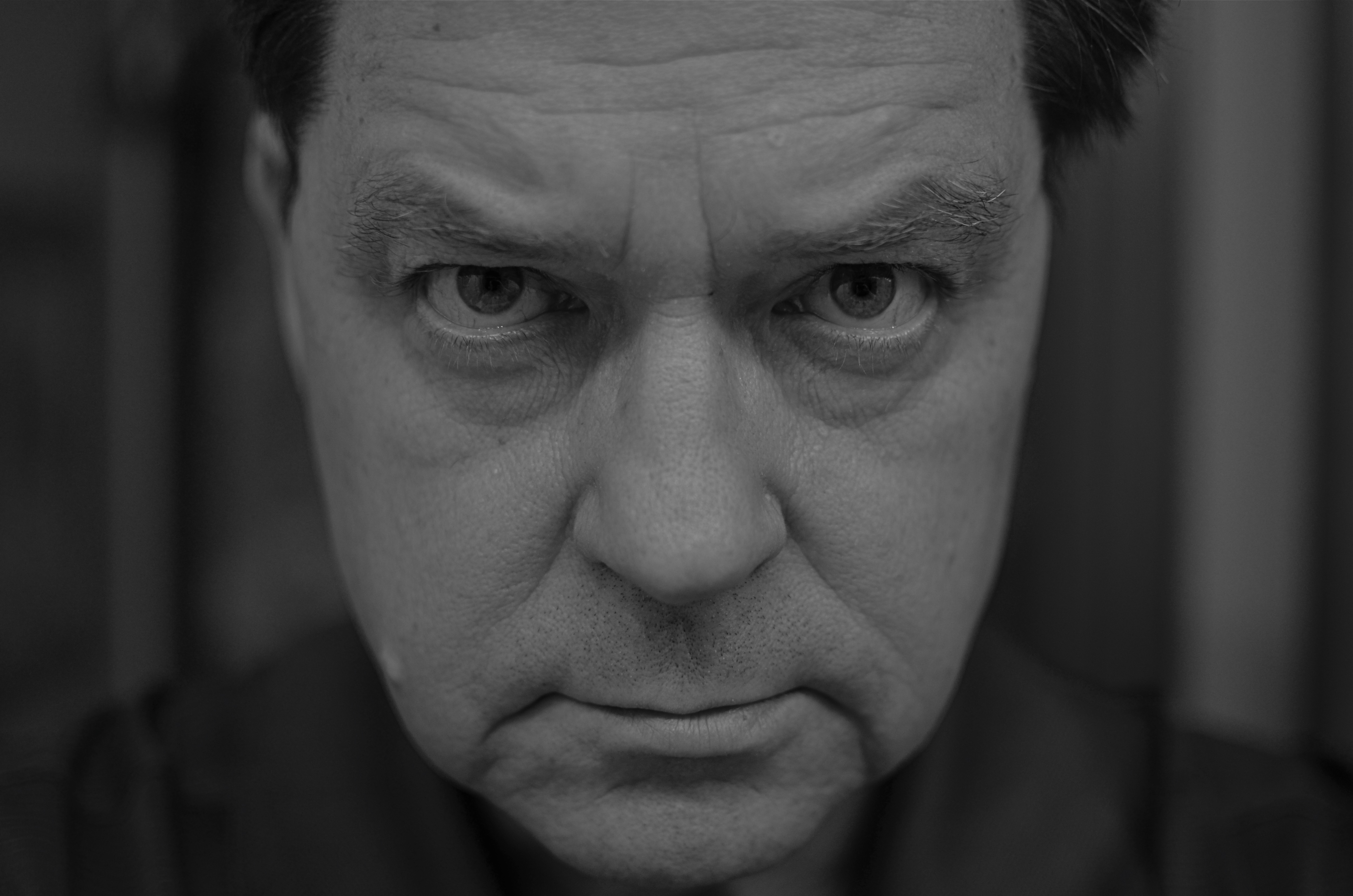
Don’t forget to document the effects of time on your own face. 1/160 sec., f/1.8, ISO 200, 35mm.
Everyone has to decide their own comfort zone, and how far it can be extended. But I think we have to stretch a bit. Pictures of essentially beautiful people who, at the moment the shutter snaps, haven’t done up their hair, put on their makeup, or conveniently lost forty pounds. People in less than perfect light, but with features which have eloquent statements and truths writ large in their every line and crevice. We should also practice on ourselves, since our faces are important to other people, and ours, like theirs, are going to go away someday.
In trying to record these statements and truths, mere flattery will get us nowhere. The camera has an eye to see; let’s take off the rose-colored filter, at least for a few frames.
Related articles
- The Great Richard Avedon (sandroesposito.wordpress.com)
SPLINTERING THE SQUARE
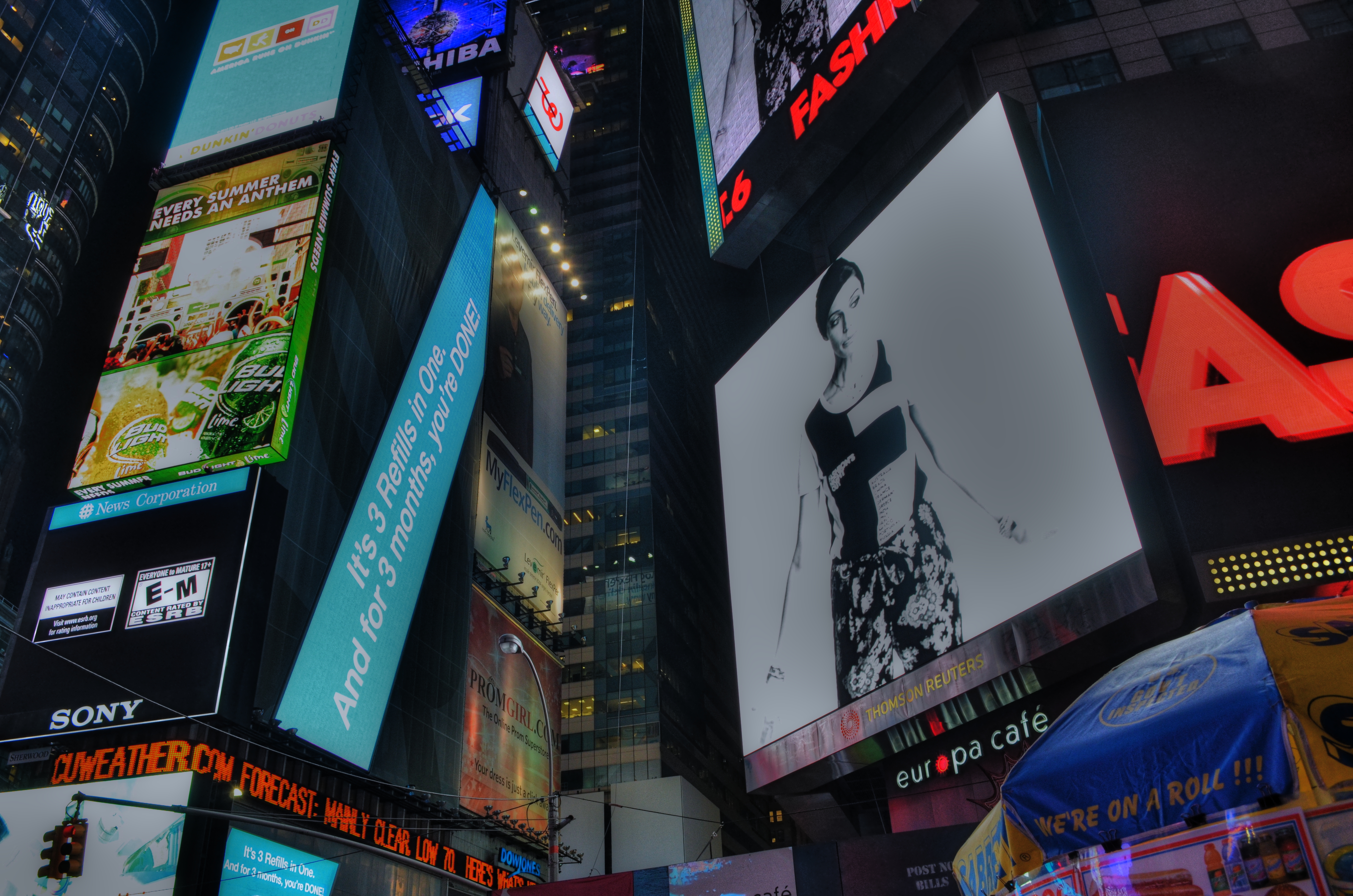
Times Square, August 2012. Somehow, the dark spaces in this spark my interest more than the garish light. 1/40 sec., F/8, ISO 320, 18mm.
By MICHAEL PERKINS
GOING BACK OVER HUGE FOLDERS OF IMAGES LONG AFTER THE FACT OF THEIR CREATION, a kind of aesthetic amnesia comes over me as to what the original intent of some of the pictures were. Who is this person? And why can’t I remember being him when this thing was shot?
A bit of background:
As much time as I have spent in New York’s Time Square, I should know better than to even raise my camera to my face, given that this particular locale has produced, for me, more hot messes and failed missions than any other subject I’ve ever aimed at. The place is a mirage, a trap for shooters: a visual overload, obscenely loud and demanding of attention, but spectacularly devoid of content. There is no “message” afoot in this vast glowing urban canyon except step right up we got what you need right here great seats at half price a whole dinner for just ten bucks hey watch who yer shovin’.
Hey, if you’re looking for meaning, stay home and read your Bible.
And yet, every time I’m there, I still try to take “THE shot”, vainly sticking to the idea that there is even one in there, and that all I have to do is find it. If I only had a helicopter, if I shot it at this end of the street, if I just find the great unifying theme, the truth will come forth….
Yeah, right.
Anyway, in reviewing the above image, one I originally consigned to the dustbin, I’m once again that aesthetic amnesiac. I don’t recognize the person who took it. It doesn’t look like anything I’d try, since it’s just an arrangement of angles, colors, and dark spaces. In other words, an attempt to see a design in part of the scene, rather than an overall tapestry of the entire phenom. Sort of splintering the square. It’s the casting of the city as a personality, I guess, that appeals to me, like the Los Angeles of Blade Runner or the neon neo-Asia of Joel Schumacher’s Gotham City.
What adds to the mystery is the fact that, I’m not usually this loose. I’m a little too formalized in my approach, a mite too Catholic. I tend to have a plan, an intention. Let’s stick with the outline, kids, and proceed in order. Shooting from the hip and living in the moment is not instinctual to me. I’m always fighting with my inner anal bureaucrat.
I seriously don’t remember what I was going for here, and maybe, with a subject like this, that’s the only way to go. Stop calculating, stop plotting, just react, and treat Times Square as the amusement park ride it is. Going for “THE shot” has always given me dozens of , eh, sorta okay pix, but this approach appeals to me a little bit. I am not totally unpleased with it, or as a more eloquent writer might put it, it doesn’t suck.
And given my track record in Times Square, that’s slightly better than a break-even.
Now if I could only remember who took the damned thing…..
Related articles
LET THERE BE (MORE) LIGHT
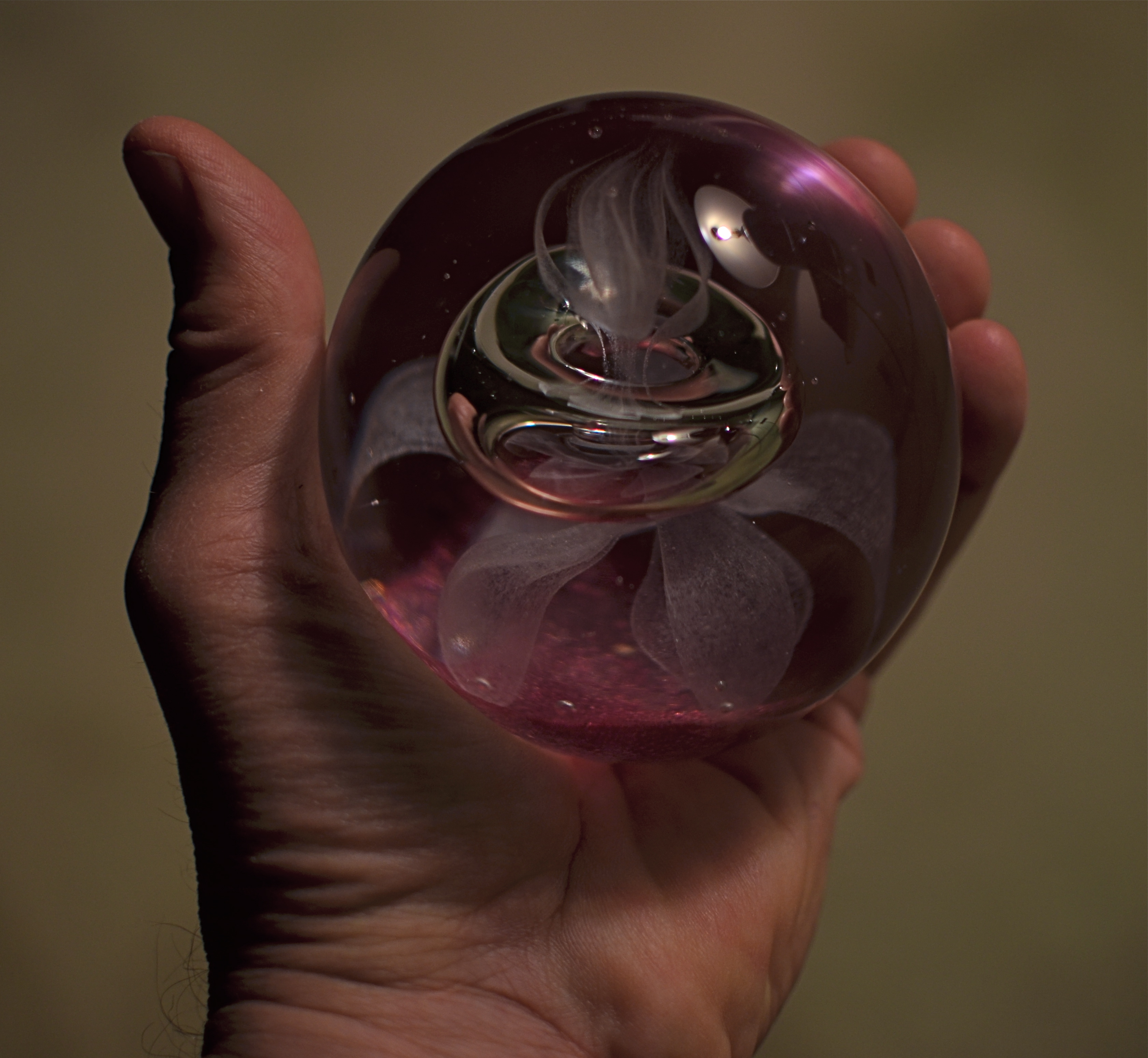
A new piece of glass makes everything look better….even another piece of glass. First day with my new 35mm prime lens, wide open at f/1.8, 1/160 sec., ISO 100.
By MICHAEL PERKINS
I HAVE RECENTLY BEEN EXPERIENCING ONE OF THOSE TIME MACHINE MOMENTS in which I am, again, right back at the beginning of my life as a photographer, aglow with enthusiasm, ripe with innocence, suffused by a feeling that anything can be done with my little black box. This is an intoxication that I call: new lens.
Without fail, every fresh hunk of glass I have ever purchased has produced the same giddy wonder, the same feeling of artistic invincibility. This time out, the toy in question is a Nikon f/1.8 35mm prime lens, and, boy howdy, does this baby perform. For cropped sensor cameras, it “sees” about like the 50mms of old, so its view is almost exactly as the human eye sees, without exaggerated perspective or angular distortion. Like the 50, it is simple, fast, and sharp. Unlike the 50, it doesn’t force me to do as much backing up to get a comfortable framing on people or near objects. The 35 feels a little “roomier”, as if there are a few extra inches of breathing space around my portrait subjects. Also, the focal field of view, even wide open, is fairly wide, so I can get most of your face tack sharp, instead of just an eye and a half. Matter of preference.
All this has made me marvel anew at how fast many of us are generally approaching the age of flashless photography. It’s been a long journey, but soon, outside the realm of formal studio work, where light needs to be deliberately boosted or manipulated, increasingly thirsty lenses and sensors will make available light our willing slave to a greater degree than ever before. For me, a person who believes that flash can create as many problems as it solves, and that it nearly always amounts to a compromise of what I see in my mind, that is good news indeed.
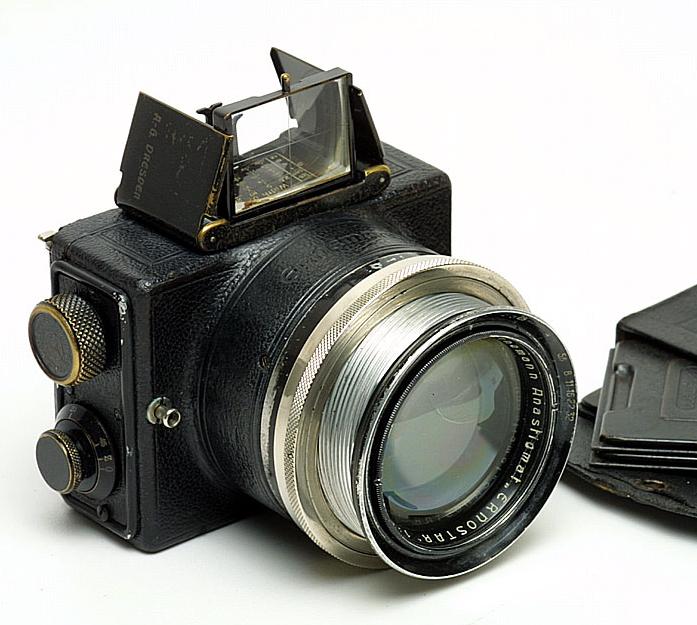
The Ermanox, perhaps the first camera designed to free mankind from the tyranny of flash.
It also makes me think of the first technical efforts to illuminate the dark, such as the camera you see off to the left. The Ermanox, introduced by the German manufacturer Ernemann in 1924, was one of the first big steps in the quest to free humankind of the bulk, unreliability and outright danger of early flash. Its cigarette-pack-sized body was dwarfed by its enormous lens, which, with a focal length of f/2, was speedy enough (1/1000 max shutter) to allow sharp, fast photography in nearly any light. It lost a few points for still being based on the use of (small) glass plates instead of roll film, but it almost single-handedly turned the average man into a stealth shooter, in that you didn’t have to pop in hefting a lotta luggage, as if to scream “HEY, THE PHOTOGRAPHER IS HERE!!” In fact, in the ’20’s and ’30’s, the brilliant amateur shooter Erich Solomon made something of a specialty out of sneaking himself and his tiny Ermanox into high-level government summits and snapping the inner circle at its unguarded best (or worst). Long exposures and blinding flash powders were no longer part of the equation. Candid photography had crawled out of its high chair… and onto the street.
Today or yesterday, this is about more than just technical advancement. The unspoken classism of photography has always been: people with money get great cameras; people without money can make do. Sure, early breakthroughs like the Ermanox made it possible for anyone to take great low-light shots, but at $190.65 in 1920’s dollars, it wasn’t going to be used at most folks’ family picnics. Now, however, that is changing. The walls between “high end” and “entry level” are dissolving. More technical democracy is creeping into the marketplace everyday, and being able to harness available light affordably is a big part of leveling the playing field.
So, lots more of us can feel like a kid with a new toy, er, lens.
Related articles
- Prime Lenses (nikonusa.com)
- Understanding Focal Length (nikonusa.com)
REWORKING THE UNIVERSE
By MICHAEL PERKINS
CONTEXT, FOR A PHOTOGRAPHER, IS LIKE THE CONDUCTOR’S BATON IN MUSIC, that magic wand that dictates fast and slow, soft and loud, ordering a specific world within a confined space. Since it impossible to show the world entire, all shooters decide what part of it, what story within it, that they will frame. Sounds obvious, but without the mastery of this skill, we fail as storytellers, and the eye that we develop for what to include and exclude is, despite all the tools and toys, the only thing that really makes an artistic performance out of a photograph.
It can also be a helluva lot of fun. With some dumb luck thrown in for good measure.
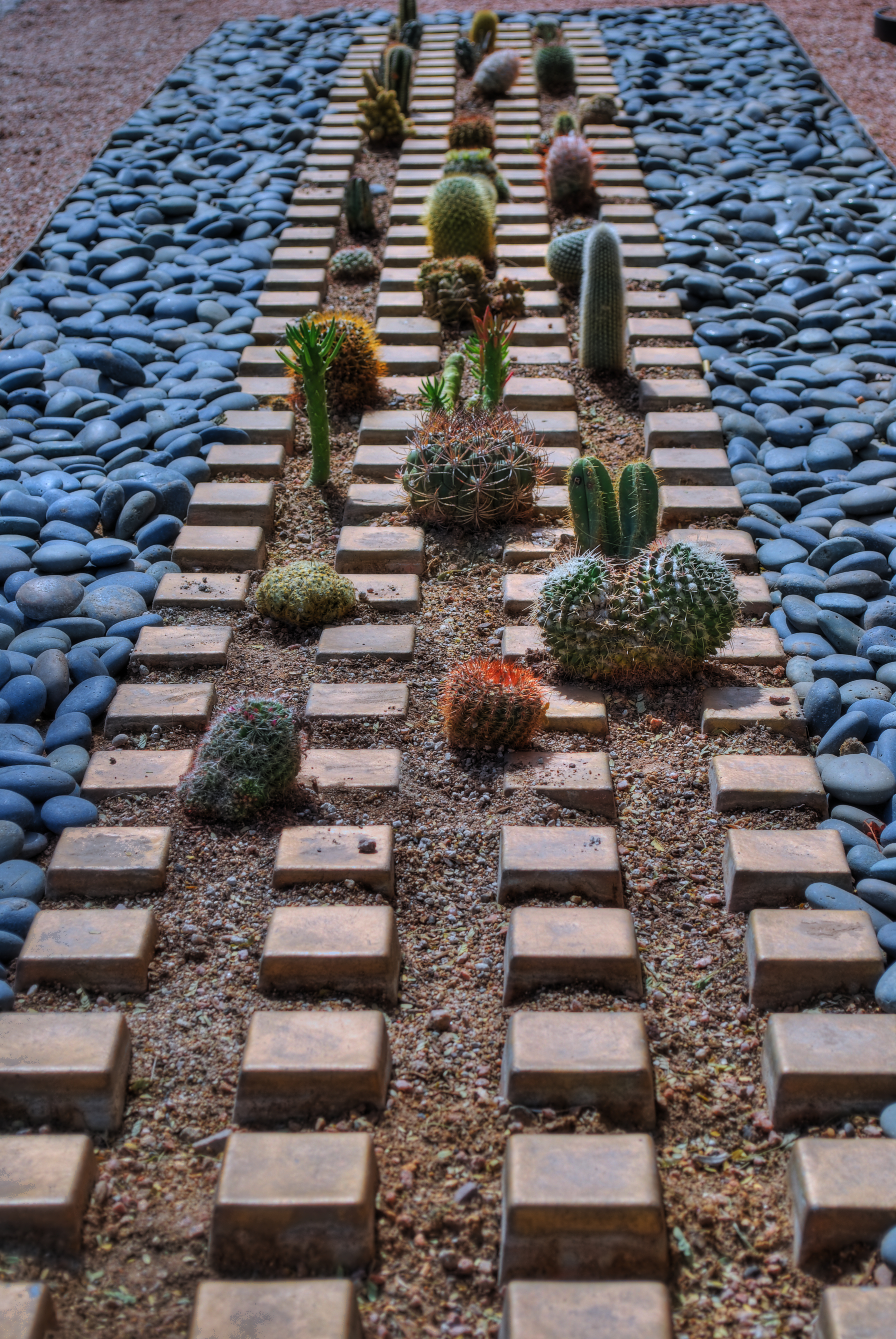
Cactropolis, 2011. A three-exposure HDR blend with a little color and contrast teaking. This whole layout, in reality, is about fifteen feet square, total. Various shutter speeds, f/8, ISO 100, 52mm.
I love opportunities that allow me to disrupt the original visual “place” of objects, to force them to be re-purposed for the viewer. A few years ago, my daily lunch routine involved a short walk across a bustling college campus to my habitual lunch hang, a stroll which took me past one of the school’s busiest crossroads, marked by the intersection of two superwide sidewalks flanked by small patches of landscaping. Since this is Arizona, such short plots of land frequently are not the stuff dreams are made of. We’re talking pink quartz gravel interrupted by the occasional scabby aloe plant or cholla. And that’s what made this one little rectangle, just several feet long on each side, vie for my attention.
An arrangement of several varieties of small cacti has been arranged in rows, regulated by square tiles, grounded in gravel, and bounded by smooth bluish stones. Simple stuff, really, but this was somebody’s deliberate design, a pattern that registered, to my eye, like some kind of fantasy urban streetscape, blocks of tiny, spiny skyscrapers vanishing off toward an unseen horizon….a miniature downtown from Weirdsville, a tabletop diorama from Beetlejuice.
I didn’t really have to compose anything. I was in the framing business. But getting that frame meant getting rid of the surrounding throngs of students, the sidewalks, the buildings, the sky…..anything that seemed outside of the closed world implied by that little rectangle. Changing the context. In fact, I was adding something for everything I was taking away.
So let’s crop this puppy and see what happens.
Now I saw what seemed to be a self-contained world, one in which I was free to imagine what lay “beyond”. I goosed up the hues and texture with HDR processing, but otherwise, what you see is what there was. Maybe it works as pure design. Maybe I conveyed something, but the fact is, we have to make choices as shooters. The only thing that marks us as individuals is what we decide to see, and show.
Like I said…fun….luck….some other somethings…..
(Many Thanks Dept.:The idea for this post was inspired, in part, by a suggestion from my good friend Michael Grivois.)
THE GOLDEN AGE OF JUST OKAY
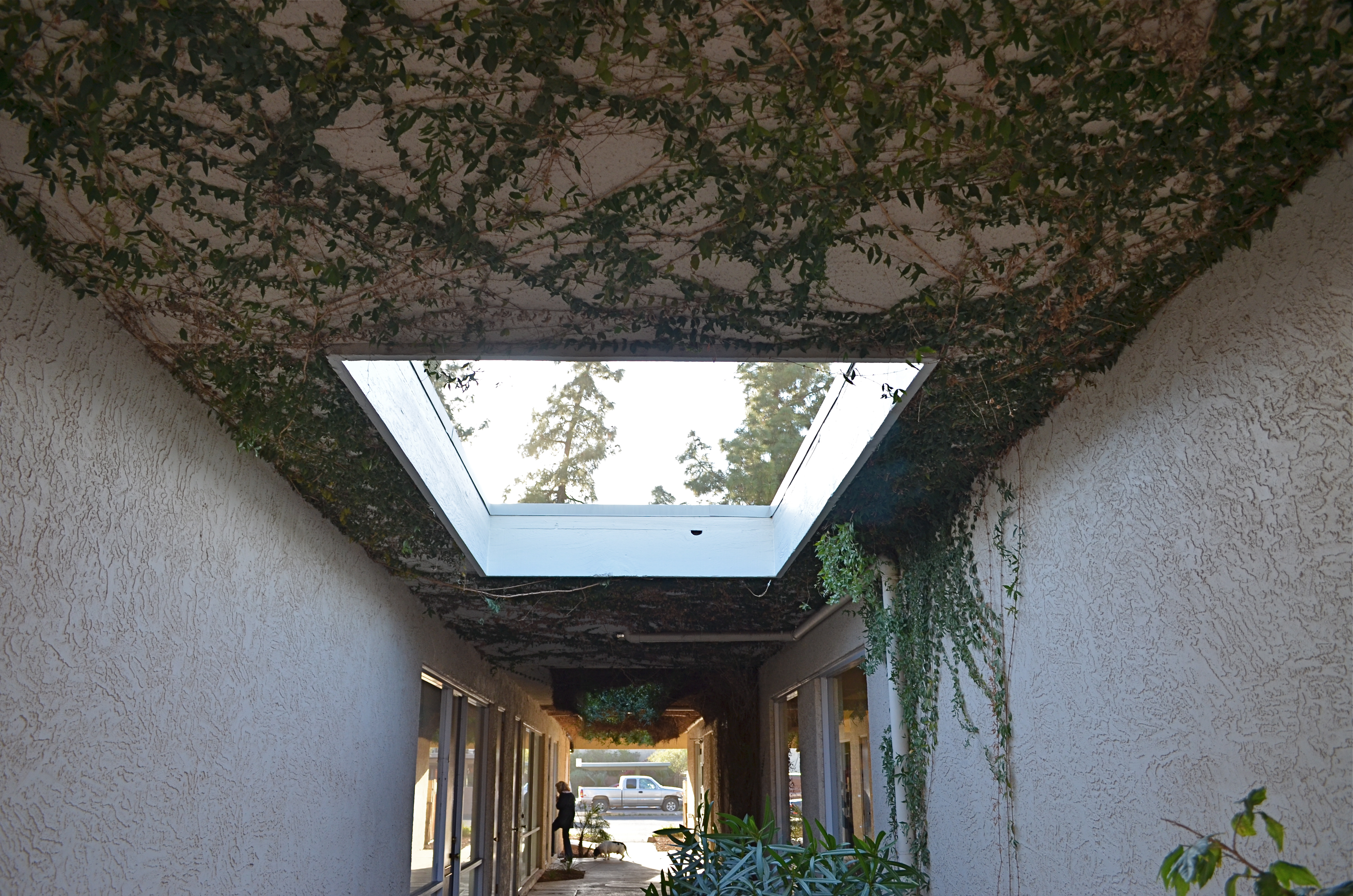
Plenty of mistakes made on this one. Is it a success or a failure? Does it matter? All that’s important is that you, not the camera, is making the picture. Manual mode, 1/100 sec., f/5.6, ISO 100, 18mm.
By MICHAEL PERKINS
WE ALL SAY IT: THERE ARE NO SHORTCUTS TO SUCCESS.
We all say it. None of us believes it. It’s just not, well, American to throw aside our national myths, and the folk tale of the lucky, quick genius who zooms to the head of the line to fame, bounding in front of all the sloggers and suckers, is intoxicating. One blinding inspiration, we tell ourselves, just one great notion, and we can bypass all that “practicing and patience” stuff, the same virtues we feel honor bound to extol in others. In anyone else but me.
Me, I’m taking the shortcut.
So now is about the time when the photography angle of this rant should kick in, right?
Okay, here goes.
As the automode functions of cameras have grown ever more complex, they have made taking a perfectly acceptable picture effortless. Great for immediate gratification. Not so great for the art of photography. Think about it. It has become so fabulously easy to point and get something that isn’t too bad, that we are bypassing the slower, uglier, but eventually more satisfying process that comes with trial, error, recalculation, and risk. We produce more error-free pictures than ever before, but, to do that, we have to hang our own creativity…..the raw, sloppy process of imagineering our own vision…on the wall. We get fat and lazy. And so do our pictures.
Now that I have successfully defended my title as the great Grinch Buzzkill, trying to rid Whoville of good, clean camera fun, let me just ask one more question. Do we want a large mountain of “okay” pictures, taken, to an ever greater degree, by our cameras, or a smaller, more amazing pile of remarkable pictures borne of our own sweat and struggle? Tricky part: there is no right or wrong answer, just a choice to be made based on your own expectations. Turning off the “green zone” of guaranteed effect modes and really educating ourselves as to what is going into the making of our pictures means turning off a snapshot mentality and opting for the unpredictable.
Hey, I’m not suggesting you go all Matthew Brady and lug around forty pounds of wet plates and a covered wagon full of caustic chemicals just to take a birthday picture of Grandma blowing out her candles. But we can probably aspire to more than just the golden age of okay.
We already know how easy it is to take a picture. Now we need to rediscover how hard it can be, and what miracles can spring from our minds when we get our hands dirty and go down the rockier path.
THE OTHER 50%
By MICHAEL PERKINS
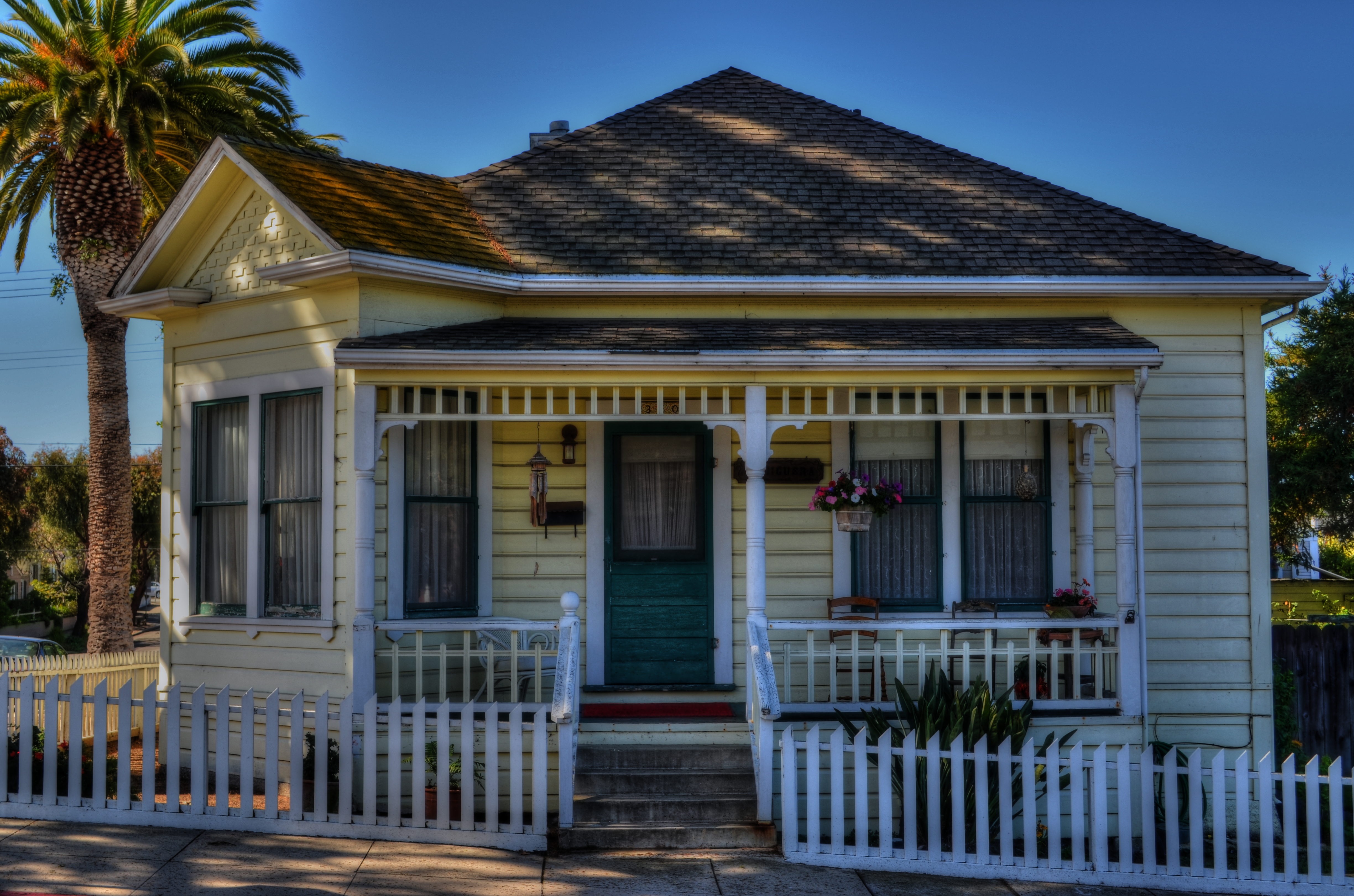
The American Dream, Pacific Grove, California, 2012. A three-exposure HDR with shutter speeds ranging from 1/100 to 1/160, all three shots at f/8, ISO 100, 32mm.
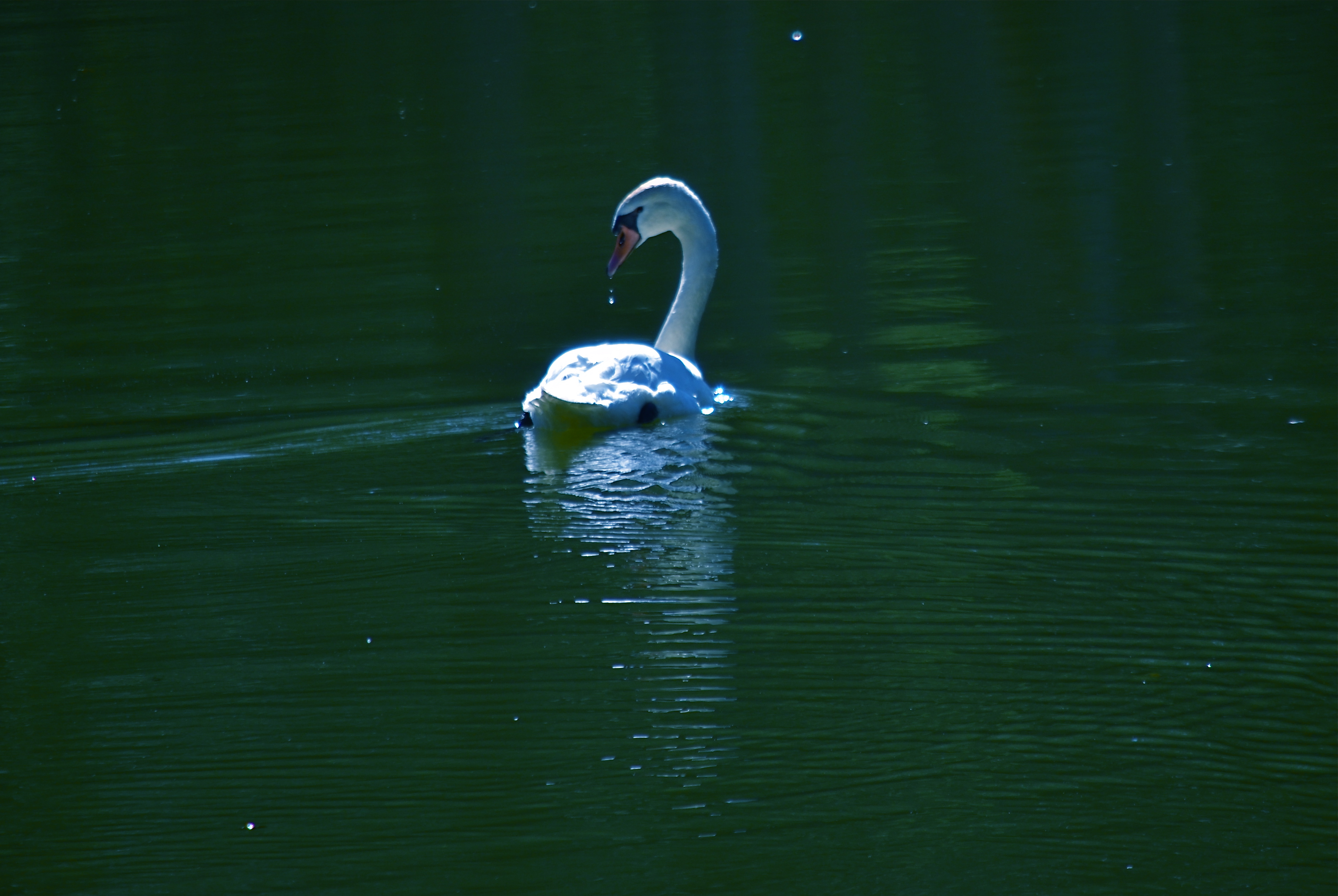
Serene On Green, near Yosemite National Park, 2012. 1/640 sec., f/5.6, ISO 100, 300mm.
THE LAST SUNDAY EDITION OF THE NEW YORK TIMES FOR 2012 features its annual review of the year’s most essential news images, a parade of glory, challenge, misery and deliverance that in some ways shows all the colors of the human struggle. Plenty of material to choose from, given the planet’s proud display of fury in Hurricane Sandy, the full scope of evil on display in Syria, and the mad marathon of American politics in an electoral year. But photography is only half about recording, or framing, history. The other half of the equation is always about creating worlds as well as commenting on them, on generating something true that doesn’t originate in a battlefield or legislative chamber. That deserves a year-end tribute of its own, and we all have images in our own files that fulfill the other 50% of photography’s promise.
This year, for example, we saw a certain soulfulness, even artistry, breathed into Instagram and, by extension, all mobile app imaging. Time ran a front cover image of Sandy’s ravages taken from a pool of Instagramers, in what was both a great reportorial photo and an interpretive shot whose impact goes far beyond the limits of a news event. Time and again this year, I saw still lifes, candids, whimsical dreams and general wonderments of the most personal type flooding the social media with shots that, suddenly, weren’t just snaps of the sandwich you had for lunch today saturated with fun filters. It was a very strong year for something personal, for the generation of complete other worlds within a frame.
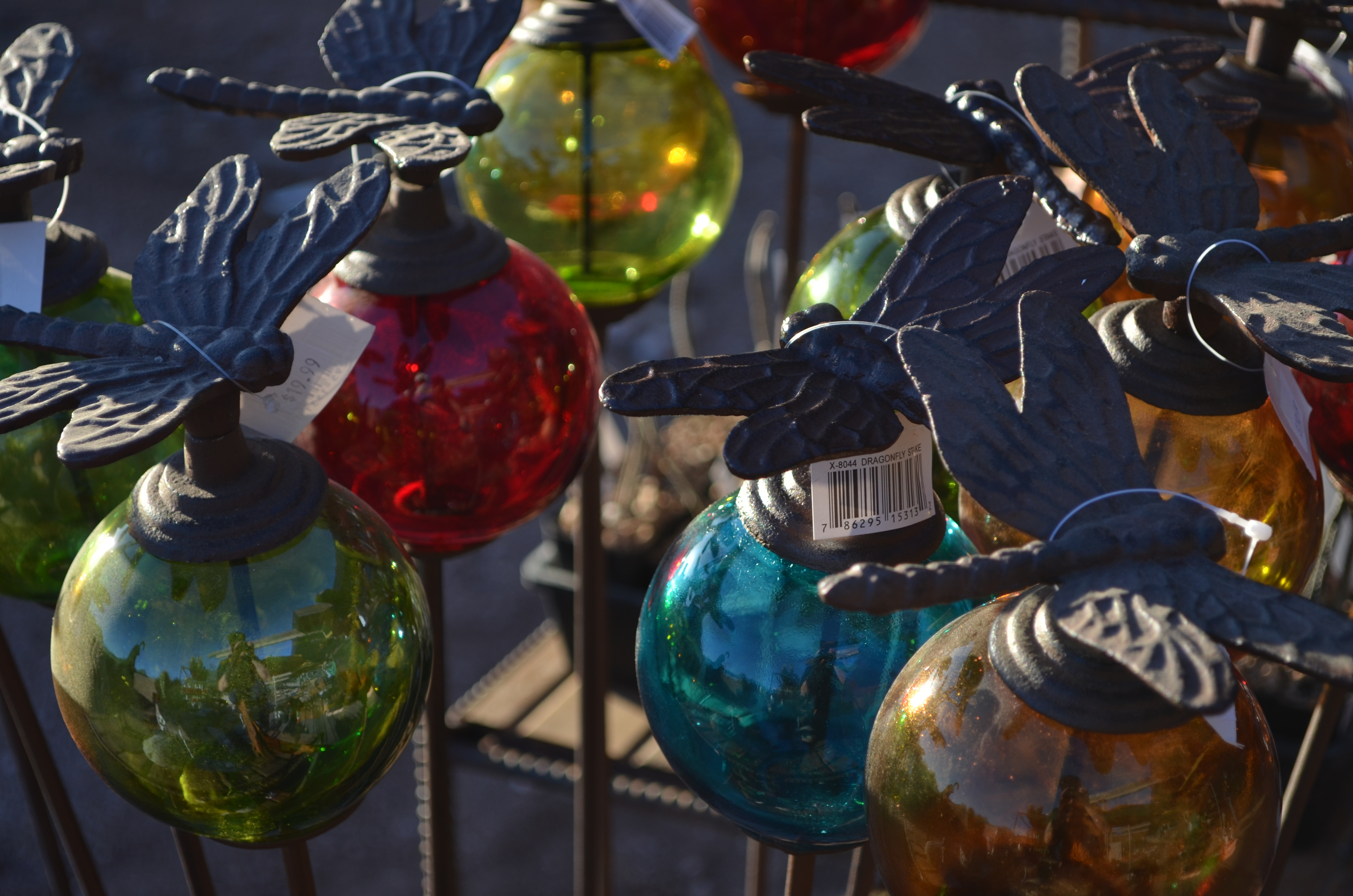
Dragonfly Globes, Tempe, Arizona, 2012. 1/200 sec., f/5.6, ISO 100, 55mm.
I love broad vistas and sweeping visual themes so much that I have to struggle constantly to re-anchor myself to smaller things, closer things, things that aren’t just scenic postcards on steroids, although that will always be a strong draw for me. Perhaps you have experienced the same pull on yourself…that feeling that, whatever you are shooting, you need to remember to also shoot…..something else. It is that reminder that, in addition to recording, we are also re-ordering our spaces, assembling a custom selection of visual elements within the frame. Our vision. Our version. Our “other 50%.”
My wife and I crammed an unusual amount of travel into 2012, providing me with no dearth of “big game” to capture…from bridges and skyscrapers to the breathlessly vast arrays of nature. But always I need to snap back to center….to learn to address the beauty of detail, the allure of little composed universes. Those are the images I agonize over the most at years’ end, as if I am poring over thumbnails to see a little piece of myself , not just in the mountains and broad vistas, but also in the grains of sand, the drops of dew, the minutes within the hours.
Year-end reviews are, truly, about the big stories. But in photography, we are uniquely able to tell the little ones as well. And how well we tell them is how well we mark that we were here, not just as observers, but as participants.
It’s not so much how well you play the game, but that you play.
Happy New Year, and many thanks for your attention, commentary, and courtesy in 2012.
Related articles
- 10 social mobile photography trends for 2013 (davidsmcnamara.typepad.com)
- Old-Timer Joins Instagram, Schools Everyone With Poignant Flood Photos (wired.com)
I SEE YOUR FACE BEFORE ME
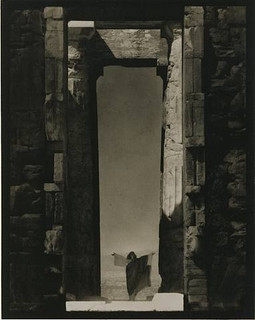
Edward Steichen’s amazing 1921 portrait of dance icon Isadora Duncan beneath a massive arch of the Parthenon in Greece, an image which recently surged to the top of my mind. See a link to a larger view of this shot, below.
By MICHAEL PERKINS
THE IMAGES SIT AT THE BOTTOM OF THE BRAIN, LIKE STONE PILLARS IN THE FOUNDATION OF AN IMMENSE TOWER.The structures erected on top of them, those images we ourselves have fashioned in memory of these foundations, dictate the height and breadth of our own creative edifices. Between these elemental pictures and what we build on top of them, we derive a visual style of our own.
In my own case,many of the pillars that hold up my own house of photography come from a single man.
Edward Steichen is arguably the greatest photographer in history. If that seems like hyperbole, I would humbly suggest that you take a reasonable period of time, say, oh, twenty years or so, just to lightly skim the breadth of his amazing career….from revealing portraits to iconic product shots to nature photography to street journalism and half a dozen other key areas that comprise our collective craft of light writing. His work spans the distance from wet glass plates to color film, from the Edwardian era to the 1960’s, from photography as an insecure imitation of painting to its arrival as a distinct and unique art form in its own right.
At the start of the 20th century, Steichen co-sponsored many of the world’s first formal photographic galleries, and was a major contributor to Camera Work, the first serious magazine dedicated wholly to photography. He ended his career as the creator of the legendary Family Of Man, created in the early 1950’s and still the most celebrated collection of global images ever mounted anywhere on earth. He is, simply, the Moses of photography, towering above many lesser giants whose best work amounts to only a fraction of his own prodigious output.
Which is why I sometimes see fragments of what he saw when I view a subject. I can’t see with his clarity, but through the milky lens of my own vision I sometime detect a flashing speck of what he knew on a much larger scale, decades before. The image at left recently rocketed to my mind’s eye several weeks ago, as I was framing shots inside a large government building in Ohio.In 1921, Steichen journeyed to Greece to use the world’s oldest civilization basically as a prop for portraits of Isadora Duncan, then in the forefront of American avant-garde dance. Framing her at the bottom of an immense arch in the ruins of the Parthenon, he made her appear majestic and minute at the same time, both minimized and deified by the huge proportions in the frame. It is one of the most beautiful compositions I have ever seen, and I urge you to click the Flickr link at the end of this post for a slightly larger view of it. (Also note the link to a great overview of Steichen’s life on Wikipedia.)
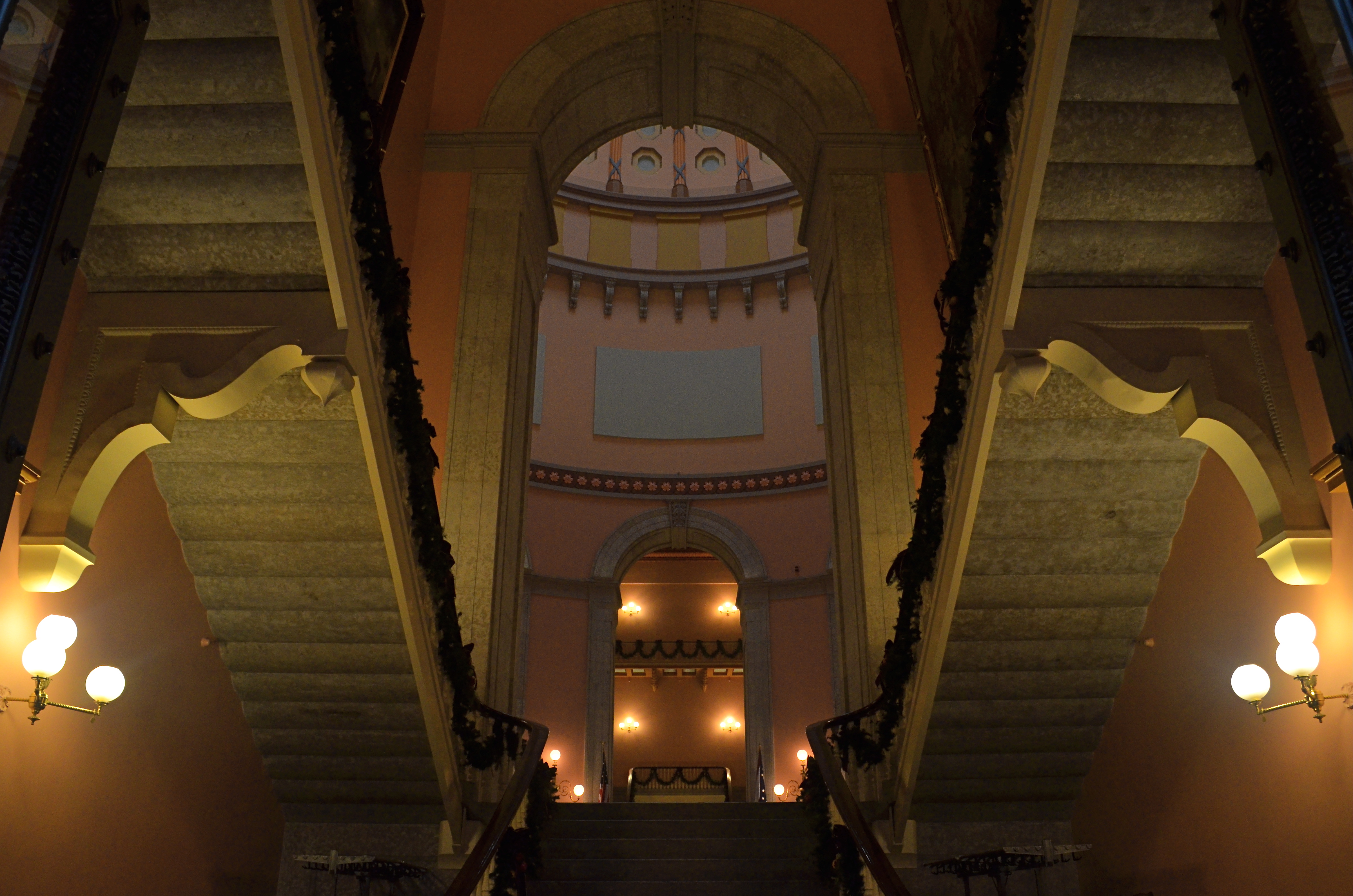
Uplighting creates a moody frame-within-frame feel at the Ohio Statehouse building, in a shot inspired by Edward Steichen’s images of massive arches. 1/30 sec., f/8, ISO 800, 18mm.
In framing a similarly tall arch leading into the rotunda of the Ohio Statehouse in Columbus, I didn’t have a human figure to work with, but I wanted to show the building as a series of major and minor access cavities, in, around, under and through one of its arched entrance to the central lobby. I kept having to back up and step down to get at least a partial view of the rotunda and the arch at the opposite end of the open space included in the frame, which created a kind of left and right bracket for the shot, now flanked by a pair of staircases. Given the overcast sky meekly leaking grey light into the rotunda’s glass cupola, most of the building was shrouded in shadow, so a handheld shot with sufficient depth of field was going to call for jacked-up ISO, and the attendant grungy texture that remains in the darker parts of the shot. But at least I walked away with something.
What kind of something? There is no”object” to the image, no story being told, and sadly, no dancing muse to immortalize. Just an arrangement of color and shape that hit me in some kind of emotional way. That and Steichen, that foundational pillar, calling up to me from the basement:
“Just take the shot.”
Related articles
- The Photograph as a Social Statement (halsmith.wordpress.com)
- Picture Imperfect (andrewsullivan.thedailybeast.com)
- http://www.flickr.com/photos/quelitab/5793648357/lightbox/
- http://en.wikipedia.org/wiki/Edward_Steichen
TURNING UP THE MAGIC
By MICHAEL PERKINS
CHRISTMAS IS SO BIG THAT IT CAN AFFORD TO GO SMALL. Photographers can, of course, tackle the huge themes….cavernous rooms bursting with gifts, sprawling trees crowning massive plazas, the lengthy curve and contour of snowy lanes and rustic rinks…..there are plenty of vistas of, well, plenty. However, to get to human scale on this most superhuman of experiences, you have to shrink the frame, tighten the focus to intimate details, go to the tiny core of emotion and memory. Those things are measured in inches, in the minute wonder of things that bear the names little, miniature, precious.
And, as in every other aspect of holiday photography, light, and its successful manipulation, seals the deal.
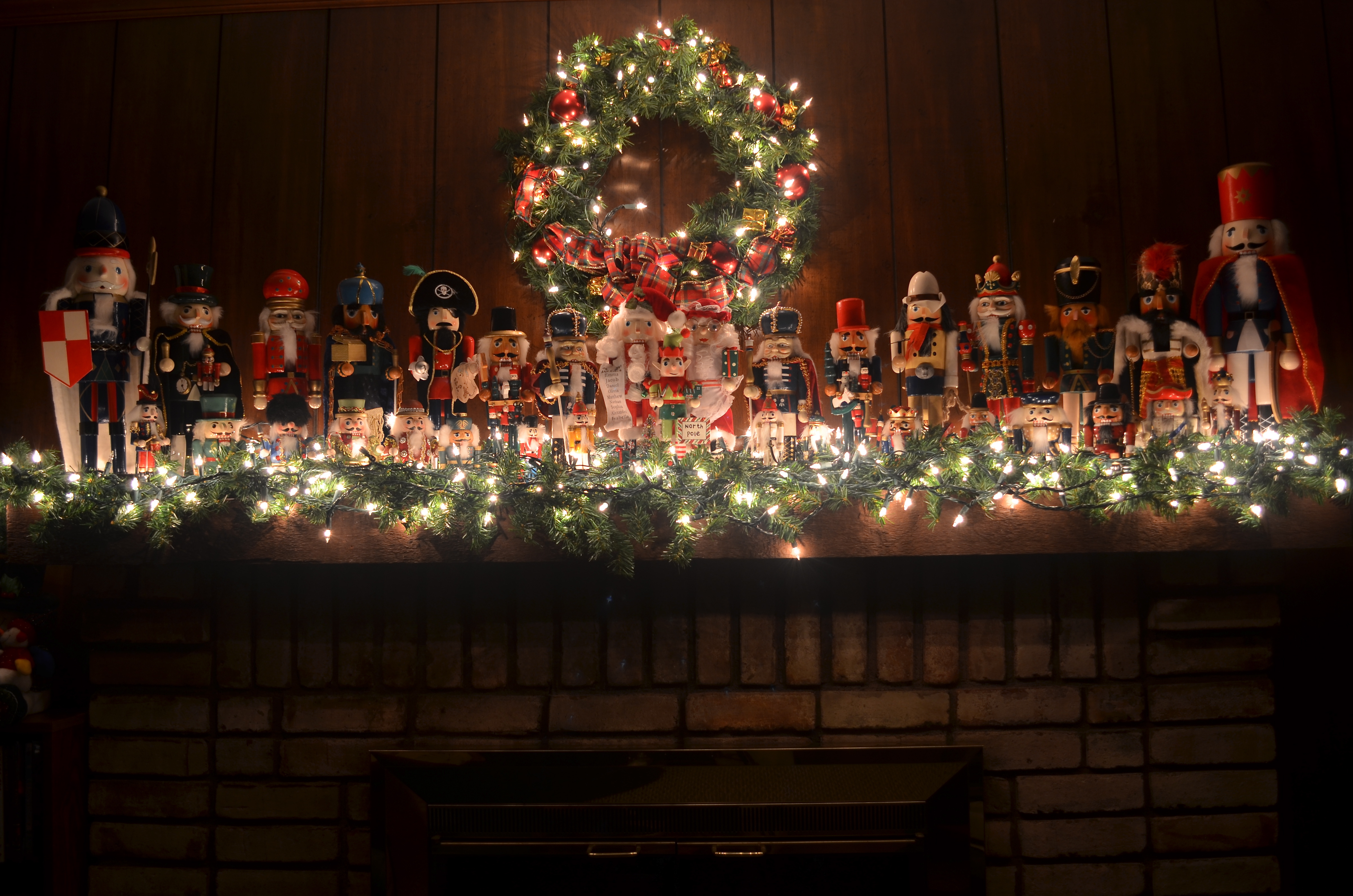
A proud regiment of nutcrackers, made a little more enchanting by turning off the room light and relying on tiny twinklers. 1/2 sec., f/4, ISO 100, 20mm
In recent years I have turned away from big rooms and large tableaux for the small stories that emanate from close examination of corners and crannies. The special ornament. The tiny keepsake. The magic that reveals itself only after we slow down, quiet down, and zoom in. In effect, you have to get close enough to read the “Rosebud” on the sled.
Through one life path and another, I have not been “home” (that is, my parents’ home) for Christmas for many years now. This year, I broke the pattern to visit early in December, where the airfare was affordable, the overall scene was less hectic and the look of the season was visually quiet, if no less personal. It became, for me, a way to ease back into the holidays as an experience that I’d laid aside for a long time.
A measured re-entry.
I wanted to eschew big rooms and super-sized layouts to concentrate on things within things, parts of the scene. That also went for the light, which needed to be simpler, smaller, just enough. Two things in my parents’ house drew me in: several select branches of the family tree, and one small part of my mother’s amazing collection of nutcrackers. In both cases, I had tried to shoot in both daylight and general night-time room light. In both cases, I needed some elusive tool for enhancement of detail, some way to highlight texture on a very muted scale.
Call it turning up the magic.
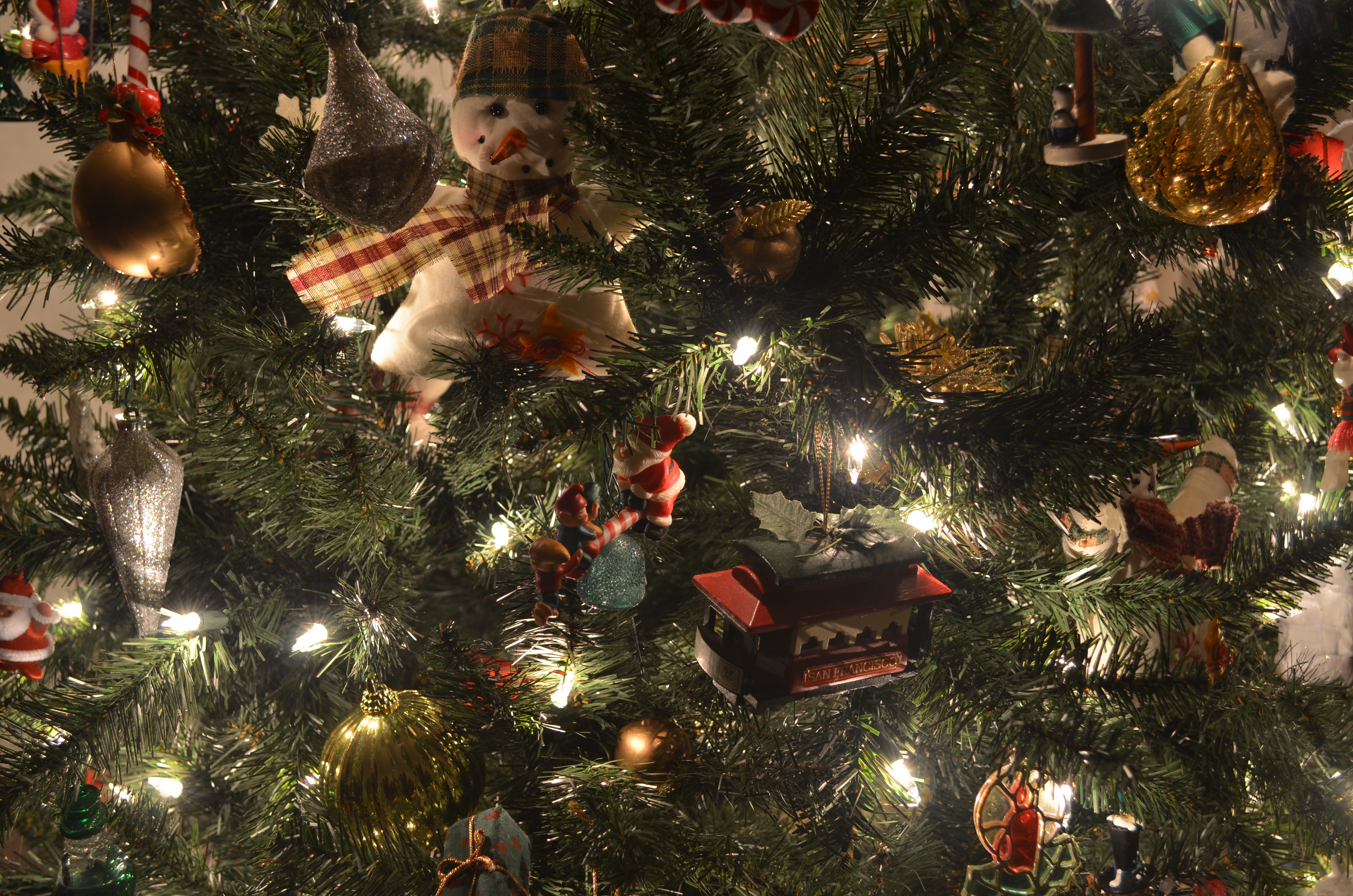
Use of low-power, local light instead of general room ambience enhances detail in tiny objects, revealing their textures. 1/2 sec., f/4, ISO 100, 20mm.
As it turned out, both subjects were flanked by white mini-lights, the tree lit exclusively by white, the nutcrackers assembled on a bed of green with the lights woven into the greenery. The short-throw range of these lights was going to be all I would need, or want. All that was required was to set up on a tripod so that exposures of anywhere from one to three seconds would coax color bounces and delicate shadows out of the darkness, as well as keeping ISO to an absolute minimum. In the case of the nutcrackers, the varnished finish of many of the figures, in this process, would shine like porcelain. For many of the tree ornaments, the looks of wood, foil, glitter, and fabric were magnified by the close-at-hand, mild light. Controlled exposures also kept the lights from “burning in” and washing out as well, so there was really no down side to using them exclusively.
Best thing? Whole project, from start to finish, took mere minutes, with dozens of shots and editing choices yielded before anyone else in the room could miss me.
And, since I’d been away for a while, that, along with starting a new tradition of seeing, was a good thing.
Ho.
Related articles
- How to Take a Picture of Your Christmas Tree (purdueavenue.com)
 thenormaleye