ALONE AGAIN, UNNATURALLY
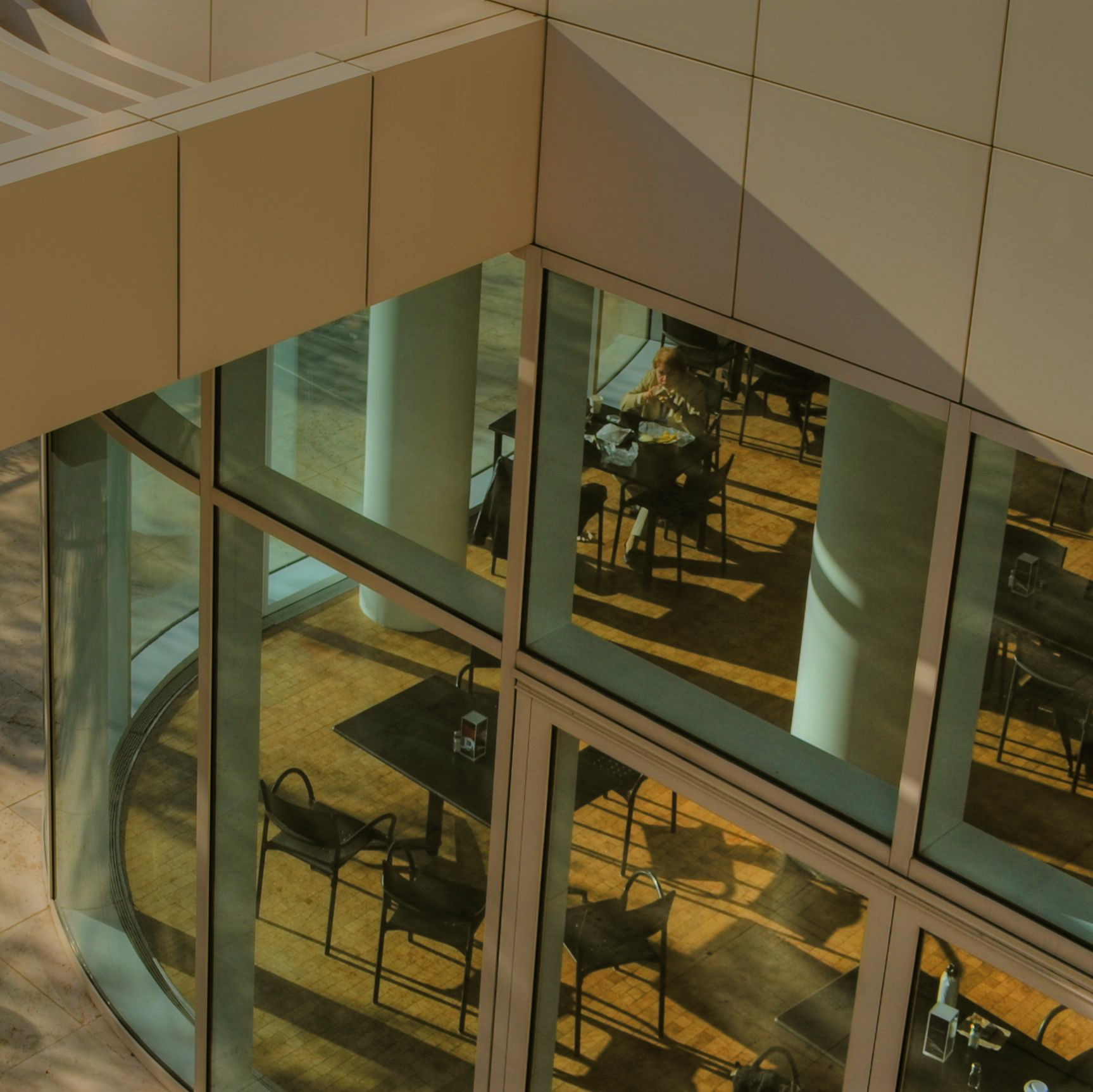
Lunch For One, 2011. Your choices as a photographer will determine if the woman in the cafeteria is alone…or lonely.
By MICHAEL PERKINS
PEOPLE ARE ONE OF THE MOST COMPLICATED ELEMENTS in a photographic composition. Unlike furniture, foliage or flotsam, humans are the one “prop” in an image which convey associations and meanings that render a photo complex, troubling, intriguing. Put a person in your picture and you have changed the terms upon which you engage the audience.
At the very least, you have posed a series of questions which color the viewer’s reaction to your work. What is that person doing there? What does he wish for, or intend? What are his dreams, his goals? Is she merely in the picture, or in some way a commentary on her context within it? You can move things around in the name of composition alone, but move a person and you have started a conversation.
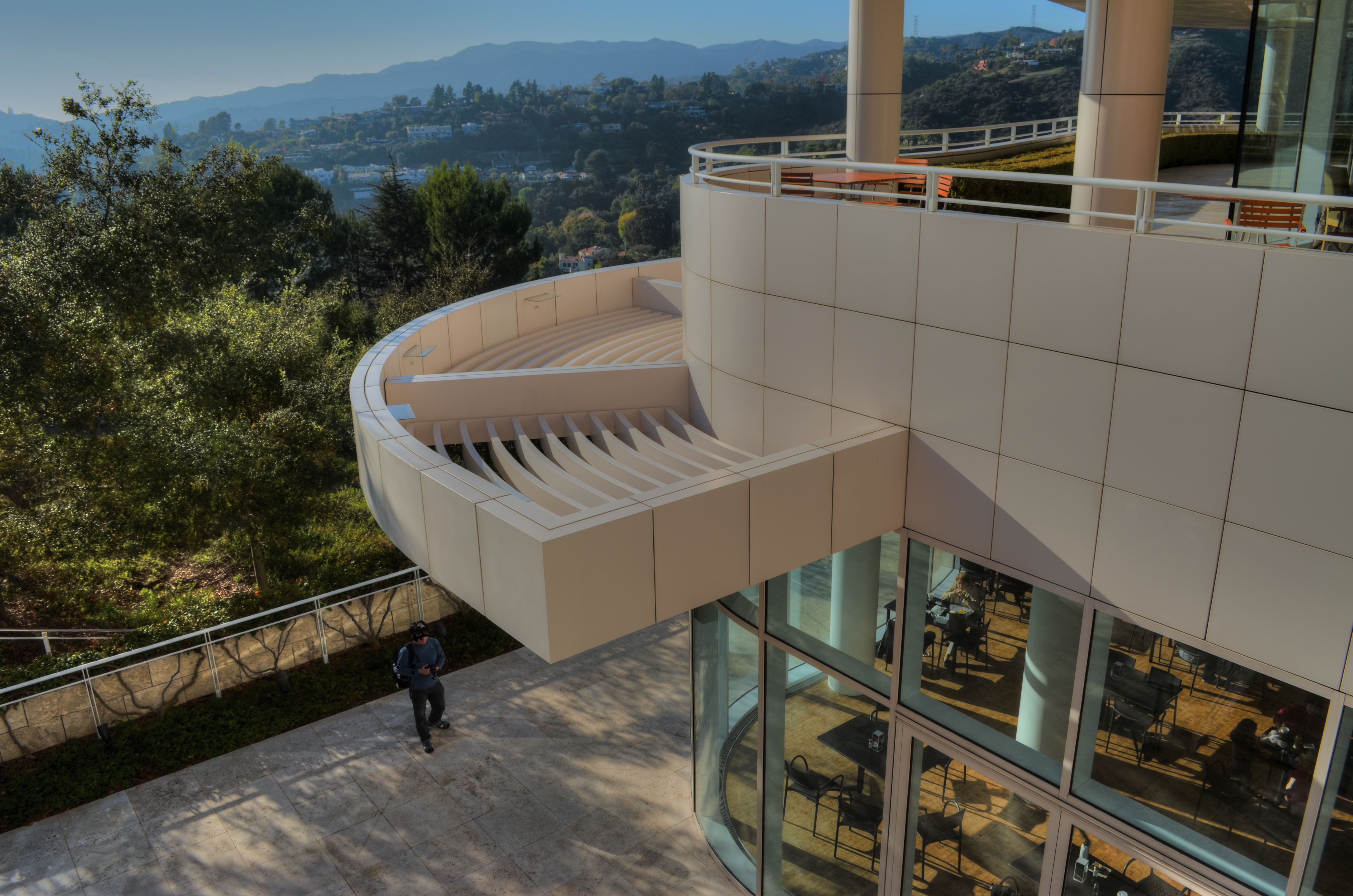
The original framing for the above shot.
The placement of people in a frame creates speculation about the motives and origins of those people before they were in the frame. A man shown standing at the platform at a train station could be eagerly awaiting an arrival, sneaking out of town, or merely wandering around. The mind starts to supply his backstory, if you like, his actions before appearing in the finite world of the frame. Put two people side by side, and you have, according to your viewer’s whim, a rendezvous, a goodbye, a conspiracy, a reunion, a chance meeting. People change the perceived intention of a photograph as a storyboard, either in the original framing or in the cropping afterwards.
The above image is the final crop of what was, originally, a scenic overview, taken at a large campus of museum buildings on a hillside. The image, as first conceived, was an overall “postcard” with the restaurant in only the lower right quarter of the frame. Later, I became aware that a single woman was visible in the cafe. Now, it’s not that she was actually the only person inside, but the photograph could be cropped to make her seem like it, meanwhile accentuating the emptiness in her immediate area.
As a consequence, instead of a lady who is merely alone, the image can make her seem “lonely”. Or perhaps you disagree. The point is that, by changing the human information in the frame (note that, in the original of the cropped shot, there is also a man standing outside the restaurant), we’ve re-drawn its narrative.
What gets left out of a picture, then, sparks speculation by the viewer, based on what has been left in.
LOOKS LIKE IT WORKS
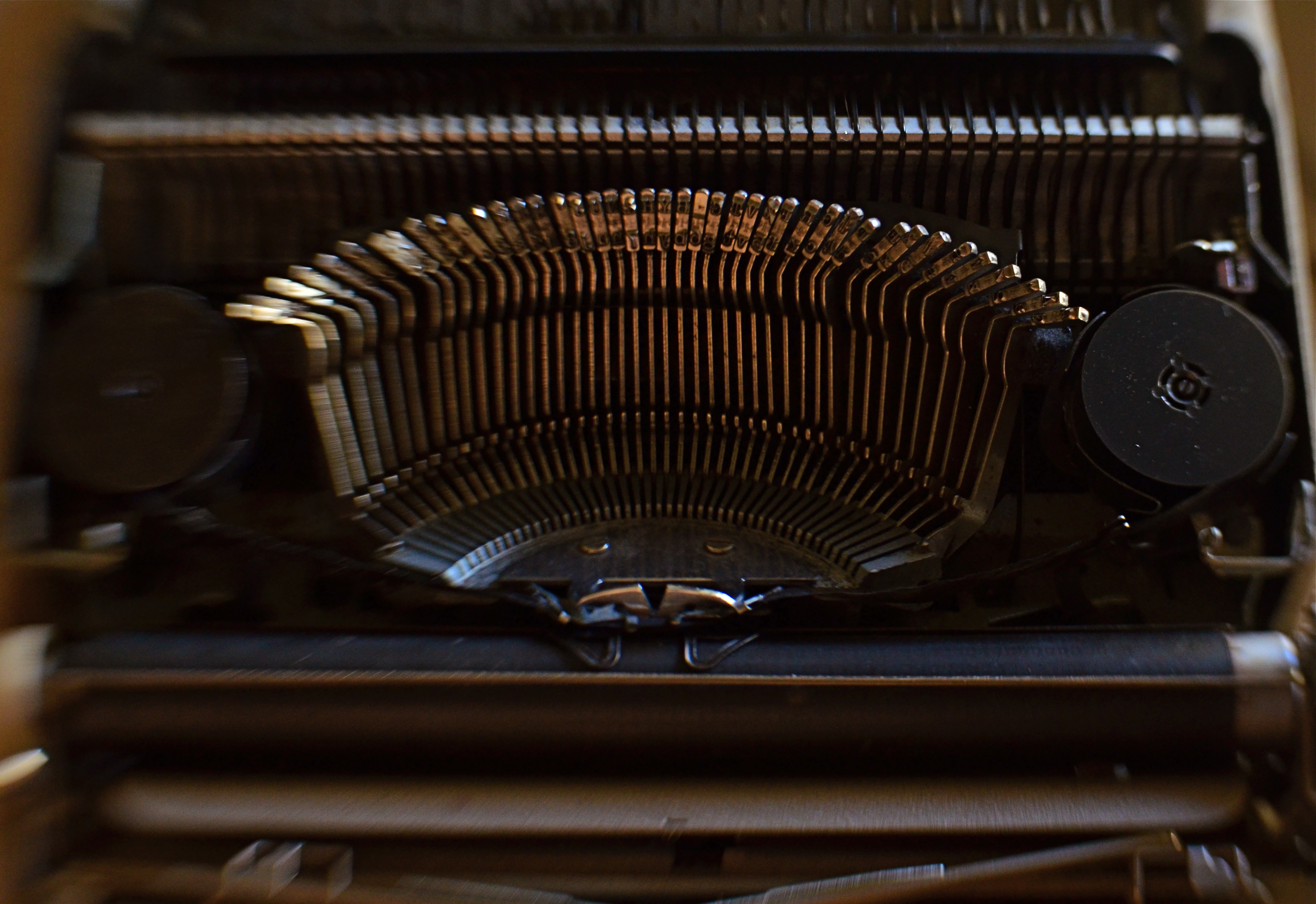
Ghost Writer In Disguise, 2016
By MICHAEL PERKINS
PHOTOGRAPHY OFTEN RE-DEFINES OUR PERCEPTION OF THE FAMILIAR, re-contextualizing everyday objects in ways that force us to see them differently. Nowhere is this more effective than in close-up and macro photography, where we deliberately isolate or magnify details of things so that they lose their typical associations. Indeed, using the camera to cast subjects in unfamiliar ways is one of the most delightful challenges of the art.
Product developers are comfortable with the idea that “form follows function”, that how we use a thing will usually dictate how it must be designed. The shapes and contours of the objects in our world are arrived at only as we tailor the look of a thing to what it does. That’s why we don’t have square wheels. The problem with familiar objects is that, as long as they do what they were designed to do, we think less and less about the elegance of their physical design. Photographers can take things out of this chain of the mundane, and, in showcasing them, force us to see them in purely visual terms. They stop playing the piano, and instead look under the lid at the elegant machine within. They strip off the service panel of the printer and show us the ballet of circuitry underneath.
It’s even easier to do this, and yields more dramatic results, as we begin to re-investigate those things that have almost completely passed from daily use. To our 21st-century eyes, a 1910 stock ticker might as well be an alien spaceship, so far removed is it from typical experience. I recently viewed a permanent wave machine from a beauty parlor of the 1930’s, sitting on a forgotten table at a flea market. It took me two full minutes to figure out what I was even looking at. Did I snap it? You betcha.
The study of bygone function is also a magical mystery tour of design innovation. You start to suss out why the Edisons of the world needed this shape, these materials, arranged in precisely this way, to make these things work. Zooming in for a tighter look, as in the case of the typewriter in the above image, forces a certain viewpoint, creating compositions of absolute shapes, free to be whatever we need them to be. Form becomes our function.
The same transformation can happen when you have seemingly exhausted a familiar subject, or shot away at it until your brain freezes and no new truth seems to be coming forth. Walking away from the project for a while, even a few hours, often reboots your attitude towards it, and the image begins to emerge. As Yogi Berra said, you can observe a lot just by watching.
TERMS OF ENGAGEMENT
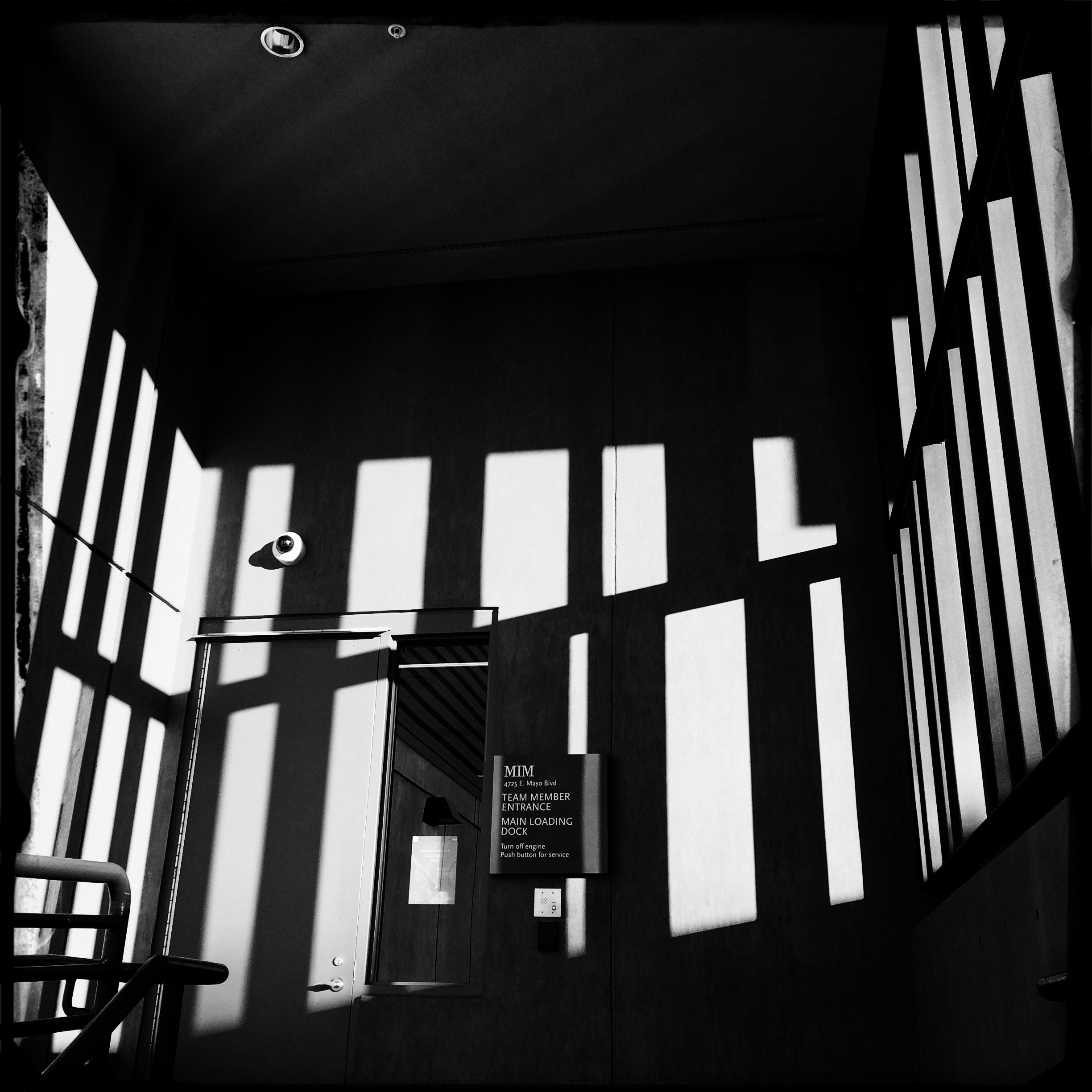
A very soft color cel phone original becomes a stark “box”, suggested solely by a pattern of black and white bands.
By MICHAEL PERKINS
ABSTRACT COMPOSITIONS AREN’T MERELY A DIFFERENT WAY OF PHOTOGRAPHING A SUBJECT: they are, in many cases, the subject itself. Arrangements of shape, shadow and contrast can be powerful enough to carry the weight of a picture all by themselves, or at least be an abbreviated, less-is-more way of suggesting objects or people. And in terms of pure impact, it’s no surprise that photographers who, just a generation ago, might have worked exclusively in color, are making a bold return to black and white. For abstract compositions, it’s often the difference between a whisper and a shout.
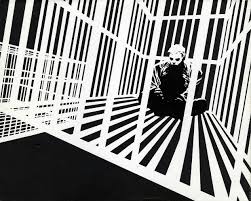
Cartoonist Frank Miller sculpts solid space out of a mix of black and white rays.
I find it interesting that the medium of comics, which has long been defined by its bold, even brutal use of color, is also experiencing a black & white resurgence in recent years, with such masters as Frank Miller (Batman: The Dark Knight Returns) rendering amazing stuff in the most starkly monochromatic terms. Likewise, the army of apps in mobile photography has reminded young shooters of the immediacy, the power of monochrome, allowing them to simulate the grain and grit of classic b&w films from Tri-X to Kodalith, even as a post-production tweak of a color original.
You know in the moment whether you’ve captured a conventional subject that sells the image, or whether some arrangement of forms suggestive of that subject is enough. In the above shot, reducing the mild color tonal patterns of a color original to bare-boned, hard blacks and loud whites creates the feel of a shaded door frame..a solid, dimensional space. The box-like enclosure that envelops the door is all there, but implied, rather than shown. As a color shot, the image is too quiet, too…gentle. In monochrome, it’s harder, but it also communicates faster, without being slowed down by the prettiness of the browns and golds that dominated the initial shot.
There are two ways to perfect a composition; building it up in layers from nothing into a “just-enough” something, or stripping out excess in a crowded mash-up of elements until you arrive at a place where you can’t trim any further without losing the essence of the picture. Black and white isn’t just the absence of color: it’s a deliberate choice, the selection of a specific tool for a specific impact.
LOOKING FOR AN OPENING
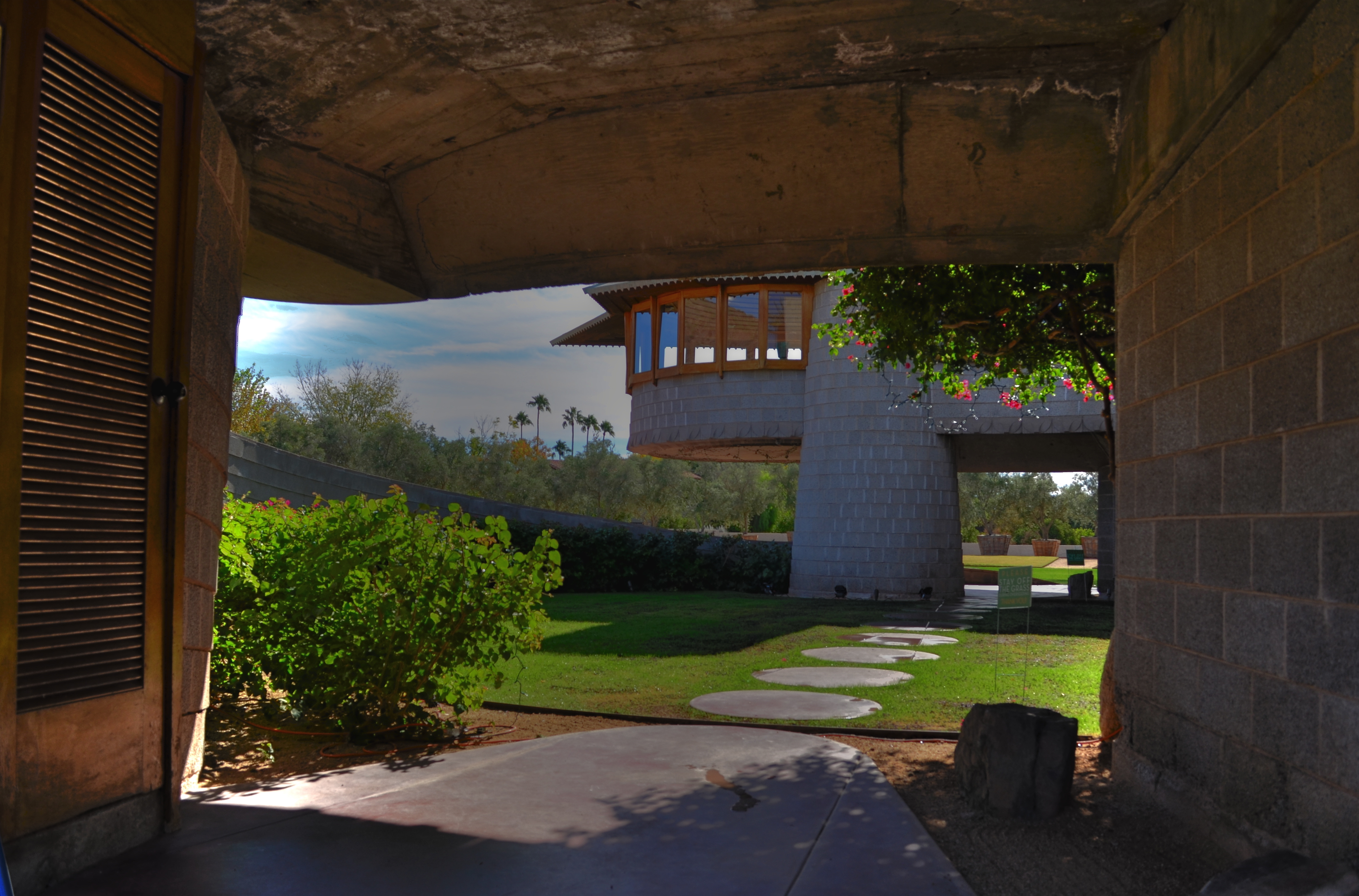
Entering a Frank Lloyd Wright home is like unwrapping a birthday present. The concrete walk ends in a circular ramp that rises to the left and around the David Wright house to create this wonderful open space.
By MICHAEL PERKINS
IF A HOME CAN BE SAID TO BE AN EVENT, then a door is the engraved invitation that bids you to witness that event. When you think about it, a door is the most crucial part of a house’s design, certainly its most deliberately provocative. It advertises and defines what lies within. It’s a grand tease to a mystery, the last barrier before you invade someone’s most personal space. It’s no wonder that entrances to places are among the most photographed objects on the planet. The subject is as inexhaustibly varied as the people who construct these lovely masks.
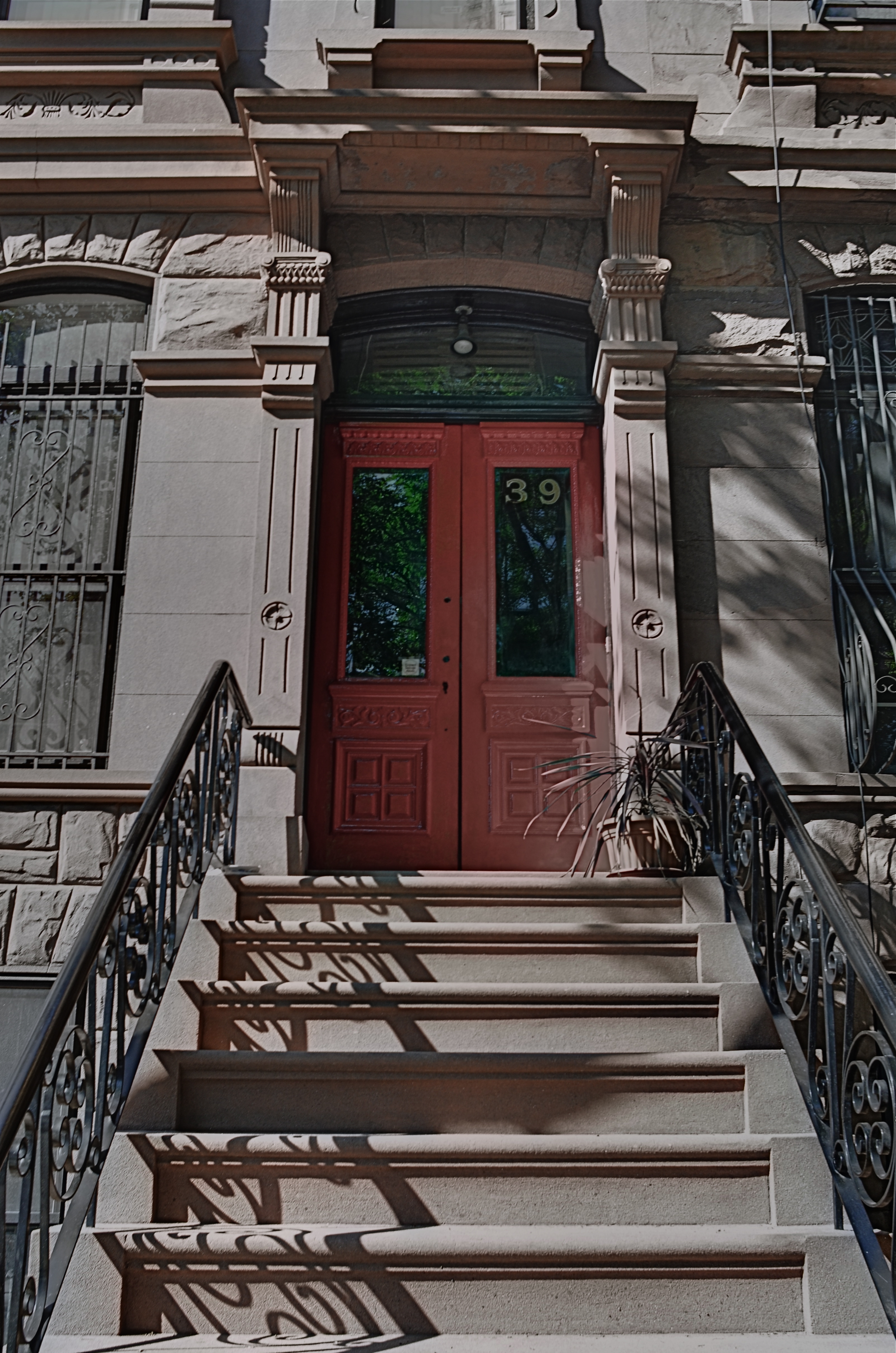
Doors are the first story tellers in a house.
Frank Lloyd Wright did more than create drama as you entered one of his houses; he actually enlisted you in generating your own wonder. Often the great man made you a little squirmy as you prepared to come inside, compressing door heights and widths to slightly uncomfortable dimensions. Pausing for a moment, you could almost feel like Alice after she ate the wrong cake, as if you might never be able to wriggle through the door frame.
Shortly after this ordeal, however, Wright would let the full dimensions of the inner house open suddenly and dramatically, as he does in the image above, taken at the home that he designed for his son David in Phoenix, Arizona. After ducking your head, you step into a court that has…no ceiling…since it ends in a ramp that both climbs around and supports a house that encircles you, creating an intimate courtyard that is both confined and limitless.
Doors make statements, almost boasts, about the wonder that lies just inches beyond them, and, like all generators of mystery, they are often most interesting when the question is never answered. Doors we never see beyond are often the most intriguing, like a woman behind a veil. When I invade a new neighborhood, my camera’s eye goes to doors before anything else. Sometimes the spaces they conceal don’t live up to the hype, but doors, these stage productions at the front of grand and humble abodes alike, offer something tantalizing to the eye.
EYE ON THE BALL
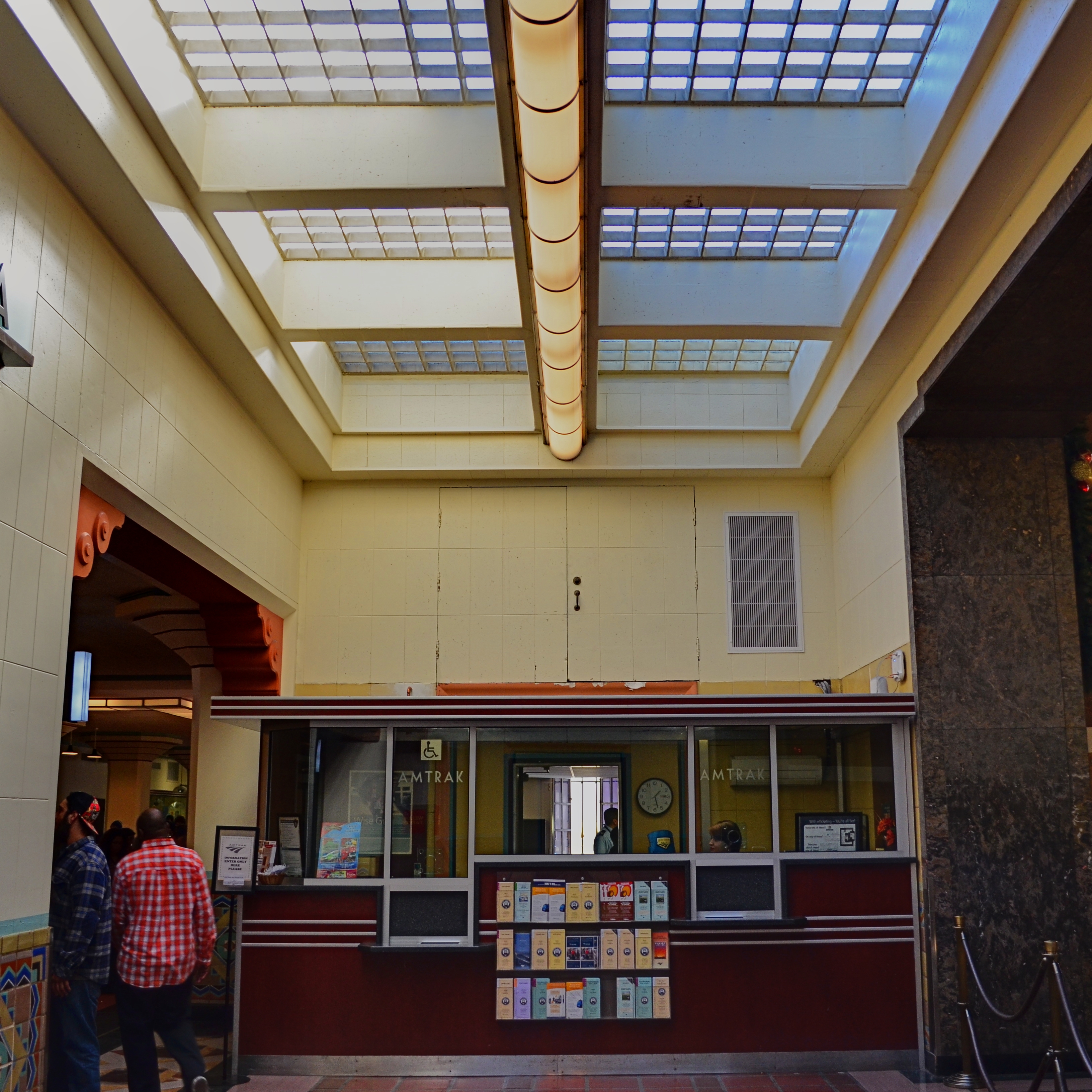
The two passersby mar what might have been an ideal composition. If I’d just reshot without them…
By MICHAEL PERKINS
I CAN STILL HEAR MY LITTLE LEAGUE COACH’S VOICE, cured into a coarse hum by too many years of Lucky Strikes, hitting me in the back of my skull as I stood shakily in the batter’s box. If he had told me once, he had told me a thousand times: don’t try to hit every ball that comes across the plate. You swing like a rusty gate, he would tease me, or don’t eat their garbage. The main message, and one that I only intermittently received: wait for your pitch.
On those rare occasions when I didn’t fish wildly in the air for every single thing that sailed in from the mound, I took great encouragement from his voice saying, good eye. Strangely, I had earned praise for essentially doing nothing, but, hey, I’d take it.
Coach sometimes comes to mind when I view the results of some of my hastier photographic decisions.
There is, for photogs, a very real translation of “wait for your pitch”, and it’s more important in the digital era because it’s such an easy rule to adhere to. Simply, you must keep shooting long enough to get the frame you saw in your mind. There can be no, “I’ve already taken a lot of frames”, or “they’re waiting for me to finish up” or “maybe today’s not my day for this shot.” First of all, it’s your picture. If you want it, take it. Secondly, there is no such thing as “a lot of frames”. There is only enough frames. If clicking one more, hell, ten more, will get you your shot, then do it. There is no phantom film counter warning you that you only have four more Kodachrome exposures left.
I am preaching this particular commandment all too loudly today because I am kicking myself for not living up to it recently. In the top frame, I got every element of a quaint old Amtrak ticket window that appealed to me, including the patterned skylight, the bored agent, the square arrangement of the Deco-ish counter space, and the left and right details of an old archway and a marble wall. Everything except the intrusive passersby on the left. They are sadly out-of-sync with the time-feel of the rest of the shot, and, had I not felt that I had nailed the general exposure and feel of the image, I might have waited for them to move out of frame, and gotten everything I wanted.
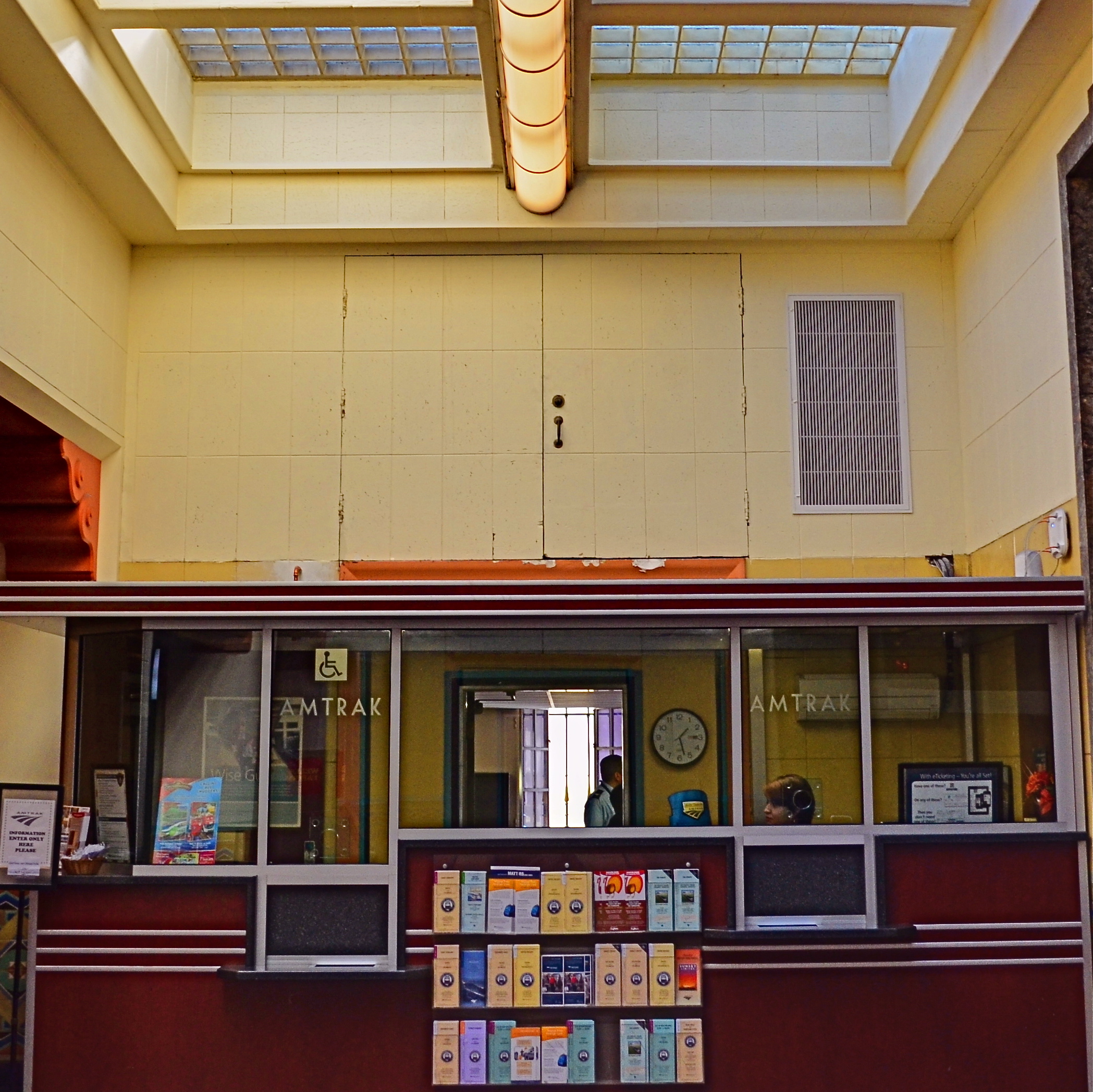
The price of impatience: the “salvaged” version of the above shot.
But I didn’t. I settled for “close enough”, and moved on to the next subject. Later, in post-production, I could certainly crop my squatters out, but at the cost of the overall composition. I now had to make do with what was left. I managed to reframe for another square shot that included nearly all the same elements. But it was “nearly”, not “all”. And “all” is what I could have had if I hadn’t tried to swing at the wrong ball. You can’t make a good shot out of a bad shot, and when an opportunity is gone, there isn’t a piece of software in the world that can make a miracle out of what’s not in your camera.
Wait for your pitch.
A WONDROUS MESS
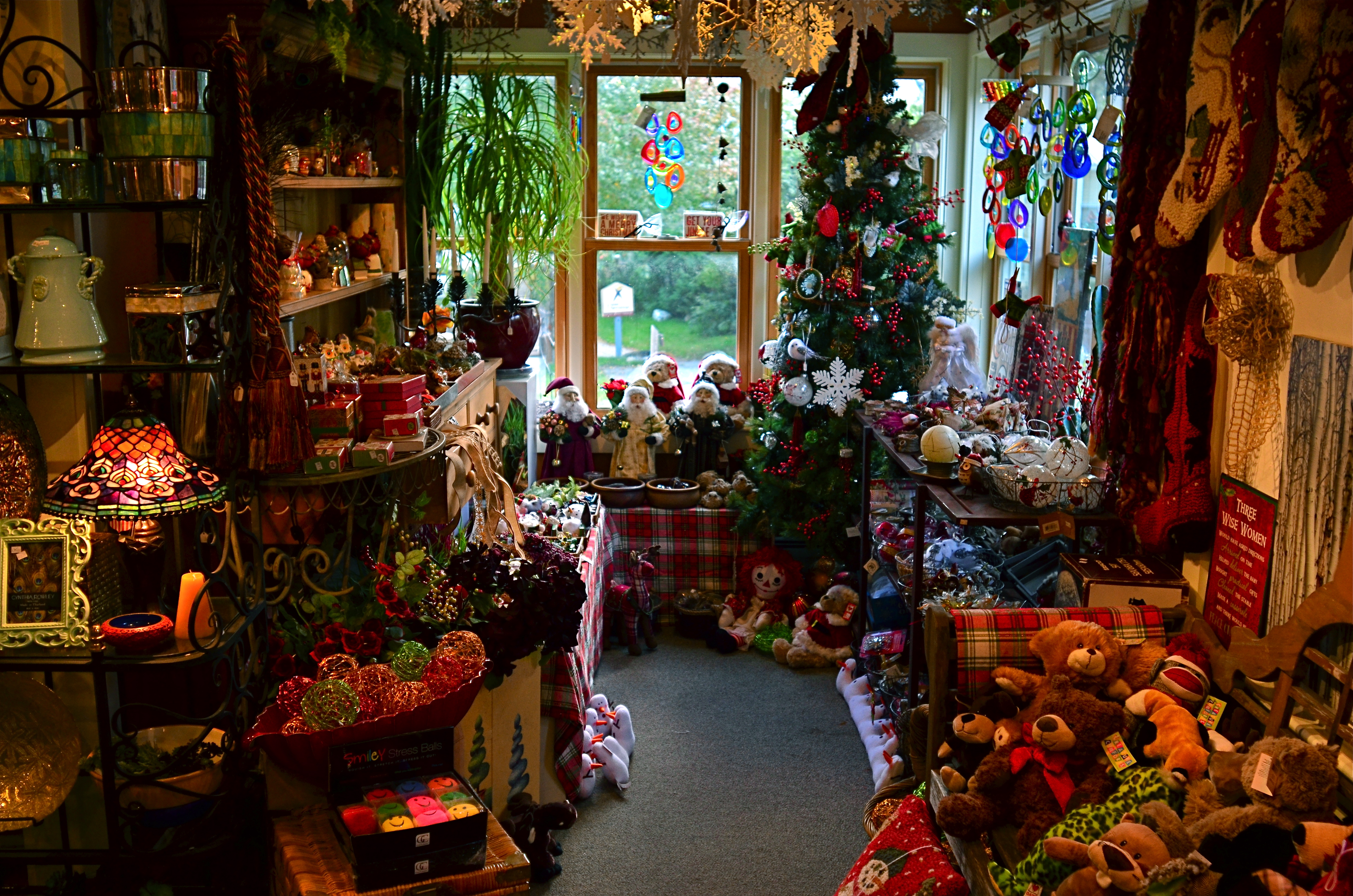
Too busy? Well, when it comes to seasonal shots, it’s a lot harder to say.
By MICHAEL PERKINS
Consulting the rules of composition before taking a photograph is like consulting the laws of gravity before going for a walk.
Edward Weston
PHOTOGRAPHERS LOVE TO COMPILE LISTS OF LAWS that must be obeyed to ensure the capture of great images. Bookshelves are jammed to fracturing with the collected works of wizards large and small who contend that all of this art stuff is really about craft, or adherence to techniques that are the equivalent of Einstein’s law. And, of course, with every fresh generation, a new slew of shooters come sneering along to deride this starched and stuffy discipline. All that matters, these young turks snigger, is my grand vision.
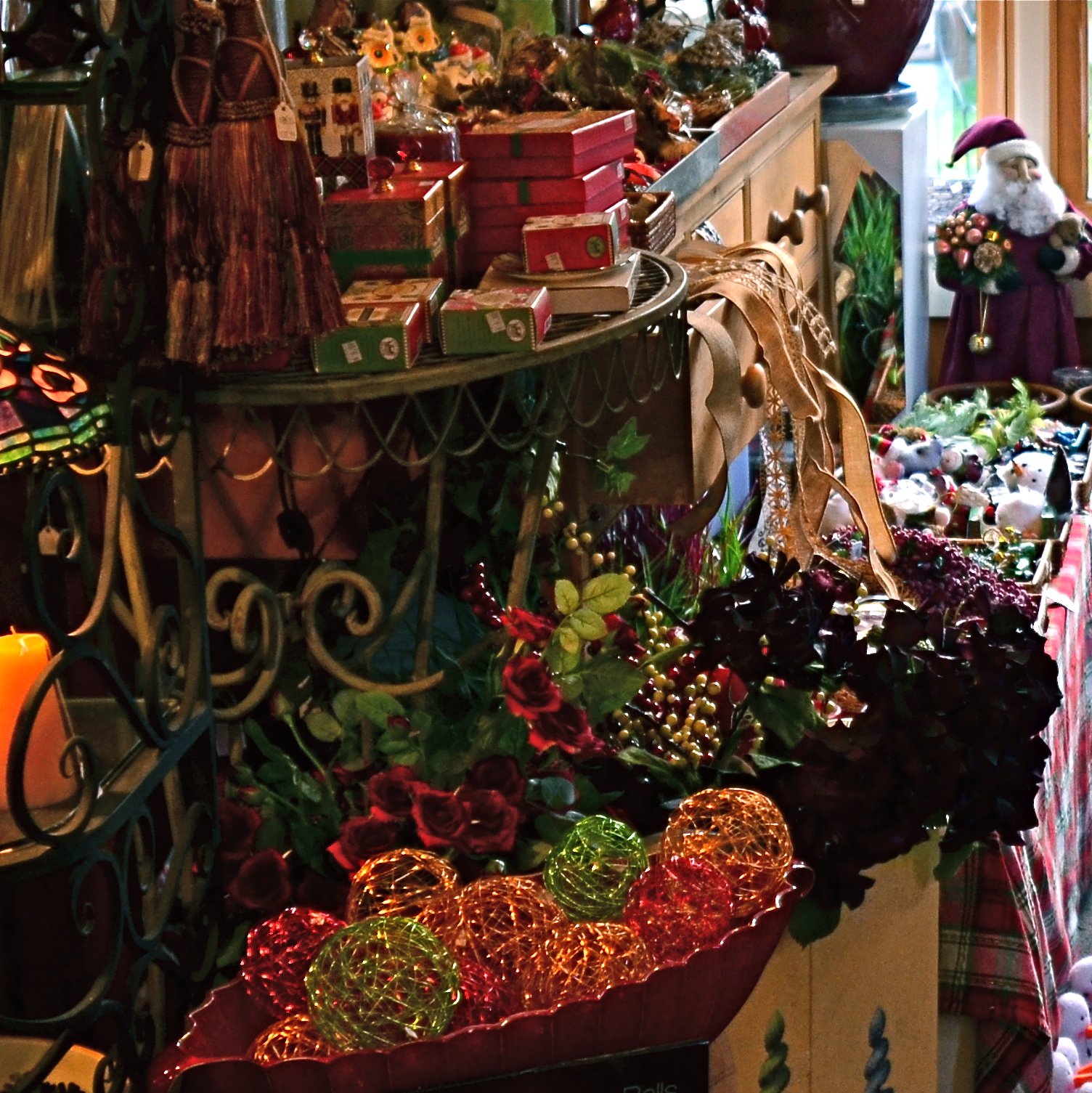
Worlds within worlds: many vast holiday scenes can be “subdivided with cropping.
Let me again re-state the obvious, which is that both viewpoints are correct and/or totally wrong. And since Mr. Weston has introduced the subject of composition, let us consider the special task of seasonal photos, specifically, arrangements of yuletide objects. The classic rule on still-life shots is that less is more, that it’s better to perfectly light and expose three pieces of fruit than whole baskets of the stuff. Meanwhile the festive, instinctual artist concedes that many holiday scenes are mad with detail and crammed with more, more, more…..and that’s okay.
The unique thing about Christmas decor is that in many cases, you not creating the compositions, but merely reacting to someone else’s creations…in nativity scenes, churches, and especially in retail environments. Obviously your local department store doesn’t adhere to the admonition “keep it simple”; quite the opposite. Seasonal trim in most stores is served up not by the spoonful but by the truckload. Anything less than overkill seems skimpy to many yuletide decorators, and so, if you favor basic subject matter, you’re either going to have to mount your own arrangements or selectively zoom and crop the more congested scenes. If, however, you already subscribe to the idea that more is better, then life gets easy fast.
Holidays come layered in much that is intensely personal, and that makes clean compositional judgements about “how much” or “how little” tricky at best. Just get the feelings right and let your regular rules relax into guidelines.
A RACE OF INCHES
By MICHAEL PERKINS
YOU CAN VIEW THE MAIN FUNCTION OF PHOTOGRAPHY AS TWOFOLD, with the deliberate creation of a vision as one path, and the arresting of time in its motion as the other. In the first case, we plan, conceive and execute at our leisure until the image that is behind our eye emerges on the page. In the second, we are hastening to capture and cage something that is in the act of disappearing. In one instance we compose. In the other, we preserve.
Sometimes the two purposes come together in one picture, although you seldom know it until after the image is made. Take the example below. In the moment, I was struck by the light patterns that bounced across the empty space of an event room at the visitor center for the Brooklyn Botanical Gardens. I wanted to do everything I could, exposure-wise, to dramatize the play of light in this special space. In addition to trying to create an image, however, I was also scurrying to keep a special number of factors from vanishing. I was both creating and preserving.
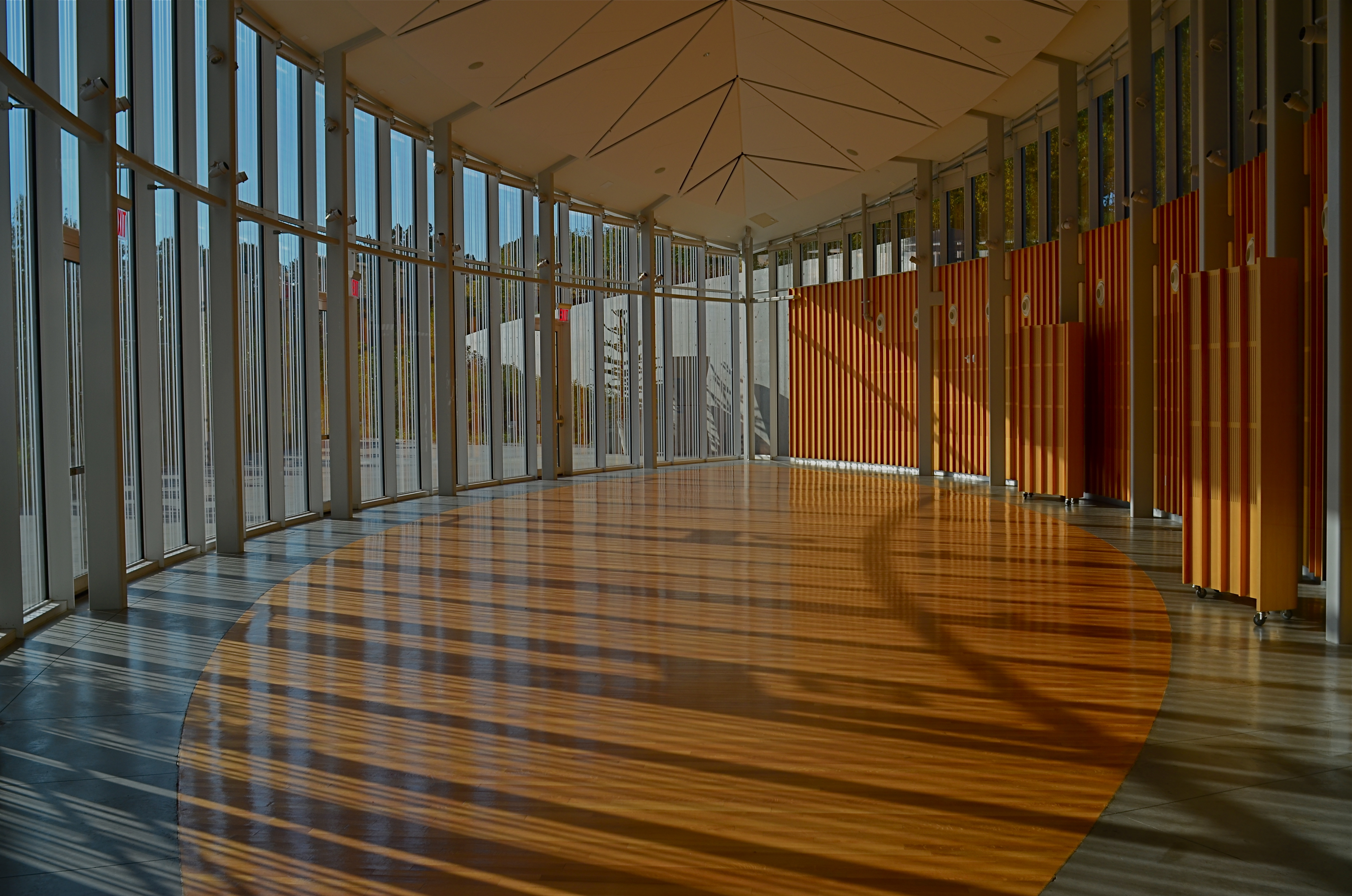
Carpe diem: when the light’s right, be ready to shoot. 1/160 sec., f/5.6, ISO 100, 24mm.
Obviously, the light you see would have had a dramatically different effect had the room been packed with, say, bodies or furniture, so its unobstructed path was one temporary condition. Another fleeting factor was the late afternoon light, which was, in addition to being extremely changeable, also one of the rare moments of pure sun the area had seen during a severely overcast day. It was as if the heavens opened up and angels were singing a song called, “Take The Picture, Already, Dummy”(perhaps you have heard this song yourself). Everything pointed to immediacy.
Full disclosure: getting this shot was not something that stretched me, or demanded exceptional skill. There was not one technically difficult factor in the making of this picture. You yourself have taken pictures like this. They are there and then they’re gone. But, they don’t get collected unless you see how fragile they are, and act in time. It’s not wizardry. It’s just acting on an instinct which, hopefully, gets sharper the longer you are in the game.
I often state one of my only primary commandments for photography as, Always Be Shooting. An important corollary to that rule might be, Always Be Ready To Shoot. Spot the potential in your surroundings quickly. Get used to the fact that many pictures will only dance before you for seconds at a time, flashing like heat lightning, then fading to oblivion. Picture-making is sometimes about casual and careful crafting of an image. And sometimes it’s a race of inches.
And sometimes it’s both.
CASTING
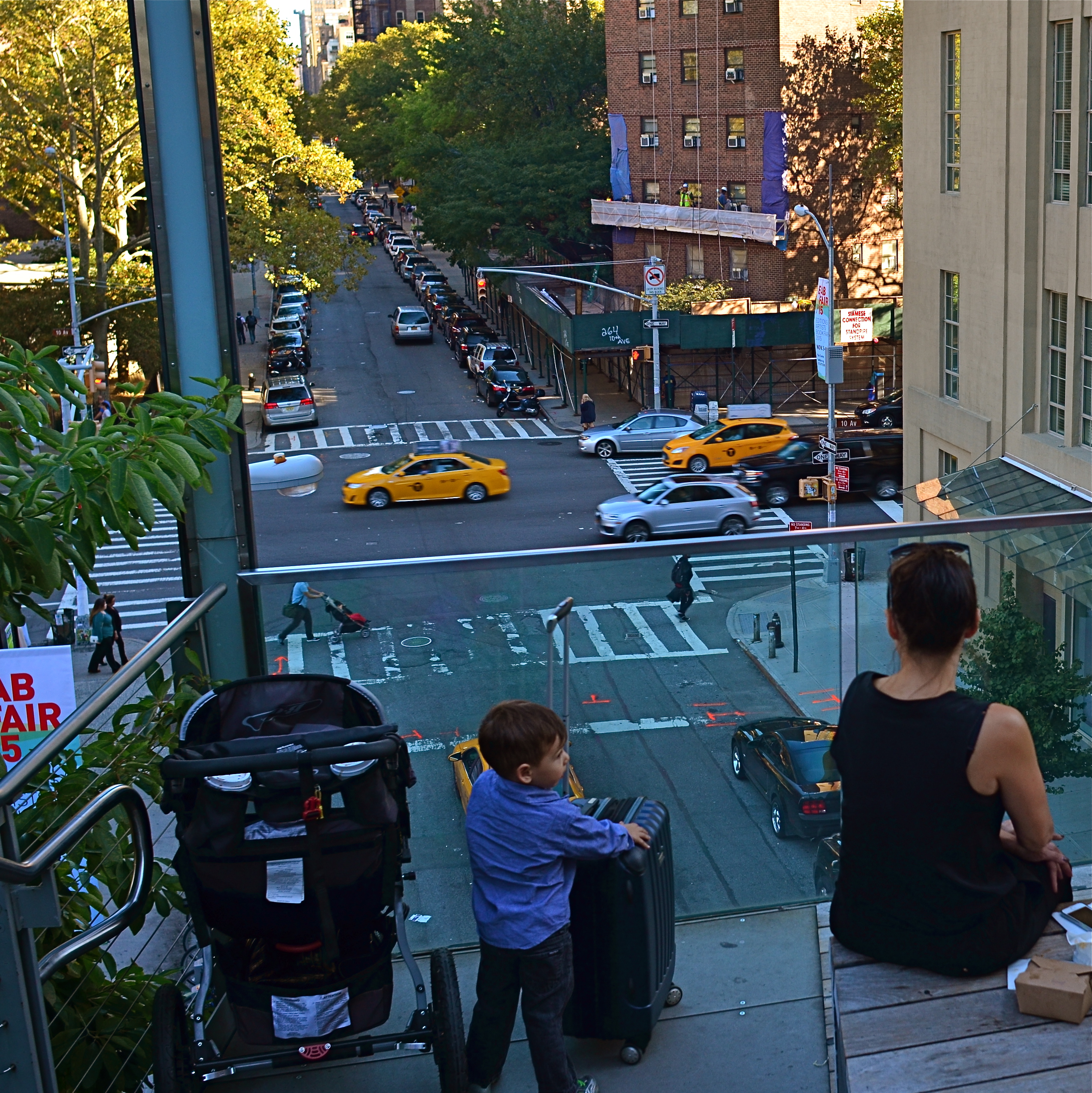
Do the woman and the child constitute a “family” in the narrative of this image?
By MICHAEL PERKINS
MORE COMPOSITIONS IN PHOTOGRAPHY ARE CRAFTED AFTER THE SNAP than naturally spring forward, fully formed, out of the camera. Frame as carefully as you may, you often find that something needs to change to help your image’s story fully emerge. This usually means taking something away, cleaning things up…and that means cropping. I think it’s fair to say that, more often than not, we start with pictures that contain too much and carve out the core picture that deserves to survive, to be pushed to the front.
Sometimes a proportionate tightening is all that a picture needs, so that a large, busy rectangle becomes a streamlined, smaller rectangle. This can clear away extraneous objects like phone poles, wires, extra buildings, any distracting junk that pulls the eye away from the important stuff. But it isn’t always things: it can also be people, surplus bodies which, like extraneous elements of any kind, change the narrative, or keep it from connecting. Think of the picture as a theatrical production and yourself as the casting director. Anyone on the set who doesn’t move the story forward is not playing a part that we need. See the girl at the office for your check, so long.
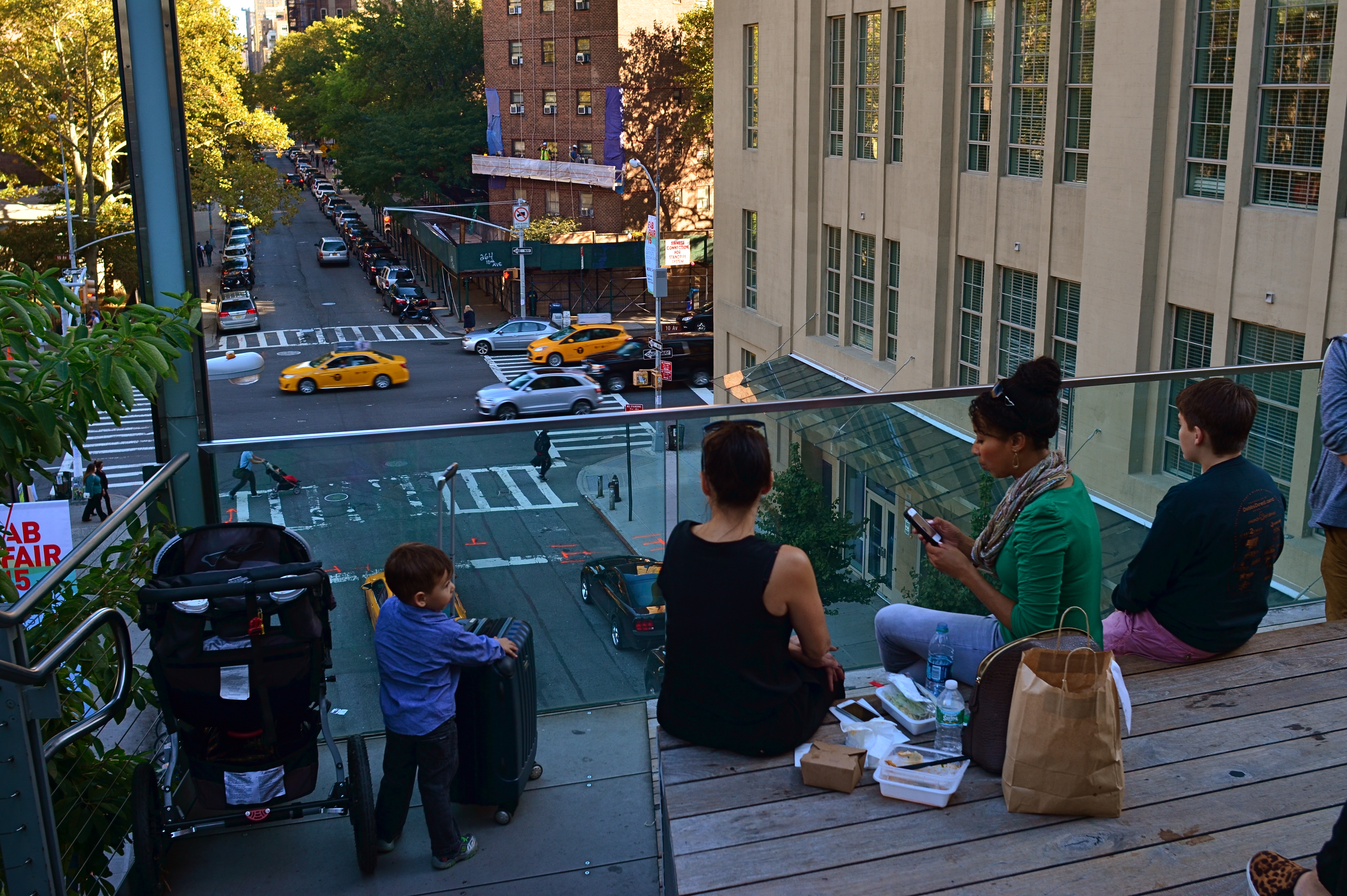
Does the removal of the extra people compromise or complete the photo’s story?
In the picture above, the cropping seems to create the story of a mother and her children taking in the view from New York’s Highline Park onto a city street below. In the original shot, seen at left, she seems less like a mother and more like just another bystander. The crop has suggested a relationship or a role for her. The woman to her right (in the original), unlike the “mother” figure, is not acting as our surrogate, seemingly looking with us at the scene. She is on her cel phone, and therefore registers as more detached than her neighbor, whose face, since it’s invisible to us, could contain anything we want it to. To the right of the cel user, we see additional people who don’t subtract from the picture, but also don’t add anything. They are extras that we, the director, have decided we don’t need to cast.
Also, structurally speaking, the “mother” is arranged so that the diagonal line from the foreground building to her right seems to proceed into the picture from around the area of her right shoulder, so that she sort of anchors the leading line and sends your eye along it to the street below. None of this, mind you, was obvious in the shooting of the original shot, which is not terrible as a composition, only compromised by the inclusion of information that simply doesn’t advance the logic of the picture. I only use it as an example of how I was able to question the “casting” of the original frame and make a conscious decision to cut away things that slowed everything down.
If you can tell a story with two people better than you can with four or five, ask yourself if you really need them. Cropping isn’t an admission that you made a bad photograph. It’s confirmation that your first draft is worth taking to a second one.
IMPRECISE BUT TRUE
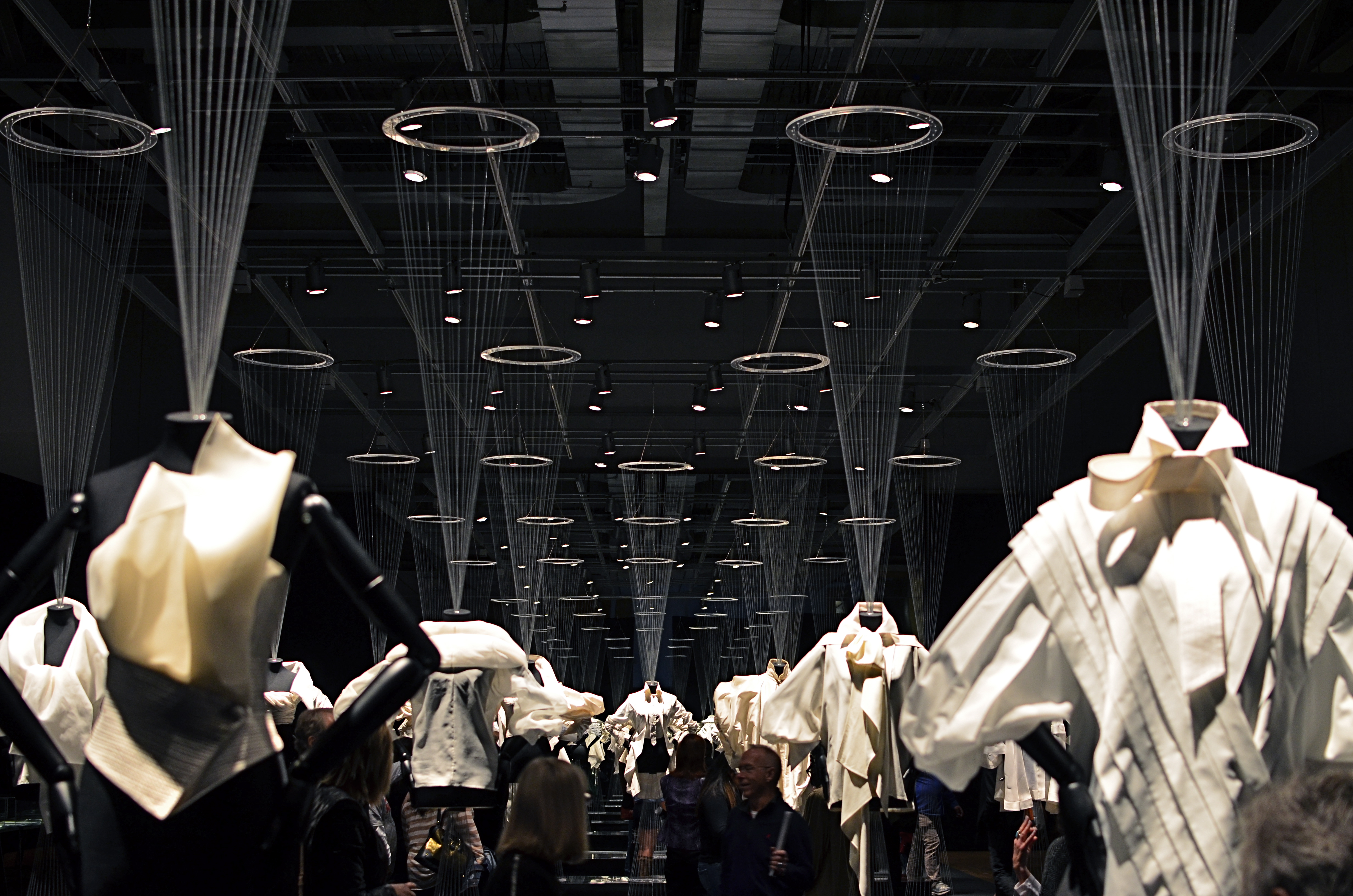
What makes an image work for you? Could it be explained in words? Or isn’t that what the image is for? 1/60 sec., f/4, ISO 400, 35mm.
By MICHAEL PERKINS
AN ELOQUENTLY DETAILED ANALYSIS OF A POWERFUL PHOTOGRAPH, which I read in a recent edition of the New York Times, convinced me anew that, apart from a few compositional basics, no one really knows what makes an image “work”. Beginners love to sing the praises of the Rule Of Thirds as a guideline for composition, and, likewise, critics rhapsodize about Golden Ratios as a way to dissect how powerful elements occupy space in great photos. But the dirty little secret about composition is that there is no dirty little secret, no Laws of Gravity or Relativity that, if consistently obeyed, will yield consistent excellence.
This doesn’t mean that we can’t emotionally identify which pictures have power, as well as those that merely lie there. It merely means that there may never be adequate verbal artillery to reduce those feelings to a law, a handbook, or a credo. We arrive with our cameras at places where there may, or may not be, a picture. Our eye tells us that something important can be extracted, isolated, amplified, re-contextualized. Beyond that, it’s a matter of fate and luck.
Of course, the more we experience what works, the better we are at seeing it in the raw and extracting better and better examples of it. However, every ride of the bucking bronco is distinctly different from all the others. Photography has certain mechanical techniques that can be mastered, certainly, but we can’t learn emotional impact in a class. We can only pour something out into the camera from what is already inside us.
Try to imagine walking up to a chalkboard and reducing your favorite photograph to a series of shorthand symbols reminiscent of a mathematician’s equation. Could anything be more bloodless, more clinical? Critics and analysts sometimes come from the ranks of doers, but many of the very best doers resist the temptation to dissect their art as if it were a lab frog. Henri Cartier-Bresson, the acknowledged Moses of street photography, once recalled that it was seeing another shooter’s best work that made him say, “Damn It!”, grab his camera, and head outside, obsessed with making something of his own that could incite such a reaction.
Photographers seize instinct and emotion in the raw and forge them into a kind of sense-fired steel. Frame a picture with that steel and it will speak a thousand times louder than any mere dissertation.
ON THE LEVEL
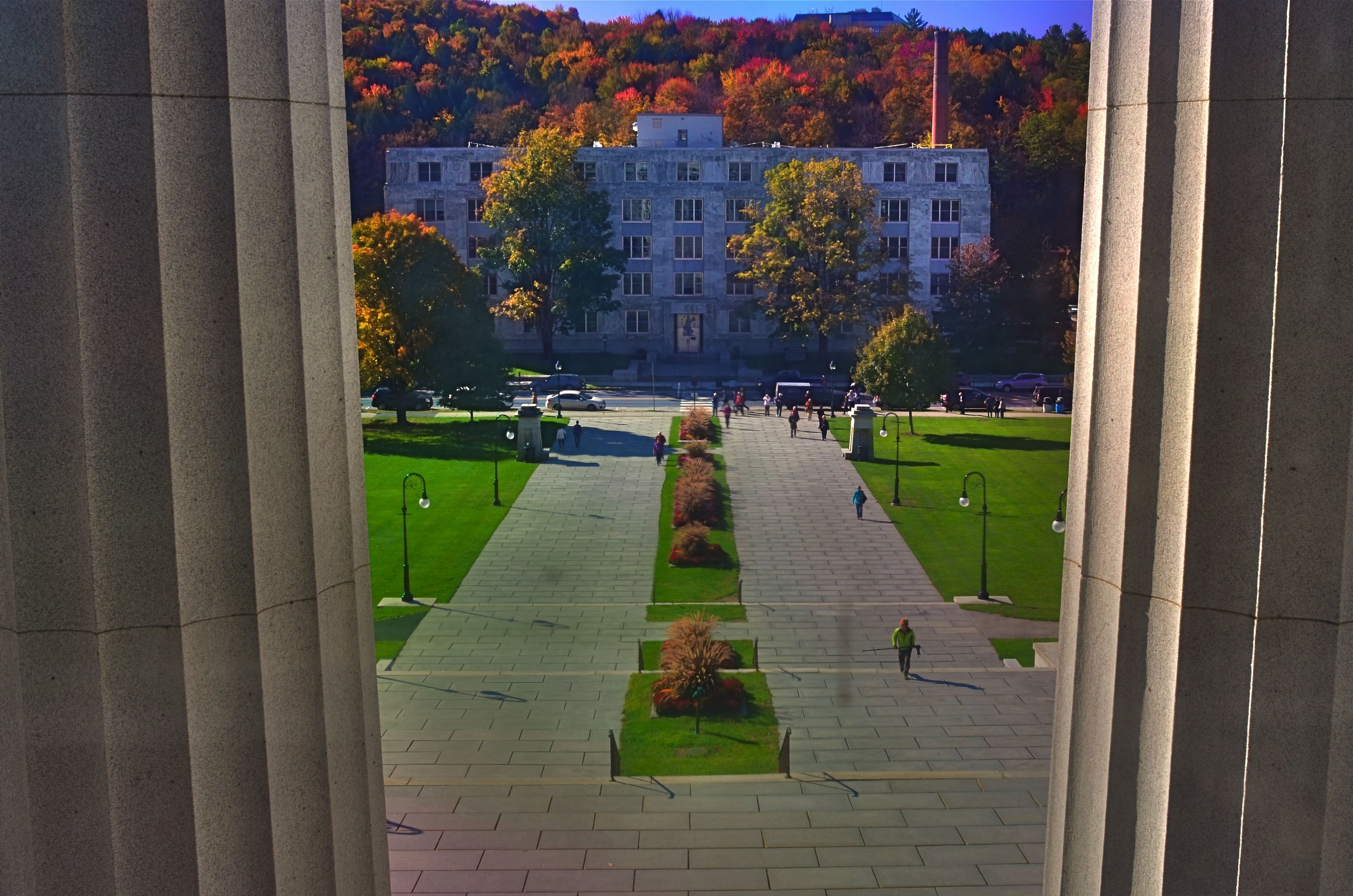
With the amount of repair time it took to straighten and resharpen this shot, I could have made ten pictures that were done correctly in-camera.
By MICHAEL PERKINS
IT’S NOW QUITE EASY TO HAVE YOUR CAMERA OR EDITING SOFTWARE correct for things you should have done before the image was made. Most of the times, these fixes cure more than curse, some of them genuinely helping a shooter extend his skills or fine-tune his control. However, in the case of one of the most common post-pic fixes, the “straighten” slider, you’re potentially messing with picture quality, to fix a problem that, quite honestly, shouldn’t have existed in the first place.
Consult every, and I mean every basic camera tutorial going back a hundred years or more. Many timely tips in such books have vanished or evolved over time, but the simple admonition to keep your shot level has remained unchanged since the dawn of photo time. So why do cameras and software even offer straightening as an option?
If you take the cynical view, the existence of this fix suggests that camera manufacturers assume that enough people will routinely take crooked pictures that, of course, they need something to tilt their images back to normal. Because, if that’s not true, then why does the fix even exist?
Here’s the critical point about straightening: it does not maintain sharpness like simply cropping a photo to a smaller size does. To restore your image to a rectangular shape after you’ve rotated it left or right to level it, your camera (or software; both do it the same way) must trim part of the picture and resize it, producing a lower total number of pixels in the “corrected” photo but within the same space as the original one. And there’s just no way to do that without degrading the sharpness.
Some straightenings, if conservative, may not fuzz up your photo as much as some more extreme adjustments. The above image was shot literally on the run during a tour, but it needed just slight adjustment, and so retained most of its sharpness after I ran it though a second editing program. However, you really have to love a shot to go to those extremes to save it.
Thing is, you can bypass this entire problem simply by shooting a level picture. Now, I won’t bore you with a list of just how many really easy ways there are to ensure this. But since sharpness makes at least the top five list of things that most people want from a picture, why not take a pass on all the post-mortem fixes by doing one of the simplest possible things in photography more often?
WAIT FOR IT….

A decent start..and yet..
By MICHAEL PERKINS
ONE OF THE GREATEST PERKS IN DIGITAL PHOTOGRAPHY is making it easy and affordable to squeeze off as many shots on a given occasion as was only possible, in films days, for well-financed pros. The history of photojournalism is rife with stories of shooters who shot four, five, even six rolls of film to produce four magazine illustrations….a yield ratio that made put those same shots insanely beyond the budget of John Q. Viewfinder. Simply put, many of us just could not afford to shoot enough bad frames to get to the good ones.
That’s all in the past now. if we update our thinking.
We still have a tendency, when shooting a subject, to stop too soon, that is, as soon as an acceptable image emerges. Give many of us 60% of what we were going for, and we tend to stand down, move on, and live with a result that we may later see as a compromise. That’s old thinking based on our years of “I only have ten shots left”, and the idea of budgeting a finite commodity, like film frames. It’s important now, however, to actually develop the habit of over-shooting, of covering our targets from as many conceptual approaches as possible. Close shot. Medium shot. Reverse angle. Looking down from above. A few tries shooting at the “wrong” shutter speed or aperture. In other words, don’t settle too soon.
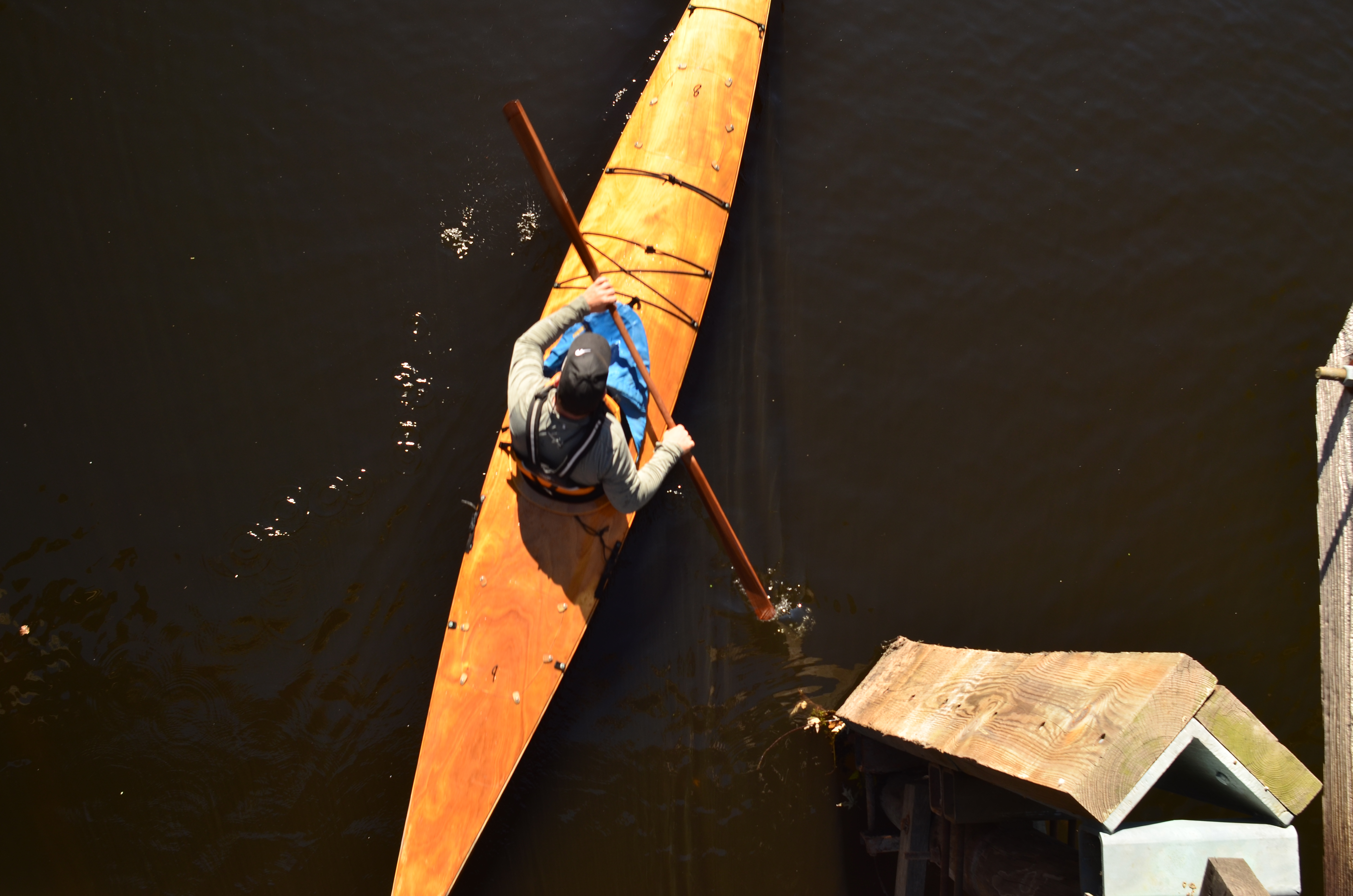
Closer to the mark..and yet..
I had a great subject in a recent walk across a small footbridge as a kayaker began a slow trek that would eventually take him toward me, underneath my stance atop the bridge, and then back into brilliant sunlight. He was taking his time, so that I could take mine, and I began by thinking that the shot I wanted was the easiest one, as he approached me head on. However, something told me that his relationship to the light would change dramatically as he crossed under the bridge, and it did.
As he emerged from beneath the span, I shot him in a straight overhead, and then came the money shot, as the kayak seemed to divide the water into rich, detailed ripples on the right side of the boat, and shining sparkles on the other side. Hardly a world-beating shot, but far more dramatic than the one I originally thought I wanted. Had I decided to accept the first frame, the third one would never have been captured. It certainly was no great technical struggle to take the final picture, nor were the extra few seconds a major strain. Simply, the deciding factor was to want the picture, and to wait long enough for it to come to me. It was worth it:
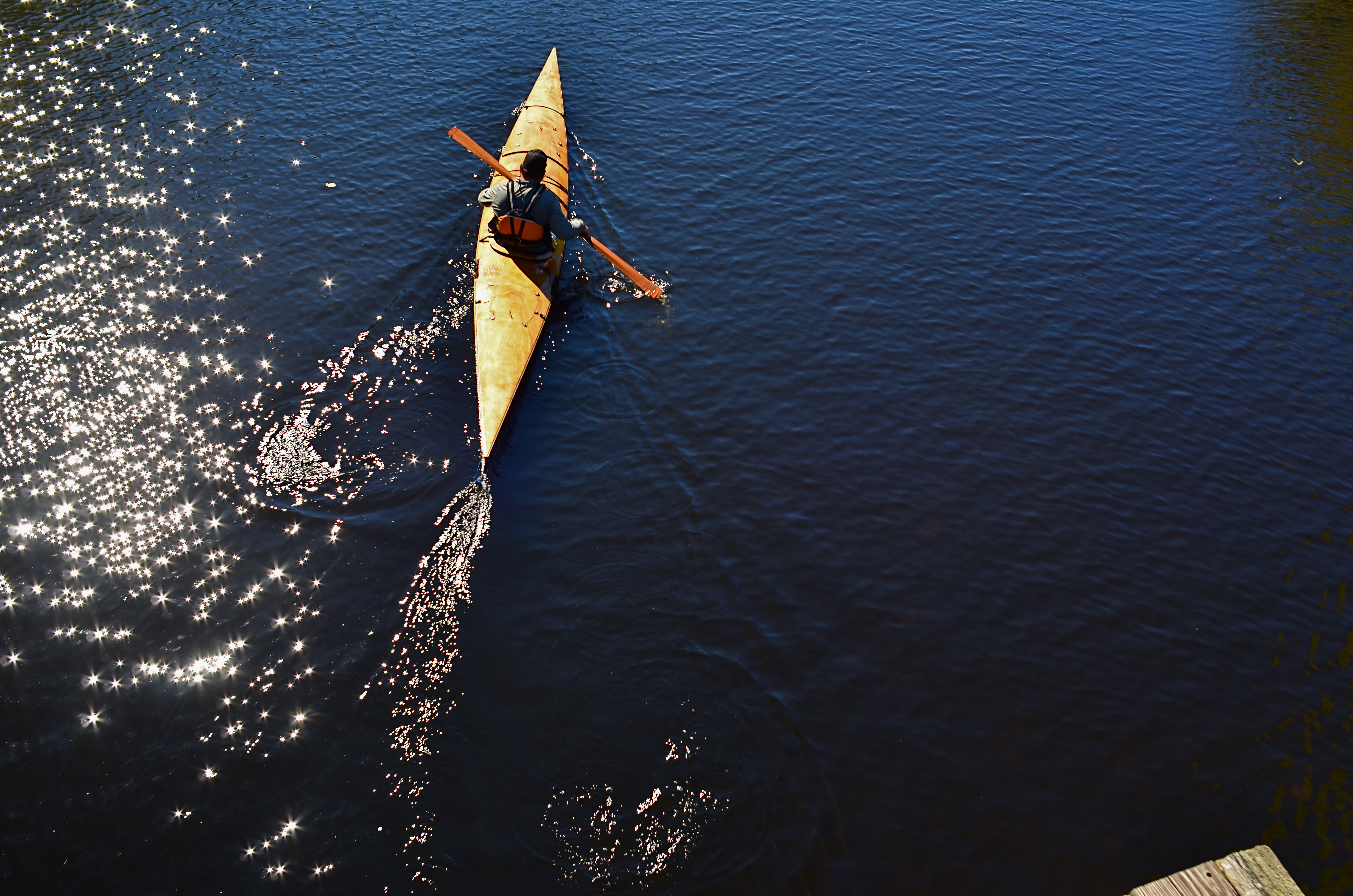
The keeper.
If you must err, err on the side of taking too many shots of something. It’s a lot easier to trim away the excess than to mourn over the miracles that never got born.
SEE DICK THINK.
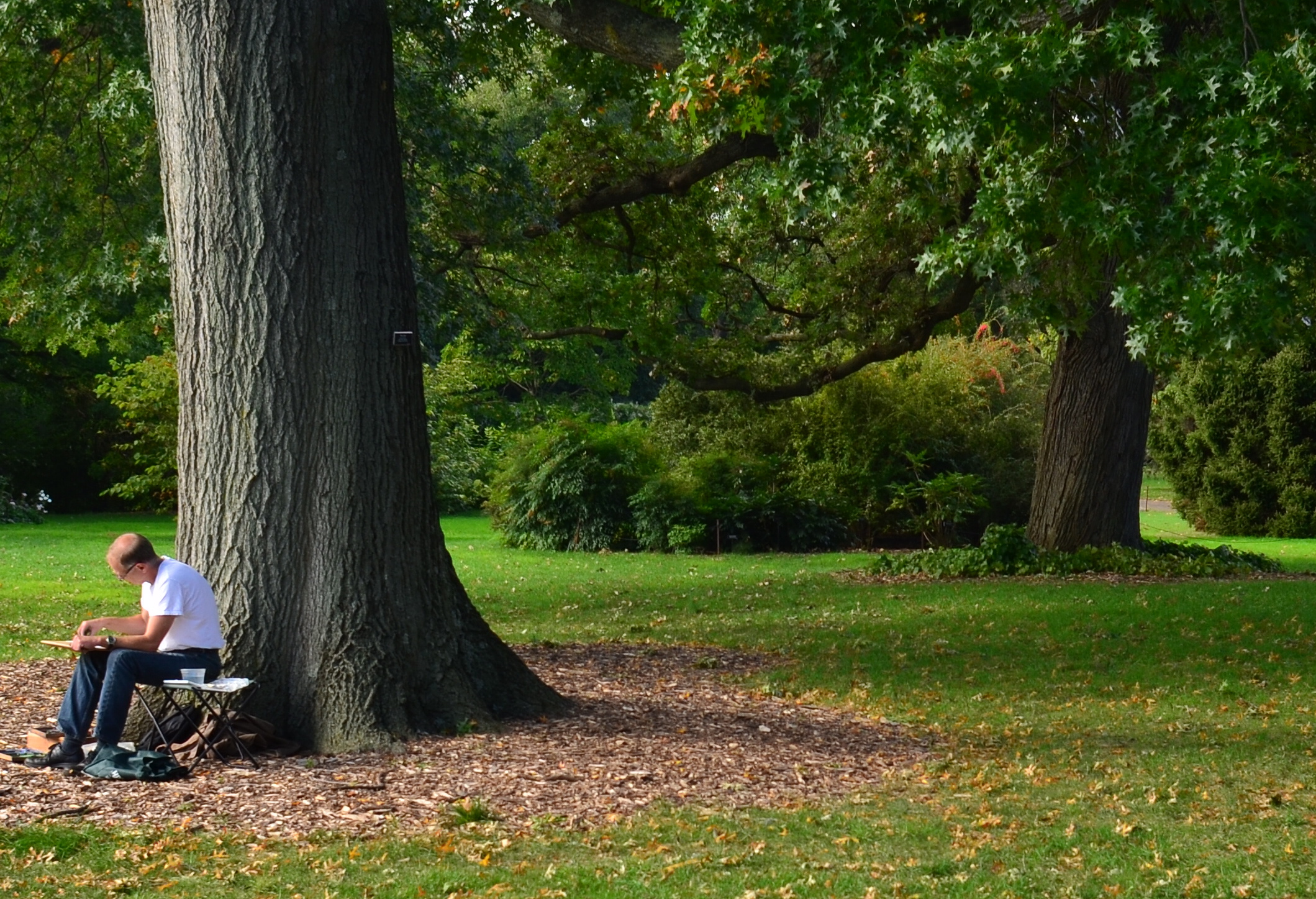
Slow yourself down by shooting someone who is slowing himself down.
By MICHAEL PERKINS
FORGET BLOWN EXPOSURES, SHAKY SNAPSHOTS, AND FLASH-SATURATED BLIZZARDS. The hardest thing to avoid in the taking of a picture is winding up with a picture full of other people taking a picture. Hey, democracy in art, power to the people, give every man a voice, yada yada. But how has it become so nearly impossible to keep other photographers from leaning in, crossing through, camping out or just plain clogging up every composition you attempt?
And is this really what I’m irritated about?
Maybe it’s that we can all take so many pictures without hesitation, or, in many cases, without forethought or planning, that the exercise seems to have lost some of its allure as a deliberate act of feeling/thinking/conceiving. Or as T.S. Elliot said, it’s not sad that we die, but that we die so dreamlessly. It’s enough to make you seek out things that, as a photographer, will actually force you to slow down, consider, contemplate.
And one solution may lie in the depiction of other people who are, in fact, taking their time, creating slowly, measuring out their enjoyment in spoonfuls rather than buckets. I was recently struck by this in a visit to the beautiful Brooklyn Botanical Gardens on a slow weekday muted by overcast. There were only a few dozen people in the entire place, but a significant number of those on hand were painters and sketch artists. Suddenly I had before me wonderful examples of a process which demanded that things go slowly, that required the gradual evolution of an idea. An anti-snapshot, if you will. And that in turn slowed me down, and helped me again make that transition from taking pictures to making them.
Picturing the act of thought, the deep, layered adding and subtracting of conceptual consequence, is one of the most rewarding things in street photography. Seeing someone hatch an idea, rather than smash it open like a monkey with a cocoanut does more than lower the blood pressure. It is a refresher course in how to restore your own gradual creativity.
STAKES IN THE GROUND
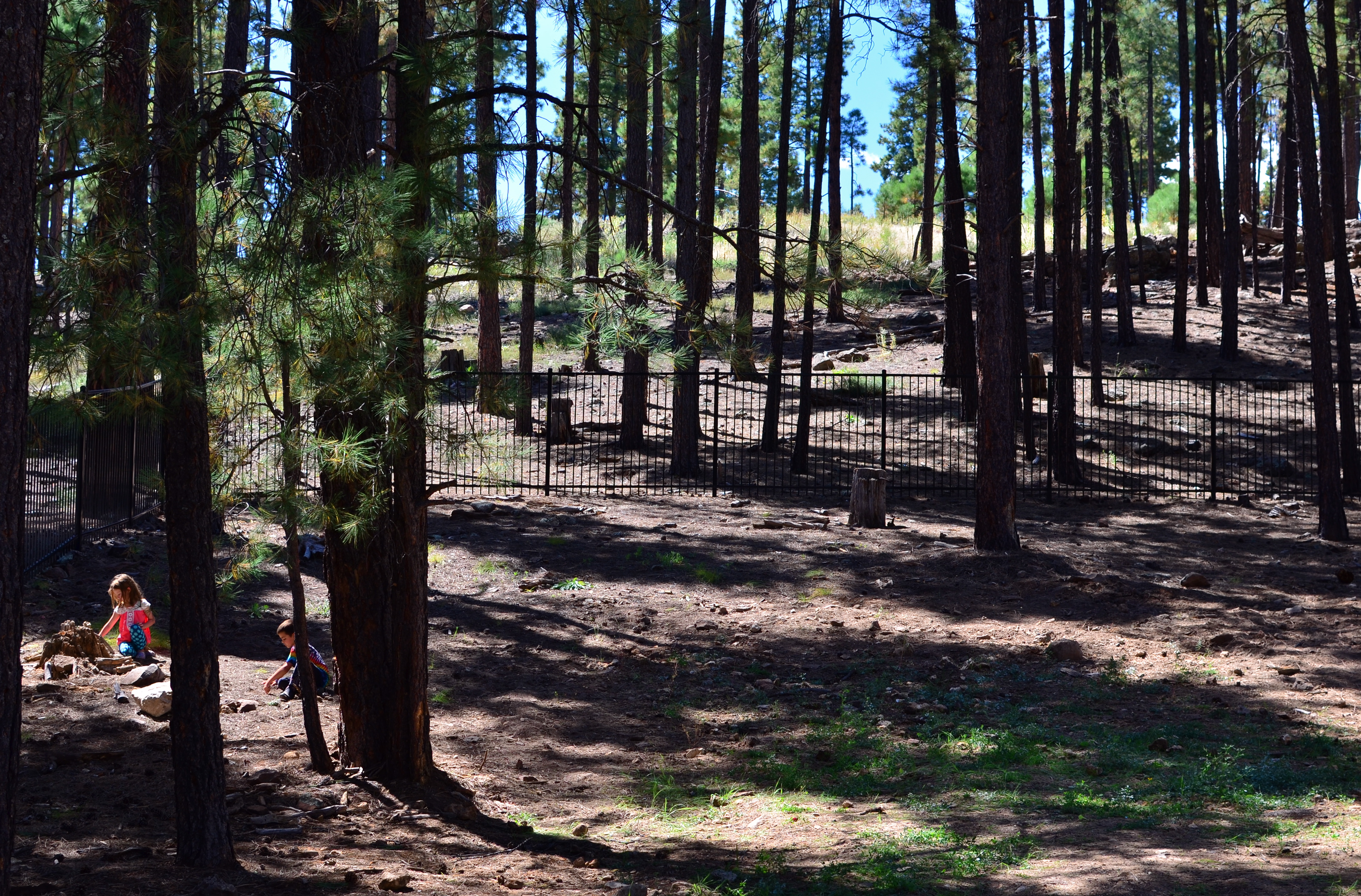
We Seemed To Be The Entire World, 2015. 1/60 sec., f/5.6, ISO 100, 35mm.
By MICHAEL PERKINS
NO DOUBT YOU KNOW WHAT IT FEELS LIKE TO SEE A PICTURE IN YOUR MIND that, for some reason, doesn’t make it into the camera.
It’s maddening. That fumbling few inches between success and failure that cannot always even be sensed during the taking of an image, but which, somehow, is as wide as a river gorge once the picture comes out. Dammit, you saw it. More importantly, you felt it. But something in perhaps a technically perfect photograph fails to engage, and the thing just can’t close the sale.
Going further with the metaphor of salesmanship for a moment, there are pictures which, in a manner of speaking, don’t “ask for the order”. They don’t effectively say, here is the main point of interest. Look here, then there. The best photos are triptychs in that they have a sense of inevitable direction. Your eye senses where to travel with the frame.
In the above forest scene, I nearly failed to provide that impetus because, in my first few shots, I was overly centered on getting the contrasty elements of the picture from fighting each other. Some trees came out like silhouettes. Some parts of the forest floor were way too bright. Somewhere along the line, I had decided that the picture was about solving those purely technical problems. Check those items off, I thought, and you’d have a real nice nature scene, or so it seemed at the time. Only one lucky thing intervened to change my mind and save the picture.
This comes under my general belief that most of the things you need to fix a composition are mere inches away from where you’re already standing. In this case, I moved a bit to the left of several trees and two small children swung into view, both of them representing a dynamic dollop of color in an overly bland palette of shades. Suddenly the picture was about these kids stealing away, inhabiting a quiet, separate world, their size dwarfed by the pines while giving measurable scale to the entire woods. They had found a complete reality away from everyone, and it would be easy to show that. Cropping to have them enter the frame at the bottom left corner helped direct the eye where I needed it to go first. Start here, and then look beyond.
It’s helpful to regularly dissect the pictures that almost had enough story to sell themselves. What stakes could I have pounded into the ground to mark the outline of the idea? Where did I fail to lay out the territory of the story?
It’s all about getting that image from your mind into the camera. That’s everything. That is, ever and always, the problem to be solved.
THE PLACES THEY LIVED
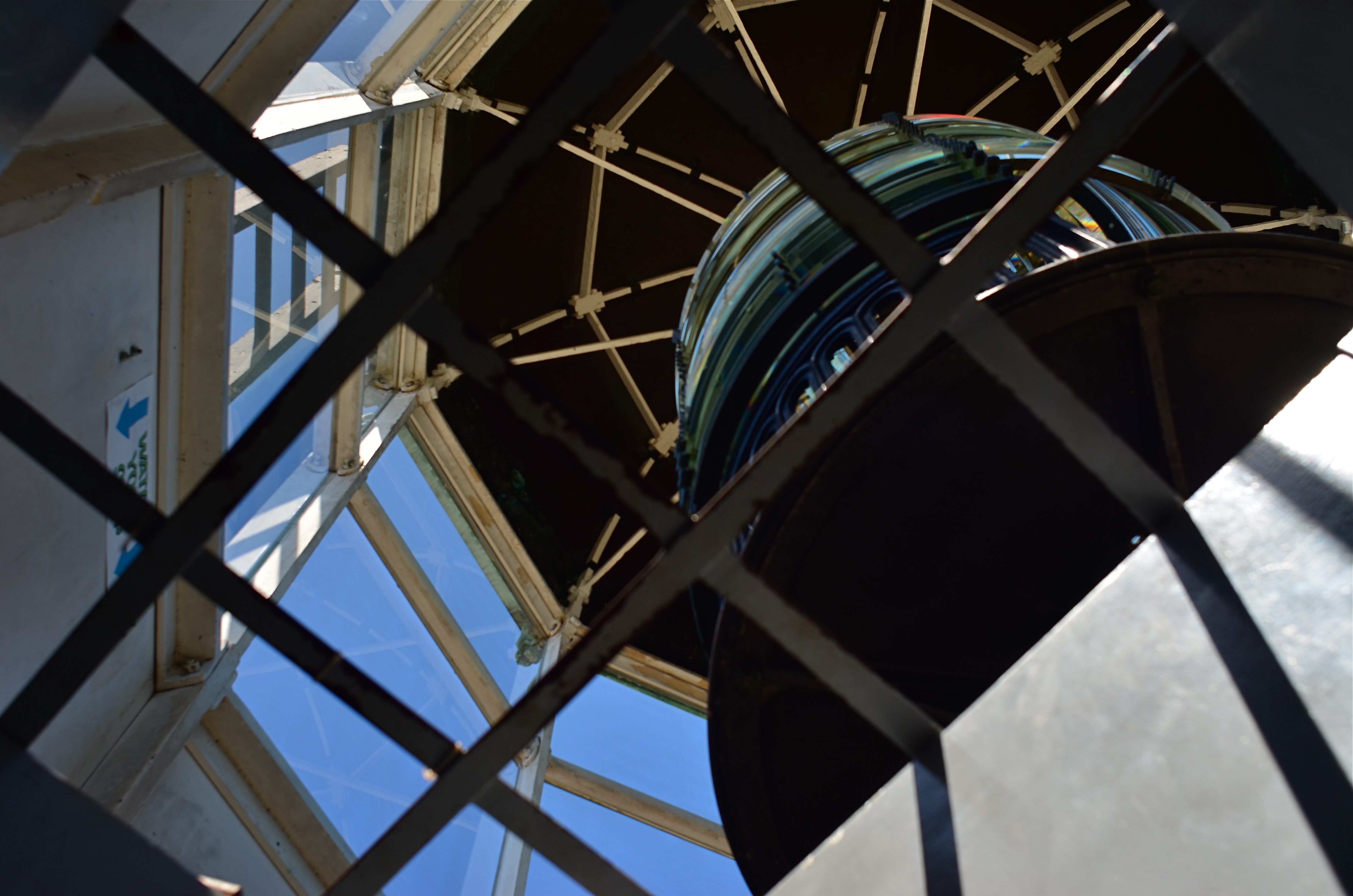
“I want to marry a lighthouse keeper…” 1/125 sec., f/3.5, ISO 100, 24mm.
By MICHAEL PERKINS
PHOTOGRAPHERS INSTINCTIVELY SEEK OUT VARIATION. We spend so much time looking at so much of the world that a lot of it starts to sort itself into file folders of things, patterns, or places, pre-sorting our pictures into this or that category. Sunsets: see Nature. Famous Buildings: a sub-set of Travel. And so on, until we are fairly starved for some visual novelty to shock us out of our slumber and spur us on to new ways of seeing.
One of the things that settles most readily into sameness is the human dwelling. Most of us live in some kind of basic four-walls, bedroom-kitchen-bath sequence, making our living spaces fairly predictable as subject matter. By way of awe and admiration, the real geniuses of, magazine illustration, to me, have always been the “house beautiful” photographers, since they must spend year after year making Mr.& Mrs. J.D. Gotmore’s McMansions seem unique and bold. That said, there is something about nearly everyone’s castle that might be distinctive, even revelatory, about the people who live within. It’s all in your approach.
I love to explore the places where people are forced to improvise living spaces either near or as part of their work, places that usually exist in stark isolation as compared to the crush of crowded urban centers. In the above image, I was allowed to climb to a small viewing angle of the beacon room atop a coastal lighthouse in San Diego, and, perhaps because I was limited to a shooting stance below the surface of the room’s floor, the resulting photo further exaggerated the confined, angular working space, which sits above living areas further down the house’s twisty central staircase.
These areas pose more questions than they answer. What is it like to have this building be your entire world for long stretches of time? What kind of person can do this work? What is the center of this unusual story? The blurring of boundaries between working and living areas is among the most novel material a photographer can tackle, since it contains one of the things he craves most….mystery.
WHERE THE RUBBER MEETS THE ROAD
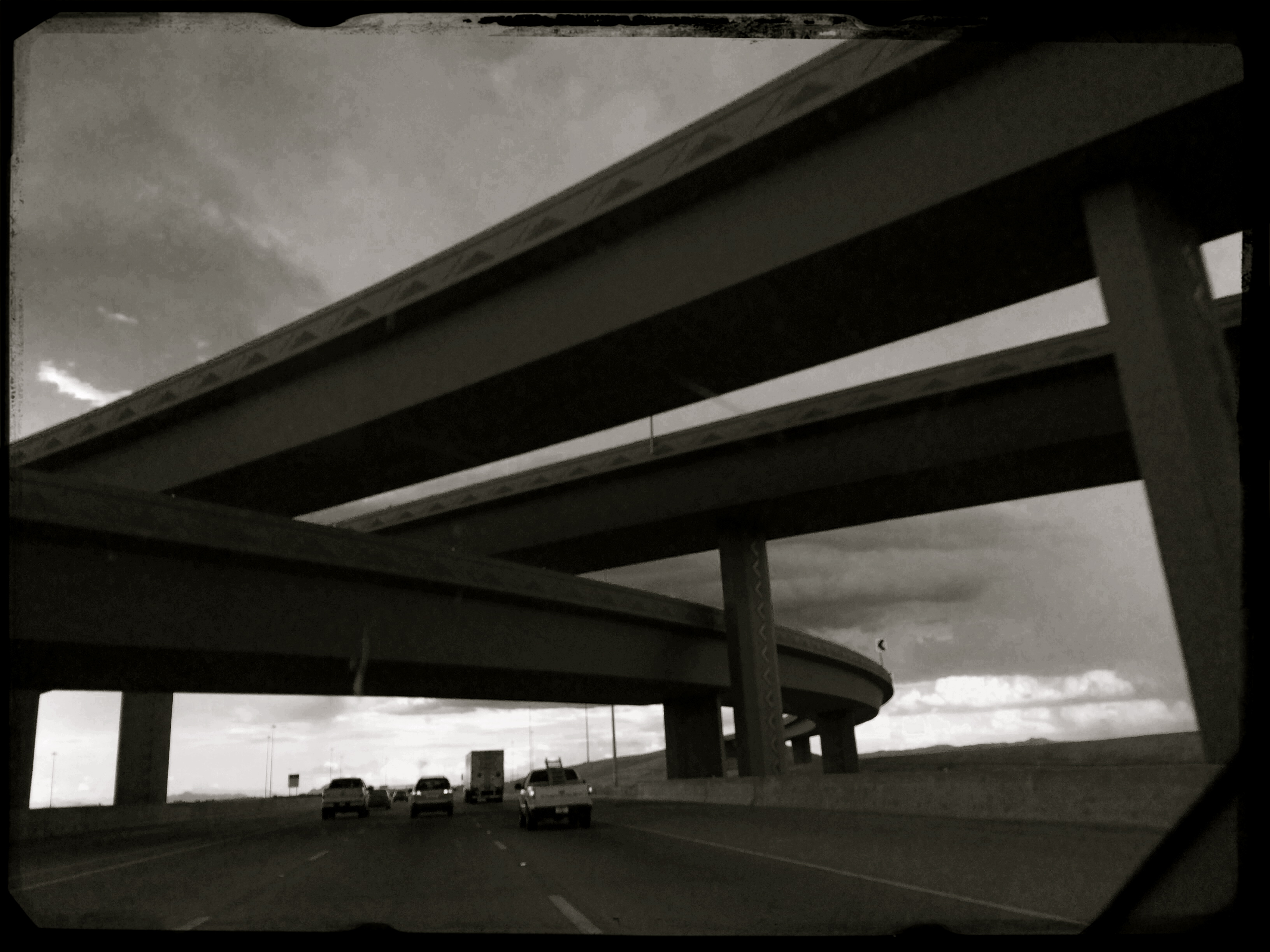
Convergences, 2015. A through-the-window iPhone quickie. Grainy, noisy, fun.
By MICHAEL PERKINS
MY WIFE AND I HAVE REACHED A REASONABLE DIVISION OF LABOR as regards road trips, with her taking on the nation’s freeways like an original cast member of The Road Warrior and me decoding various navigational vectors, from AAA maps to iPhones, as well as uber-producing the in-car tune mix. Everybody to their strengths and all that. This arrangement also frees me up to pursue the mythical goal of Immortal Photograph I Shot Out A Car Window, which will also be the title of my Pulitzer Prize acceptance speech.
Any day now.
Most of these potential world-beater images have been attempted through the front windshield, where it is at least a little easier to control blur, even glass reflection. Additionally, the majority of them, more and more, are done on mobile phones, which is not the greatest for resolution, but gives you that nice exaggeration on dimensions and depth that comes with a default wide-angle lens, which, in some cases, shoots broader vistas than even the kit lens on your “real” camera.
If you find yourself doing the same thing, you have no doubt noticed that you must get really, really close to your subject before even mountains look like molehills, as the lens dramatically stretches the front-to-back distances. You might also practice a bit to avoid having 10,000 shots that feature your dashboard and that somewhat embarassing Deadhead sticker you slapped on the windshield in 1985.
So, to recap: Shoot looking forward. Use a mobile for that nice cheap arty widescreen look. Frame so your dash-mounted hula girl is not included in your vistas (okay, she does set off that volcano nicely..). And wait until you’re almost on top of (or directly underneath) the object of your affection.
And keep an ear out for important travel inquries from your partner, such as: “are you gonna play this entire Smiths CD?”
Sorry, my dear. Joan Baez coming right up.
POINTERS
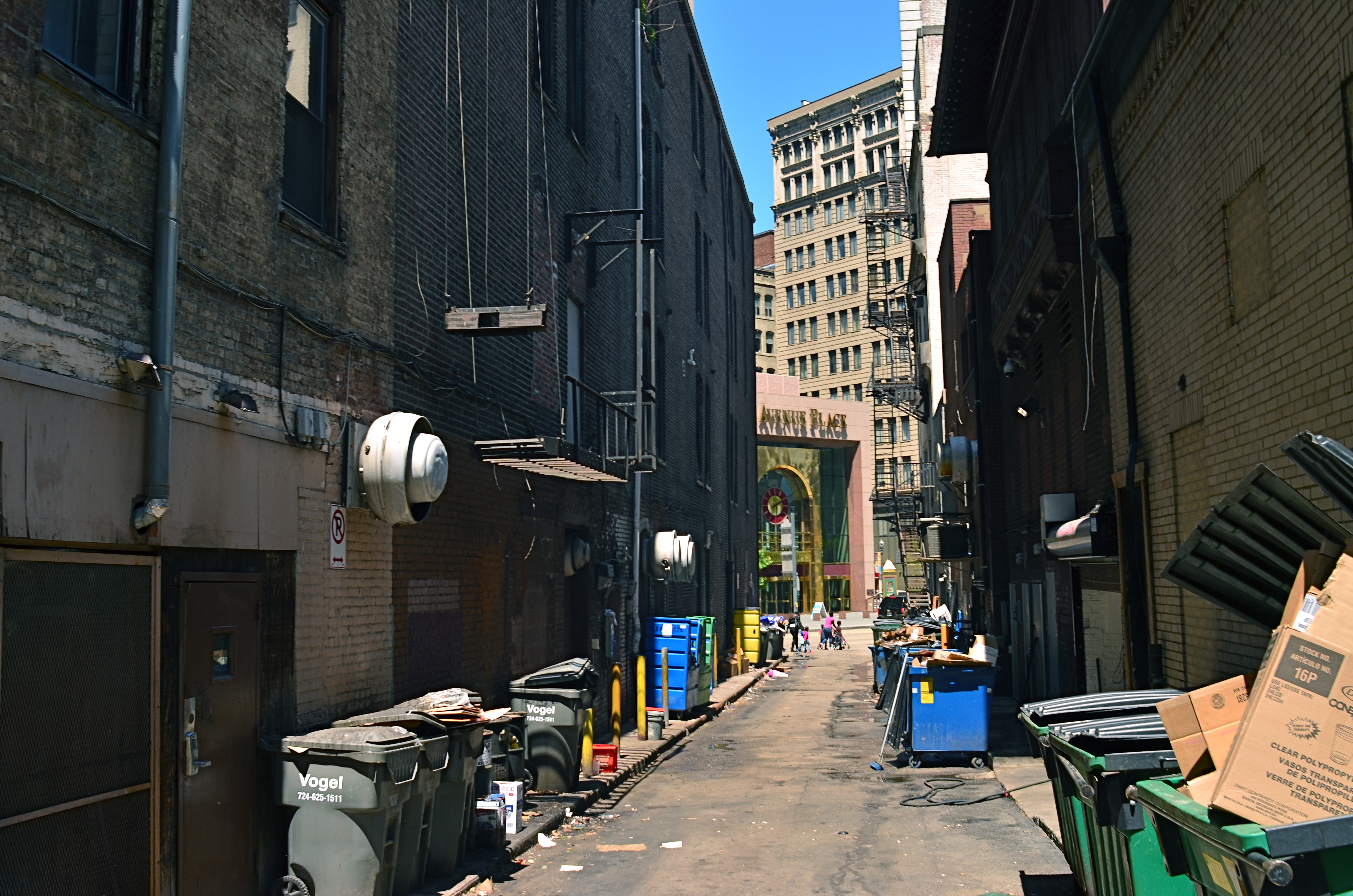
A traditional wide-angle approach to the suggestion of depth.
By MICHAEL PERKINS
WE ALL WENT THROUGH THAT OLD PERSPECTIVE EXERCISE IN ART 101. You know, the one where we draw the train tracks trailing away to an imaginary horizon, compressing the distance between the tracks as they “recede” to suggest depth, or a simulation of the way our eyes perceive it. It’s a lesson that dances somewhere back in our lizard brain whenever we compose a shot to suggest three dimensions on a flat plane (film or sensor) that only possesses two. Ongoing challenge, etc., etc.
In composing a photograph, it’s pretty easy to decide which factors in the picture actually aid that illusion, creating a big fat neon arrow to the thing we’re want to draw attention to. And some ways are better than others at selling that idea. One of the strong myths about these kinds of shots is that you need a wide-angle to make the argument for depth. Of course, that’s like a lot of “rules” in photography. It’s always true, except in those cases when it’s kinda…not.
In the top image, shot with a 24mm lens, the building at the back of the shot is lit better than the two alley walls that lead to it….a basic no-brainer of a composition. Moving left or right a bit can put the major emphasis on one wall or the other to be the arrow pointing to that object, or you can make the shot even more compact, although no less effective, in the cropping process.
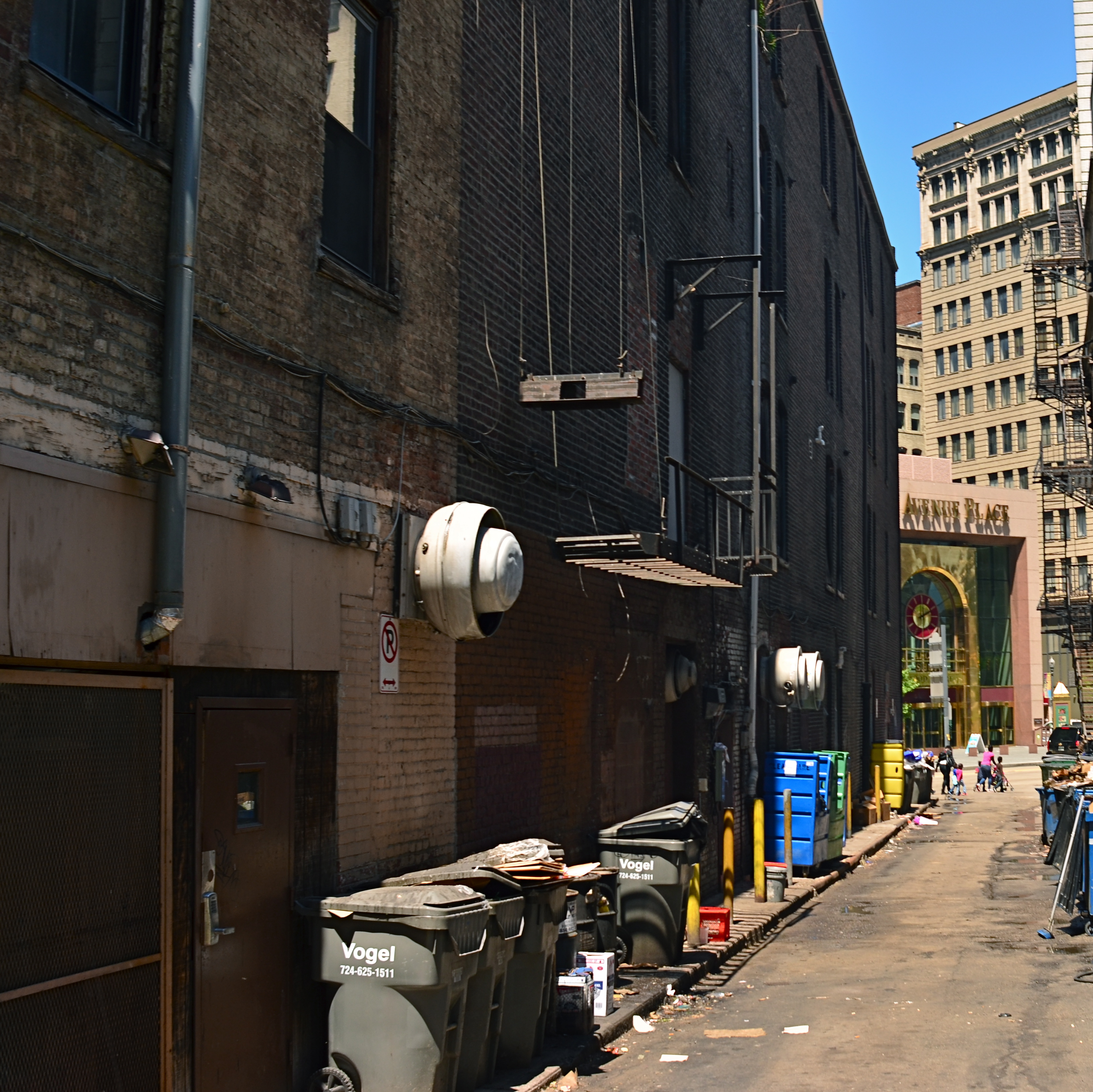
Instead of two leading lines heading for the building at the back, let’s try just one.
Of the two walls, the rows of trash cans and receding lines of windows on the left seem, at least to me, to lead more powerfully to the back building than the right, where detail is darker and objects that could act as a leading line are a little more angled and compressed. Just for kicks, I cropped the shot to a square you see just above, reframing the back building as the end of a straight, single diagonal along the left wall, making the instruction to the eye a lot more streamlined.
It’s not that the fuller frame is “wrong” per se, but I always believe that inside many shots just might be a better shot waiting to get out. Some photographs are full-born in-camera, while others emerge during what I call the “on second thought” phase.
Now to try this idea out at a railroad crossing….
WRITE YOUR OWN STORY
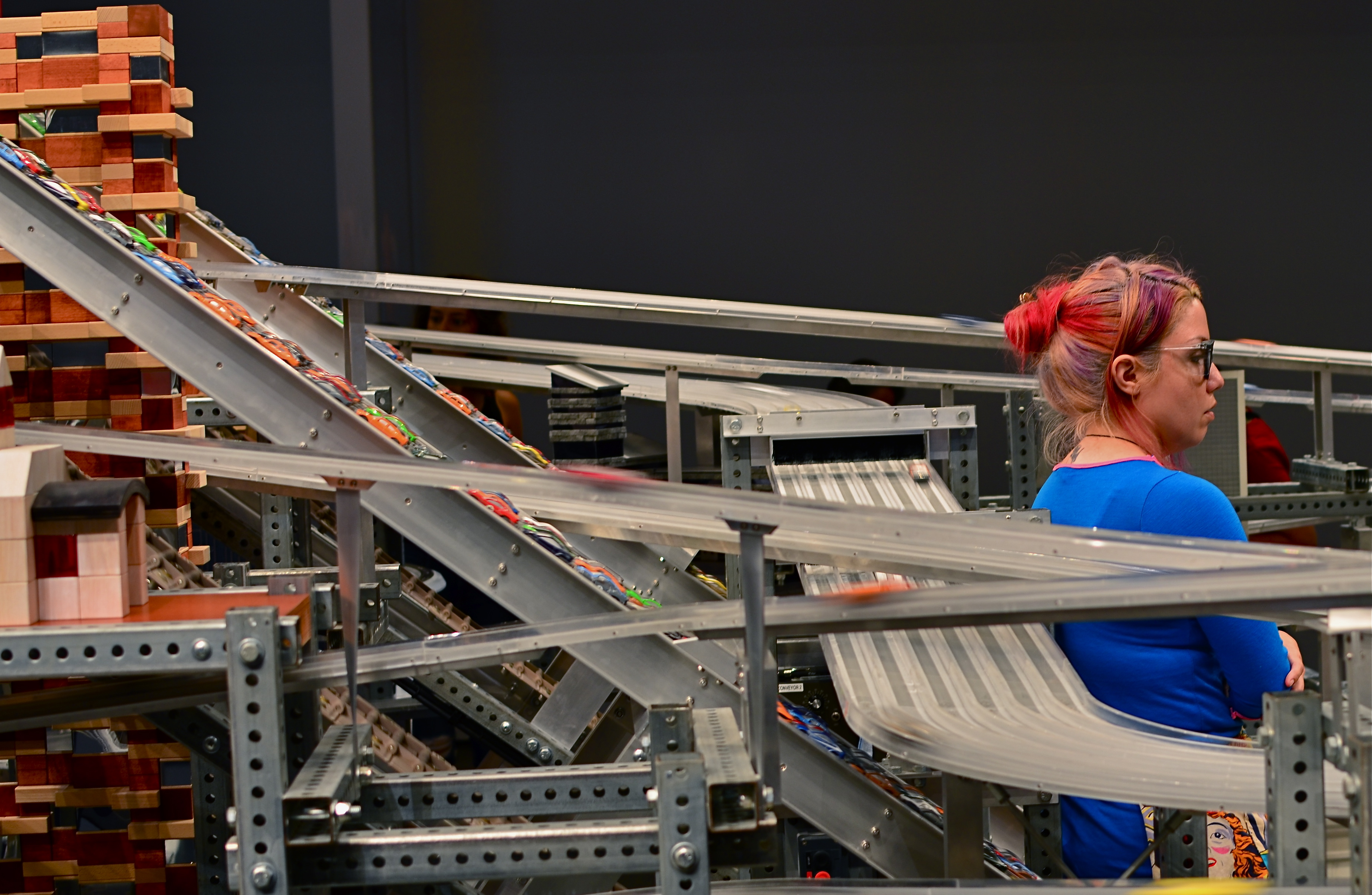
On Stand-By, 2015. 1/25 sec., f/3.5, ISO 100, 35mm.
By MICHAEL PERKINS
THE OLDEST CONSISTENT ROLE OF PHOTOGRAPHY IS AS NARRATIVE, its storytelling ability borrowed from painting but later freed, as painting would also be, from representations of mere reality. Before the beginning of the 20th century, photographs held moments, chronicled events, froze people in time. Over the next hundred tumultuous years, every part of the narrative process for all arts would be challenged, shattered and reassembled several times over. We pretend there are still rules that always apply to what an image says to us, but that is really only sentiment. Some photographs simply are.
What they are is, of course, both fun and infuriating for creator and audience alike. We wonder sometimes what we are supposed to think about a picture. We take comfort in being led a certain way, or in a set sequence. Look here first, then here, then here, and draw such-and-such a conclusion. But just as music need not relate a story in traditional terms (and often does not) the photograph should never merely present reality as a finished arrangement. The answer to the question, “what should I think about this?” can only be, whatever you find, whatever you yourself see.
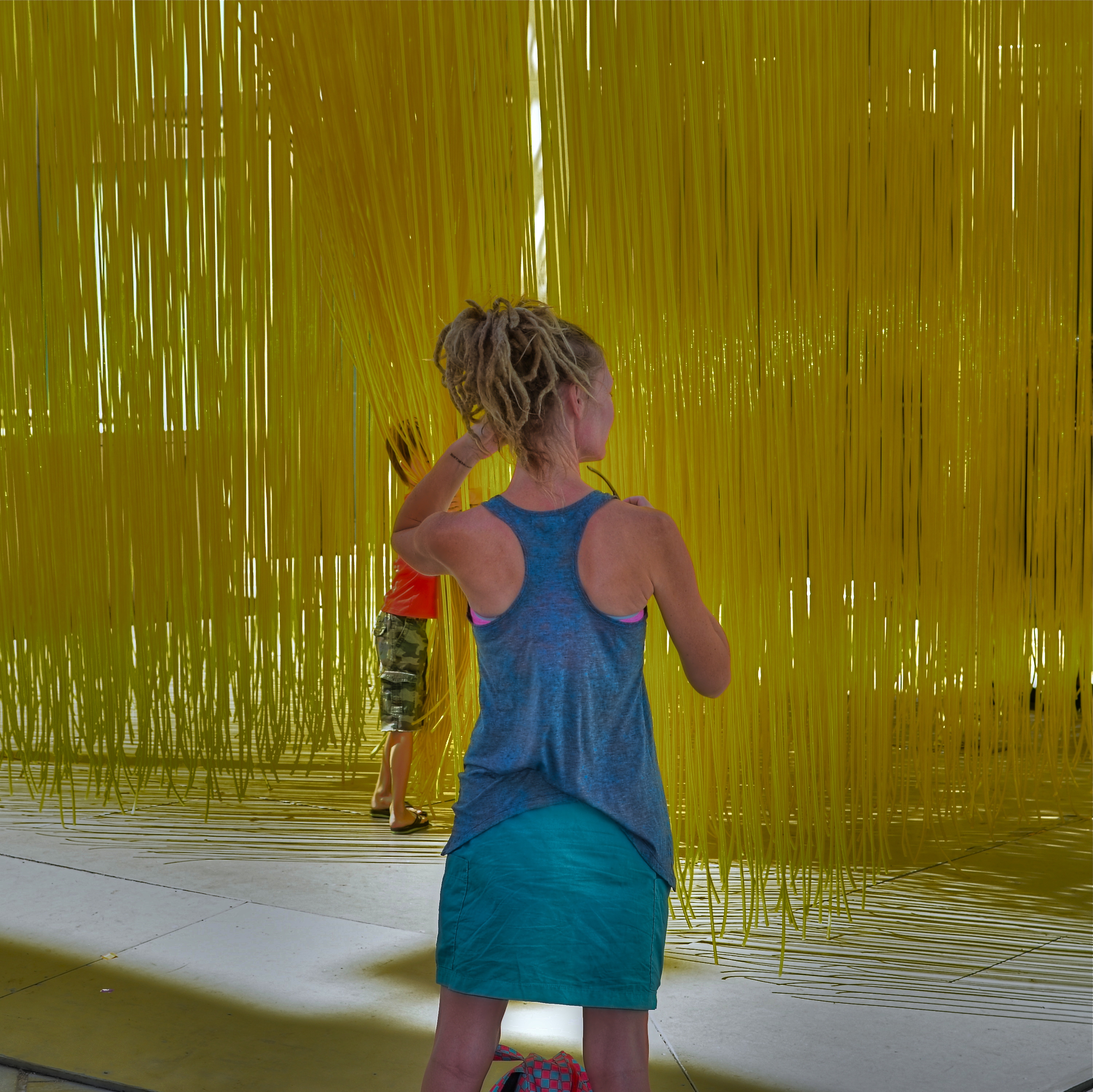
Strands, 2015. 1/200 sec., f/5.6, ISO 100,35mm.
I love having a clear purpose in a picture, especially pictures of people, and it has taken me years to make such images without the benefit of a deliberate road map. To arrange people as merely elements in a scene, then trust someone else to see what I myself cannot even verbalize, has forced me to relax my grip, to be less controlling, to have confidence in instincts that I can’t readily spell out in 25 words or less.
What are these people doing? What does their presence reveal beyond the obvious? Is there anything “obvious” about the picture at all? Just as a still life is not a commentary on fruit or a critique of flowers, some photographed people are not to be used in the service of a story. They can, in the imaginations of viewers, provide much more than that. Photography is most interesting when it’s a conversation. Sometimes that discussion takes place in strange languages.
THE SINGLE BULLET THEORY
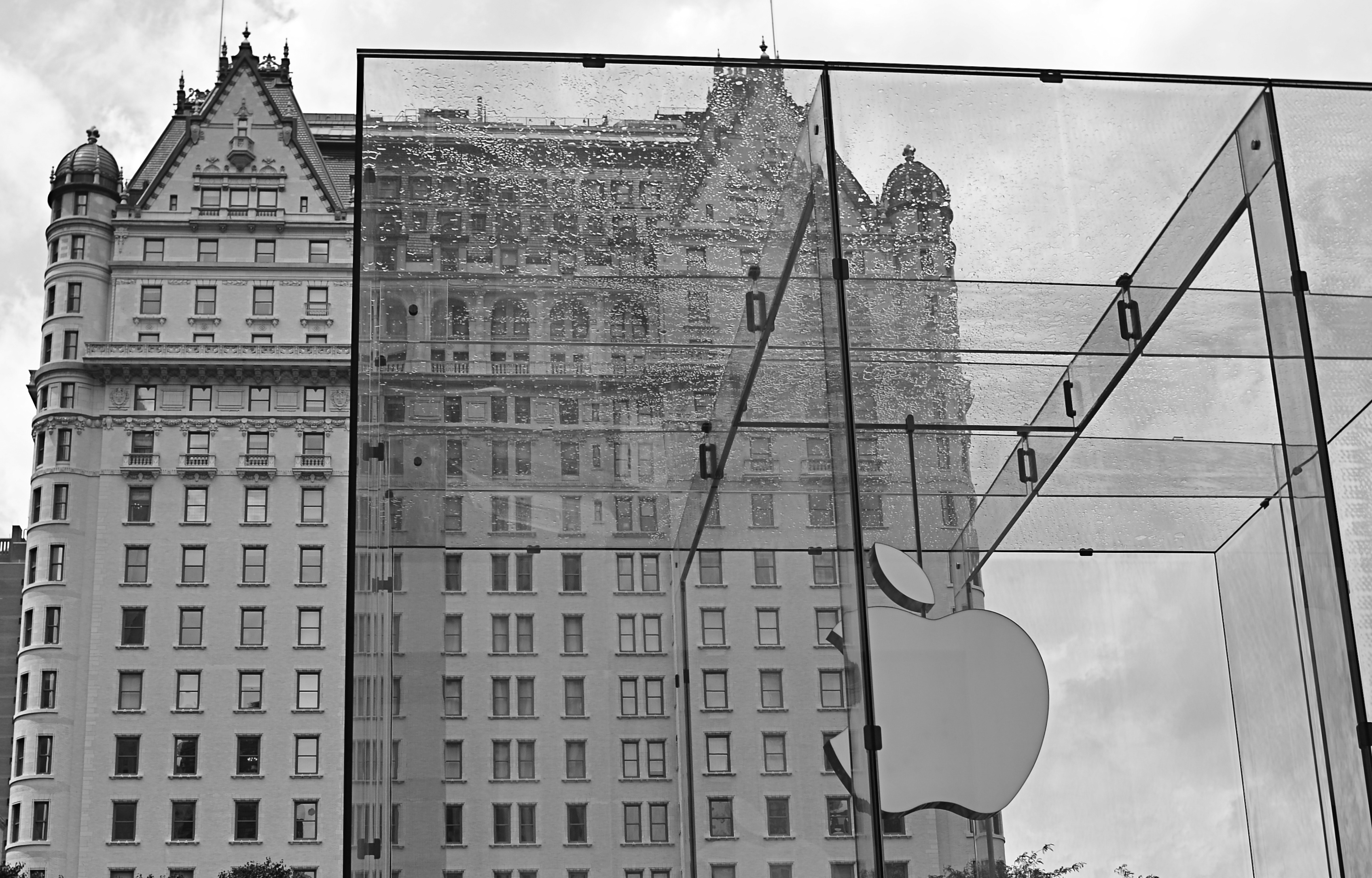
Many of your own best pictures are single-take, all-or-nothing shots. There’s a reason for that.
By MICHAEL PERKINS
Okay, Wang, I think that’s enough pictures of the parking lot. —Rodney Dangerfield, Caddyshack
IF YOU WERE TO EXPRESS TODAY’S PHOTOGRAPHIC FREEDOM IN TERMS OF FIREPOWER, it would be fair to say that many of us have come to shoot in a somewhat scatter-shot fashion, like someone sweeping a machine gun. Indeed, digital allows us to overshoot everything to such a degree that doing so becomes our default action, because why would you take one picture of your child digging into birthday cake when fifty will do just as well?
Some over-shooting is really what pro photogs used to call “coverage” and is actually beneficial for particularly hard subjects. Awe-inspiring sunsets. A stag at bay. The fiery burst from a Hawaiian volcano. Such subjects actually warrant a just-one-more approach to make sure you’ve thought through every possible take on something that can be interpreted in a variety of ways, or which may be vanishing presently. But that’s a lot different from cranking off four dozen clicks of the visitor’s center at Wally World.
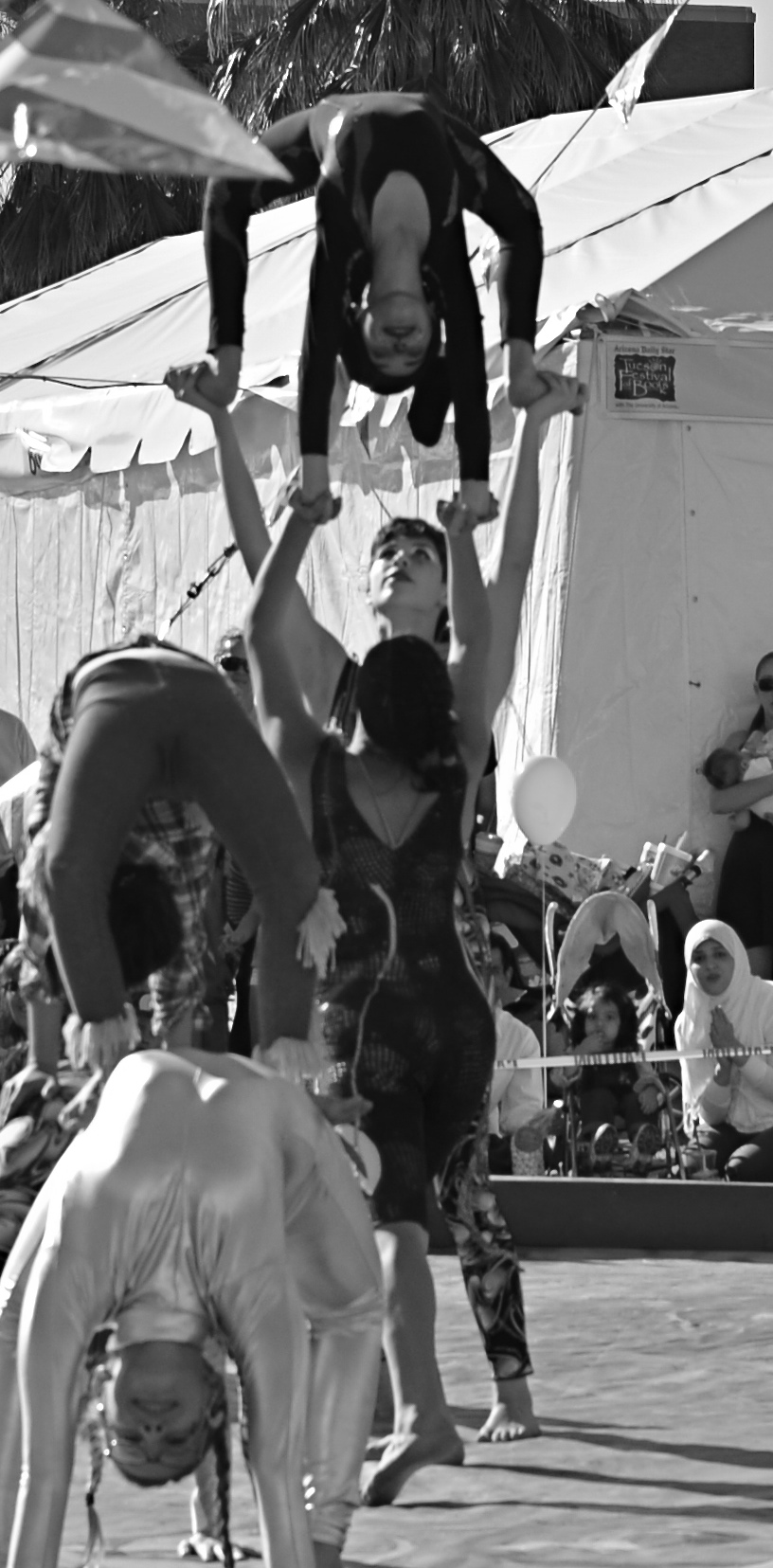
Shoot things reactively.
Shooting better isn’t always assured by merely shooting more. Instead of the machine gun technique, we might actually improve our eye, as well as our ability to strategize a shot, by limiting how many total tries we make at capturing an image. My point is that there are different “budgets” for different subject matter, and that blowing out tons of takes is not a guarantee that Ze Beeg Keeper is lurking there somewhere in the herd.
So put aside the photographic spray-down technique from time to time and opt for the single bullet theory. For you film veterans, this actually should be easy, since you remember what it was like to have to budget a finite number of frames, depending on how many rolls you packed in. Try giving yourself five frames max to capture something you care about, then three, then one. Then go an entire day taking a single crack at things and evaluate the results.
If you’ve ever spent the entire day with a single focal length lens, or fought severe time constraints, or shot only on manual, you’re already accustomed to taking a beat, getting your thinking right, and then shooting. That’s all single-take photography is; an exercise in deliberation, or in mindfulness, if you dig guru-speak. Try it on your own stuff, and, better yet, use the web to view the work of others doing the same thing. Seek out subjects that offer limited access. Shoot before your walk light goes on at an intersection. Frame out a window. Pretend an impatient car-full of relatives is waiting for you with murder in their hearts. Part of the evolution of our photography is learning how to do more with less.
That’s not only convenient, in terms of editing. It’s the very soul of artistry.
THE LONG AND SHORT OF IT
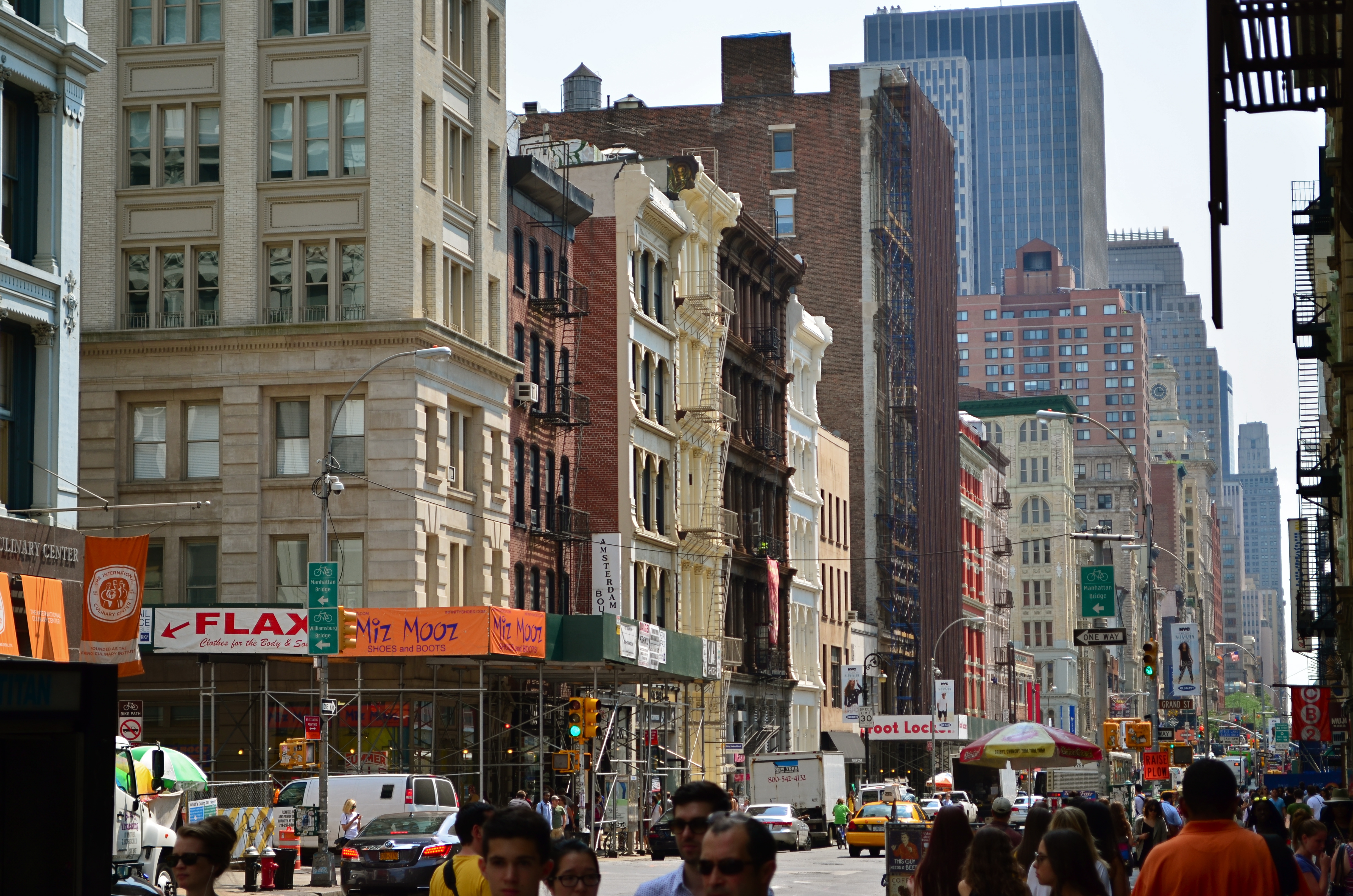
This original frame was just, um, all right, and I kept wanting to go back and find something more effective within it.
By MICHAEL PERKINS
THE INTRODUCTION OF THE FIRST PANORAMIC CAMERAS in the 1840’s can be seen as a freeing-up of the camera frame, a way to more accurately depict the entire field of view open to the human eye. And, of course that’s true. However, the first panos were also an early attempt by photographers to deliberately direct and orchestrate not only what you see, but how they want you to see it. Let’s concede that the western mind tends to absorb information in linear fashion. We read from left to right, we scan the horizon, and so forth. So making a photograph that instructs you to interpret horizontally is fairly natural.
So the first panos seem like a fairly modest extension of our visual bias. But think about the fundamental change that represented. Suddenly, photographers were saying, there are no rules except the rules I dictate. I decide what a frame is. I arrange not only the information inside the frame, but the frame itself. By re-shaping the box, I re-shape what you are to think about what’s in the box. That’s revolutionary, and today’s shooters would be wise to be mindful of that wonderful power.
I am fond of making what I will generously call “carved” panoramics, shots that began as standard framings but which I have cropped to force a feel of left-to-right linearity. Unlike standard panoramics, the shots were conceived and made with a very different compositional strategy, not necessarily trying to tell a horizontal story. However, on review, some stories-within-stories contain enough strong information to allow them to stand as new, tighter compositions in which the new instruction to the viewer’s eye is quite different from that in the original.
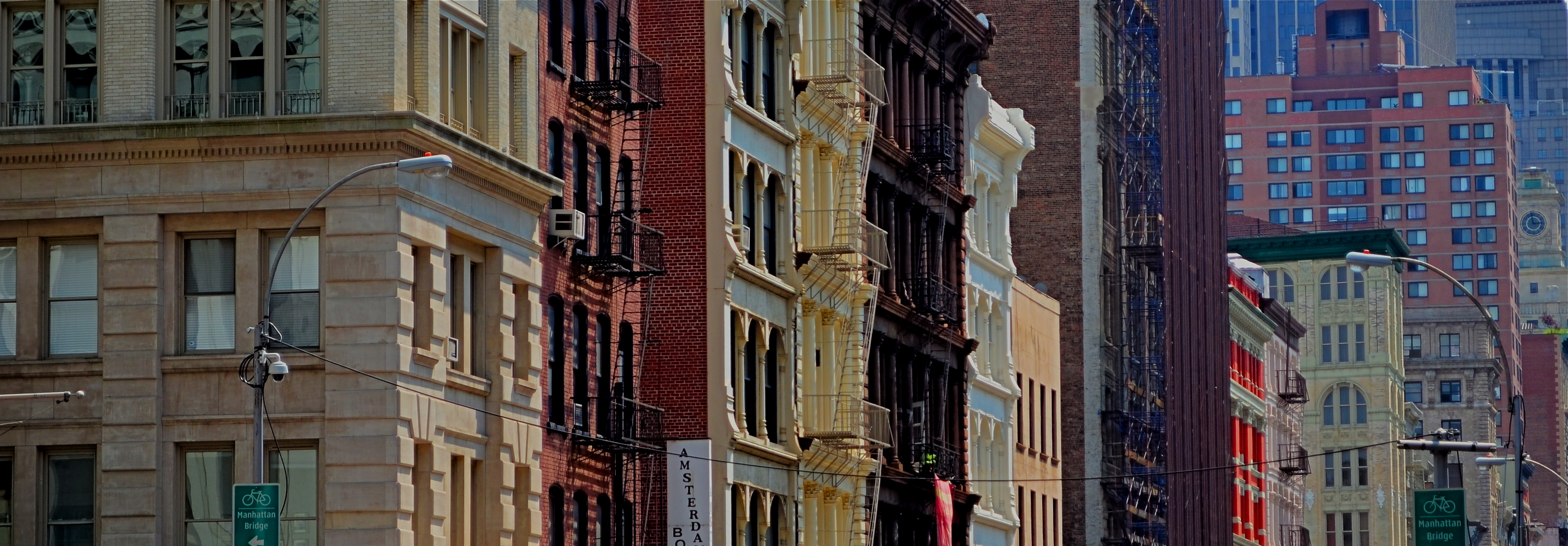
Change the frame, change the message.
The full shot seen at the top of this page may or may not succeed as a typical “urban jungle” snap, in part because it contains both horizontal and vertical indices that can pull the eye all over the place. Since I wasn’t amazed by the shot itself, I decided to select a horizontal framing from its middle real estate that purposely directed the eye to laterally compare the facades of several different buildings stacked tightly down the street. Full disclosure: I also re-contrasted the shot to make the varying colors pop away from each other.
The result still may not be a world-beater, but the very act of cutting has re-directed the sight lines of the picture. For better or worse, I’ve changed the rules of engagement for the photograph. When such surgeries work, you at least fix the problem of extraneous clutter in your pictures, making them easier to read. Then it’s down to whether it was a good read or a beach read.
Hey, the box can’t fix everything.
 thenormaleye
ANTHROPOGRAPHY
Tuning up: a fiddler runs a few practice riffs before a barn dance in Flagstaff, Arizona.
By MICHAEL PERKINS
WRITING CLICHE NUMBER 5,218 STATES THAT YOU SHOULD WRITE about what you know. Mine your own experience. Use your memories and dreams as a kickoff point for the Great American Novel, or, at least, the Okay American E-book. But while the “know-it-do-it” school of technique offers writers a pretty sound foundation for scribblers, photographers need to learn how to leave their native nests and fly into unknown country. The best pictures sometimes are where you, comfortably, aren’t.
Caperin’ up a storm, by golly.
Shooting an event or lifestyle that is completely outside yourself confers an instantaneous objectivity of sorts to your pictures, since you don’t have any direct experience with the things you’re trying to capture. You’re forced to pretty much go instinctive, since you can’t draw on your memory banks. This is certainly true of combat photographers or people dropped down into the middle of fresh disasters, but it also works with anything that’s new to you.
Take square-dancing. No, I mean it. You take square-dancing, as in, I’d rather be covered in honey and hornets than try to master something that defines “socially awkward” for yours truly. I can’t deny that, on the few occasions that I’ve observed this ritual up close, it obviously holds infinite enjoyment for anyone who isn’t, well, me. But being me is the essential problem. I not only possess the requisite two left feet, I am lucky, on some occasions to even be ambulatory if the agenda calls for anything but a rote sequence of left-right-left. Again, I concede that square-dancers seem almost superhumanly happy whenever doing their do-si-doing, and all props to them. Personally, however, I can cause a lot less damage and humiliation for all concerned if I bring a camera to the dance instead of a partner.
Shooting something you don’t particularly fancy yourself is actually something of an advantage for a photographer. It allows you to just dissect the activity’s elements, using the storytelling techniques you do know to show how the whole thing works. You’re using the camera to blow apart an engine and see its working parts independently from each other.
In either writing or shooting, clinging to what you know will keep your approach and your outcomes fairly predictable. But when photography meets anthropology, you can inch toward a little personal growth. You may even say “yes” when someone asks you if you care to dance.
Or you could just continue to maintain your death grip on your camera.
Yeah, let’s go with that.
Share this:
September 25, 2015 | Categories: Americana, Black & White, Candid, Conception, iPhone, Musical Instruments | Tags: Composition, crowds, Entertainment, Music, social commentary | Leave a comment