ROUNDING TO THE NEXT BEST YOU
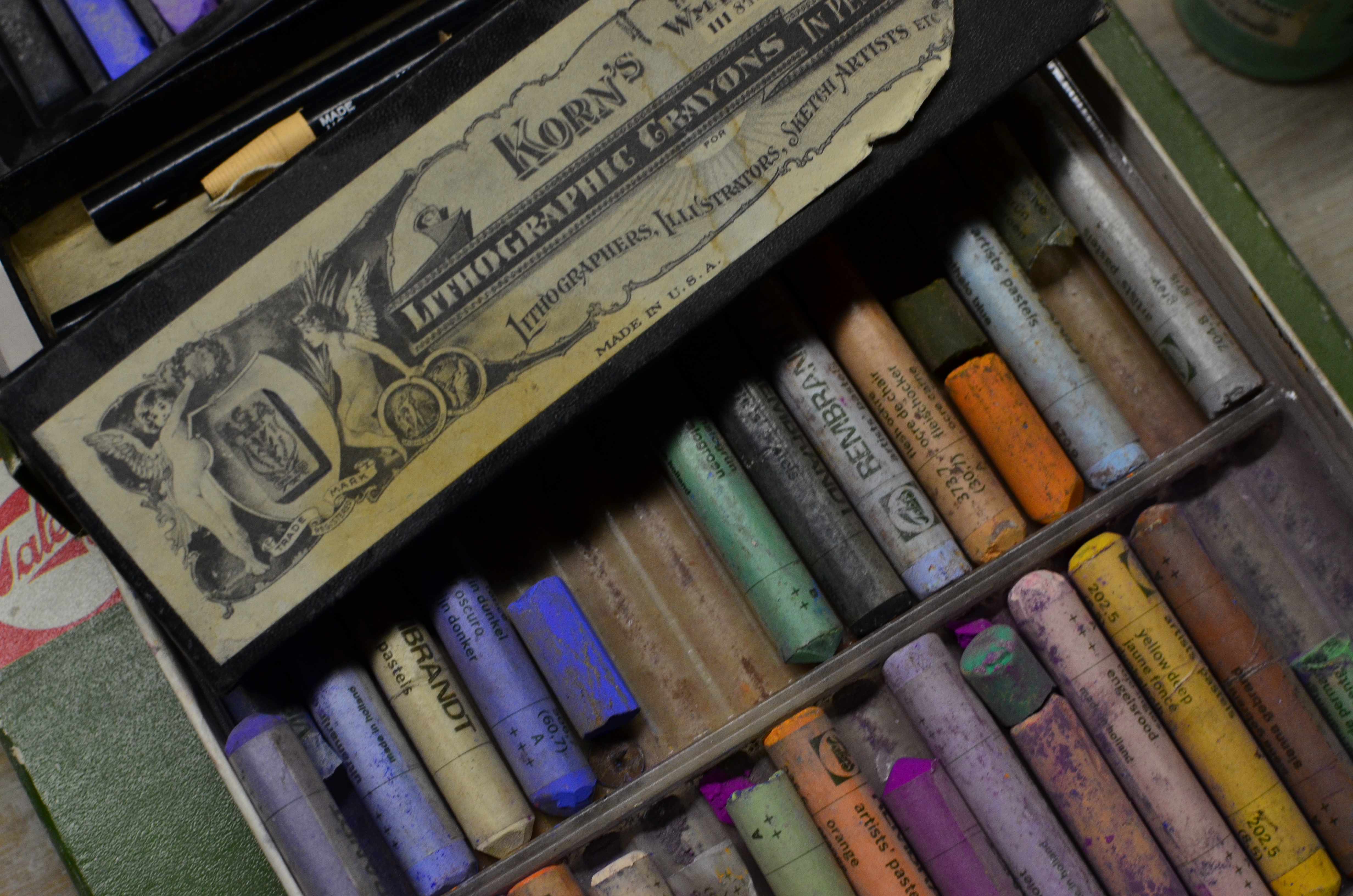
Knowledge in any area of art can only feed your photography.
By MICHAEL PERKINS
YOU MAY FIND, AS I HAVE, THAT MANY OF THE BEST PHOTOGRAPHERS ARE ALSO, ARTISTICALLY, SPEAKING, “SOMETHING ELSE“. That is, their creative energies emerge in more than just one medium, even if images are their preferred language. This has always been thus. During the camera’s infancy, many photogs were former painters. Writers were also among the first to explore the new art of picture-making, and the amateur photo work of scribes like Emile Zola and Lewis Carroll remain worthy of note today.
In the 20th century, some painters-turned-photographers like Henri Cartier-Bresson turned back to the brush late in life, while other artists like Man Ray stayed firmly anchored in both camps. And even the great theologian and poet Thomas Merton spent his last years as a Trappist monk dabbling in a kind of zen expressionism through the viewfinder of his Canon 35mm.
This doesn’t exactly prove that everyone who is adept in one kind of art will also be effective as a photographer, but it does demonstrate that some people who are curious in all ways of expression will sometimes also choose the camera as an instrument. I personally believe that this can only improve your way of seeing, since “vision” isn’t achieved merely through the eyes, but through the accumulation of all one’s life experience.
I would even go one step farther and claim that just studying photography may be bad for one’s development as a photographer. Rather, it is the total weight of one’s life which shapes one’s seeing, just as a worldlier view can inform one’s writing, cooking, singing, or strumming. No one art is so complete that it can operate in a vacuum, sealed away from all the other arts.
We readily accept that composers need to occasionally be historians, that writers should sometimes be philosophers, and that both painters and chefs should master a little science, so how can we believe that photographers can comment on the whole of life without at least dabbling in the world beyond their computers or darkrooms? You cannot be willfully blind as a person and visionary as a photographer at the same time. The more there is of you, the more of you there is that makes it into your pictures.
IMPRECISE BUT TRUE
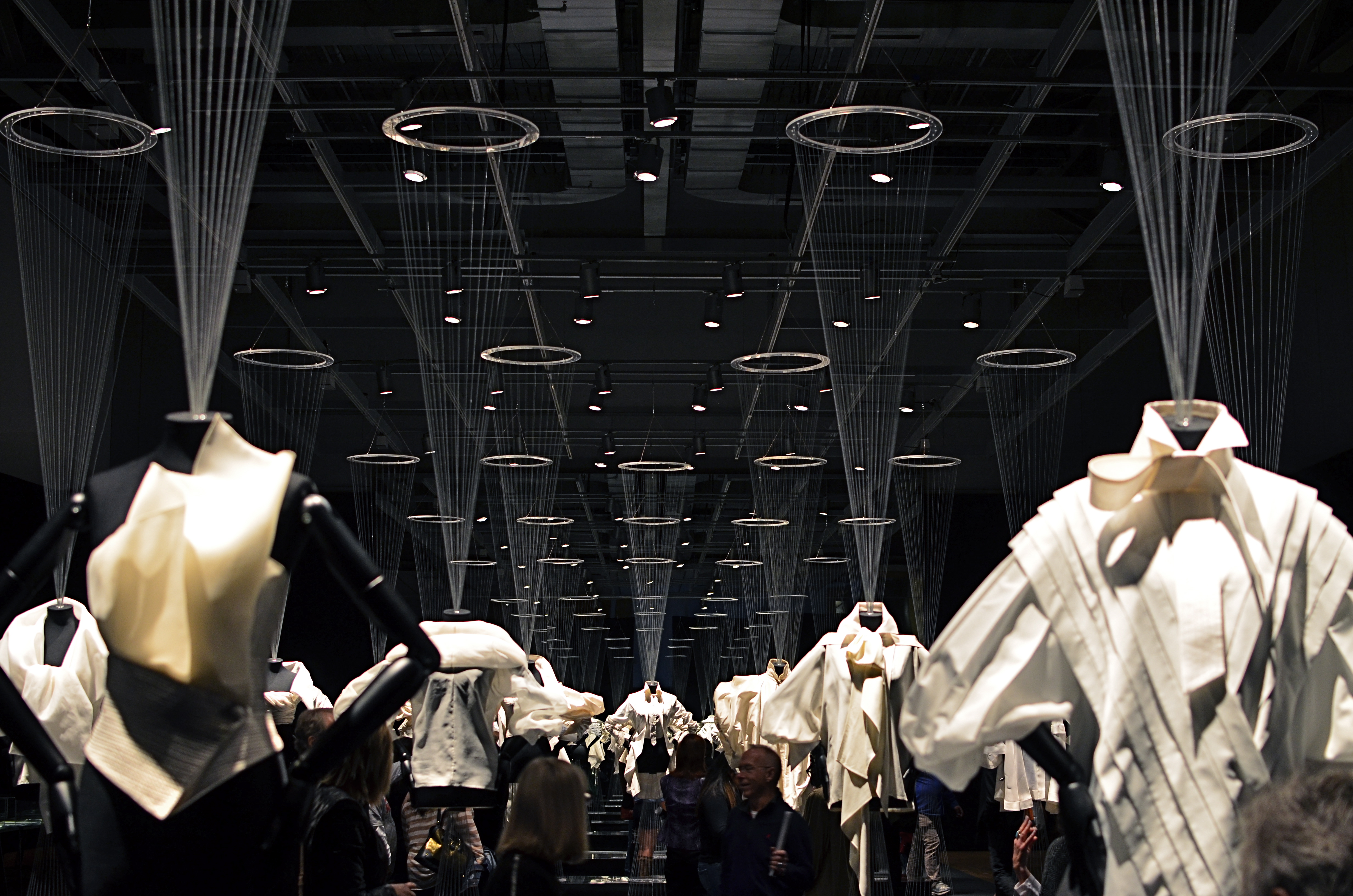
What makes an image work for you? Could it be explained in words? Or isn’t that what the image is for? 1/60 sec., f/4, ISO 400, 35mm.
By MICHAEL PERKINS
AN ELOQUENTLY DETAILED ANALYSIS OF A POWERFUL PHOTOGRAPH, which I read in a recent edition of the New York Times, convinced me anew that, apart from a few compositional basics, no one really knows what makes an image “work”. Beginners love to sing the praises of the Rule Of Thirds as a guideline for composition, and, likewise, critics rhapsodize about Golden Ratios as a way to dissect how powerful elements occupy space in great photos. But the dirty little secret about composition is that there is no dirty little secret, no Laws of Gravity or Relativity that, if consistently obeyed, will yield consistent excellence.
This doesn’t mean that we can’t emotionally identify which pictures have power, as well as those that merely lie there. It merely means that there may never be adequate verbal artillery to reduce those feelings to a law, a handbook, or a credo. We arrive with our cameras at places where there may, or may not be, a picture. Our eye tells us that something important can be extracted, isolated, amplified, re-contextualized. Beyond that, it’s a matter of fate and luck.
Of course, the more we experience what works, the better we are at seeing it in the raw and extracting better and better examples of it. However, every ride of the bucking bronco is distinctly different from all the others. Photography has certain mechanical techniques that can be mastered, certainly, but we can’t learn emotional impact in a class. We can only pour something out into the camera from what is already inside us.
Try to imagine walking up to a chalkboard and reducing your favorite photograph to a series of shorthand symbols reminiscent of a mathematician’s equation. Could anything be more bloodless, more clinical? Critics and analysts sometimes come from the ranks of doers, but many of the very best doers resist the temptation to dissect their art as if it were a lab frog. Henri Cartier-Bresson, the acknowledged Moses of street photography, once recalled that it was seeing another shooter’s best work that made him say, “Damn It!”, grab his camera, and head outside, obsessed with making something of his own that could incite such a reaction.
Photographers seize instinct and emotion in the raw and forge them into a kind of sense-fired steel. Frame a picture with that steel and it will speak a thousand times louder than any mere dissertation.
A DIFFERENT BRAND OF DARK
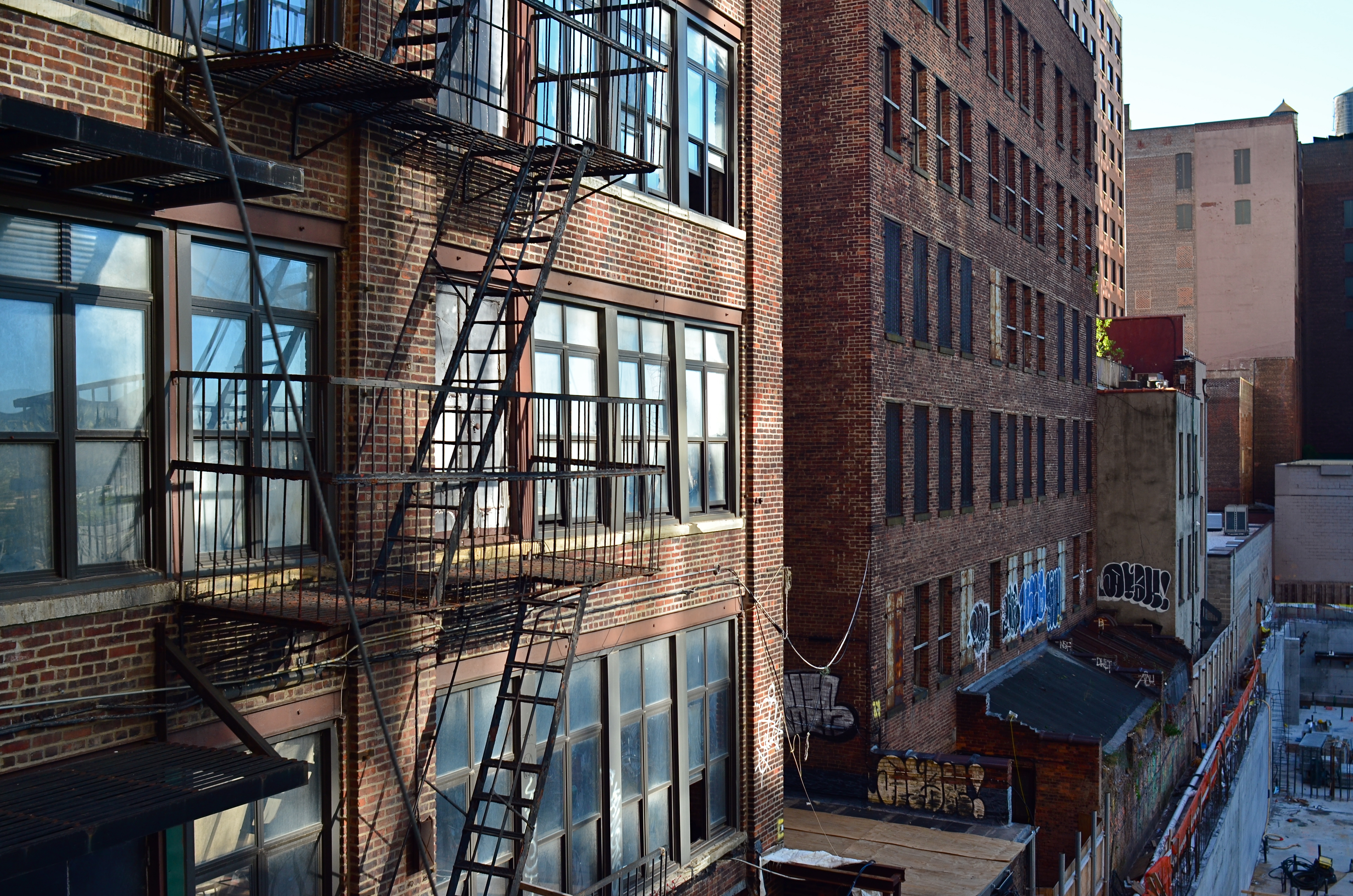
A texturally rich subject, but its natural color is too Disney.
By MICHAEL PERKINS
ONE PHOTOGRAPHER’S LAB ACCIDENT IS, OCCASIONALLY, ANOTHER PHOTOGRAPHER’S EUREKA MOMENT. Take the case of a visual effect that, in the film era, may have originated with an error in darkroom technique, and which is now being sought after by movie directors and amateurs alike as a look that they actively desire. Recent use of this effect ranges from the gritty, muted color and high-contrast of films like Steven Spielberg’s Saving Private Ryan, to lab-less shortcuts in Photoshop and even shorter shortcuts in ready-to-eat iPhone apps. The look is called Bleach Bypass and it’s worth a look for certain moods and subjects.
The term derives its name from one of the steps used in film processing color film in which bleach is used to rinse away silver nitrate. By skipping this step, the silver is retained in the emulsion along with the color dyes. The result is a black-and-white image over a color image…kind of a photo sandwich. The resulting composite is lighter in hue but packs more extreme contrast and graininess in the monochrome values…an intense, “dirty” look.
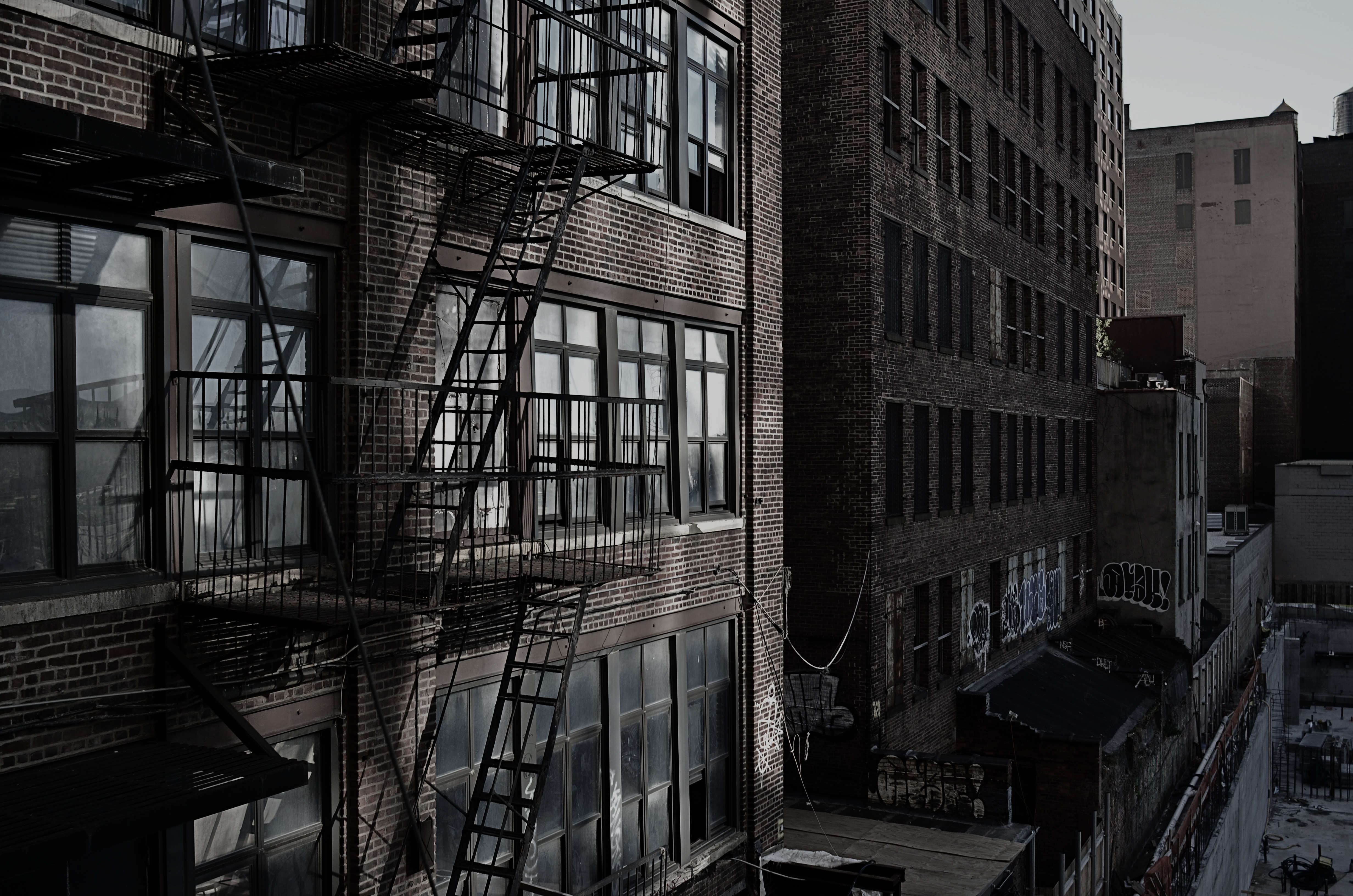
The same shot with a simulated bleach bypass effect, done in Photomatix.
Now, for those of you that don’t have a traditional darkroom handy, creating a bleach bypass “look” is easy in nearly any basic editing software suite. Check out the basic steps for Photoshop here. In most cases, you duplicate your original shot, desaturate it slightly, and convert the dupe shot to complete monochrome. The mono copy must also be manipulated for ultimate contrast, and the two shots must be layered in software to give you the desired blend. I tend to use Photomatix more often than Photoshop, since I work a lot with various kinds of tone-mapping for HDR, so I processed the “after” shot you see here in that program’s “exposure fusion” tab. However, as I say, lots of programs can do this with virtually no sweat.
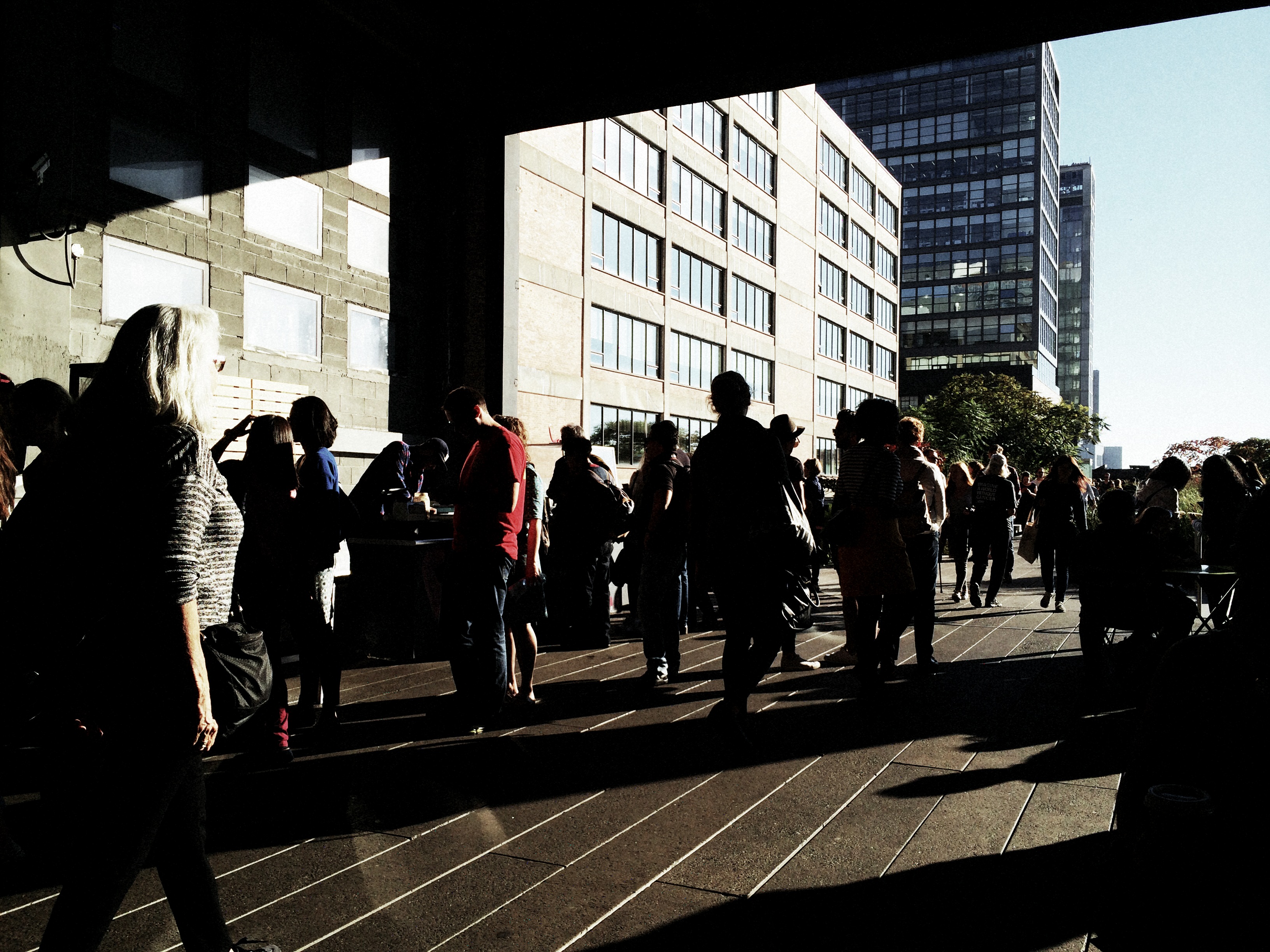
Another path: an iPhone image with the AltPhoto app’s Bleach Bypass filter applied.
The third image in this article (at left) was produced with a click and some swipes with the Bleach Bypass simulator in the AltPhoto app, which also mimics the look of antique film stocks from Kodachrome to Tri-X. As with many phone apps, it doesn’t offer much in the way of fine control, but if you do all your shooting and/or retouching in your mobile, it’s a pretty good quickie fix.
Once again, in the digital era, what was once (a) messy and troublesome becomes (b) no fuss, no muss, and therefore, (c) something that will be adopted and used by many, many more shooters. Democracy in technology does not, of course, guarantee equality of results. You just have more tools to serve you when the ideas come.
INTERACTIONS
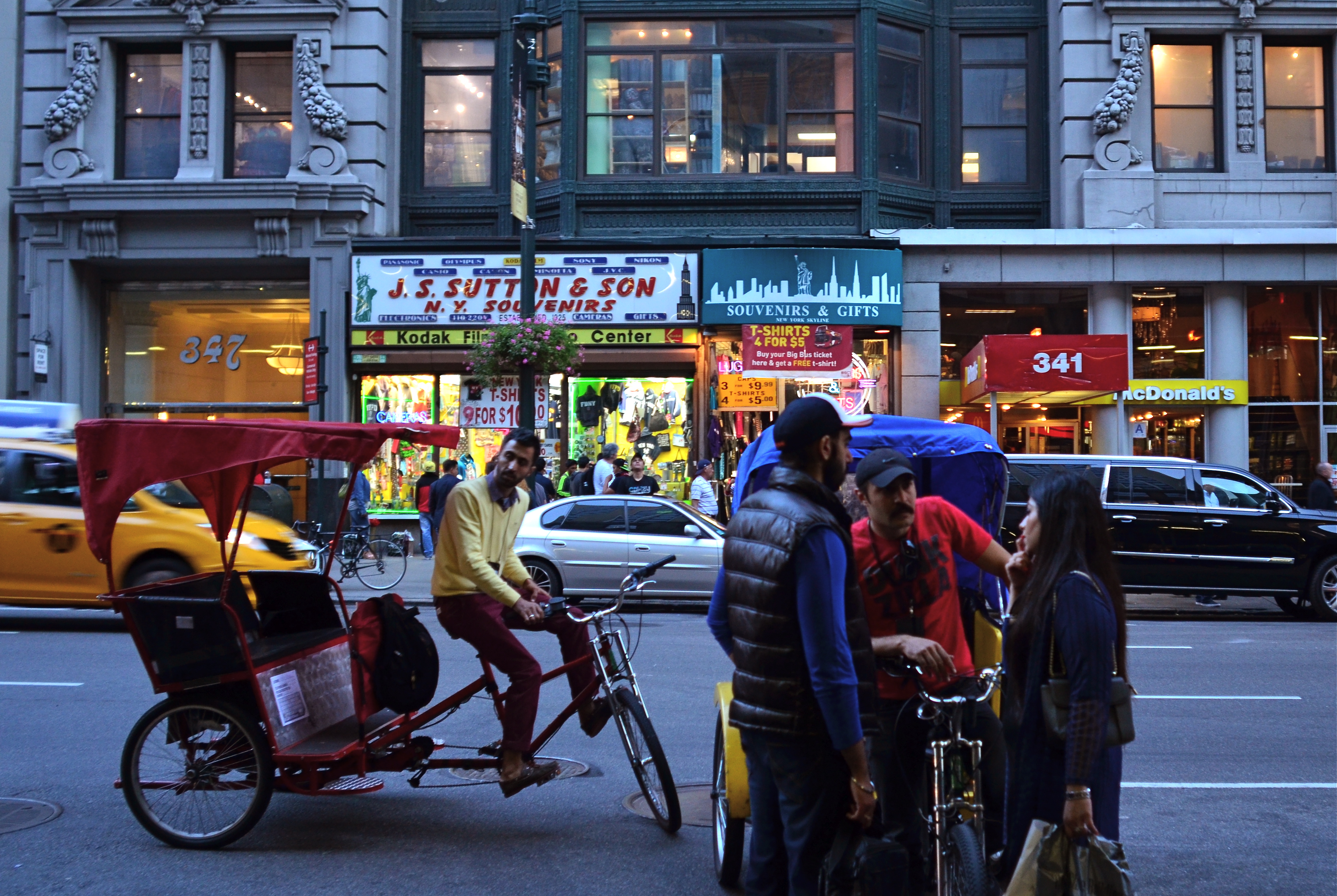
All Around The Town, 2015. 1/50 sec., f/5.6, ISO 320, 24mm.
By MICHAEL PERKINS
IT’S FAIRLY EASY TO FIGURE OUT WHERE TO TAKE YOUR CAMERA if you are trying to visually depict a vibe of peace and quiet. Landscapes often project their serenity onto images with little translation loss, and you can extract that feeling from just about any mountain or pond. For the street photographer, however, mining the most in terms of human stories is more particularly about locations, and not all of them are created equal.
Street work provides the most fodder for storytelling images in places where dramatically concentrated interactions occur between people. One hundred years ago, it might have been the risk and ravage of Ellis Island. On any given sports Sunday, the opposing dreams that surround the local team’s home stadium might provide a rich locale. But whatever the site, social contention, or at least the possibility of it, generates a special energy that feeds the camera.
In New York City, the stretch of Fifth Avenue that faces the eastern side of the Empire State Building is one such rich petri dish, as the street-savvy natives and the greener-than-grass tourists collide in endless negotiation. Joe Visitor needs a postcard, a tee-shirt, a coffee mug, or a discounted pass to the ESB observation deck, and Joe Hometown is there to move the goods. Terms are hashed over. Information slithers in and out a dozen languages, commingling with the verbal jazz of Manhattan-speak. Deals are both struck and walked away from. And as a result, stories flow quickly past nearly every part of the street in regular tidal surges. You just pick a spot and the pictures literally come to you.
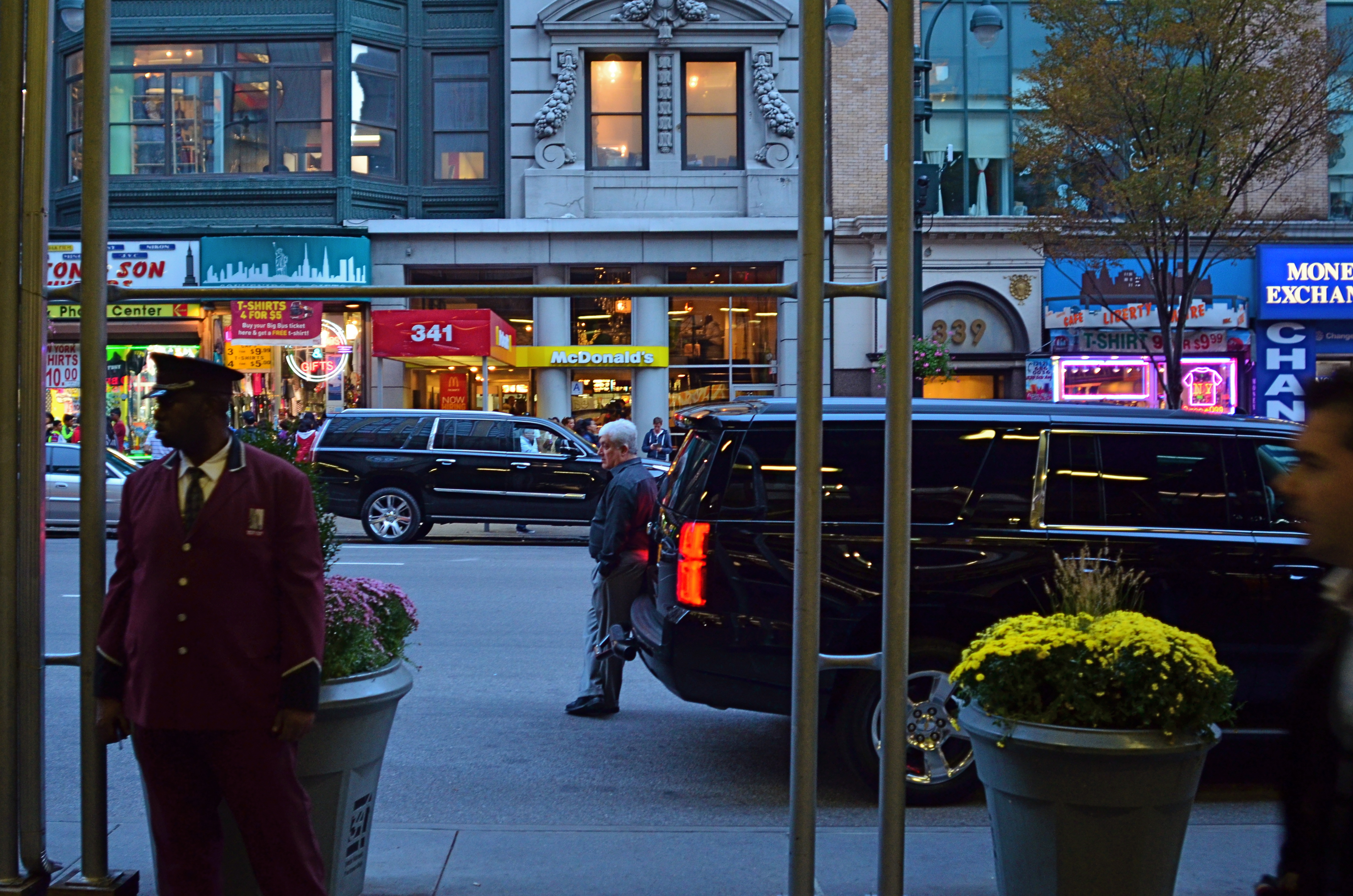
At Their Posts, 2015. 1/50 sec ., f/5.6, ISO 500, 24mm.
In these images, two very different tales unfold in nearly an identical part of the block. In the first, bike rickshaw drivers negotiate a tourist fare. How long, how far, how much? In the second, two regulars demonstrate that, in New York, there is always the waiting. For the light. For parking. For someone to clear away, clear out or show up. But always, the waiting. These are both little stories, but the street they occur on is a stage that is set, struck and re-set constantly as the day unfolds. A hundred one-act plays a day circle around those who want and those who can provide.
Manhattan is always a place of great comings and goings, and here, in front of the most iconic skyscraper on earth, those who haven’t seen anything do business with those who’ve seen it all. Street photography is about opportunity and location. Some days give you one or the other. Here, in the city that never sleeps, both are as plentiful as taxicabs.
(JUST BEFORE) THE SHOW MUST GO ON
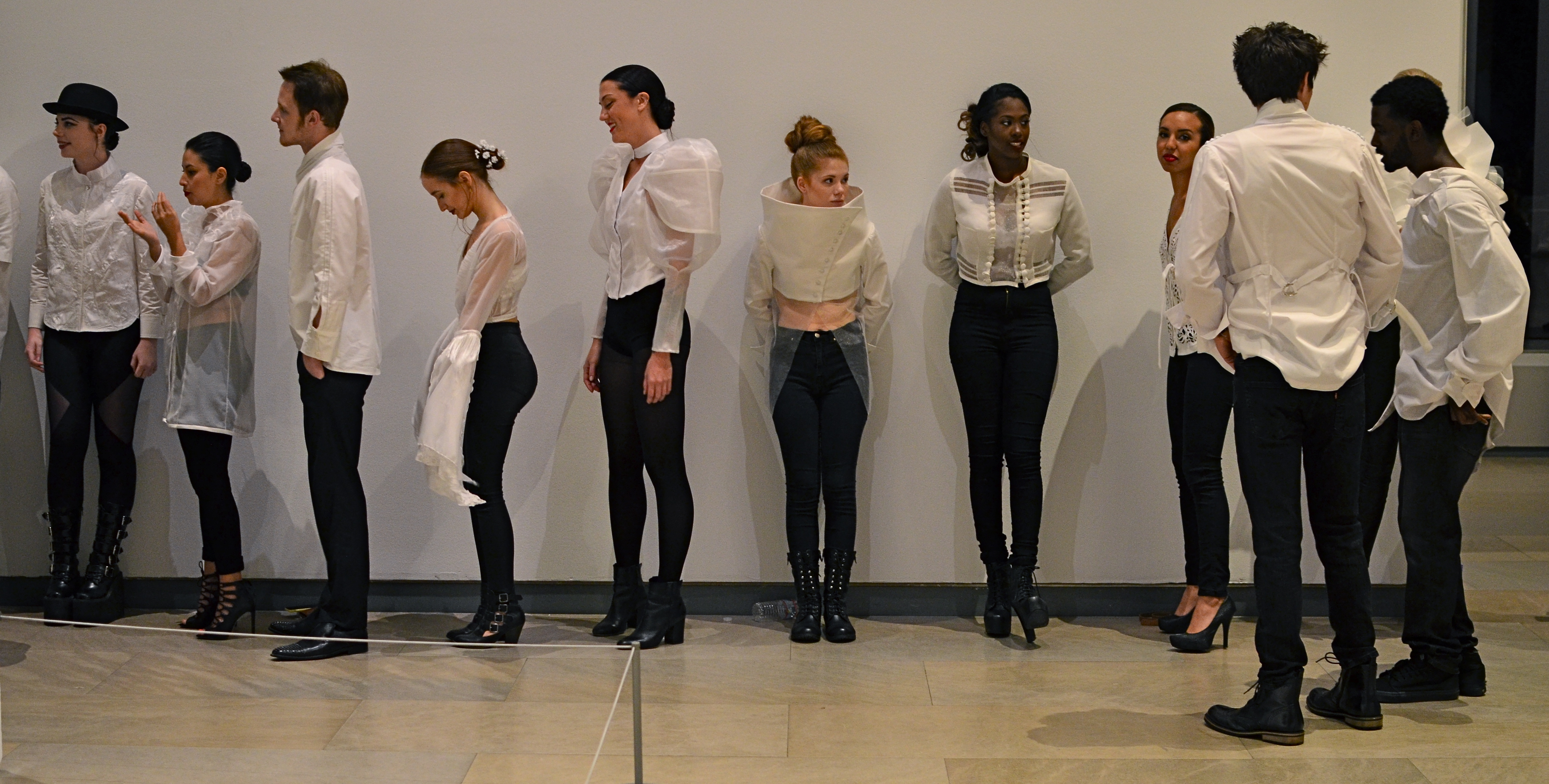
I’m Too Sexy For My Shirt, 2015. 1/80 sec., f/2.8, ISO 640, 35mm.
By MICHAEL PERKINS
ALMOST WITHIN MINUTES OF THE INVENTION OF THE CAMERA, we humans countered by inventing the camera face.
You have one. I have one. It’s the layer, the mask, the official story, the press release, the prepared consumer product. And while we often associate the making of a photograph with the creation of a document, a frozen slice of actual reality, that has never really been true, especially when it comes to capturing the raw essence of our fellow homo sapiens. It’s not that we don’t occasionally manage to glimpse the real person within: it’s that such glimpses are anything but easy.
And if our regular life is something of a performance, at least where a camera’s concerned, what of the acknowledged manipulation of an “official” performance….a play, a concert, a naked poetry slam? In such cases, the amount of artifice presented to the camera is amped up even more, so that the actual show may reveal nearly nothing of the person staging it. Total opacity.
It’s enough to make a photographer sneak backstage, minutes before the lights go down and the curtain goes up.
And that’s the kind of performance image I look for. The jangled nerves. The last-minute tunings and scales. The features that betray the anguish of going out there and putting your whole self on approval before strangers. In effect, the story that plays out on faces despite the prep, beyond the skill, behind the mask.
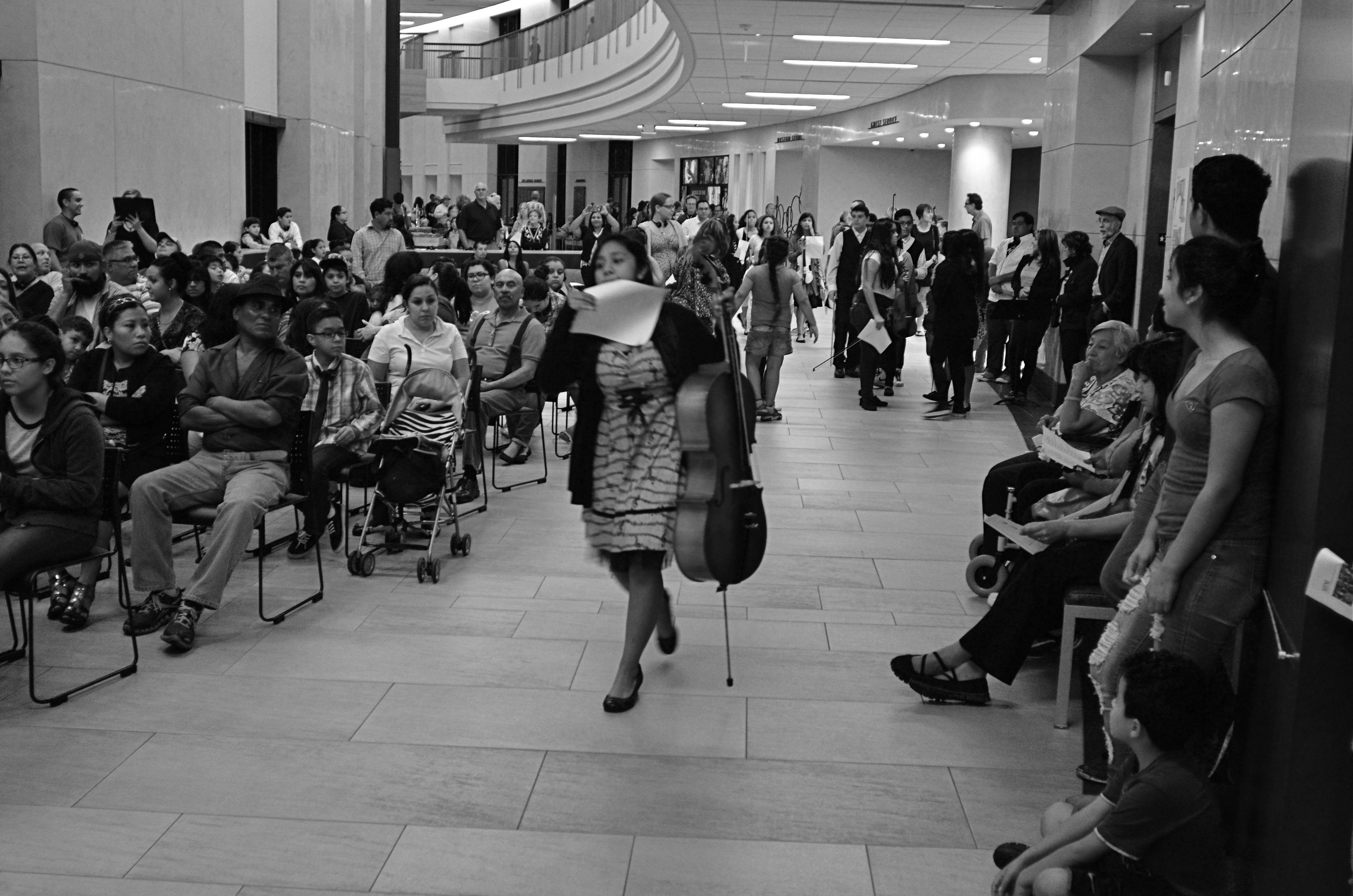
String Section To The Stage!, 2015. 1/50 sec., f/2.8, ISO 1000, 24mm.
As seen here, the girl hurrying to the stage for her string solo is trustworthy. She’s nervous, a little embarrassed at being late, desperate to hold, onto her music, literally by the skin of her teeth. Above, the string of young people at an amateur fashion show are busier being kids than being pros. Their take on modeling is not cold or detached, although in seconds, out on the catwalk, they will affect that “look”. But now, in this moment, they are friends, co-conspirators, partners in a commonly weird process. They relax. They laugh.
In both cases, these are people. Without the polish, minus the artifice, their striving visible, if just for a second, as our own.
And that’s when the magic happens.
ON THE LEVEL
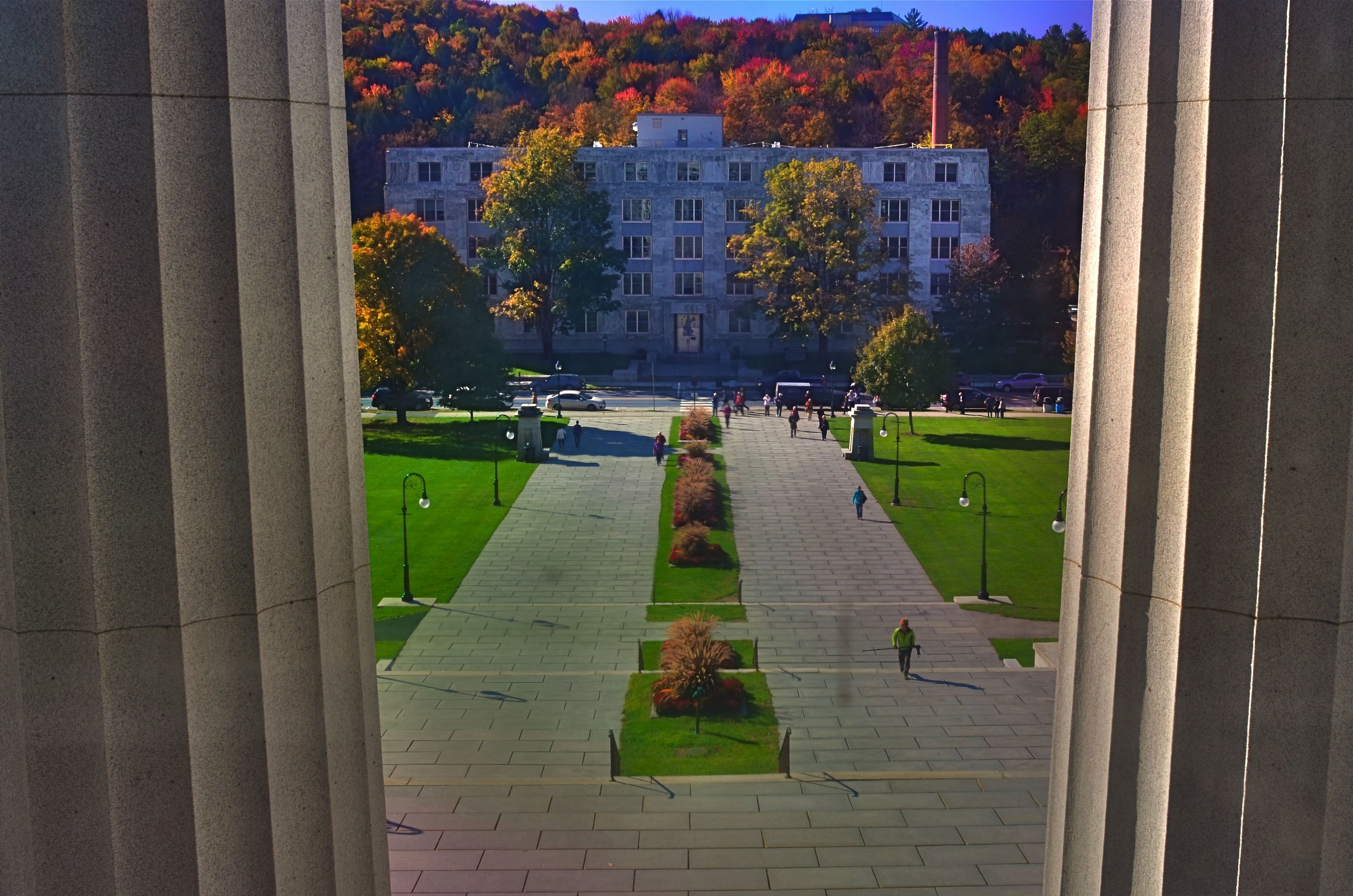
With the amount of repair time it took to straighten and resharpen this shot, I could have made ten pictures that were done correctly in-camera.
By MICHAEL PERKINS
IT’S NOW QUITE EASY TO HAVE YOUR CAMERA OR EDITING SOFTWARE correct for things you should have done before the image was made. Most of the times, these fixes cure more than curse, some of them genuinely helping a shooter extend his skills or fine-tune his control. However, in the case of one of the most common post-pic fixes, the “straighten” slider, you’re potentially messing with picture quality, to fix a problem that, quite honestly, shouldn’t have existed in the first place.
Consult every, and I mean every basic camera tutorial going back a hundred years or more. Many timely tips in such books have vanished or evolved over time, but the simple admonition to keep your shot level has remained unchanged since the dawn of photo time. So why do cameras and software even offer straightening as an option?
If you take the cynical view, the existence of this fix suggests that camera manufacturers assume that enough people will routinely take crooked pictures that, of course, they need something to tilt their images back to normal. Because, if that’s not true, then why does the fix even exist?
Here’s the critical point about straightening: it does not maintain sharpness like simply cropping a photo to a smaller size does. To restore your image to a rectangular shape after you’ve rotated it left or right to level it, your camera (or software; both do it the same way) must trim part of the picture and resize it, producing a lower total number of pixels in the “corrected” photo but within the same space as the original one. And there’s just no way to do that without degrading the sharpness.
Some straightenings, if conservative, may not fuzz up your photo as much as some more extreme adjustments. The above image was shot literally on the run during a tour, but it needed just slight adjustment, and so retained most of its sharpness after I ran it though a second editing program. However, you really have to love a shot to go to those extremes to save it.
Thing is, you can bypass this entire problem simply by shooting a level picture. Now, I won’t bore you with a list of just how many really easy ways there are to ensure this. But since sharpness makes at least the top five list of things that most people want from a picture, why not take a pass on all the post-mortem fixes by doing one of the simplest possible things in photography more often?
POST #500: ON THE ROAD TO CHERRY GARCIA
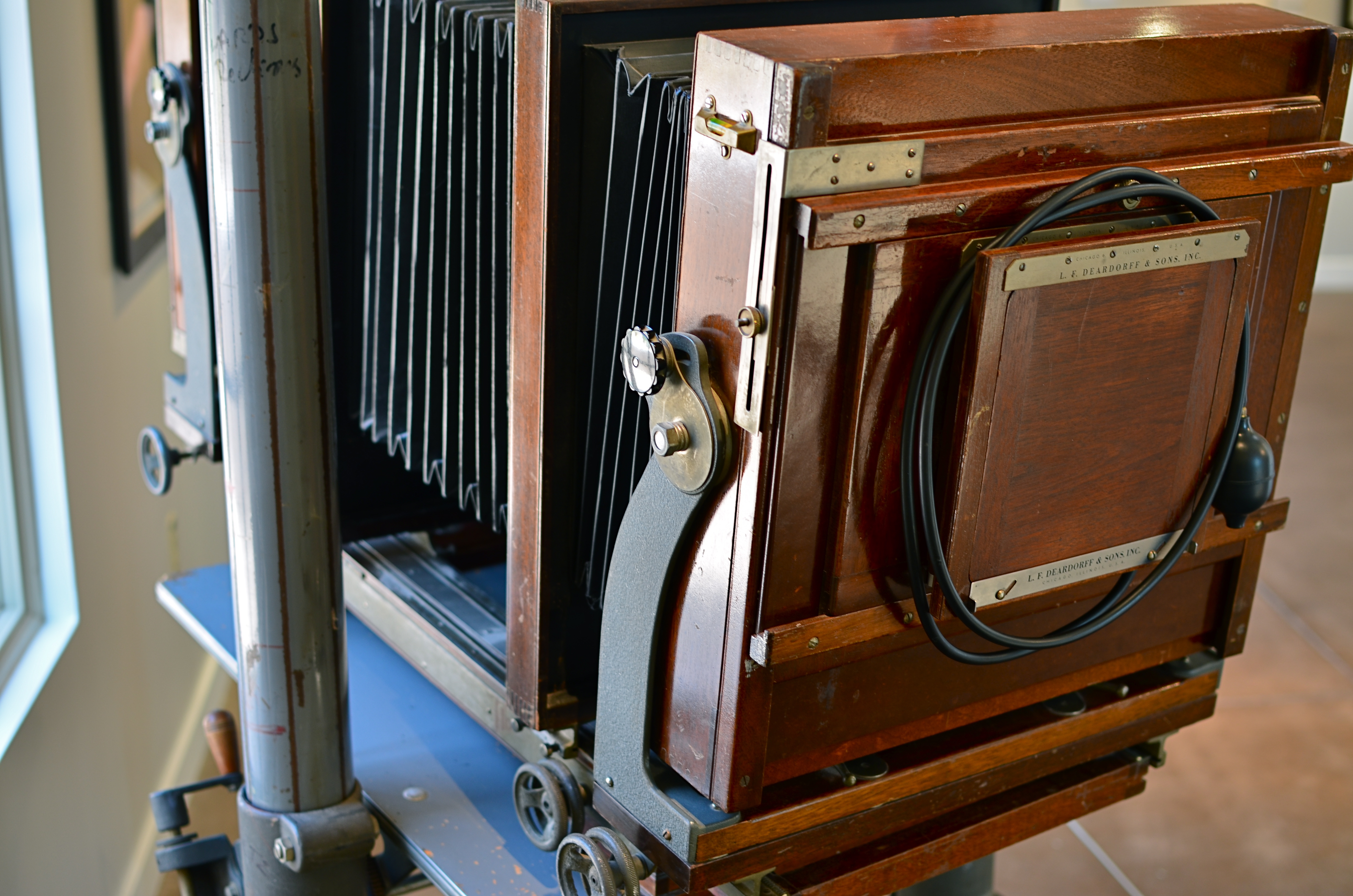
Taking control of your photography can be a daunting process.
By MICHAEL PERKINS
VISITORS TO THE FACTORY HEADQUARTERS OF BEN & JERRY’S ICE CREAM in Stowe, Vermont, upon completing the standard tour of the works, are encouraged to climb a small hill out back of the building to view the company’s Dead Flavor’s Graveyard, an actual cemetery, complete with elegantly epitaphed tombstones and dedicated to such failed B&J varietals as Turtle Soup, Fossil Fuel, White Russian and Sweet Potato Pie. It’s a humorous way to point out that, even for talented startups, there’s no such thing as a direct shot up the mountain of fame. We duck. We detour. We change direction. It’s a process, not a product.
Photography is, in this way (and in no other way that I can think of) much like ice cream.
As we clear the 500 mark on posts for The Normal Eye, I want to (a) profoundly thank all those who have joined us on the journey, and (b) restate that, as our sub-head reads, it really is about a journey, rather than a destination. This small-town newspaper began because I had met so many people over the years who had become suspicious of their camera’s true intentions. Sure, they admitted, the automodes do pretty great on many pictures, but what if I actually want some say in the process? Can I be an active agent in the making of my own pictures?
Now, these weren’t people who wanted to purchase $10,000 worth of gear, sell their houses, abandon their children, and become photo gypsies for NatGeo. These were simply people whose photographic curiosity had finally got the better of them. What would happen, they asked, if I were to, all by myself, make one little extra choice, independent of the camera’s superbrain, before the shutter snapped? And what if I made two? Or three? Other questions followed. What is seeing? How do you learn to value your own vision? And what tasks from the era of film still apply as solid principles in the digital age?
The Normal Eye has spent the last four years trying to ask those questions, not from a top-down, “here is how to do it” approach, since so many of these solutions must be privately arrived at. This is not, and will never be, a technical tutorial. I reflect on what thoughts went into a particular problem, and how I personally decided to try to solve it. The results, as are all my words, are up for debate.
It’s humbling to remember that, in photography, there is always more than one path to paradise. And when I find myself being crushed under the weight of my own Dead Flavor Graveyard, I take heart in those moments when your feedback has made a difference in my motivations, or methods, or both. Recently, I received what I still cherish as one of the best comments over the entire run, with one gentleman proclaiming:
I’m not a fan of words, but the ones in this article are in a tolerable sequence.
Hey, that’s enough to hold me for another 500, and I hope you’ll be along for the ride.
CHOCK-A-BLOCK
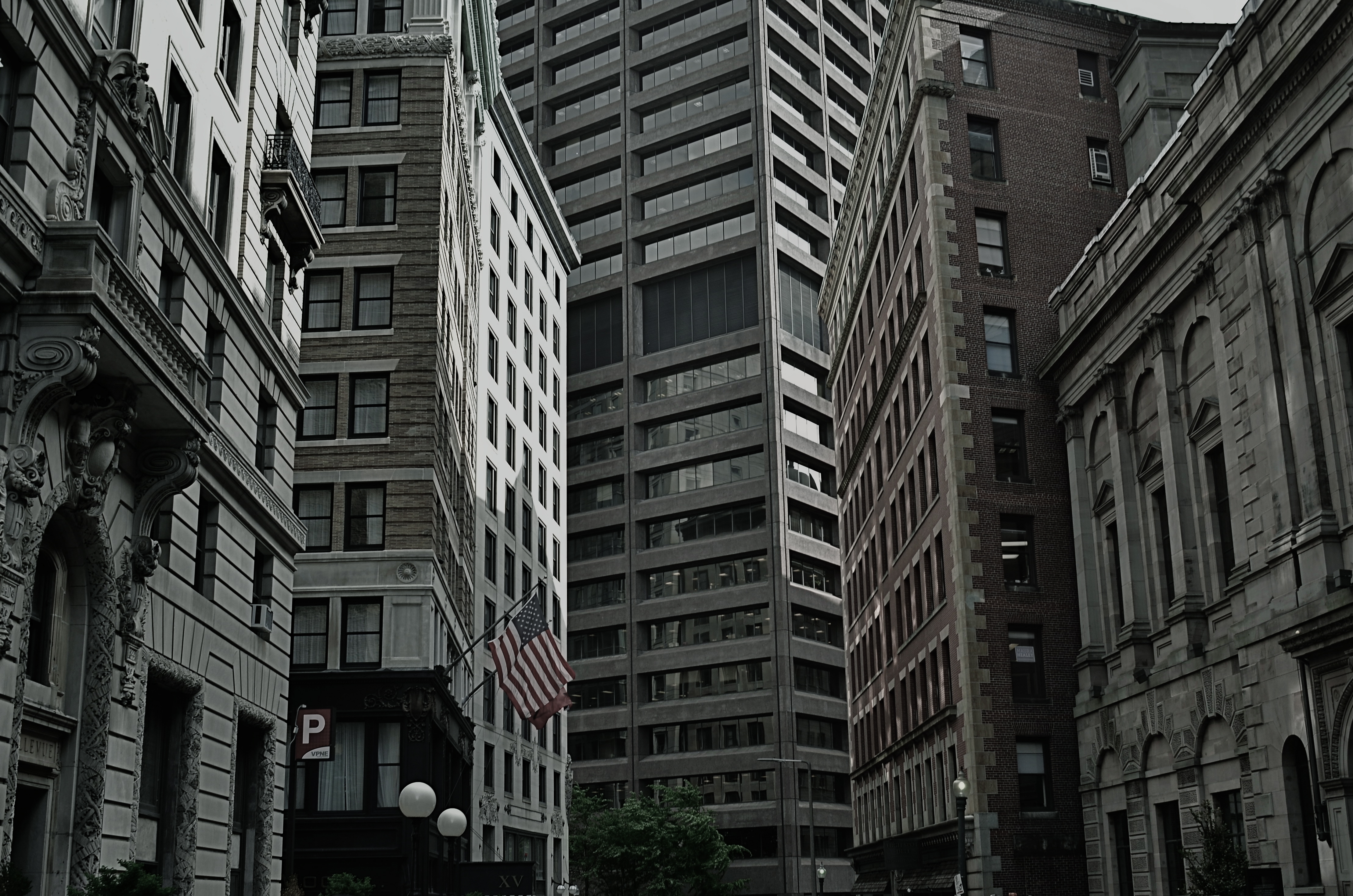
Yes, you could find a more frustrating job than making city maps for Boston streets. But you’d have to look hard….
By MICHAEL PERKINS
WHEN WE THINK OF URBAN BLOCKS, IT’S NATURAL TO THINK of those blocks as regular rectangles, well-regulated, even streets that run at direct parallels or hard right angles to each other. And while there certainly are cities with such mathematically uniform grids, some of the most interesting cities in the world don’t conform to this dreamy ideal in any way. And that means opportunities for photographers.
We’ve all seen street scenes in which the left and right sides of the road vanish directly toward the horizons, like staring down the middle of a railroad bed. But for the sake of dramatic urban images, it’s more fun to seek out the twisty mutants of city design; the s-and-z curves, the sudden zigzags, the trapezoids and triangles which signify confusion to cabbies and pedestrians but which mean good times for photogs. Let’s face it; snapping pictures of orderly things gets old fast. The very nature that makes us idealize “rightness” also makes us want to photograph “wrongness.”
That’s why I love to shoot in towns where the city was laid out with all the logic of the Mad Hatter on speed, those streets that seem barely coherent enough to admit the successful conduct of trade. Cities where locals and visitors alike curse the names of the urban planners, if there ever had been planners, if there ever had been a plan. A grand collision of avenues and alleys that looks like a kid whose teeth are crowding together in a greedy orthodontist’s dream fantasy. In such cities, including Manhattan, Pittsburgh, San Francisco, Boston and many others, “order” is a relative term. There are precious few neat streets vanishing back to infinity, politely lined by cooperative structures queueing up parallel to the curb. And that’s my kind of living, breathing… chaos.
As a mild example, consider the Boston street shown above, on which nearly every building seems slightly askew from every other building, sitting on foundations that jut out at every conceivable angle and plane. It’s a grand, glorious mess, and a much more interesting way to show the contrasting styles that have sprouted in the neighborhood over the centuries. It’s reality that looks like an optical illusion, and I can’t get enough of it.
A straight line may be the shortest distance between two points, but it’s also the least interesting. Go find cities that make no sense, God bless ’em.
WINDOW OF OPPORTUNITY
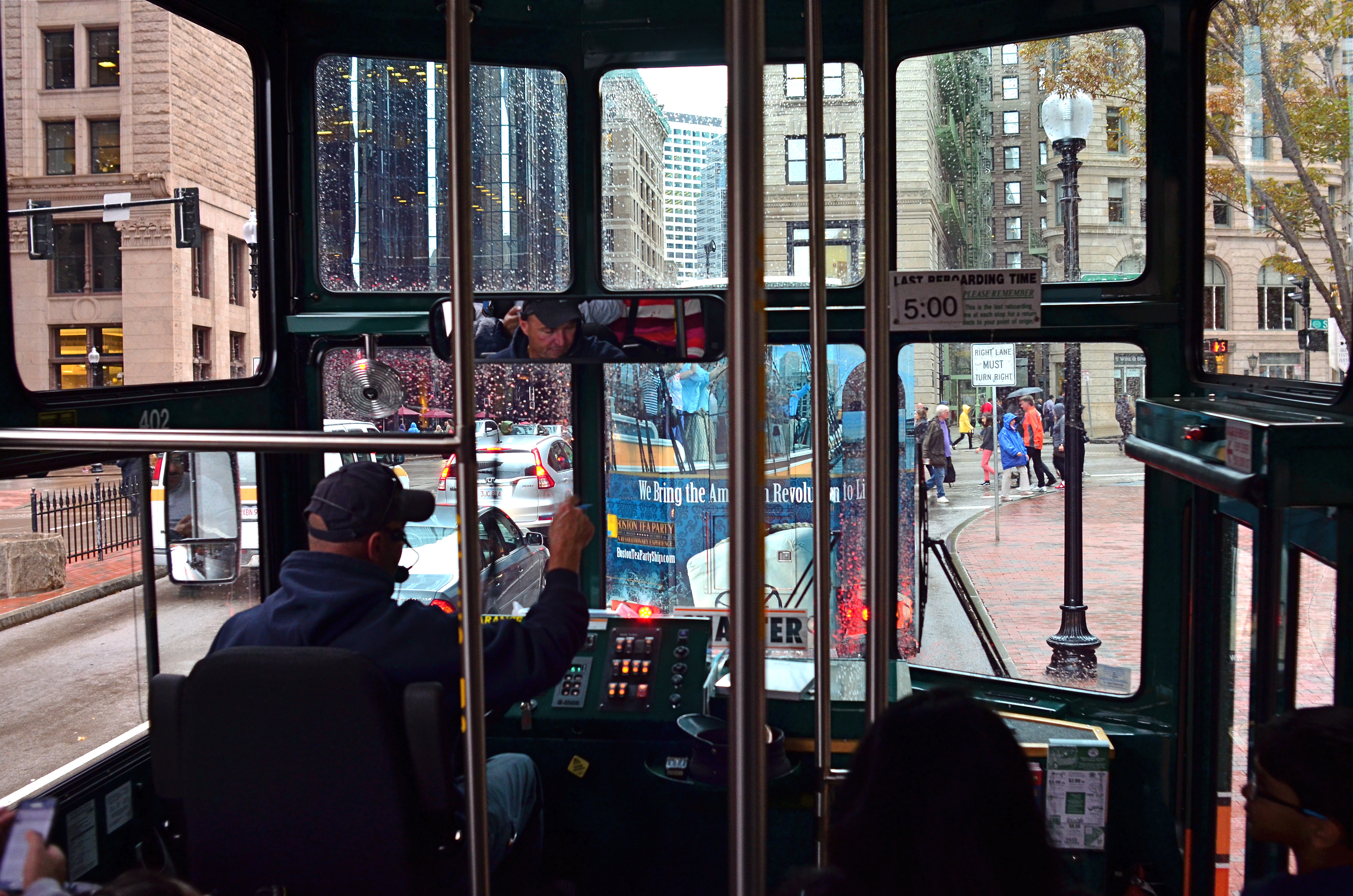
“…the driver on the bus says……” Sometimes a window is part of the story.
By MICHAEL PERKINS
PHOTOGRAPHERS’ FIRST USES OF FILTERS WERE AS THE TWIST-ON TOOLS designed to magnify, nullify or modify color or light at the front end of a lens. In the digital era, filtration is more frequently added after the shutter clicks, via apps or other post-production toys. You make your own choice of whether to add these optical layers as a forethought or a post-script. However, one of the simplest and oldest of filtering options costs no money and little time, and yet continues to shape many a great image: a window.
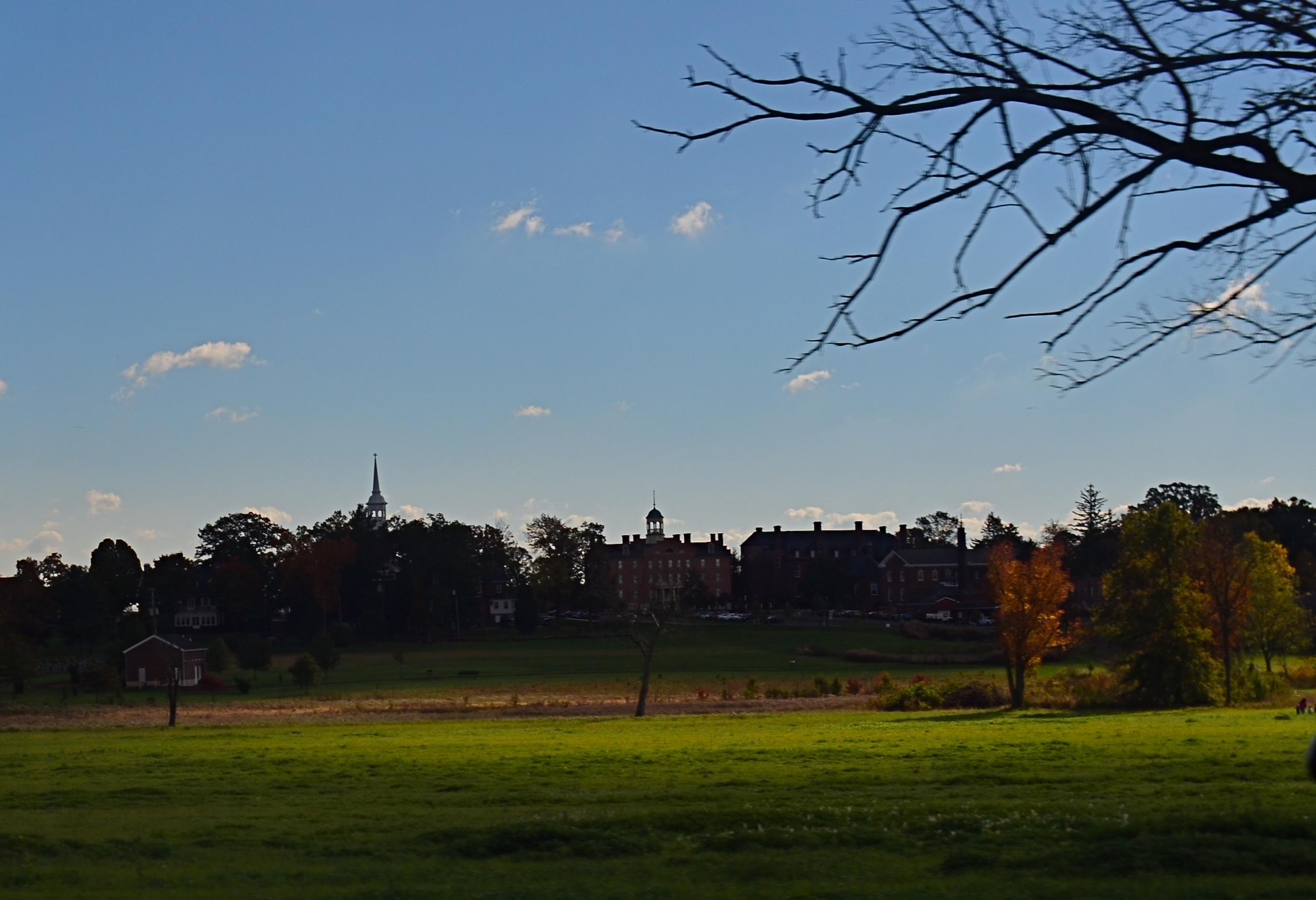
Early morning + tinted window=moody, right? Gettysburg from the tour bus.
No panes are optically identical, just as the lighting conditions that affect them are likewise completely unique, so the way that they shape pictures are constantly in flux, as are the results. It’s no surprise that the shoot-from-the-hip urban photographers who favor spontaneity over all pay little attention to whether shooting through a window “ruins” or “spoils” an image. Taking an ad-lib approach to all photographic technique, the hip shooters see the reflections and reflections of glass as just another random shaper of the work, and thus as welcome as uneven exposure, cameras that leak light, or cross-processed film: another welcome accidental that might produce something great.
Windows can soften, darken or recolor a scene, rendering something that might have been too strait-laced a little more informal. This quality alone isn’t enough to salvage a truly bad shot, but might add a little needed edge to it. The images seen here were both “what the hell” reactions to being imprisoned on tour buses, the kinds that don’t stop, don’t download their passengers for photo or bathroom breaks, or which are booked because I am tired of walking in the rain.
In the case of the tour driver’s cab, his inside command center and personal view are really part of the story, and may outrank what he’s really viewing. In the side-window shot of an early morning in Gettysburg, Pennsylvania, the tinted glass acted much in the way of a polarizing filter, making the resulting photo much moodier than raw reality would have been.
Which is the point of the exercise. When you feel yourself blocked from taking the picture you thought you wanted, try taking it the way you don’t think you want to. Or just think less.
Wait, what did he just say?
WEIRD SCIENCE
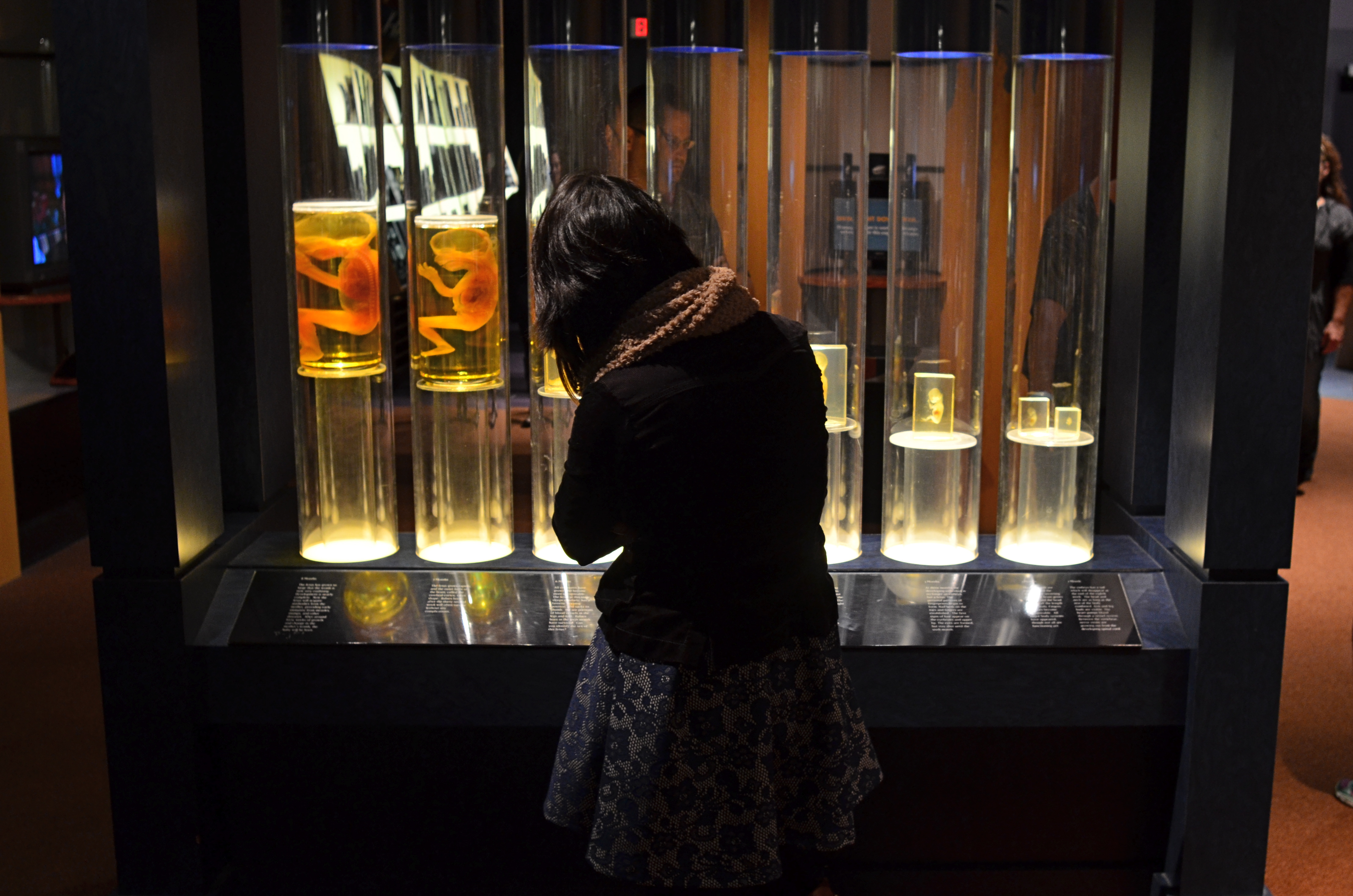
The fetal gestation timeline at Columbus, Ohio’s Center Of Science & Industry. 1/60 sec., f/3.5, ISO 500, 24mm.
By MICHAEL PERKINS
ONE OF THE RITES OF PASSAGE FOR SCHOOL KIDS IN COLUMBUS, OHIO IN THE 1960’s was a field trip to the Center of Science and Industry, or COSI, one of the nation’s first interactive tech museums, mounted before either the terms “interactive” or “hands-on” were common parlance. In those JFK-flavored days of early space exploration and Jetson-gee-whiz futurism, flying cars and picture phones seemed our inevitable legacy, and the Center’s exhibits often veered closer to the World’s Fair than the science fair, its dazzling displays often trumping pure enlightenment. A generation later, the sizzle lingers in the mind a little better than the steak. Something to work on.
Science was presented as something of a magic trick then, a sure and certain answer to all human needs and desires. But to my tween-sized mind, it also retained an air of mystery, something wondrously alien to my daily experience. Few of COSI’s exhibits from the time created more of a sense of wonder in me than an illuminated timeline of fetal gestation, with each crucial stage between embryo and newborn illustrated by a separately preserved specimen of a transitional human that never made it to the delivery room. As fascinating as the display was, it was also a little creepy, somewhat like, if you will, viewing pre-mummies from a colony of visitors from the future.
In a recent visit to the new COSI, now re-located to a larger, brighter HQ across from Columbus’ downtown riverfront, I was both amused and amazed to see that the timeline had been retained in nearly the same way I remembered it from 1964. Having survived to the era of iPhones and DNA mapping, its dim, the strange, amber-glow profiles still had a hypnotic effect on me, housed as they were in a dark, shadowy sector of the museum, sealed within a showcase that distorted the faces of passersby, even as it shrouded their bodies in mystery. For the shot you see here, I liked the strange juxtaposition of the exhibit’s clinical coldness with the form of a young visitor, casually viewing the timeline as if it were no more notable than a collection of butterflies. I shut the exposure down so that the case provided the only light, opened the lens as far as I dared for the right depth of field, and jacked the ISO slightly to compensate for the murky room ambience.
The COSI of the New Frontier years was always a place that could cast science in a distinctly optimistic light. In 2015, I hoped to re-imagine that magic through the insight of an additional fifty years of living. Mood in photography is created as much by what you conceal as by what you reveal, and trying to get that balance right is 90% of the game.
A WHITER SHADE OF PALE
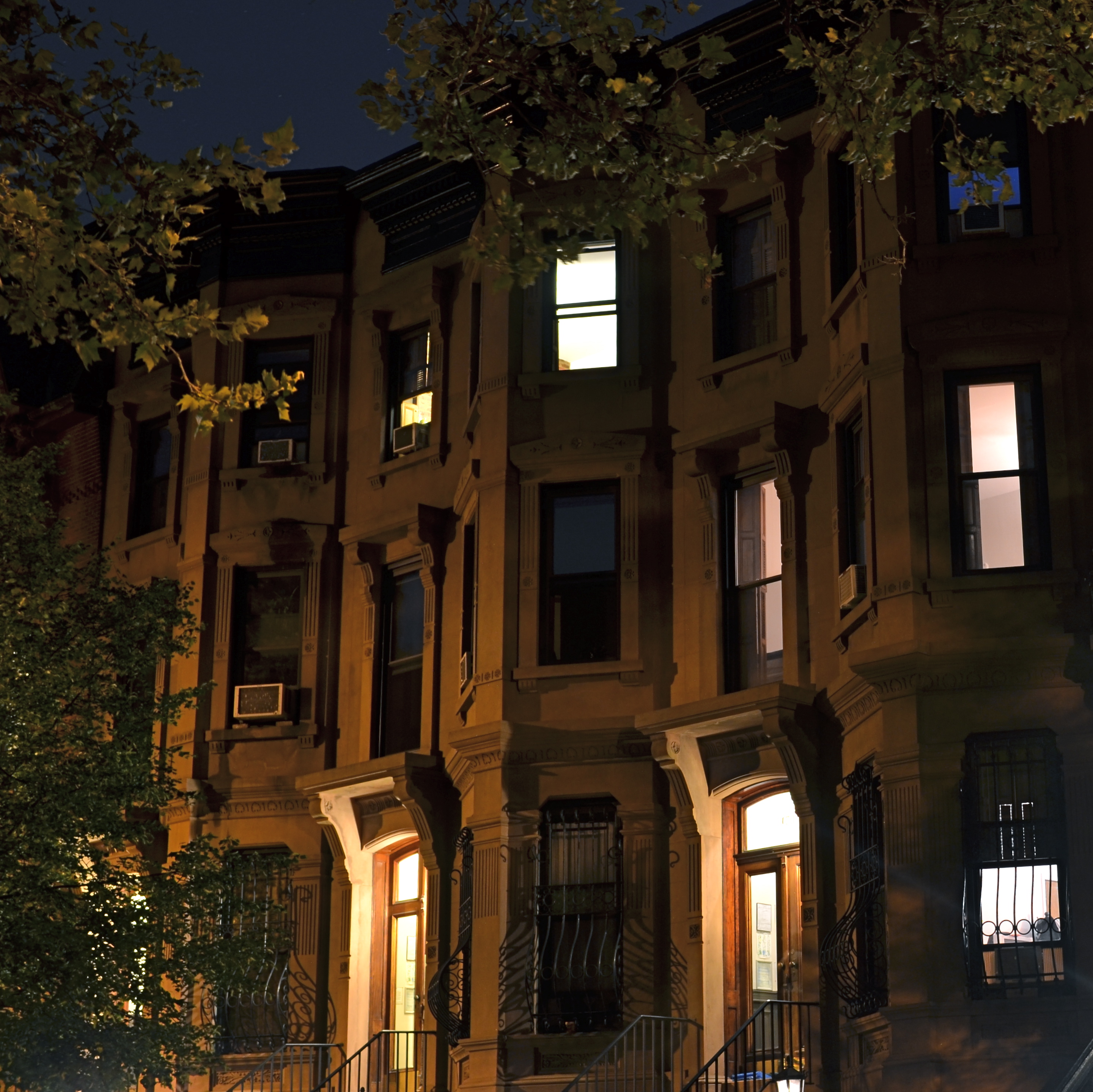
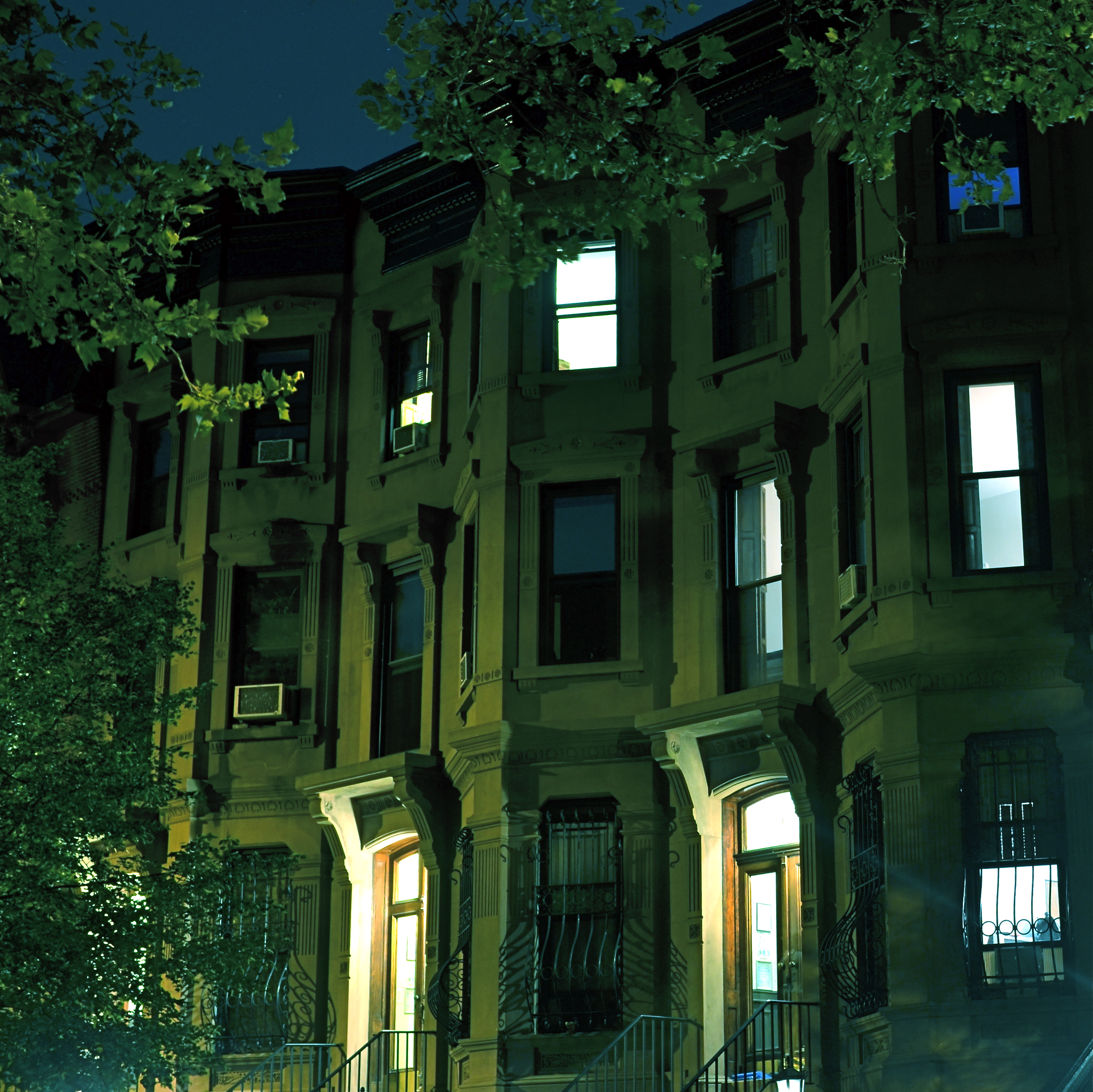
Will energy-efficient street lighting make your neighborhood look like this….
By MICHAEL PERKINS
IN THE FACE OF CHANGE, HUMANS WILL DOGGEDLY DEFEND ALMOST ANYTHING, as long as they’ve grown accustomed to it. At their introduction, we inveighed against the intrusion of the telephone (the end of privacy!) and the automobile (they scare the horses and they’re filthy!), but soon learned to love chatting, well, from our freaking cars, so…
One of the things solid citizens of the late 1800’s most objected to was the slicing of the night by the first network of urban street lamps, which were excoriated in editorials from New York to Paris. An invasion! An insult! Unnatural.
Boy, if they could see us now.
In the name of energy savings and sustainability (both good things, right?), street lights across the country are in the midst of a rapid conversion from several types of fluorescent lamps to LEDs. They last longer, they burn cheaper, they cost less. All to the good, except that the light these new torches deliver is blue, pale, cold, and, in the minds of many, harsh. Even those who champion ecologically righteous causes are squinting at LEDs which strike them as grim, sickly, colorless and (wait for it) unnatural.
Writing in the New York Times in the essay “Ruining That Moody Urban Glow“,
…or this?
novelist Lionel Shriver calls LED light “conducive to dismembering a corpse” and cites studies that claim the fixtures contribute to sleep loss, mood disorders, and, who knows, ingrown toenails. For photography (you knew I’d get here eventually), the new light presents a completely fresh challenge to your camera’s ability to achieve white balance, or an accurate reading of white values according to a given light’s temperature, expressed in degrees Kelvin.
Conventional lights are lower on the Kelvin scale, thus warmer, with more yellow in the mix. LEDs are higher in Kelvin value and register blue-white, muting or mutating colors. At present, both Canon and Nikon have many in-camera settings to balance for a number of sodium-vapor or fluorescents, but have yet to offer options for adjusting for LEDs, even though entire cities have made the switch to what many feel is an ugly, stark source of illumination.
In her Times article, Shriver notes that there are, in fact, subtler types of LEDs, which sacrifice only a bit of energy efficiency and yet emit warmer light, and advocates that citizens go proactive to keep their neighborhoods from looking like the parking lots on interstate truck stops. So take that for what it’s worth. But be aware that more and more of your night shots may, in the near future, have to be adjusted in post-production to resemble a century in which you feel at home.
THE WRITE SIDE OF HISTORY
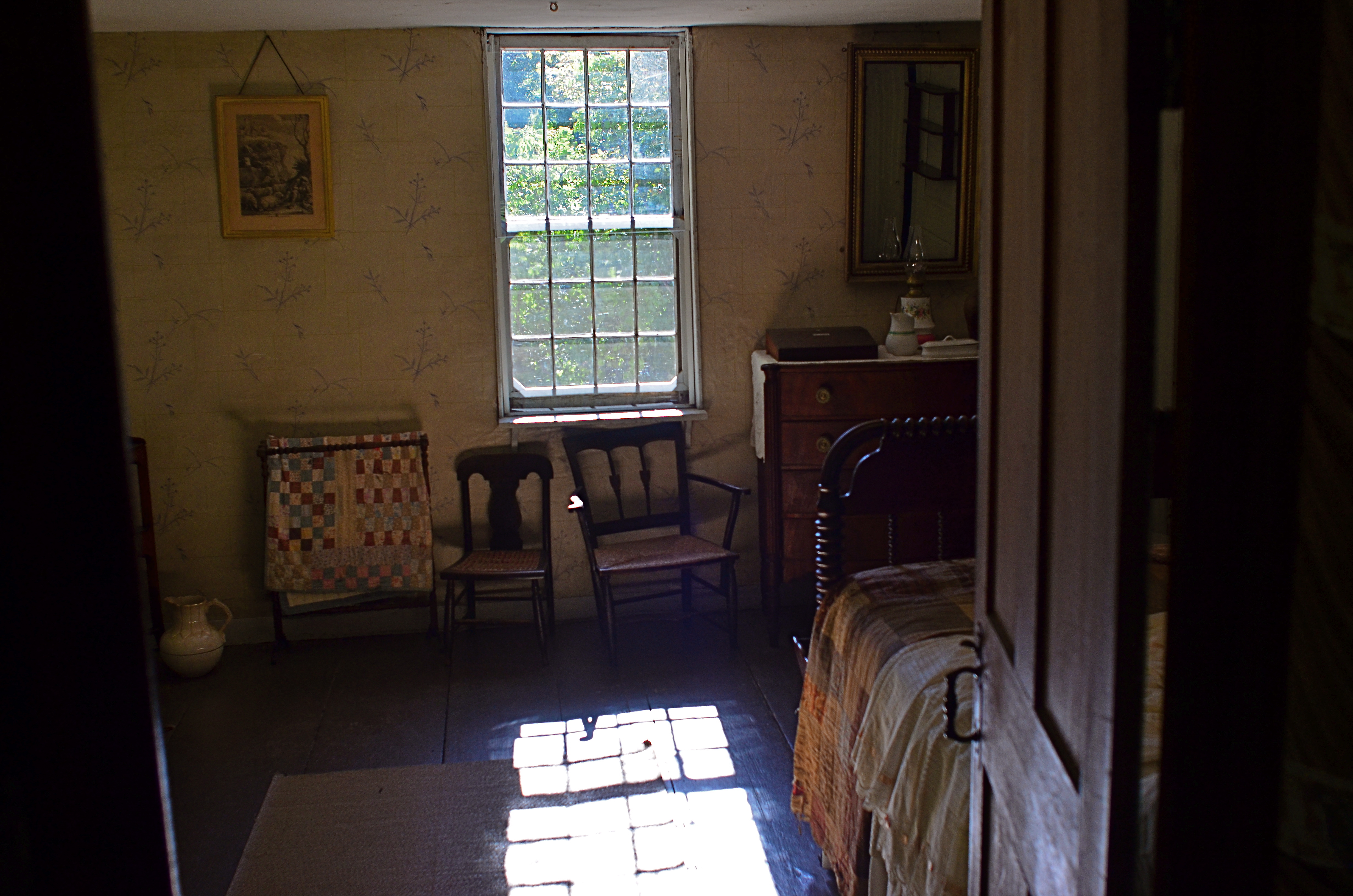
A sunlit bedroom at the Old Manse, the farm home built for the grandfather of Ralph Waldo Emerson.
By MICHAEL PERKINS
THERE CAN BE NO BETTER DEMONSTRATION OF THE HUMAN RACE’S TWO CONFLICTING APPROACHES TO EXISTENCE than are on display in the peaceful town of Concord, Massachusetts, where one of the most renowned jumping-off sites for war and destruction sits cheek-by-jowl with one of the quietest monuments to the serenity of the mind. It’s a contrast which no photographer should fail to experience.
Just a few hundred yards from the tiny footbridge which is rumored to have launched the American Revolution is a carefully preserved haven known as the Old Manse, a modest two-story country home built in 1770 for patriot minister William Emerson. The home came, eventually, to temporarily host a trio of the young nation’s most eloquent voices: Nathaniel Hawthorne, Henry David Thoreau, and Ralph Waldo Emerson (the good minister’s grand-son).
The house remained in the hands of the extended Emerson family until as late as 1939, when it was conveyed to the state’s Trustee of Reservations. Over the years, the Manse helped incubate the energies that produced Emerson’s Nature, Hawthorne’s Mosses From An Old Manse, and various love poems written between Thoreau and his wife. The house also retains writing desks used by Hawthorne and Emerson.

Over 90% of the Manse’s original furnishings from the 18th century have been preserved.
The manse supports itself, its side garden and its replica corn field with a modest bookstore and daily walking tours of the house’s rooms, which are said to feature nearly 90% of the structure’s original furnishings. However, as is the case with Annie Liebowitz’ profound essay on the living spaces of quintessential Americans, Pilgrimage, the effect of the house on the photographer’s eye can never only be in the arrangement of physical artifacts. There is something more ethereal going on than merely snapping The Place Where He Sat And Wrote, an unfilled space that exists between these mere things and the essence of those transcendent writers.
And while I’m not sentimental enough to believe that you can render a person just by photographing an object from his desk, there is something that lingers, however impossible it is to quantify. Revolutions are very amorphous things. Some come delivered by musket ball. Others arrive in wisps of quietude, seeping into the soul with the stealth of smoke. The Old Manse launched its own crop of “shots heard ’round the world”, the echoes of which can sometimes resound in the echo of an image.
It’s a lucky thing to be ready when the message comes.
WAIT FOR IT….

A decent start..and yet..
By MICHAEL PERKINS
ONE OF THE GREATEST PERKS IN DIGITAL PHOTOGRAPHY is making it easy and affordable to squeeze off as many shots on a given occasion as was only possible, in films days, for well-financed pros. The history of photojournalism is rife with stories of shooters who shot four, five, even six rolls of film to produce four magazine illustrations….a yield ratio that made put those same shots insanely beyond the budget of John Q. Viewfinder. Simply put, many of us just could not afford to shoot enough bad frames to get to the good ones.
That’s all in the past now. if we update our thinking.
We still have a tendency, when shooting a subject, to stop too soon, that is, as soon as an acceptable image emerges. Give many of us 60% of what we were going for, and we tend to stand down, move on, and live with a result that we may later see as a compromise. That’s old thinking based on our years of “I only have ten shots left”, and the idea of budgeting a finite commodity, like film frames. It’s important now, however, to actually develop the habit of over-shooting, of covering our targets from as many conceptual approaches as possible. Close shot. Medium shot. Reverse angle. Looking down from above. A few tries shooting at the “wrong” shutter speed or aperture. In other words, don’t settle too soon.

Closer to the mark..and yet..
I had a great subject in a recent walk across a small footbridge as a kayaker began a slow trek that would eventually take him toward me, underneath my stance atop the bridge, and then back into brilliant sunlight. He was taking his time, so that I could take mine, and I began by thinking that the shot I wanted was the easiest one, as he approached me head on. However, something told me that his relationship to the light would change dramatically as he crossed under the bridge, and it did.
As he emerged from beneath the span, I shot him in a straight overhead, and then came the money shot, as the kayak seemed to divide the water into rich, detailed ripples on the right side of the boat, and shining sparkles on the other side. Hardly a world-beating shot, but far more dramatic than the one I originally thought I wanted. Had I decided to accept the first frame, the third one would never have been captured. It certainly was no great technical struggle to take the final picture, nor were the extra few seconds a major strain. Simply, the deciding factor was to want the picture, and to wait long enough for it to come to me. It was worth it:
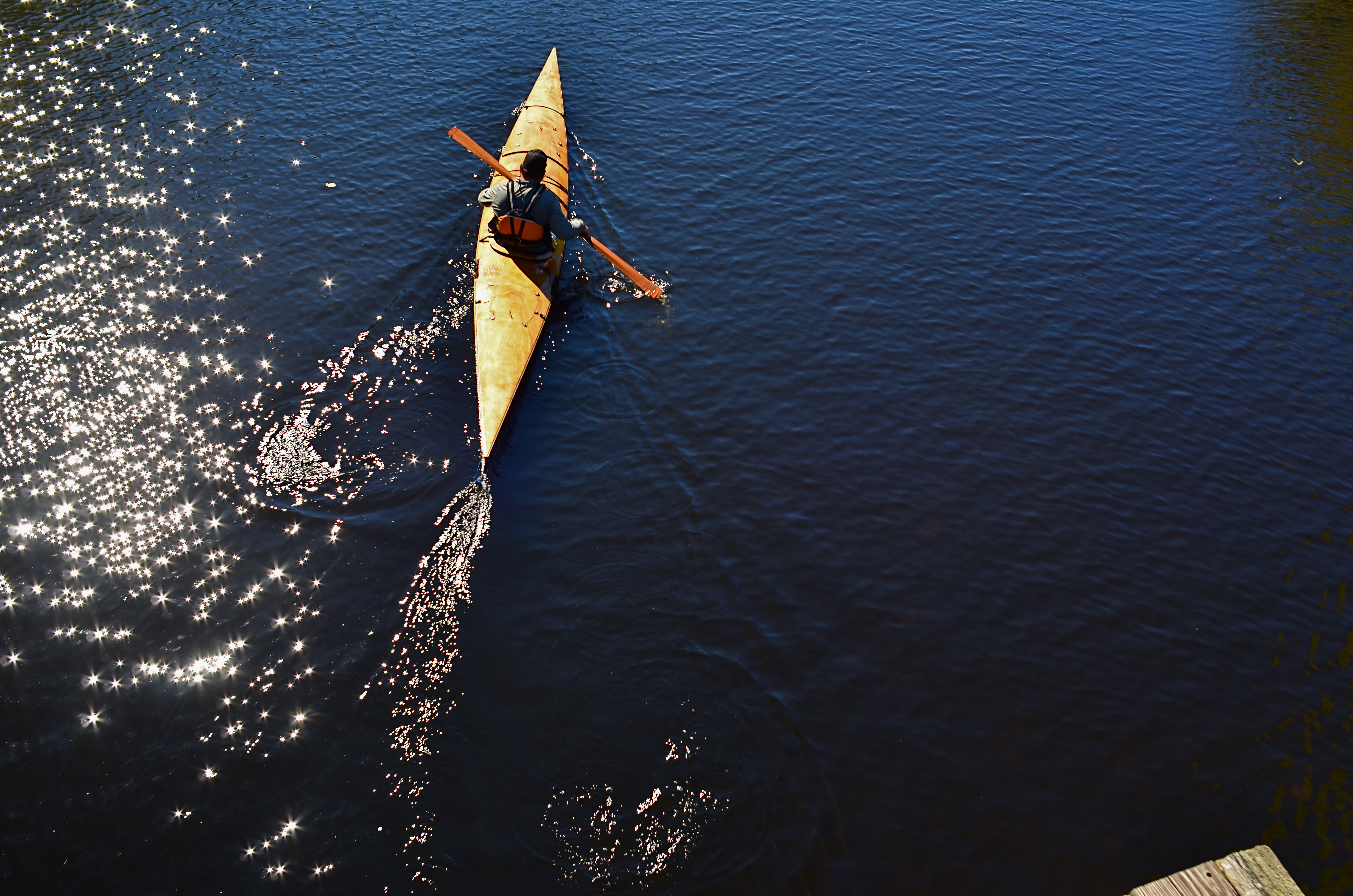
The keeper.
If you must err, err on the side of taking too many shots of something. It’s a lot easier to trim away the excess than to mourn over the miracles that never got born.
THE ONLY REAL PRIORITY
By MICHAEL PERKINS
THERE ARE MANY VALUABLE SERVICES OUR CAMERAS WILL RENDER without our consent or participation. Without even considering how many people shoot on full automatic 100% of the time, there are a hundred small calculations that these marvelous devices make to prevent the kind of errors in judgment that used to routinely trip us up, from autofocus and white balance, face detection and contrast control. However, there is a variable percentage of decisions on which we should really take personal action, despite the camera’s best efforts to, in effect, save us from ourselves.
In iffy light situations, for example, several key “semi-auto” modes are truly handy in helping us compensate for grey days or dark corners. One of these is called aperture control, in which you dial in the f-stop you want, based on your preferred depth of field, leaving the camera to set the shutter speed needed to properly expose at that aperture. At first blush, this seems to be a great short cut, and is in fact a neat option for people who are “running and gunning”..shooting lots of frames in a very quick time span. However, what looks like cutting your work in half can also mean cutting the legs off your creativity.
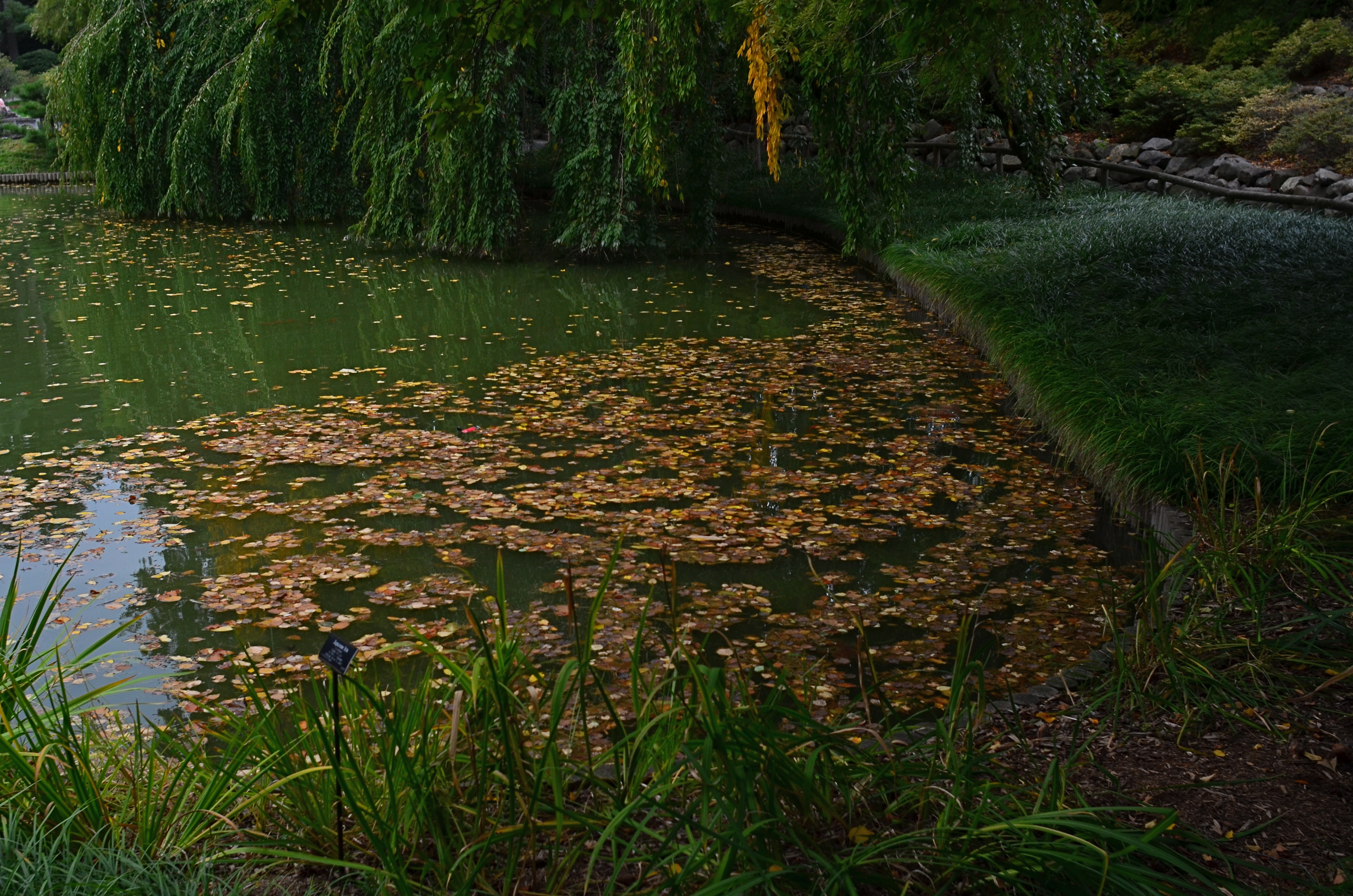
Aperture priority would have worked too hard to make this exposure “balanced”, which was the opposite of what I wanted.
In the above situation, I had a severely overcast day in a lushly green Japanese garden. Without shadows for contrast, I would need colors to be as deep as possible to bring off the mood I was going for, so a slightly underexposed look seemed to be in order. Dialing in f/5.6 as a desired D.O.F. in aperture priority was giving me very slow shutter speeds as the camera tried to give me an ideal exposure. This made a handheld shot a little tougher and gave me way too much high color to suggest anything quiet or moody.
Going to full manual, I dialed in a shutter speed that would render the greens nice and deep, around 1/80, and bumped up the ISO a tad as insurance. It was true that I was shooting a lot at the same f-stop, but not so fast that I would have to surrender fine control by shooting in aperture priority for mere convenience’s sake.
I love some of the protections against my own folly offered by today’s devices, but I just can’t go completely driver-less and feel that I am taking enough responsibility for my results. Hey, if I blow it completely, I can still explain a lousy shot in two simple words.
“…stupid camera…”
SEE DICK THINK.
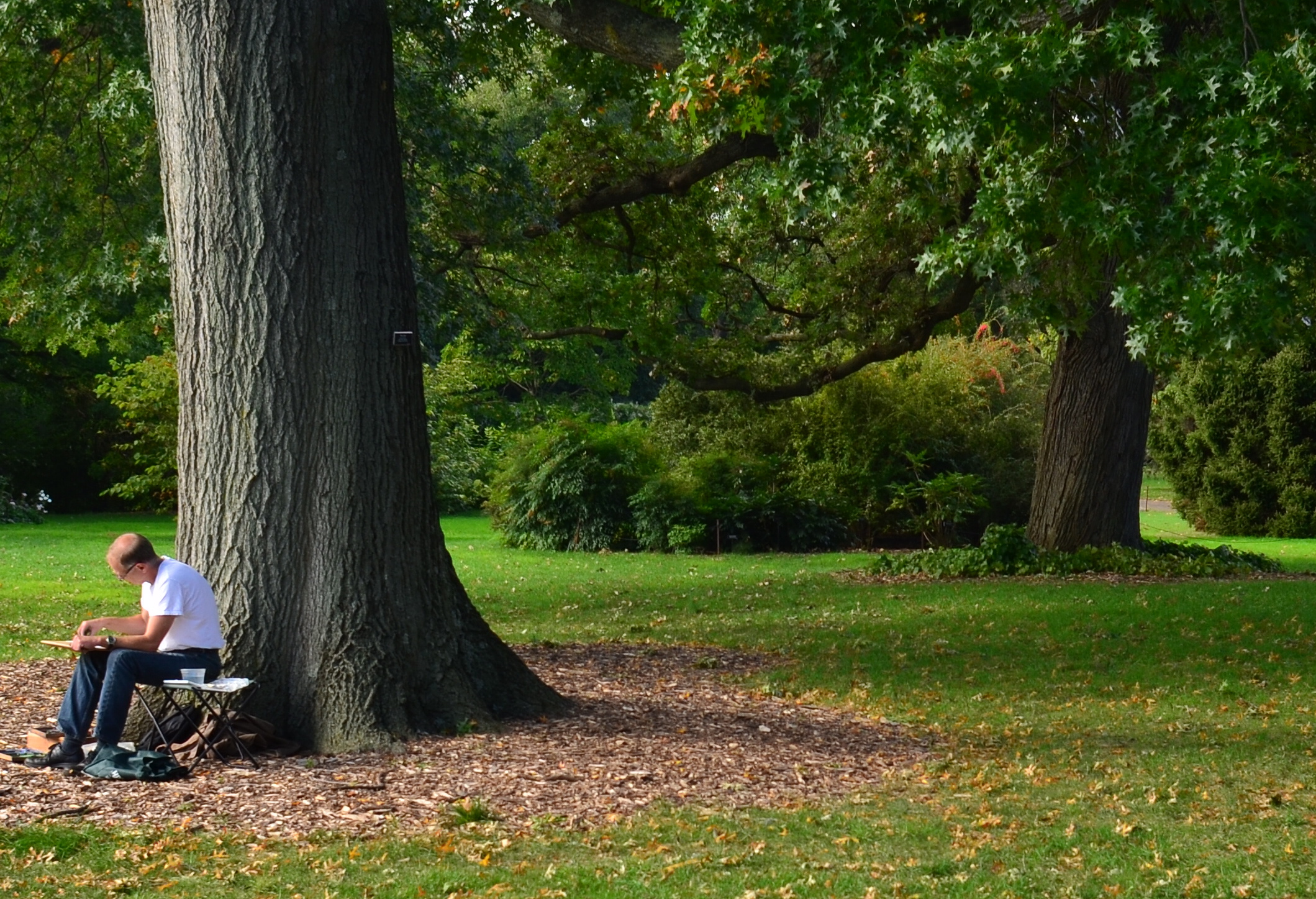
Slow yourself down by shooting someone who is slowing himself down.
By MICHAEL PERKINS
FORGET BLOWN EXPOSURES, SHAKY SNAPSHOTS, AND FLASH-SATURATED BLIZZARDS. The hardest thing to avoid in the taking of a picture is winding up with a picture full of other people taking a picture. Hey, democracy in art, power to the people, give every man a voice, yada yada. But how has it become so nearly impossible to keep other photographers from leaning in, crossing through, camping out or just plain clogging up every composition you attempt?
And is this really what I’m irritated about?
Maybe it’s that we can all take so many pictures without hesitation, or, in many cases, without forethought or planning, that the exercise seems to have lost some of its allure as a deliberate act of feeling/thinking/conceiving. Or as T.S. Elliot said, it’s not sad that we die, but that we die so dreamlessly. It’s enough to make you seek out things that, as a photographer, will actually force you to slow down, consider, contemplate.
And one solution may lie in the depiction of other people who are, in fact, taking their time, creating slowly, measuring out their enjoyment in spoonfuls rather than buckets. I was recently struck by this in a visit to the beautiful Brooklyn Botanical Gardens on a slow weekday muted by overcast. There were only a few dozen people in the entire place, but a significant number of those on hand were painters and sketch artists. Suddenly I had before me wonderful examples of a process which demanded that things go slowly, that required the gradual evolution of an idea. An anti-snapshot, if you will. And that in turn slowed me down, and helped me again make that transition from taking pictures to making them.
Picturing the act of thought, the deep, layered adding and subtracting of conceptual consequence, is one of the most rewarding things in street photography. Seeing someone hatch an idea, rather than smash it open like a monkey with a cocoanut does more than lower the blood pressure. It is a refresher course in how to restore your own gradual creativity.
STAKES IN THE GROUND
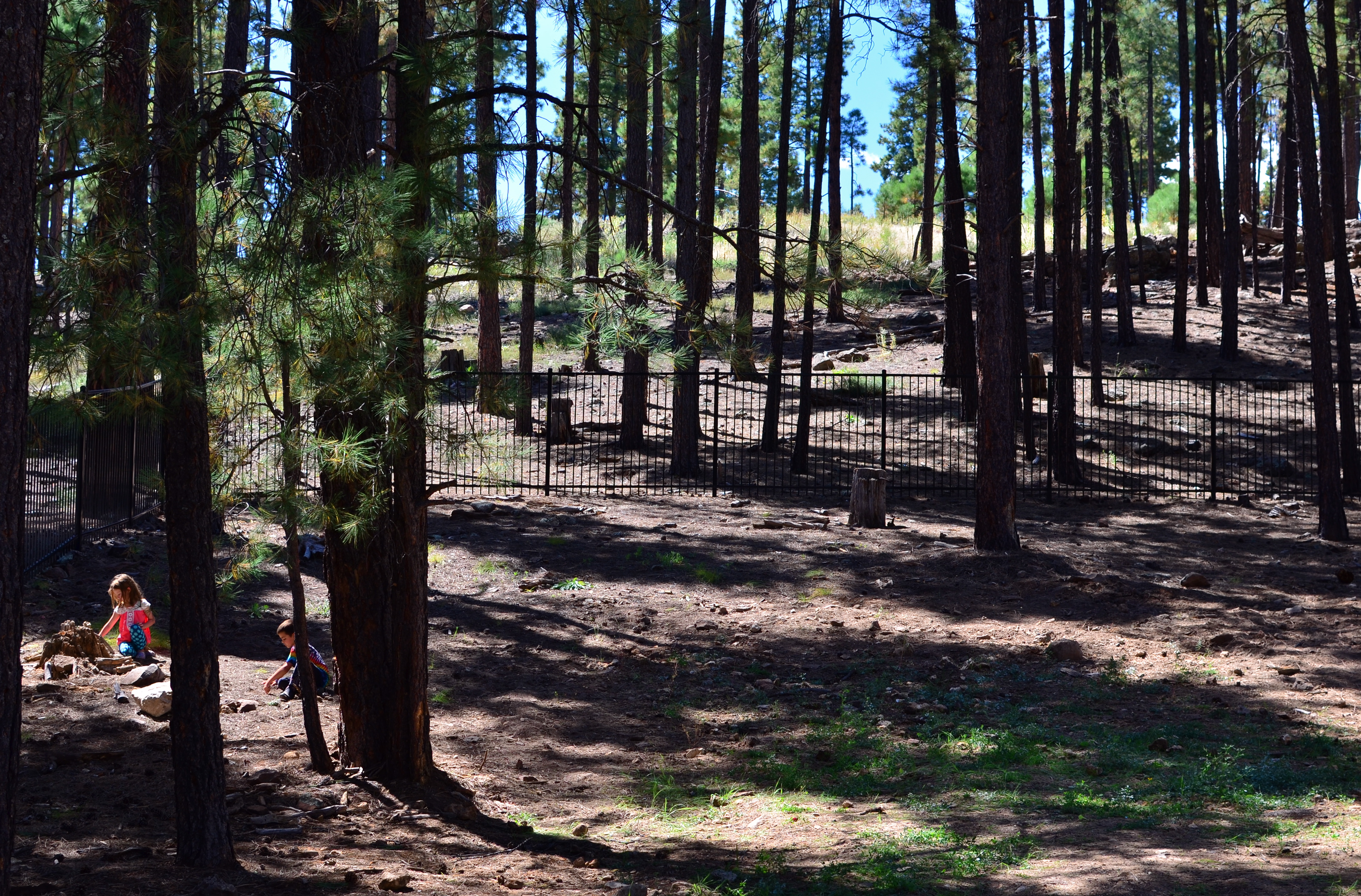
We Seemed To Be The Entire World, 2015. 1/60 sec., f/5.6, ISO 100, 35mm.
By MICHAEL PERKINS
NO DOUBT YOU KNOW WHAT IT FEELS LIKE TO SEE A PICTURE IN YOUR MIND that, for some reason, doesn’t make it into the camera.
It’s maddening. That fumbling few inches between success and failure that cannot always even be sensed during the taking of an image, but which, somehow, is as wide as a river gorge once the picture comes out. Dammit, you saw it. More importantly, you felt it. But something in perhaps a technically perfect photograph fails to engage, and the thing just can’t close the sale.
Going further with the metaphor of salesmanship for a moment, there are pictures which, in a manner of speaking, don’t “ask for the order”. They don’t effectively say, here is the main point of interest. Look here, then there. The best photos are triptychs in that they have a sense of inevitable direction. Your eye senses where to travel with the frame.
In the above forest scene, I nearly failed to provide that impetus because, in my first few shots, I was overly centered on getting the contrasty elements of the picture from fighting each other. Some trees came out like silhouettes. Some parts of the forest floor were way too bright. Somewhere along the line, I had decided that the picture was about solving those purely technical problems. Check those items off, I thought, and you’d have a real nice nature scene, or so it seemed at the time. Only one lucky thing intervened to change my mind and save the picture.
This comes under my general belief that most of the things you need to fix a composition are mere inches away from where you’re already standing. In this case, I moved a bit to the left of several trees and two small children swung into view, both of them representing a dynamic dollop of color in an overly bland palette of shades. Suddenly the picture was about these kids stealing away, inhabiting a quiet, separate world, their size dwarfed by the pines while giving measurable scale to the entire woods. They had found a complete reality away from everyone, and it would be easy to show that. Cropping to have them enter the frame at the bottom left corner helped direct the eye where I needed it to go first. Start here, and then look beyond.
It’s helpful to regularly dissect the pictures that almost had enough story to sell themselves. What stakes could I have pounded into the ground to mark the outline of the idea? Where did I fail to lay out the territory of the story?
It’s all about getting that image from your mind into the camera. That’s everything. That is, ever and always, the problem to be solved.
MODEL CITIZENS
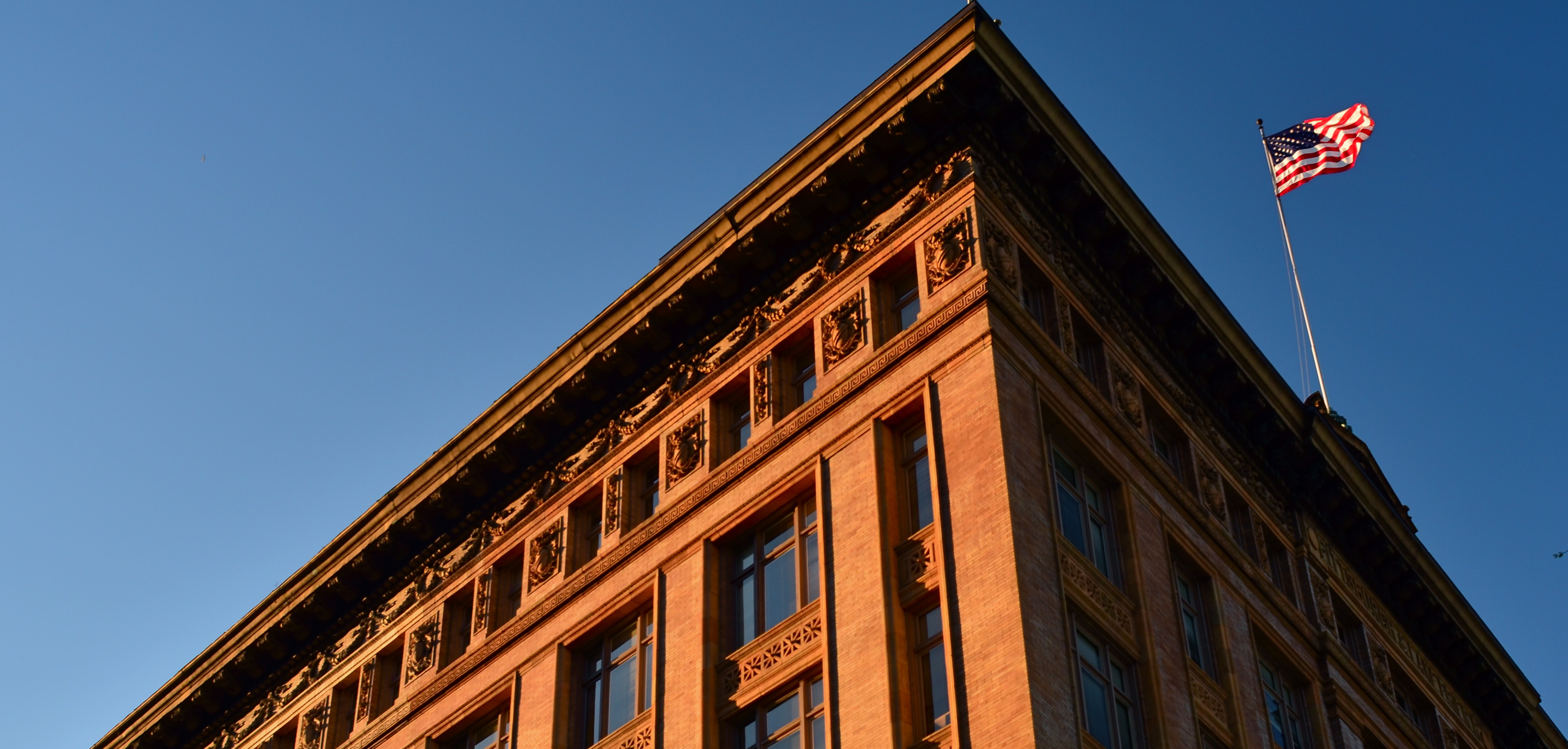
Cities can suggest any place, any time, even within your most familiar neighborhoods.
By MICHAEL PERKINS
THE ROLE OF THE URBAN PHOTOGRAPHER IS TO REKINDLE OUR RELATIONSHIP to our cities, to ignite a romance that might have gone cold or fizzled out. We grow up inside the buildings and streets of our respective towns one day at a time, and, while familiarity doesn’t always breed contempt, the slow, steady drip of repetitive sequence can engender a kind of numb blindness, in that we see less and less of the places we inhabit. Their streets and sights become merely up, down, in, out, north side or east side, and their beauty and detail dissolve away before the regular hum of our lives.
An outside eye, usually trained on a camera, is a jolt of recognition, as if our city changed from a comfy bathrobe into a cocktail dress. We even greet images of our cities with cries of “where’s THAT????”, as if we never saw these things before. The selective view of our streets through a camera, controlling framing, context, color and focus, enchants us anew. If the photog does his job properly, the magic is real: we truly are in new territory, right in our own backyards.
A city with iconic landmarks, those visual logos that act as absolute identifiers of location, actually are easier for the urban photographer, since their super-fame means that many other remarkable places have gone under-documented. Neighborhoods are always rising and falling, as the Little Italys fade and the Chinatowns ascend. Yesterday’s neglected ghetto becomes today’s hip gallery destination. Photographers can truly rock us out of the lethargy of daily routine and reveal the metropolis’s forgotten children in not only aesthetic but journalistic ways, reminding us of problems that need remedy, lives that plead for rescue.
The photographer in the city is an interpretive artist. His mantra: hey, townies, you ain’t seen nothin’ yet.
GAS ATTACK
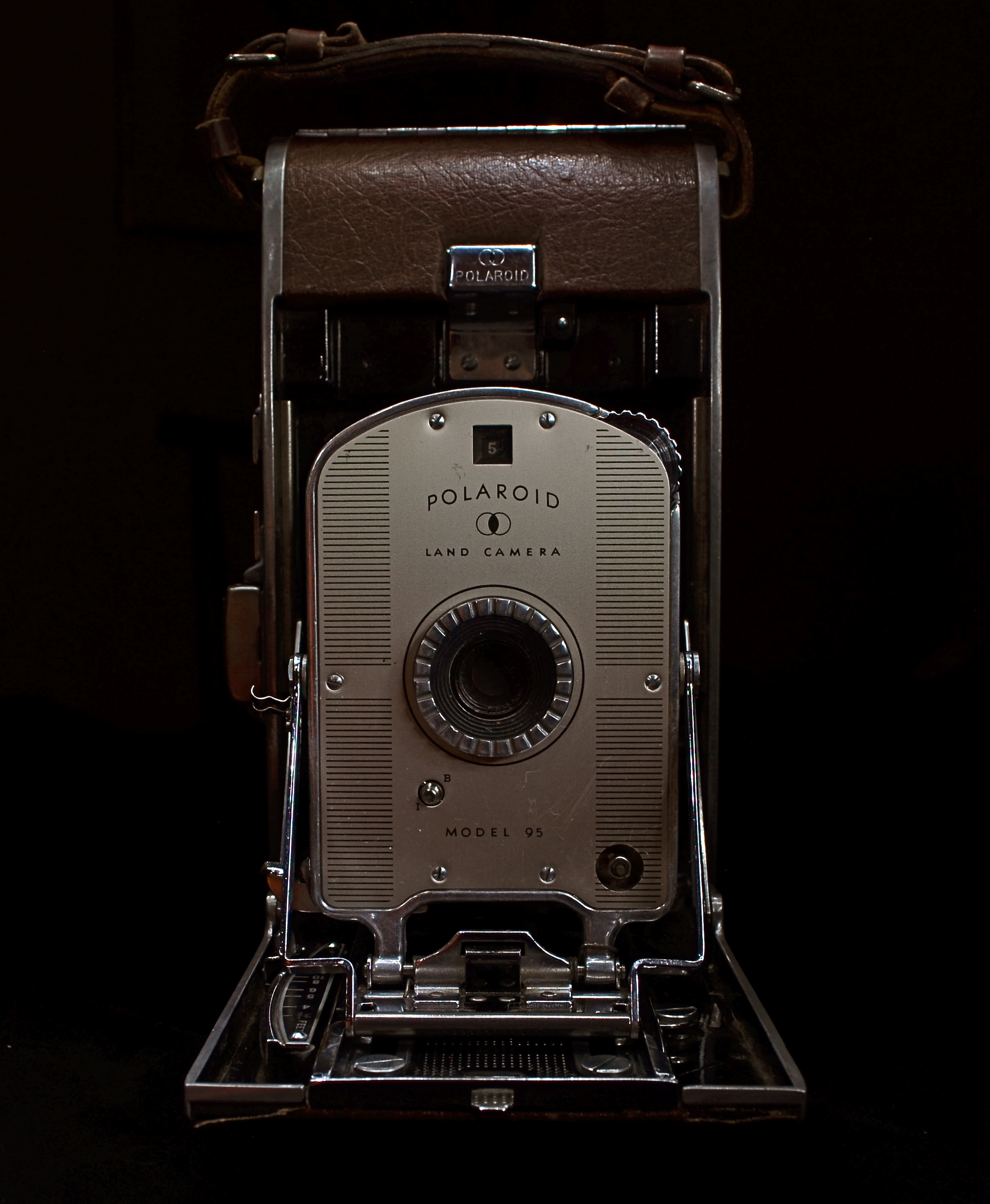
The first-ever cause of Gotta-Getta-Toy disease in my life, the Polaroid Model 95 from 1949. Ain’t it purty?
By MICHAEL PERKINS
AT LEAST TWO ACQUAINTANCES HAVE RECENTLY APPROACHED ME, knowing that I shoot with Nikons, to gauge my interest in buying their old lenses. One guy has, over the years, expertly used every arrow in his technical quiver, taking great pictures with a wide variety of glass. He’s now moving on to conquer other worlds. The other, I fear, suffered a protracted attack of G.A.S., or Gear Acquisition Syndrome, the seductive illness which leads you to believe that your next great image will only come after you buy This Awesome Lens. Or This One. Or…
Perk’s Law: the purchase of photographic equipment should be made only as your ability gradually improves to the point where it seems to demand better tools to serve that advanced development. Sadly, what happens with many newbies (and Lord, I get the itch daily, myself) is that the accumulation of enough toys to cover any eventuality is thought to be the pre-cursor of excellence. That’s great if you’re a stockholder in a camera company but it fills many a man’s (and woman’s) closet with fearsome firepower that may or may not ever be (a) used at all or (b) mastered. GAS can actually destroy a person’s interest in photography.
Here’s the pathology. Newbie Norm bypasses an automated point-and-shoot for his very first camera, and instead, begins with a 25-megapixel, full-frame monster, five lenses, two flashes, a wireless commander, four umbrellas and enough straps to hold down Gulliver. He dives into guides, tutorials, blogs, DVDs, and seminars as if cramming for the state medical boards. He narrowly avoids being banished from North America by his wife. He starts shooting like mad, ignoring the fact that most of his early work will be horrible, yet valuable feedback on the road to real expertise. He is daunted by his less-than-stellar results. However, instead of going back to the beginning and building up from simple gear and basic projects, he soon gets “over” photography. Goodbye, son of Ansel. Hello Ebay.
This is the same guy who goes to Sears for a hammer and comes back with a $2,000 set of Craftsman tools, then, when the need to drive a nail arrives, he borrows a two dollar hammer from his neighbor. GAS distorts people’s vision, making them think that it’s the brushes, not the vision, that made Picasso great. But photography is about curiosity, which can be satisfied and fed with small, logical steps, a slow and steady curve toward better and better ways of seeing. And the best thing is, once you learn that,you can pick up the worst camera in the world and make music with it.
There is no shortcut.There are no easy answers. There is only the work. You can’t lose thirty pounds of ugly fat in ten days while eating pizza and sleeping in late. You need to stay after class and go for the extra credit.
FACING UP
By MICHAEL PERKINS
ONE LUXURY THAT PAINTERS HISTORICALLY ENJOYED OVER PHOTOGRAPHERS was the pure prolonged incubation time between their conception of a thing and its realization on the canvas. Whatever else painting is, it is never an instantaneous process, something that is especially true for portraits. The daubing of strokes, mixing of paint, the waiting for the light, and the waiting for the model to arrive (take a bathroom break, eat dinner, etc.) all contribute to painting’s bias toward the long game. The process cannot be hurried. There is no pigmentary equivalent of the photographic snap shot. Patience is a virtue.
The first photographs of people were likewise a gradual thing, with extended exposure times dictated by the slow speed of early plate and film processes. Once that obstacle was overcome, however, it became a simple thing to snap a person’s face in less and less time. Today, outside of the formal studio experience, most of us freeze faces in record timae, and that may be a bit of a problem in trying to create a true portrait of a person.
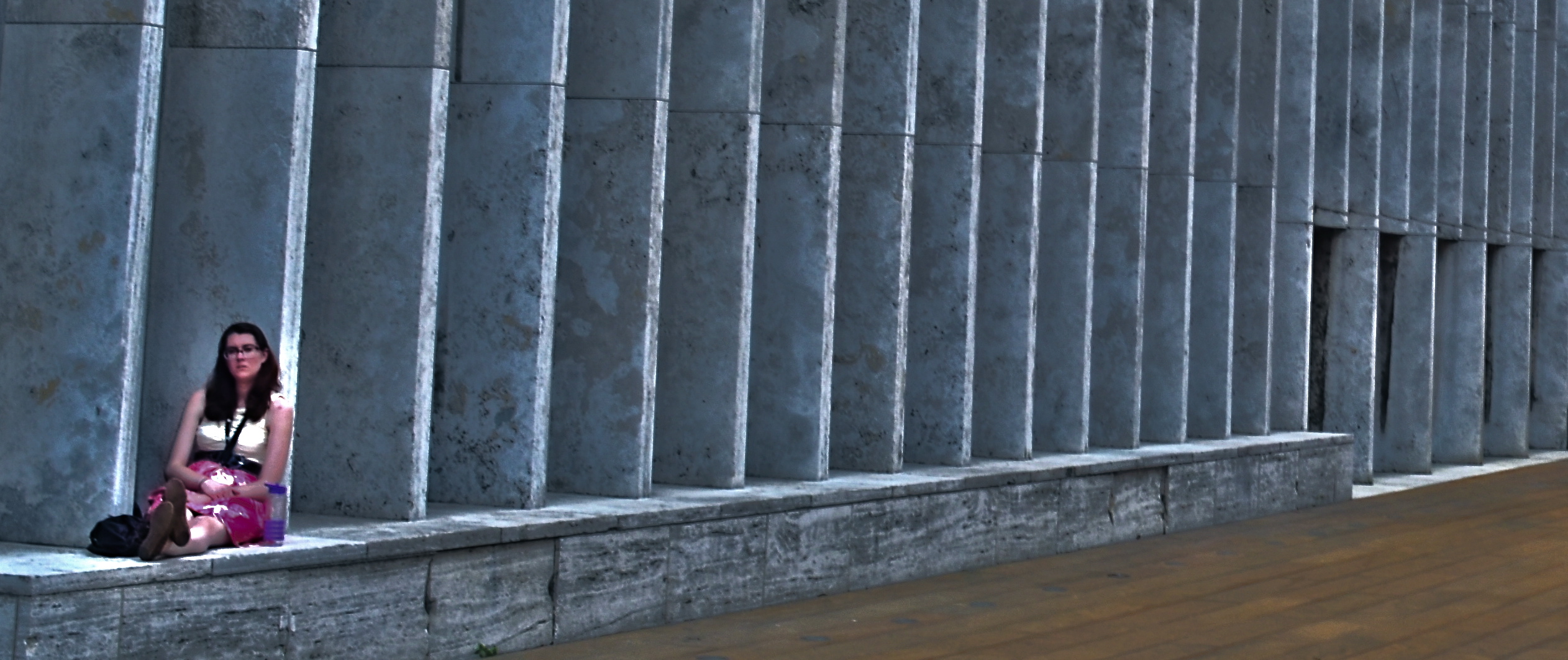
Hello, there. I know nothing of you. Now let me tell your story….
Portraits are more than mere recordings, since the subject matter is infinitely more complex than an apple or a vase of flowers. The daunting task of trying to capture some essential quality, some inner soulfulness with a mechanical device should make us all stop and think a little, certainly a little longer than a fraction of a second. Portraits at their best are a kind of psychoanalysis, an negotiation, maybe even a co-creation between two individuals. The best portraitists can be said to have produced a visible relic of something invisible. Can that be done in the instant that it takes to shout “cheese” at somebody?
And if the process of portraiture is, as I argue, an innately personal thing, how can we trust the “street portraits” that we steal from the unsuspecting passerby? Are any of these images revelatory of anything real, or have we only snatched a moment from the onrushing current of a person’s life? Taking the argument away from the human face for a moment, if I take a picture of a single calendar date page, have I made a commentary on the passage of time, or merely snapped a piece of paper with a number on it?
Painters have always been forced into some kind of relationship with their subjects. Some fail and some succeed, but all are approached with an element of planning, of intent. By contrast, the photographer must apprehend what he wants from a face in remarkably short time, and hope his instinct can make an intimate out of a virtual stranger.
THE PLACES THEY LIVED
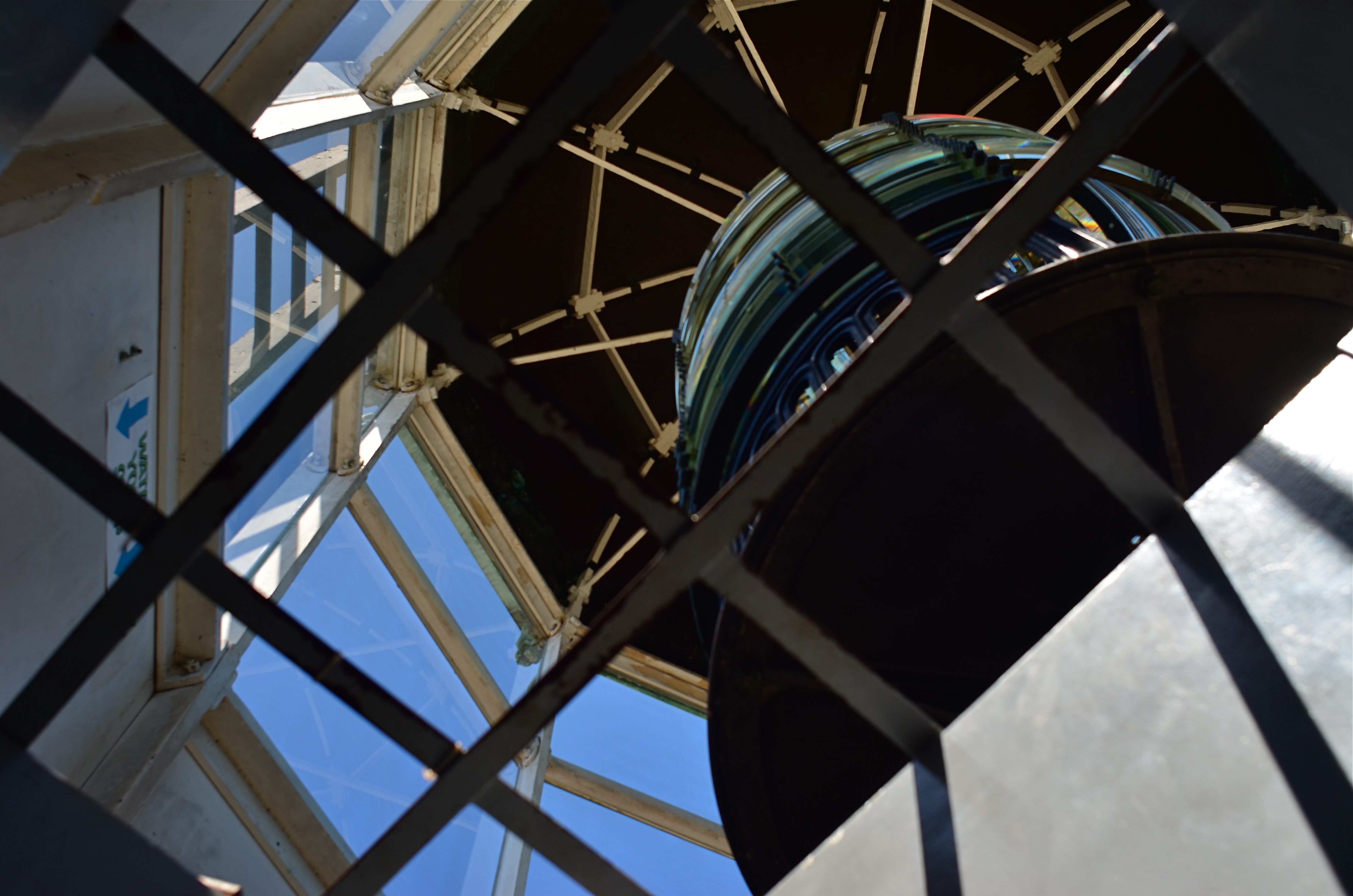
“I want to marry a lighthouse keeper…” 1/125 sec., f/3.5, ISO 100, 24mm.
By MICHAEL PERKINS
PHOTOGRAPHERS INSTINCTIVELY SEEK OUT VARIATION. We spend so much time looking at so much of the world that a lot of it starts to sort itself into file folders of things, patterns, or places, pre-sorting our pictures into this or that category. Sunsets: see Nature. Famous Buildings: a sub-set of Travel. And so on, until we are fairly starved for some visual novelty to shock us out of our slumber and spur us on to new ways of seeing.
One of the things that settles most readily into sameness is the human dwelling. Most of us live in some kind of basic four-walls, bedroom-kitchen-bath sequence, making our living spaces fairly predictable as subject matter. By way of awe and admiration, the real geniuses of, magazine illustration, to me, have always been the “house beautiful” photographers, since they must spend year after year making Mr.& Mrs. J.D. Gotmore’s McMansions seem unique and bold. That said, there is something about nearly everyone’s castle that might be distinctive, even revelatory, about the people who live within. It’s all in your approach.
I love to explore the places where people are forced to improvise living spaces either near or as part of their work, places that usually exist in stark isolation as compared to the crush of crowded urban centers. In the above image, I was allowed to climb to a small viewing angle of the beacon room atop a coastal lighthouse in San Diego, and, perhaps because I was limited to a shooting stance below the surface of the room’s floor, the resulting photo further exaggerated the confined, angular working space, which sits above living areas further down the house’s twisty central staircase.
These areas pose more questions than they answer. What is it like to have this building be your entire world for long stretches of time? What kind of person can do this work? What is the center of this unusual story? The blurring of boundaries between working and living areas is among the most novel material a photographer can tackle, since it contains one of the things he craves most….mystery.
 thenormaleye